The HomelandNews

From Yerevan to Tehran: Iranians demand an end to the Islamic Republic
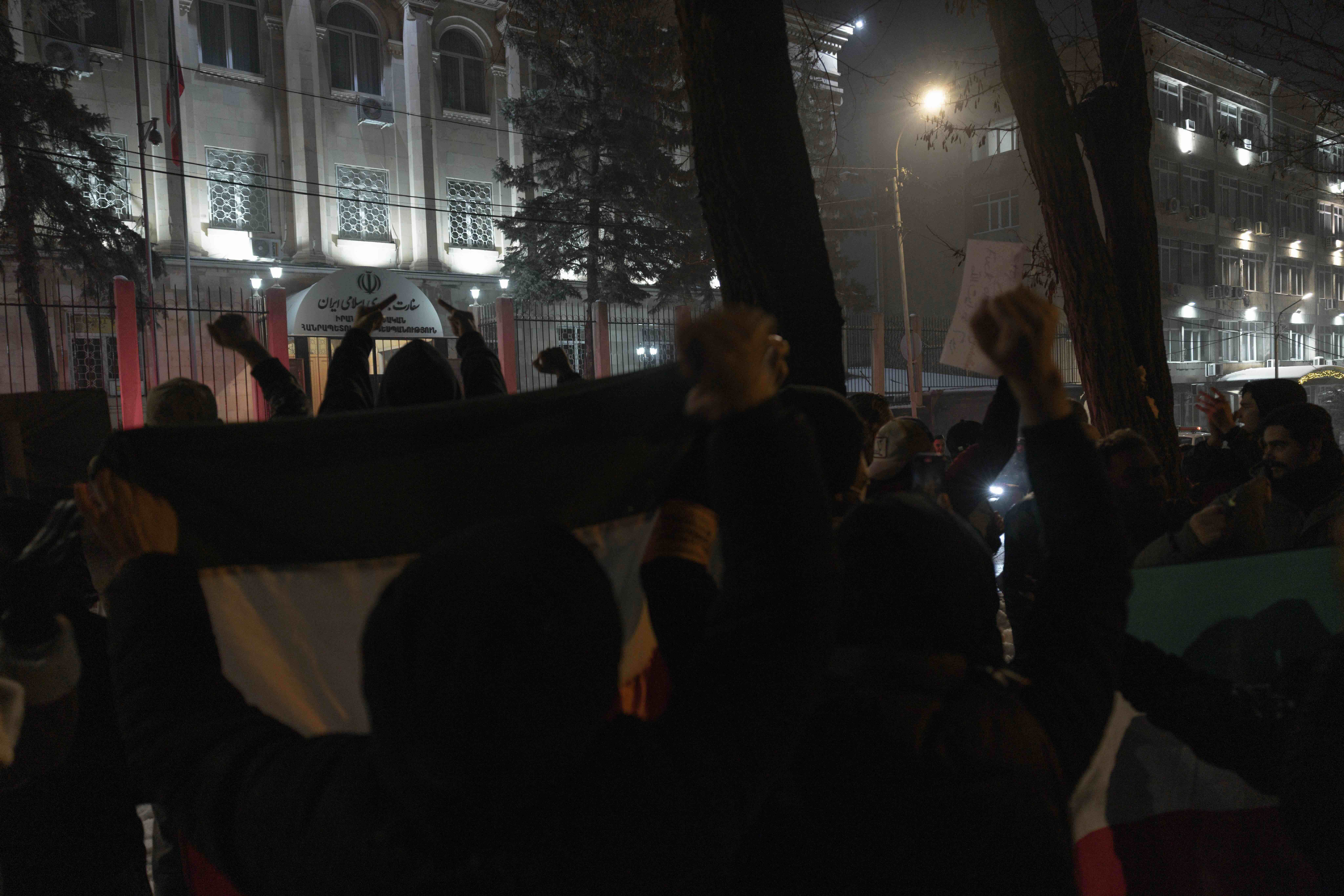
Iranians living in Armenia gathered outside the Iranian Embassy in Yerevan for a fourth consecutive day on Jan. 12, 2026, calling for the removal of Iran’s Supreme Leader, Ayatollah Ali Khamenei, and openly voicing support for Reza Pahlavi, the son of Iran’s last shah, who was overthrown during the 1979 Islamic Revolution.

The rally comes as protests inside Iran enter their third week, with many describing the unrest as the early stages of a revolution. What began as public outrage over the collapse of the Iranian rial has evolved into a nationwide uprising, spreading to more than 185 cities and towns across all 31 provinces. It has also ignited widespread demonstrations among the Iranian diaspora around the world. 

This slideshow requires JavaScript.

Inside Iran, security forces have responded with tear gas and live ammunition, even as officials in Tehran claim they are willing to address economic grievances. At the same time, authorities have framed the protests as the work of “rioters” and “terrorists” backed by foreign powers, particularly the United States and Israel.

According to the U.S.-based Human Rights Activists News Agency (HRANA), at least 646 people have been killed so far, with the toll continuing to rise as information remains limited. More than 10,700 people are believed to have been arrested.

As the protests have grown, demands have shifted beyond economic concerns to outright rejection of the system itself, with chants increasingly calling for the end of the Islamic Republic.

In an effort to suppress the unrest, authorities have imposed sweeping internet shutdowns and intensified a violent crackdown. Protesters inside Iran, along with Iranians abroad, are calling for stronger international support — particularly from the United States — following statements by U.S. President Donald Trump expressing solidarity with the Iranian people and warning Tehran against further bloodshed.

This slideshow requires JavaScript.

In comments reported by state media on Sunday, Iranian President Masoud Pezeshkian blamed the unrest on foreign “terrorists,” while acknowledging the economic pressures that initially pushed people into the streets. That same day, Pahlavi addressed demonstrators in a post on X, urging them to persist. “Do not abandon the streets,” he wrote. “My heart is with you. I know that I will soon be by your side.”

At the Yerevan rally, protesters focused on ending the current regime and backing Pahlavi as an alternative. Many spoke openly about their personal rejection of the Islamic Republic’s ideology. Some said they no longer practice Islam, while others have converted to Christianity, describing religion in Iran as a tool of control and repression. Several expressed anger and fear over what they see as the West’s willingness to accommodate an ideology they believe has caused immense damage to their country.

This slideshow requires JavaScript.

Protesters chanted slogans including “Javid Shah” (جاوید شاه), meaning “long live the Shah,” with “shah” rooted in a distinct historical and cultural meaning rather than a simple equivalent of “king.” 

Other chants included “Marg bar dictator” (مرگ بر دیکتاتور), “death to the dictator”; “Marg bar Khamenei” (مرگ بر خامنه), “death to Khamenei”; and “Marg bar se fased: mollah, chapi, mojahed” (مرگ بر سه فاسد مولا، چپی ، مجاهد), meaning “death to the three corrupt forces: the clerics, leftists and Mojahedin,” the latter referring to Islamist socialists. 

Protesters also chanted “Marg bar asl-e velayat-e faqih” (مرگ بر‌اصل ولایت فقیه), calling for the end of the system of clerical rule known as Velayat-e Faqih, which places ultimate authority in the hands of a religious jurist.

This slideshow requires JavaScript.

Despite the scale of repression, demonstrators continue to risk their lives in pursuit of political change. The current wave of unrest is widely seen as the most serious challenge to Iran’s leadership since the disputed 2009 presidential election and the nationwide protests of 2022, which followed the death of Jina Mahsa Amini after her arrest by Iran’s morality police.

Update: Iran says it is “prepared for war,” but insists it remains open to talks with the United States if negotiations are based on “mutual respect and interests.” The statement comes after U.S. President Donald Trump claimed Tehran had reached out to negotiate, even as his administration weighs possible military action amid widespread anti-government protests.

Meanwhile, a communications blackout imposed by Iranian authorities has stretched into its fourth day, further obscuring the scale of the crackdown.

All photos are by Weekly contributor Anthony Pizzoferrato.


Anthony Pizzoferrato

Anthony Pizzoferrato is an Italian American freelance photojournalist, documentarian and filmmaker based in Yerevan, Armenia. His work places emphasis on reporting and documenting conflicts, political events, complex social issues, human rights and cultural history within post-Soviet states and the Middle East while creating understanding, intimacy and empathy. His work on the war in Ukraine and protests in Yerevan has been published in Getty Reportage.

5 Comments

Leave a Reply

Your email address will not be published. Required fields are marked *


Back to top button