



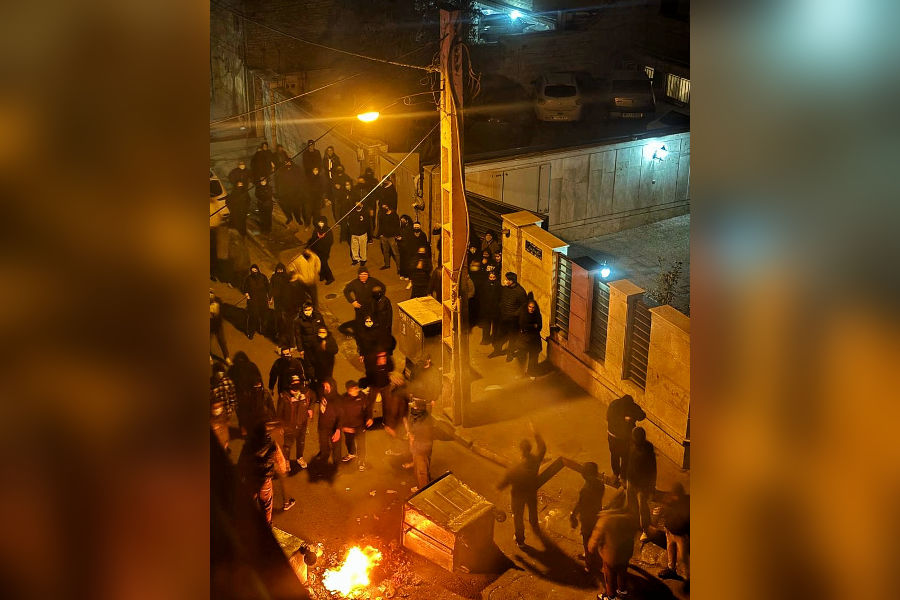
Authorities in Armenia say they have been unable to contact ethnic Armenians in Iran since January 9, amid nationwide protests and a near-total internet blackout. Mobile communications have been restricted, and even Starlink satellite internet has been scrambled, making it difficult to verify conditions or assess risks to the community.
The protests erupted following a wave of anti-government demonstrations across Iran, which have been ongoing for nearly two weeks. Human rights groups report hundreds of deaths and thousands of arrests, though the true toll remains uncertain due to limited communications.
Iran’s Armenian population, one of the country’s oldest Christian minorities, numbers between 100,000 and 150,000, with large communities in Tehran and Isfahan.
“Since Friday, we cannot reach our compatriots, which worries us greatly,” said Armenia’s High Commissioner for Diaspora Affairs, Zareh Sinanyan in a press conference on January 12. He noted that Armenia may need to gather information at the Meghri border, as it did during past crises, before any steps toward evacuation or assistance can be considered.
The Armenian Weekly has reached out to colleagues at Alik, the Armenian daily in Iran, and is awaiting updates.



Armenians have been suffering and enduring a lot in Iran after it became a theocratic Islamist dictatorship in 1979 (and also in Iraq, Syria, Lebanon, Turkey and Israel), like no other Armenian community does in the diaspora. While Armenians are not targeted and persecuted by the Islamic Republic, as non-Muslims in a shariah state like Iran, where they are categorized as “dhimmis”, they are officially second-class citizens with fewer rights (they cannot become judges or prosecutors and many other state jobs are off-limits to them). I know it is wishful thinking on my behalf, but I wish Armenia would invite them and could settle them in their homeland. More realistically, I hope that the Armenians in Iran, Syria, Lebanon, Iraq leave those utterly hopeless conflict lands and immigrate to the West, for a better and much safer life. This is also something I wish for the Armenians in Turkey and Israel – where they are actively discriminated, coerced and intimidated by the Turkish and Israeli states.
A testament to the effectiveness of the internet blockage. As Iran is benign to Armenia there’s no reason to have particular fears of the safety of the Armenians there as such. Whether the clerical regime survives this unrest remains to be seen it’s weathered many challenges but theres a point when it fails. Syria in 2024 is a recent example.
The worst-case scenario is if Iran plunges into a civil war. Let’s hope it never comes to that. Any turmoil and conflict on Armenia’s borders can and does inevitably hurt Armenia. And when it comes to wars and conflicts in the Middle East, Armenian communities living there have always suffered them directly and enormously. The Lebanese Civil War has more than halved the Armenian community, the Iraqi and Syrian civil wars have disintegrated the Armenian communities. Many Armenians also left Iran to the West after the Islamic Revolution, also because moving to Soviet Armenia was not really an option nor desired by them. If the worst-case scenario does materialize, Armenia ought to make preparations to accept Armenian refugees from Iran who are estimated to number between 110,000-300,000 and do its upmost not to get dragged into the turmoil in Iran. 80,000 Armenians from Iran have settled in Armenia since it became independent, and they make up by far the largest number of returnees from the diaspora. I doubt that the current Armenian government has prepared any scenarios and contingency plans if Iran descends into a civil war, and will likely resort to a trying-to-fix mode if the worst-case scenario does materialize. Armenia was caught off-guard when the Iran–Israel war broke out in June 2025 and there was a large influx of people who crossed the border of Armenia from Iran.
This is not good. In fact it is unacceptable. Iranian government should immediately reinstate the internet and phone connections so that we know Armenians there are safe. Their demonstrations are not our problem.
How shameful this is!
Despite all the religious oppression and all the Islamic tyranny, the Armenians there still prefer to live in Iran rather than cross the border and come home to Armenia.
@ reader, Iran’s government focusing on its national interest currently censoring communications in the country to curb disorder, the idea that they should reinstate communications so the Armenian community there can communicate with their brethren in Armenia and elsewhere is preposterous it has its own priorities and would be crazed to loosen it for the reasons stated, exceptionalist notions implied will do no favours at all.
As I’ve stated before it’s remarkable that pro Russian commentators seem to be supporting the unrest against the clerical regime since if it collapses any successor is likely to be less close to Russia such as it’s supply of weapons for its conflict in Ukraine, and closer to the USA and Israel instead.
How can Armenia realistically monitor the safety of its diaspora when all normal communication channels are cut?
The part about even Starlink being scrambled really shows how extreme this blackout is, not just an ordinary internet shutdown. With so little reliable information, it makes sense that Armenian officials are worried, especially given how large the communities in Tehran and Isfahan are. The uncertainty feels just as frightening as the protests themselves.
The Armenian Diaspora in Iran, former Persia, is over four centuries old. Perhaps even alot longer than that considering the shared border between the two and close relations between Armenian and Persian kings and kingdoms over the centuries. Their communities are deeply rooted in cities in which they live. While they never lost their connection with the homeland and are active participants in Armenian cultural and political activities and events, they are also fully integrated into the Iranian societies. They are well-regarded and respected in Iran. As a small minority of anywhere from 100K to 500K population at various times, they have had more rights in Iran than many others with much larger populations and I think that is because, unlike other minorities, they mind their own business for a lack of better term and have always stayed out of Iranian internal politics, while having two Armenian representatives in the Iranian parliament, and have pretty much remained neutral in the country’s affairs. It is true that they have gone through some rough times since the Iranian 1979 Islamic revolution, such as an end to the Armenian coed school systems and women having to adhere to country’s dress codes in public, they have pretty much been insulated from the tumultuous politics of the country. They are for most parts self-sufficient in communities in which they live and in most cases these communities are more or less exclusively Armenian populated. The situation for them was life-changing and probably much more dangerous 46 years ago than it had ever been, including what is happening there these days. I don’t see any “targeted” danger to them other than the daily hardships they, like many others, have to endure under the new system there. Even though we now live in a global age, I still strongly believe the safest place for the Armenians worldwide is their ancestral homeland in Armenia. My personal opinion!
P.S. Armenia’s oldest church located in northwestern Iran, the Monetary of Saint Thaddeus, Սուրբ Թադեոսի Վանքը in Armenian, was built in the first century in 66AD at a spot where Saint Thaddeus was martyred for the faith and said to have been buried there. Furthermore, while there has been an active and on-going Armenian cultural genocide, since the 1915 Armenian Genocide, in Armenian territories under our terrorist Turkish and pseudo-Turkish Azerbaijani occupations, the Armenian houses of worship throughout Iran are protected and a state annual budget is set aside for their maintenance and renovations.
How old is their Azerbaijani diaspora?
I personally don’t believe there is any Azerbaijani diaspora in Iran. I think the Turkish-speaking population living mostly in northwestern Iranian provinces of east & west Azerbaijan are Iranian nationals, Iranian Azerbaijanis, who descend from pre-Turkic Iranian peoples but their identity and language became Turkic through centuries of Oghuz Turkic influence and migration into the region from Central Asia creating a mixed heritage with strong cultural and religious (Shia Muslim as opposed to Sunni Muslim Turks) ties to Iran but with a Turkic language. Neither a country nor a people by this name ever existed in the history of the region until its artificial creation at the turn of the 20th century at the end of WWI as a Turkish outpost in South Caucasus, to pursue fascist pan-Turkic agenda, after the defeat and fall of the corrupt and genocidal Ottoman empire and as a Soviet base of expansion. This is the name of a geographical location, south of the Aras River, referring to that part of Iran and nothing more. The name was stolen from Iranians by cunning Azerbaijani and Turkish politicians and deliberately given to the Azerbaijan republic in the South Caucasus artificially invented on occupied Armenian and Iranian lands. This was a political scheme by them, despite Iranian protest, as part of their future separatist plan to refer to their newly-invented republic in South Caucasus as “north Azerbaijan” and therefore the Iranian provinces bearing this same name as “south Azerbaijan” requiring their “reunification” to falsely claim territory from Iran. I also learned that this name was given to them and their language by the Soviets so as to make a distinction between them and the Turks to avoid their unification against Russia and to keep Azerbaijan away from Turkey and in the Russian sphere of influence.
I believe there is a small minority of brainwashed separatists living in Iran, who make some noises when the time is right for that like when Iran is in political turmoil, who are financed and supported by Turkey and Azerbaijan but the majority population is fully integrated into the Iranian society and consider themselves as Iranian nationals wanting nothing to do with the Turks or Azerbaijanis and take offense to being called Turkish or Turkic. Many of their separatist leaders are and have ended up in Iranian prisons!
Ararat, puts it well there being no targeted danger to Armenians there regarding the unrest in Iran.
I have read all the comments above and and am so heartened by their intelligence and depth of knowledge, even wisdom. I would only add that the strength of Armenians everywhere lies in their deep bond as a people and your comments here exemplify that bond. Amen. PS For the record, I am the son of an Armenian mother born and bred in Tehran, where my parents were married. I am an Australian citizen currently residing in India. My mother was Vartanoosh Badalian, and she has a grave in the Armenian cemetery in Mumbai, India. My parents, and myself, were frequent visitors to both Iran and Armenia as we had close relatives in both countries. Just sharing.