



What a Ukraine-Russia peace deal could mean for Armenia’s economy and security
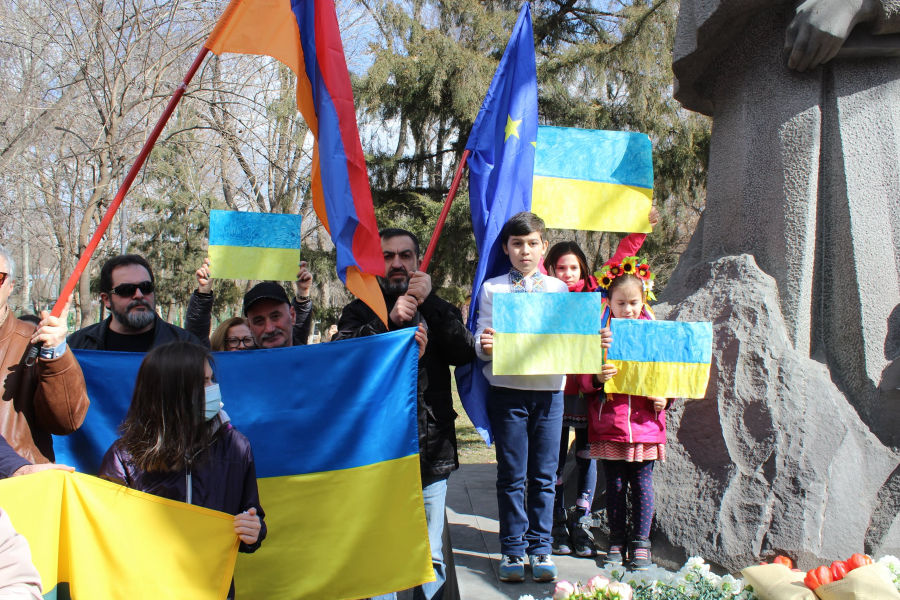
The Ukraine–Russia border lies more than 1,700 miles from Armenia’s capital. So why should it matter to Armenians? While global media has focused largely on Russia’s occupation of Ukrainian territory, far less attention has been paid to other regions under Russian influence, including the South Caucasus. This raises a critical question: If Russia struggles to achieve its objectives in Ukraine, what does that mean for Armenia’s security?
Armenia’s post-Soviet security architecture has long depended on Russia. The country’s membership in the Collective Security Treaty Organization (CSTO) reflected decades of reliance on Moscow for defense and military support. Prime Minister Nikol Pashinyan has since acknowledged that depending solely on Russia for security was a “strategic mistake.” Ukraine, like Armenia, once relied on Russia as a security guarantor until Moscow’s aggression in 2014. With Russian resources consumed by Ukraine, its ability to act as a regional security guarantor has diminished, leaving Armenia to explore alternative partnerships.
Economic exposure adds another layer of vulnerability. Armenia imports far more from Russia than it exports, making its economy sensitive to sanctions and fluctuations in Russian trade. U.S. Treasury Secretary Scott Bessent recently noted Russia’s continued “refusal to end the senseless war” in Ukraine, highlighting the ripple effects of both primary and secondary sanctions.
Initiatives like the TRIPP corridor, designed to open transit routes and foster regional connectivity between Armenia and Azerbaijan, illustrate Armenia’s potential to diversify its trade and logistics networks. Yet, these projects remain deeply bound to broader geopolitical negotiations. Public opinion further reflects the stakes: a 2025 survey showed that 78.5% of Azerbaijanis favor a peace deal with Armenia, whereas only 30% of Russians back a peace deal with Ukraine that would require the return of annexed territories — attitudes shaped by a political environment where criticism can carry serious consequences.
The human dimension remains equally pressing. Diaspora leaders such as Aram Hamparian have emphasized that any lasting peace must address humanitarian concerns, including the right of Armenians to return to Artsakh, the release of hostages and the withdrawal of Azerbaijani forces from sovereign Armenian territory. As he stated, “Absent that, what we are talking about is not a peace agreement but coercion, imposed at the point of a gun.” These concerns echo United Nations General Assembly Resolution 194 (III) of 1948, which upholds the right of refugees to return home and receive compensation for losses if return is not possible.

Armenia’s Prime Minister Nikol Pashinyan and Ukraine’s President Volodymyr Zelenskyy share strikingly similar political trajectories. Both came to power through popular movements — Zelensky in 2019, after widespread frustration with entrenched elites, and Pashinyan in 2018’s “Velvet Revolution,” on the promise of ending decades of oligarchic influence in the country.
Each has had to balance domestic reform with pressures from powerful neighbors: Zelenskyy faces daily Russian military aggression, while Pashinyan contends with border tensions with Azerbaijan and a security system heavily dependent on Russia. Both leaders use media-savvy communication to sustain public support, reflecting a generational shift in post-Soviet leadership. At the same time, both administrations have faced criticism over corruption and inconsistent governance, highlighting the challenges of leadership amid reform, diplomacy and regional instability.
Amid these overlapping pressures, shifting Russian influence, economic vulnerability, border insecurity and unresolved humanitarian issues, Armenian now stands at a pivotal moment. The outcome of the Ukraine–Russia conflict is not a distant concern; it is both a warning and a lesson.
For Armenians, the question is no longer if change is coming, but whether the country is ready to act decisively: to reduce reliance on external powers, strengthen regional partnerships and take concrete steps to safeguard its people, borders and future. Continued advocacy for Artsakh, Armenia, Sudan, Ukraine, Somalia and all communities facing oppression remains vital. The time for preparation, solidarity and action is now, lest history repeat itself in Artsakh or beyond.
The author has chosen to remain anonymous due to safety and privacy concerns.



Trivial as this is, the Ukraine–Russia border is not “1700 miles” (2735 km) from Yerevan, let alone from Armenia; on a straight line from its nearest point in Kerch, Ukraine is 869 km (540 miles) from Yerevan and is 721 km (448 miles) from northwesternmost Armenia. Karachi in Pakistan or the southeasternmost point of Central Europe are 2700 km from Yerevan.
What is the relevance of the straight line distance if you cannot travel between those two points in a straight line? Anyway, did anyone figure out what the war is about or what its goals are? 4 years now.
@reader
I pointed out the author’s geographical disorientation with distances. Whether one can travel to Ukraine or not, doesn’t matter and nor is the issue. Armenia has its own existential problems to deal with. It cannot afford to and nor should pick sides in other countries’ conflicts, be it Ukraine, Sudan, Somalia, Yemen, etc.
This is such a patronizing and preachy article. The author who hides his or her identity, is not only ignorant about geography (could he or she be American?), is ignorant about the geopolitical realities of Armenia, and obviously thinks that Pashinyan is a democrat, reformer and a patriot. If this failed journalist, political novice and incompetent upstart had not come to power, turned Armenia’s foreign policy upside down, shifted Armenia’s foreign policy to the West in disregard of its geopolitical realities with no alternative safety guarantees whatsoever, and needlessly antagonized Russia and Iran, Armenia wouldn’t be exposed, wouldn’t have lost Artsakh, and wouldn’t be in this overall mess. This incognito author is out of touch with Armenia’s stark realities, seems to forget that Armenia is located in volatile West Asia surrounded by two hostile Turkic neighbors, and obviously thinks that real peace can be established with these two Turkic countries, which have not changed their aggressive posture and mentality towards Armenia and Armenians for the past hundred+ years. And by the way, when Armenia is dealing with its own gargantuan and existential problems, why on earth should it pick sides, and side with or against Ukraine, Sudan, Somalia, etc., or in the conflicts and problems of other countries?
@ ‘Steve’- what do you mean by ‘could he/she be American’?
You realize this is an American newspaper, right? Published in Massachusetts.
@reader
Americans are world famous for being geographically challenged. Not only describing the distance between the (nearest) Russian-Ukrainian border and Yerevan as “1700 miles” is highly inaccurate and outlandish, even describing the distance as 1700 km, would miss the shot by roughly 900 km. Apart from not being able to locate places on a map, many Americans cannot even calculate between their hodgepodge units of measurement, and to and from the metric system, let alone intuitively understand the differences. That’s why.
Needlessly antagonize Russia? 🤣 Armenia, just like every other former soviet nation, has to take a very firm stance against Russia whenever they can. Each and every one of them could be in Ukraine’s spot tomorrow. Lots of fancy language and irrelevant information to cover up the fact that you want the USSR back, just like your glorious king Putin 🤦.
Needlessly antagonize Russia? Ahahahahaha, ha, ha. Armenia, just like every other former Soviet nation, has to take a very firm stance against Russia whenever it can. Each and every one of them could be in Ukraine’s spot tomorrow. Lots of fancy language and irrelevant information to cover up the fact that you want the USSR back, just like your glorious king Putin. SMH. Grow a backbone, support your country if you are Armenian, and stop glazing Russia.
Ad hominem. You also simplify a far more complex geopolitical situation with the few causes you include. Russia has already demonstrated itself as an unreliable partner and provides no realistic long term solution to the security of Armenia. Such a path only results in submission to Russia and no guarantees even then for Armenia. The best choice is into engage in strategic diplomacy with multiple partners giving actors a stake in Armenia’s success. Strength lies not only in what can be achieved with such a balance, but leveraging the diaspora to build support abroad. I hope you understand the broader implications of what unconditional allegiance to one state brings and the weakness that is included. Especially when it comes to Armenia. Maybe you would have a better perspective if you stepped outside for once and didn’t spend all day on online internet forums. But then that would mean experiencing joy in life and not berating online authors providing differing perspectives on a delicate geopolitical situation.
Ad hominem. You also just simplify a far more complex geopolitical situation with the few causes you include. Russia has already demonstrated itself as an unreliable partner and provides no realistic long term solution to the security of Armenia. Such a path only results in submission to Russia and no guarantees even then for Armenia. The best choice is into engage in strategic diplomacy with multiple partners giving actors a stake in Armenia’s success. Strength lies not only in what can be achieved with such a balance, but leveraging the diaspora to build support abroad. I hope you understand the broader implications of what unconditional allegiance to one state brings and the weakness that is included. Especially when it comes to Armenia. Maybe you would have a better perspective if you stepped outside for once and didn’t spend all day on online internet forums. But then that would mean experiencing joy in life and not berating online authors providing differing perspectives on a delicate geopolitical situation.
Needlessly antagonize Russia? 🤣 Armenia, just like every other former soviet nation, has to take a very firm stance against Russia whenever they can. Each and every one of them could be in Ukraine’s spot tomorrow. Lots of fancy language and irrelevant information to cover up the fact that you want the USSR back, just like your glorious king Putin 🤦.
Needlessly antagonize Russia? 🤣 Armenia, just like every other former soviet nation, has to take a very firm stance against Russia whenever they can. Each and every one of them could be in Ukraine’s spot tomorrow. Lots of fancy language and irrelevant information to cover up the fact that you want the USSR back, just like your glorious king Putin 🤦.
I assume the identical troll answers are given by the anonymous author. It is easy to preach and lecture from afar, and to offer simple “solutions”. People like yourself and Pashinyan, live in a fantasy world, and are ignorant and dismissive of Armenia’s geography and of its geopolitical realities. Being landlocked and surrounded by two hostile Turkic neighbors, Armenia doesn’t have the luxury of simply decoupling and switching sides, when there are no security guarantees whatsover promised from the other camp, especially with Turkey as a NATO member, which means this security umbrella is off limits for Armenia. That politically illiterate and reckless Pashinyan foolishly just did that with his pro-West shift, antagonizing Russia and Iran, and leaving Armenia totally exposed, thus giving Azerbaijan and Turkey the green light to attack and conquer Artsakh. Had Pashinyan not taken this disastrous route, Artsakh would not have been lost. Simple as that. And by antagonizing Iran, by inviting the US on the Armenian-Iranian border, Armenia risks being sucked into a potential war between the US/Israel/Turkey/Azerbaijan and Iran. All of these were totally avoidable, had Pashinyan not gambled away Armenia’s few trump cards and its security, for unrealistic foreign policy objectives, which are frankly daydreams.