



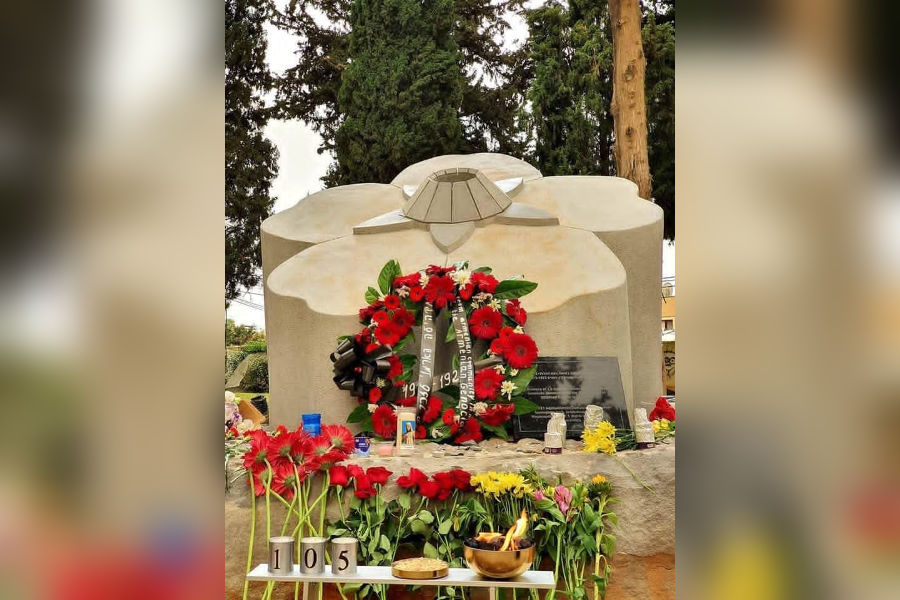
April 24 of this year marks the 111th anniversary of the Armenian Genocide, perpetrated by the Ottoman Turks between 1915 and 1923. This tragedy unfolded during a campaign of deportation and mass killing carried out by the Young Turks government against its Armenian subjects within the Ottoman Empire during World War I. An estimated 1.5 million Armenians were killed, with many perishing during forced marches and deportations into the Syrian Desert.
Numerous foreign journalists, missionaries, diplomats, Jewish fighters who served in the ranks of the Allied forces, and German military officers witnessed and documented the events, sending reports back to their home countries detailing the mass killings and death marches.
By the end of World War I, more than 90% of Armenians within the Ottoman Empire had vanished or been removed from Turkey. For centuries, the vast mountainous plateau of Eastern Anatolia, currently referred to as Eastern Turkey or Western Armenia, was inhabited primarily by Armenians. At the turn of the 20th century, approximately 2.5 million Armenians were living within the Ottoman Empire, with the majority concentrated in Eastern Anatolia.
Genocide is defined as an act committed with the intent to destroy, in whole or in part, a national, ethnic, racial or religious group. The term “genocide” was coined in 1944 by the Polish-Jewish lawyer Raphael Lemkin (1900-59). Through this term, Lemkin aimed to define the crime of mass killing of groups of people and to raise awareness of it.
Lemkin had learned of the Ottoman genocide against the Armenian people during World War I and was deeply disturbed by the absence of international legal provisions to indict and punish those responsible. He defined the concept of genocide based on the extermination campaigns launched by Nazi Germany during World War Il in an attempt to wipe out entire ethnic groups, including Jews during the Holocaust. Genocide became a distinct crime following the adoption by the United Nations General Assembly of the Convention on the Prevention and Punishment of the Crime of Genocide on Dec. 9, 1948. The Convention entered into force on Jan. 12, 1951.

The convention defines various acts as genocide, including:
- Killing members of a group.
- Causing serious bodily or mental harm to members of a group.
- Deliberately inflicting on a group conditions of life calculated to bring about its physical destruction in whole or in part.
- Imposing measures intended to prevent births within a group.
- Forcibly transferring children of the group to another group.
In 1939, following the German invasion of Poland, Lemkin fled the country, making his way through Lithuania and eventually reaching Sweden. With the assistance of his prewar colleague Malcom McDermott, Lemkin secured permission to enter the United States. He arrived in 1941, where he established himself as an academic at American universities and was subsequently granted U.S. citizenship.
Meanwhile, in 1951, the U.S. Department of State cited the fate of the victims of the Armenian Genocide as an example of genocide in a written statement submitted to the International Court of Justice. The statement read: “The Roman persecution of Christians, the Turkish massacres of Armenians, and the extermination of millions of Jews and Poles by the Nazis are outstanding examples of the crime of genocide.” The United States officially recognized the Armenian Genocide in 2021.
Israel denies the Armenian Genocide
Israel denies the genocide committed by the Ottoman Empire against the Armenians and has actively sought to influence other nations to refrain from recognizing it. Since the establishment of the State of Israel, Armenians, particularly those within Israel but also those worldwide, have sought to persuade the Israeli government to recognize the Armenian Genocide.
Conversely, Jews across the globe have worked against recognition of the genocide, boycotting conferences convened to discuss or examine the Armenian cause. In particular, they sought to dissuade the United States from officially recognizing the extermination of Armenians as a genocide.
The primary reason behind this reluctance is Israel’s desire to position the Jewish people as the sole victims of genocide globally, a stance often termed the “monopoly on genocide,” to garner worldwide sympathy. Decision-makers in successive Israeli governments believe that recognizing the Armenian Genocide marginalizes the Holocaust.
The second significant reason is that Jews in the Ottoman Empire supported Talaat Pasha, often described as the architect of the Armenian Genocide, a claim that Israel does not wish to be publicly emphasized.
The third reason is that Israel uses the Armenian issue as a bargaining chip, brandishing it as a tool of pressure against Turkey in anticipation of any potential move by Ankara against Israeli interests in the region.
In April 2001, the Turkish Daily News quoted the then-Israeli Foreign Minister Shimon Peres as saying: “Claims of an Armenian Genocide are meaningless. We reject attempts to draw a parallel between the Holocaust and Armenian claims. Nothing comparable to the Holocaust ever occurred. What Armenians endured is a tragedy, but it is not genocide.”
Every year, on Jan. 27, the United Nations General Assembly observes International Holocaust Remembrance Day. In 2015, in commemoration of Holocaust victims, the then-Israeli President Reuven Rivlin delivered an address before the United Nations in New York on Jan. 28.
Coincidentally, four months later, on April 24 of that same year, Armenians worldwide and particularly in Jerusalem, commemorated the centenary of the Armenian Genocide. Rivlin devoted a significant portion of his speech to discussing the suffering of the Armenian people a century earlier without using the term “genocide.” He said: In 1915, when members of the Armenian Nation were being massacred, Avshalom Feinberg, a leading member of Nili, the Jewish underground that cooperated with the Allies during World War I, wrote the following: ‘My teeth have been ground down with worry. Whose turn is next?’ Avshalom added: ‘I asked myself if I have the right to weep over the tragedy of my people, only, and whether the Prophet Jeremiah did not shed tears of blood for the Armenians as well?”
Avshalom wrote that exactly 100 years earlier. Rivlin then shifted to his personal experience, saying: “One hundred years of hesitation and denial. But in the Land of Israel (Mandatory Palestine) at that time, in the Jerusalem in which I was born, no one denied that massacre. The residents of Jerusalem, my parents and family members, saw Armenian refugees arriving by the thousands, starving, piteous survivors of calamity. In Jerusalem, they found shelter, and their descendants continue to live there to this day. There were two questions reverberating then: Whose turn is next, and will we Jews weep tears of blood for the tragedy of others too? The first question was answered by history some two decades later. The Jews were next. There has been no atrocity in human history comparable in its viciousness, scope and magnitude to the Holocaust.”
On Sept. 7, 2018, an article published in The Times of Israel was titled: “Before the Holocaust, Ottoman Jews supported the Armenian genocide’s architect.” The author noted that a vote scheduled in the Knesset, Israel’s parliament, in June 2018 to recognize the killings of Armenians during the World War I as genocide was cancelled due to a lack of government support.
Israel’s decision to maintain its silence on the 103rd anniversary of the Armenian Genocide drew criticism from academics, writers, historians and human rights activists. For example on June 26, 2018, Prof. Hans-Lukas Kieser of the University of Newcastle in Australia published the book “Talaat Pasha: Father of Modern Turkey, Architect of Genocide.”
The political biography explores how Mehmed Talaat Pasha almost single-handedly masterminded the Armenian Genocide. Kieser writes: “Recognition of the Armenian Genocide holds significance for Israelis today that extends beyond the scope of routine debate regarding Israeli-Turkish relations; Jews played a pivotal role in promoting propaganda on behalf of the Ottoman side at the very time Armenians were being massacred.”
He adds that Talaat received particularly positive coverage in the Jewish press, both in Istanbul and abroad, during the period surrounding the Armenian Genocide, notably in Germany, an ally of Ottoman Turkey. Newspapers such as the Deutsche Levante-Zeitung hailed Talaat as an exceptional leader and the savior of Imperial Turkey.
Although this glorification was rife with propaganda and falsehoods, Kieser argues that many Germans believed what was published in the Jewish press at the time and were influenced by its logic. He notes that many Jews loyal to the Ottoman Empire largely looked the other way regarding the suffering of Armenians. This included figures such as Alfred Nossig, who helped found both the General Jewish Colonization Organization and the Zionist Organization.
Talaat’s relationship with Jews during this time gave him considerable international leverage that he successfully used to deflect attention from Armenia. “In spring 1915 — which was a honeymoon for the Zionists in Istanbul — Talaat made sure there were no conflicting international issues because he wanted to strike the Armenians,” says Kieser. “Jews feared they would suffer the same fate as the Armenians, so they did not welcome any pro-Armenian or pro-victim reporting because they feared for themselves.”
“Unfortunately, the silence carried on many decades after the war. So you had Jews in Israel and Jews in Turkey who continued to help Turkey deny the Armenian genocide,” Kieser says.
On the occasion of the 106th anniversary of the Armenian Genocide, a report published April 30, 2021, in the Hebrew edition of the Israeli newspaper Haaretz stated that a file was recently discovered in Israeli archives documenting efforts by the Israeli Ministry of Foreign Affairs to prevent the convening of an academic conference in Israel in April 1982 that was scheduled to address both the Holocaust and the Armenian Genocide.
One of the documents in this archival file stated: “We continue to work toward minimizing and downplaying the Armenian issue to the greatest extent possible, and by any means available. We are maintaining intensive and comprehensive efforts to secure the cancellation of the conference — or, at the very least, to have the Armenian item removed from its agenda — given that holding a conference that addresses both the Holocaust and Armenian Genocide presents a problematic issue, as it risks undermining the unique distinctiveness of the Holocaust.”
Another document noted: “We are currently attempting to persuade the invited participants not to take part in the conference.” Haaretz also reported that following the announcement of the conference in April 1982, the Israeli Ministry of Foreign Affairs did not cease its attempts to thwart it.
Consequently, Yad Vashem — the Holocaust Remembrance Authority — withdrew its sponsorship of the conference; Tel Aviv University refused to participate; the Henrietta Szold Institute pledged not to provide funding; and Holocaust survivor and Nobel Peace Prize laureate Elie Wiesel resigned from the conference chairmanship, becoming the first to decide against participating. Prominent historians also boycotted the event. Ultimately, the conference was held without any official Israeli framework, and its content failed to garner the widespread attention envisioned by its initiators.
On Feb. 27, 2016, an article was published in the online Azerbijiani newspaper Azvision.az titled “Garden opened in Israel in honor of victims of Khojaly Genocide.” It states: “A garden in memory of the victims of the Khojaly tragedy was opened today in Israel in the Chaim Weizmann forest”. Representatives from both Israeli and Azerbaijani governments participated in this ceremony.
The active participation of Israeli government representatives in the opening ceremony of this park constitutes an indirect Israeli acknowledgment of the so-called “genocide” of Azerbaijani civilians at the hands of Armenian forces in the town of Khojaly on Feb. 26, 1992. This conduct is regarded as an act directed against the Armenian people, as well as an unjustified act of bias and a provocation.
Principles and ethics must transcend arrogance and personal interests
Given that the Jewish people were themselves victims of the Holocaust, it is incumbent upon Israel — on moral and principled grounds — to stand in solidarity with the Armenian people, recognize the Armenian Genocide, and to refrain from acting against such recognition in international forums. Yet neither principles nor sound ethics guide this state.
For just as the Jewish people were subjected to genocide at the hands of the Nazis, Armenians were subjected to genocide at the hands of the Ottomans. The Republic of Armenia has recognized the Holocaust; in cooperation with local Jewish community, the government erected a memorial in the Armenian capital, Yerevan, to commemorate the victims of both the Jewish and Armenian genocides.
In stark contrast, however, the Israeli government maintains a stance of indifference — and even hostility — toward the Armenian people. Successive Israeli governments demand that other nations respect the victims of the Holocaust — and we, indeed, do respect those victims — yet they fail to show respect for victims of genocides committed against other peoples.
On Sept. 19, 2023, with the help of Israeli military experts, Azerbaijan launched a military offensive on Artsakh, committing genocide against its Armenian population. Less than a month later — specifically on Oct. 7, 2023 — Hamas launched an armed offensive on Israel from the Gaza Strip, leading to military, security and political instability in Israel. In addition, Israeli forces are committing genocide against the Palestinian population in Gaza, with no law or international intervention deterring these actions.
In summary, the contradiction lies in the fact that the Jewish lawyer Raphael Lemkin — the very individual who coined the term “genocide” — based his formulation of the concept on the suffering of Armenians during World War I and Jews during the World War II, drawing from both firsthand observation and documented accounts. Yet the Jewish state continues to deny the Armenian Genocide, as well as what is described as an ongoing genocide in Gaza. The Armenian massacres preoccupied Lemkin throughout his life and shaped his understanding of modern genocide. In the mid-1940s, he was the first to use the term “Armenian Genocide” and publicized the concept in a 1949 CBS television program following the ratification of the U.N. Genocide Convention.


Thank you Dr. Kevorkian for your excellent reporting from Jerusalem. What the State of Israel and their proxies like AIPAC have done to block Armenian Genocide recognition is revolting. This blatant lack of empathy towards the suffering of others suggests an ingrained multi generational sociopathic mentality among a significant segment of Israeli society.
At the same time it is important to mention US Ambassador to the Ottoman Empire in 1915 Henry Morganthau, an American Jew, who did his utmost to try and stop the killing and call attention to the suffering of the Armenian people. There are similarly many honest and principled Jews such as those in Jewish Voice for Peace who also despise the hideous monsters governing the State of Israel.
Prior to the 2009 fall out between Turkey and Israel over Gaza and Erdogan’s support for Hamas, the two countries had been allies since Israel’s founding in 1948, and the Jewish lobby had prevented the recognition of the Armenian Genocide by the US Congress as early as 1975, until it was finally recognized by this body in 2019, and formally recognized by the US executive in 2021, after the Jewish lobby withdrew its “veto”.
The same “veto” tactic used by the Jewish lobby against Armenian interests in the US Congress is now being applied to relations between Azerbaijan and Israel. This will not change unless a spectacular fall out occurs between Azerbaijan and Israel (and by default the US), as happened between Turkey and Israel, and unless Armenia’s and Israel’s geopolitical stars align, and there is no sign of that happening.
It’s rather moronic of Jews to try and monopolize a ghastly human crime for the purpose of locking-in permanent sympathy in perpetuity but then they were not always the brightest examples of human intelligence. Unfortunately, and sadly, a more recent genocide escapes mention outside the African Continent….The Rwandan genocide, also known as the Tutsi genocide, occurred from April 7 to July 19, 1994, during which an estimated 800,000 people, primarily Tutsi and moderate Hutu, were killed by Hutu extremists in a systematic campaign of mass murder. This tragic event was fueled by long-standing ethnic tensions and political conflicts, particularly following the assassination of President Habyarimana.