


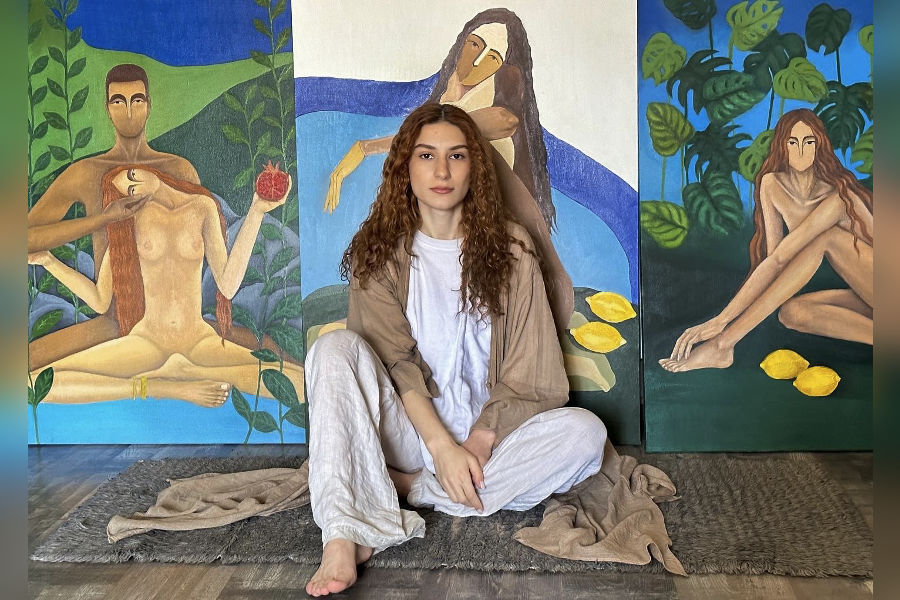
The exhibition hall is filled with the fresh scent of lemon. It feels as though you are entering not just a physical space, but an entire world where gentle waves lap the shore and forests whisper in the wind. At the center stands a tall young woman with flame-colored hair, as if she has stepped out of one of her own paintings. This is Maria Kotoghyan, the creator behind the exhibition and the silent figures within it.
There is a deep, inner peace in Kotoghyan’s art, felt indirectly at first glance, yet powerful enough to make you stop and fall silent. Her story begins long before the first stroke: with family memories, ancestral roots and the quietly transmitted tradition of art. She has been drawing since her school years, inspired first by her uncle, architect Eduard Tevanyan. In his home, drawing materials, sketches and the constant movement of colors became her first atelier.
Her artistic sensibility is also rooted in her multilayered heritage — from Constantinople and Greece. Born in Ukraine, she moved to Armenia at a young age. Her grandfather, Jean Kotoghyan, was a well-known calligrapher from Constantinople.
“He was a bird-painter; he created hand-drawn bird miniatures,” Kotoghyan told the Weekly. Art continues to flow in her family. “My sister is also an artist,” she explained. “She’s a painter-designer and she’s inspired me a lot.”

Kotoghyan earned her degree from the painting department of the Panos Terlemezyan State College of Fine Arts. Her first solo exhibition-sale, titled Balance, opened at Pyunik Development Center last month. The displayed figures are positioned in peaceful, harmonious environments, reflecting the idea that balance governs not only the characters but the entire exhibition. “They are emotions,” the artist described.
“Each has its own mood, yet all revolve around a single idea: balance. Through lines, positions, emotions — everything leads to that idea.”

Nudity in her paintings carries a particular meaning. “It’s not eroticism, but simple, open nudity. A pure state. Humans come into the world naked. It’s natural,” she explained.
Kotoghyan’s characters have no mouths, a choice that embodies silence. “For me, silence is the most helpful force that brings a person into balance. It’s not an empty silence but one of acceptance, understanding, attunement. When you have that, words become unnecessary,” she continued.
The exhibition presents 23 paintings, several sculptures, handmade jewelry and clay plates. The artistic depth and volume of work astonish visitors; it is hard to believe such a young woman created so many pieces. Only one work from her Terlemezyan years is displayed: her diploma sculpture. Asked if she would sell it, she smiles gently and shakes her head.
The rhinoceros holds an important place in two of her paintings. “For me, the rhinoceros is a symbol of strength — a protector. At the same time, I was protecting myself through its image. Sometimes strength is born from pain, and strength born of pain is the strongest.”
Images featuring Armenian carpets carry stories as well, merging contemporary art with heritage. Armenian patterns rooted in Artsakh serve as a language of identity, preserving memory while shaping artistic expression.
In recent works, fruits appear as familiar associations. “Recently, a couple bought the painting with pears. Their last name is Tandzikyan [tandz meaning pear in Armenian], and they found something personal and familiar in the painting,” Kotoghyan explained. “I’m very happy when people find themselves in my work.”

White carnations in another painting recall childhood memories — her grandmother’s favorite flowers, painted with great love. “Precious memories, captured on canvas,” she added.
The turning point in Kotoghyan’s life came when she chose art over years spent playing badminton. “I love sports too, but art consumed me — in the best way.” Asked what her art would be if it were a person, she answered, “A woman. Balanced, aware of her roots and identity. Somewhere in nature, far in the background. And next to her, definitely a rhinoceros.”
The artist explained that her creative process begins long before the first stroke: “The image comes, but not from a specific place. An emotion attaches itself to me, and I begin collecting it. It can stay with me for months.” Standing before the canvas, her thoughts “switch off,” and the colors follow their own path. Sometimes, she writes to avoid losing an idea. Other times, she paints slowly, letting the color mature layer by layer.
Asked if the world fell silent and she could create only one painting, what would she leave as a legacy? Kotoghyan thinks for a long time, then says, “I’d want something that hints an Armenian painted it — not for nationalism, but so that it is always preserved.”
One of the main works in the exhibition, Balance, depicts a couple communicating through gestures. The girl holds the boy’s hand; the boy supports her head. They balance each other, interact and play with emotions. Both sit in the lotus position, a symbol of balance. In the girl’s hand is a pomegranate, symbolizing warmth and family.
In Kotoghyan’s world, colors are never just colors — they are memories, roots, strength born from pain, the scent of childhood and silent truths. If her work becomes a legacy, it will convey a simple yet powerful idea: wherever we go, whatever we change, our silent balance is our identity. It is that silence that Kotoghyan paints.
Follow Maria Kotoghyan’s artistic journey on Instagram.
All photos are courtesy of Maria Kotoghyan unless otherwise noted.