




Cross over crown: Defending the independence of the Armenian Church
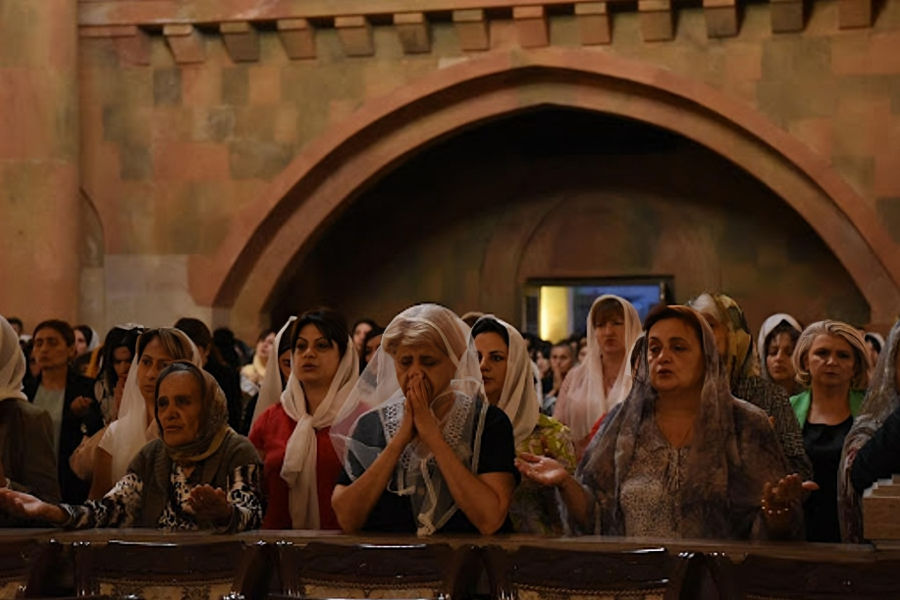
The Armenian crest bears a cross above the crown, a powerful symbol that Christianity stands above politics. Many observers note that leaders in government, including the prime minister, would do well to remember this principle.
Tensions between the Armenian government and the Armenian Apostolic Church (AAC) have escalated sharply since June. On Oct. 14-15, six clerics from the Aragatsotn Diocese, including Bishop Mkrtich Proshyan, were detained by law enforcement authorities. Reports indicate that the arrests followed a criminal complaint alleging that church officials encouraged participation in opposition rallies.
This wave of unrest traces back to May 2024, when Armenia handed over four border villages to Azerbaijan. In response, Archbishop Bagrat Galstanyan, backed by the Armenian Apostolic Church, launched the Sacred Struggle Movement. He led a peaceful protest march from Tavush to Yerevan, symbolizing the people’s growing frustration.
Early attempts to ease tensions included outreach from church leaders. Prime Minister Nikol Pashinyan met with Archbishop Shahan Sarkissian of the Holy See of Cilicia, who presented him with a book commemorating the 30th anniversary of Catholicos Aram I’s enthronement.
Yet, the rift deepened following the June arrest of Russian-Armenian billionaire Samvel Karapetyan, a vocal defender of the Church and of Catholicos Karekin II, amid renewed calls for the Catholicos’s removal. The Catholicosate of the Great House of Cilicia later emphasized that “the supreme interests of our nation and homeland require close and strong relations between the two pillars of our people: the State and the Church.”


For many in the diaspora, watching these events unfold has stirred a complex mix of grief, confusion and resolve.
The Republic of Armenia Prayer Breakfast exists to renew Armenia’s spiritual foundations and affirm its Christian values, bringing together leaders with a shared moral vision to promote peace, prosperity and principled governance. Yet, these ideals stand in sharp contrast to recent government actions — from the arrest of clergy to online posts ridiculing religious practices such as circumcision.
The dissonance raises serious questions about whether the State still upholds the very moral and spiritual principles that the Prayer Breakfast was founded to protect.
The irony of this crisis is impossible to ignore. How can a nation whose identity was forged in faith disregard the very institution that safeguarded that identity through genocide, exile and loss?
For those of us raised in the diaspora, the Church has always been more than a place of worship. It is where we learned the alphabet of our ancestors, sang the hymns our grandparents once whispered under Soviet rule and ate so much choreg that we fell asleep on the car ride home. When we hear of priests being arrested or churches searched, it feels as though something sacred to our collective identity is being challenged.
In North America, the diocesan primates of the Eastern and Western United States and Canada recently met in New York and issued a unified statement regarding the arrests. They expressed solidarity with His Holiness Karekin II, the Catholicos of All Armenians, and with all clergy and faithful in Armenia and the diaspora. Signatories included Archbishop Hovnan Derderian, Primate of the Western Diocese; Bishop Mesrop Parsamyan, Primate of the Eastern Diocese; and Bishop Abgar Hovakimyan, Primate of the Armenian Diocese of Canada.
Many in the diaspora view this coordinated response as a long-awaited sign of unity. While the current status of the detained clergy remains unclear, these statements serve as a reminder of the urgent need to protect religious freedom and the Church’s independence. Observers suggest that continued international attention, including from major global powers, could influence the course of events in Armenia.
In July, Christian Solidarity International, Coptic Solidarity and SOS Chrétiens d’Orient released a joint statement condemning the arbitrary detention of clergy, the expropriation of Church property and the use of police force in sacred spaces, including the Mother See of Holy Etchmiadzin.
Two weeks ago, the speaker of the Armenian Parliament, Alen Simonyan, declared, “I do not recognize the legitimacy of Catholicos Karekin II and consider the structure he leads illegitimate.” Yet the same government allowed Stepan Asatryan, a defrocked priest, to continue preaching and even extended an invitation to the prime minister to attend his services. So, whom should we believe: the law or the faith? For Armenians everywhere, especially our youth, this question should never have to be asked.
Before the genocide, census data from the Ottoman Empire and the Armenian Patriarchate of Constantinople recorded around four million Armenians, of whom 1.5 million were lost during the genocide. We were the first nation to adopt Christianity. We cannot afford to lose that legacy, too.
For Armenians worldwide, this moment underscores the enduring role of faith in bringing our people together. As the cross rises above the crown on our national emblem, it reminds us that political power is fleeting, but faith — our collective belief in justice, compassion and truth — endures.
This moment, perhaps more than any in recent memory, calls us to defend that truth.

The “independence of the Church should remain in the confines of the church itself. We are not living in the past where the church, understandably assumed the role of governing the daily life of the Armenian society, whether in the Ottoman, Russian or the Persian Empires. However, there is no precedence where the Armenian church, under any of the above mentioned foreign rule, had the right, or even a desire to interfere in internal or foreign policy issues. Today, in the State of Armenia there is a clear separation of church and state, therefore, no clergy, bishop or Catholicos has the right (moral or otherwise) to interfere in the State governance issues. But you already know this, and therefore what you are writing is nothing but a false propaganda run by your superiors. We, in the diaspora have had enough, and we are sick and tired of such manipulations, especially when there is clear foreign interference in propping up the Church to go against the Armenian State. This also is something you know very well. The miserable failure of Kremlin-led stooges, who call themselves “opposition”, have proved, time and again, to be less than desirable elements by the collective Armenian citizenry, the Church is simply discrediting itself by putting its nose where it does not belong, made even more painful when we look who is behind all this. DO NOT take your readers as having been born an hour ago.
@Zareh Sahakian
All you’ve managed to achieve, Zareh, is to show everyone that you failed your Geography exams at school.
Do you even know where Armenia actually is?
Contrary to all the propaganda swirling around your head, the Seventh Cavalry is not coming to Armenia’s aid.
Nobody from the West is.
Go and look at a map and learn to understand how vital Armenia’s alliance with Russia is.
Do you have a magic wand that can change Armenia’s geography?
No, you don’t.
Geography can never be beaten.
Mr. Whig’s reply to this article is uncannily similar to his reply to a different article on a different topic. Curious how these different Armenian state concerns (be it military, economic, or in this case, Social/Spiritual) all seem to have the same answer: Mother Russia.
Mr. Whig seems to be looking at the map without comprehending that actual _people_ inhabit these territories. These people have interests, and those interests may or not align with ours.
History has shown that state interests and politics trump geography. Interests can lead former allies (or perceived allies) against each other, and can force enemies to concede to common interests.
Contrary to the propaganda swirling in some other heads, as close as Russia is geographically, there is absolutely NOTHING obliging it to support Armenia or Armenia’s interests. Do you need another 2020 war to prove it to you? Good thing we were part of the CSTO, no?
Take a look at what Russia has been doing in Moldova – through those peoples’ own Church no less – to interfere with their political/economic/social choices as a small state. Remind you of anything going on in our back-yard?
Russia is not a friend – just a nearby superpower that is pursuing its own agenda. It’s time to realize that Russia’s stance toward Armenia, Turkey, and Azerbaijan is dictated by its own interests. It’s foolish – and ahistorical – to believe otherwise.
Mr. Kalayjian’s reply shows his total detachment from Reality.
Armenia’s alliance with Russia is based on GEOGRAPHY.
The Seventh Cavalry is not coming, the Americans only care about their base in Incirlik, the Germans, French and British are not coming.
Every Armenian who lives in the real world knows that nobody in the West is ever coming to Armenia’s aid.
On the contrary, the West will connive at Armenia’s destruction.
The Turks have the second largest army in Nato, Armenia’s possession of Syunik stops the Turks from linking up with the Azerbaijanis and the other Turkic countries in Central Asia, which would be a huge expansion of Turkish and, therefore Nato, power.
Russia is committed to the defence of mainland Armenia only.
Even in the times of Armenian military supremacy in the 1990s, Armenia made no attempt to annex Artsakh.
As for 2020 :
1) How, exactly, is Russia responsible for Armenian incompetence?
Armenia had better and more modern weapons than the Turks, Sukhoi Jets and Ishkandar missiles – they weren’t even used!
2) How, exactly, is Russia responsible for Armenian corruption?
The Turks used Israeli and Turkish drones. Where were the Armenian drones? The money for Armenian drones was siphoned off for the lavish mansions in and around Yerevan – that’s where!
3) What, exactly, was Russia supposed to do when –
Pashinyan declared that Artsakh was part of Azerbaijan – that meant Russia could do nothing about the blockade of Artsakh as that would have been interference in Azerbaijan’s internal affairs.
4) Artsakh was lost in 2023 when Pashinyan declared that the Armenian Army would not fight for Artsakh. It is the sacred duty and honour of Armenians to die for Artsakh – and when Armenians refuse to do so, why the heck should anybody else?
Artsakh was lost because of Armenians, nobody else.
The only reason why Armenia survives as a country at all is because of the cheap energy, which it receives at a very heavily subsidised price from Russia.
Tell us all what will happen to Armenia if it had to pay world market prices for its energy?
As for your dig about “Mother Russia”, who else does Armenia have ?
WHO ?
Go on, tell us all who is coming to aid Armenia against the Turks?
WHO ?
You bring up some interesting points, Mr. Whig.
Could you please supply some more insight – perhaps with evidence – of the West’s conniving at Armenia’s destruction? I’d like to hear more about that.
Regarding your other points, I think our reading of history and geopolitics – of “reality” – could not be more starkly different. Let me explain where I’m coming from, and I hope you can do the same for me.
You claim Armenia had better and more modern weapons than the Turks (i.e. the Azeris). From what I’ve studied, that statement is easily shown to be false. Armenian Radar and Air-to-Air defenses were 1990’s technology (a mere 30 years behind the times). These were deployed and tuned for completely different targets and combat scenarios – not the drone threat Armenia was facing in 2020. Even more out-dated was our military doctrine, which hailed from Soviet times. Command and control and communications were not up to the challenges of modern warfare – in fact, they were a liability, as the unfortunate (and inexplicable!) field use of cell-phones attests. Our radar and anti-air batteries deployed in Artsakh were largely (some estimates are 60%) taken out in the first _day_ of hostilities, showing both our technological and doctrinal backwardness relative to Azerbaijan.
Yes, we had Iskander missiles and SU-30s – so what? These were based in Armenia proper, and unless you think we should have blasted Baku in a hail-Mary coup de grace, and risked dragging “mainland Armenia” into the fray WITHOUT the protection of the CSTO (since it would be hostilities initiated by Armenia against a non-CSTO country), then these missiles and systems did exactly what they were designed to do: be used against tactical targets during a war with Armenia (not Artsakh). (BTW, didn’t you just love how the CSTO came to the aid of Russia in its Ukraine war, just like it came to the aid of Armenia during the 2020 war?) I think you would benefit from some reading about military strategy before you go launching ballistic missiles at your neighbor, Mr. Whig.
You lament that Armenia had no drones to field. Do you know whom you can thank for that? Not Armenian “corruption.” It was the CSTO, in fact, that required member states to “share” military technology. No non-CSTO international arms manufacturer with decent military tech wanted to sell to Armenia (Israel included) since they knew their precious tech would immediately get into Russia’s hands. Please send a “Thank you” card to Mr. V. Putin for that clause in the CSTO agreement, which crippled Armenia’s ability to procure reasonably modern military technology. Perhaps now you can see why Pashinyan can say without irony that pulling out of the CSTO will make Armenia’s military stronger.
By the way, some of that money you’re looking for that should have been used to purchase drones – they found it “used for lavish mansions” in France: “$132 million mansion seized from Samvel Karapetyan and Gazprom.” So, I take back what I said before: there was corruption, just not on the part of who you thought.
You ask “What was Russia supposed to do when Pashinyan declared Artsakh part of Azerbaijan.” I’m sorry if I misunderstood, but was that a joke? If so, I had a good laugh, since that was Russia’s intent since Lavrov’s plan since 2015. Perhaps you should carefully read your comrades’ proposals and not ignore inconvenient facts just because you love the word “geography.” Russia did not ever intend to fight for Artsakh. There is no need for you to apologize for them. (And where, by the way, was Russia when Azeri missiles fell near Vartenis? Shouldn’t that have invoked Article 4 of the CSTO? So much for Russia being committed to the defense of mainland Armenia…)
Here’s another inconvenient fact that you seem to want to sweep under the rug: Azerbaijan is (and has been for some time) militarily and economically stronger than Armenia. (Levon Ter Petrosyan saw this 30 years ago – annexing Karabagh would not have changed this.) Why would Pashinyan declare in 2023, after being soundly beaten by a much stronger neighbor, that he would fight (again) for Artsakh. Put yourself in the PM’s chair for a moment – would you send thousands more to their deaths with no possible hope for military or political gain? As much as I would also like to live in a reality where patriotism and heroism _alone_ can win wars, we live in an altogether different reality.
To me, your most serious point was about energy. This points to Armenia’s past dependence on Russia and its current strategy to be freed from that morbid dependence. As an example, let’s recall how we got into this energy quandary with a gas and oil rich friendly neighbor to our South. Remember how Russia (Gazprom and Kocharyan) reduced the possible Iranian flow to Armenia by 4x by building a narrower pipe than they could/should have? By doing so, Russia guaranteed Iranian gas could never supplant Russia’s (until new pipelines were built). Who builds the pipelines, again? Gazprom. Now, Russia can turn off the gas to Armenia for “repairs” whenever it wants to give us a spanking. Sorry – we’ve had enough Russian spankings, and it’s time for us to grow up. It may be painful, but we’ve lived with enough exploitative Russian “generosity” and subsidies to know that it’s not worth living in bondage to Mother Russia.
What seems to be your strongest argument – “Who else does Armenia have if not Russia” – shows the dearth of geostrategic thinking that’s infected many Armenians. I don’t want to get ahead of myself and be optimistic, but – would anyone have guessed that Japan, Germany, Greece, the EU, UAE, China, and the United States (of all places) would be in line to invest in Armenia? (I know it’s premature, and we don’t know what the US investment looks like, but nobody could have dreamed about a US presence in Armenia outside of the embassy until today.)
We’ve seen what a “one and only one” super-power security guarantee is like: a trade of sovereignty and potential for “security.” (Benjamin Franklin had a few choice words for those who make that Faustian bargain of safety at the expense of liberty.) What we need is to get inter-connected with global partners – each of whom can exert their influence on Turkey and Azerbaijan and Russia in the world market and in the political back-rooms to protect and improve their investments in Armenia.
Lastly, a word about Turkey and Azerbaijan. They are countries with interests, too. The sooner we realize that they are not merely vampires waiting for nightfall to suck the last drops of blood out of Armenia, that they also have non-genocidal interests that they want to pursue (I know that’s very hard for many people to imagine, but it is a fact that we need to recognize), and that Armenia could play a complementary and mutually-beneficial role in these interests, then the sooner we can liberate ourselves from paralyzing fear and engage in rational strategy within our regional context.
Before you start calling me “traitor” (a popular word in this forum, it seems), none of the above means that we forget about the Genocide, about Artsakh, or about our history or our forebears. What it means is this: we need a sober assessment about who we are and what we can achieve in this world we have where the international currency is power, and then build a rational, methodical strategy based on that assessment. From where I stand, that’s the Reality in which we live.
You want Armenia to rely on Iran?
During the 800 years when there was no Armenia, the land was ruled either by the Turks or tje Persians or sometimes by both.
It didn’t really matter.
Both the Turks and the Persians treated the Armenians as the same – as dhimmis.
Neither of them have ever changed.
As for drones, I am talking about Armenia’s own domestic production. It was that money that was siphoned off.
Proof?
Take a walk around Yerevan and look at all those beautiful mansions. Ask yourself where does the money come from? Then ask a passer by who owns them. You’ll get an angry comment about a government minister or civil servant. They can afford homes like that on a government salary?
The people of Armenia know what’s going on.
Zareh,
You are contradicting yourself. It is true that there is the separation of the church and state in Armenia. Given this fact, why then does Pashinyan poke his nose into the affairs of the church making accusations against the head of the Armenian church and demanding his resignation? Does he have the right and the authority to make such demands if there is the separation of the church and state? No he does not. The church itself independently has mechanisms in place to deal with any and all internal issues. Now, the question is why does Pashinyan, despite being such a hypocrite, want to interfere in church affairs, not to mention at a time when there are so many other critical and urgent issues to deal with? Because when that psychopathic, flip-flopping, incompetent, dysfunctional traitorous Pashinyan gave away to the enemy everything the enemy ever wanted and had demanded, declaring the issue of Artsakh closed and done with washing his hands altogether clean of Artsakh ethnically cleansed at the hands of the enemy for the first time in its multi-millennial existence in history, the head of the Armenian church, contrary to Pashinyan’s declarations, began raising this issue declaring it as open and unresolved. In other words, Pashinyan is trying to use his power by manufacturing events and fabricating accusations to remove all obstacles to put the last nail on Artsakh’s coffin, presenting his treasonous acts to his ignorant and gullible followers, as well to his ex-followers, as a path to peace under his “era of peace” nonsense, needless to say at a time when he is cutting back on military spending while the enemy has increased military spending to highest levels, in order to cheat people into re-electing him into office to avoid accountability for what he has done to the country and to save himself from criminal persecution!
Mr. Ararat asks: Why does Pashinyan poke his nose in Church affairs? For two reasons:
First, because the Armenian constitution (Article 18.2) allows the State to do so – WHEN there are alleged violations of Armenian law. Arresting a bishop or even the Catholicos is within the purview of the state when a law has been allegedly broken. I’m not a fan of the Armenian legal system’s pre-trial detention process, but that’s the way it is there. We will see how the legal system deals with the allegations – it’s too early to condemn or exonerate any side at this point. We should keep in mind that priests and bishops are not immune from breaking the law, nor are they exempt from legal punishment.
Second, as a citizen of Armenia and purported believer, Pashinyan – or anyone – has a right to be outraged at the personal behavior of the leaders of our Church. In this case, the Church’s internal mechanism _ought_ to deal with the scandalous behavior of any clergy, but it’s clear that those internal mechanisms are broken. They have been broken for a while now. Turning a blind eye to it does not help the Church or the State. Pashinyan is using his bully pulpit to call attention to this matter, and I for one hope that the Church wakes up and attends to its own spiritual and moral state.
As for how this matter rates in importance relative to other issues Armenia is dealing with, this article and its responses show rather clearly that for many in this forum the Church is merely a symbol, if not a tool. As I’ve written elsewhere, the Church is either the eternal Kingdom of God on Earth, or it is a farce. If it is the former, then we need to properly understand and appreciate its primacy in our lives. The Church does not _serve_ the Armenian state or people as a cornerstone, anchor, or lighthouse. To think of it this way instrumentalizes the Gospel and reduces it to one of many other components within our existence and under our control. This is not a Christian view of the Church. The Gospel of Jesus Christ and His Church are eternal Truths within which, through which, and in the light of which we Armenians have flourished and survived. We share the Church with the rest of Christendom, and we need to respectfully and humbly live within this shared and eternal gift to humanity.
On this view, Pashinyan’s actions toward the Armenian Church are justified, even in the face of other pressing State concerns.
I would refer Mr. Ararat to another reply I wrote to Mr. Sassounian regarding Armenian military expenditures. Suffice it to say here that we need to dispense with emotional reactions from arm-chair diplomats and generals and move on toward more rational analysis based on the reality we live in, not a reality we dream about where Armenia can increase military spending to Azerbaijani levels without going bankrupt.
I could not agree more with Mr. Bahamian. Thank you.