Youth OpinionYouth

We’re here, we will remain
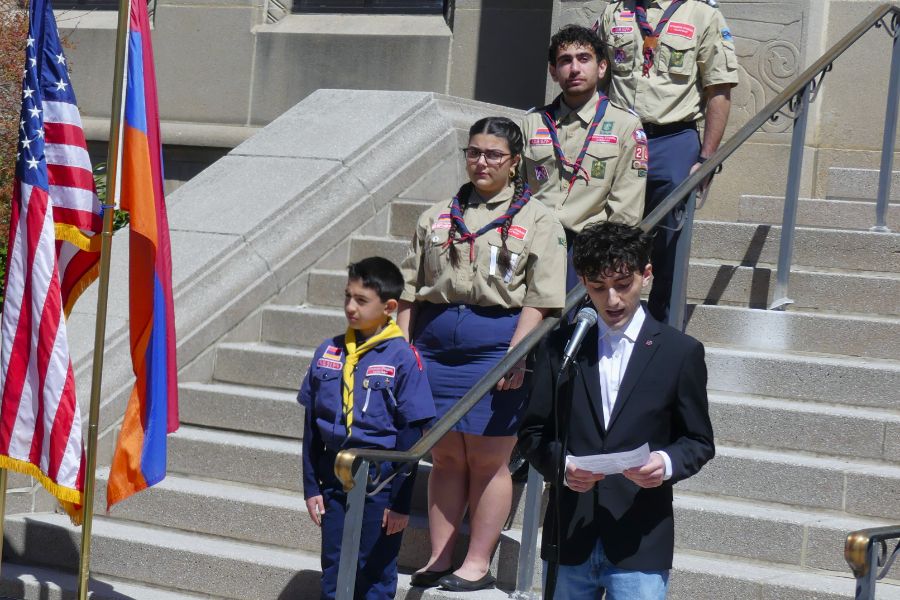
The following speech was delivered outside the Fort Lee Municipal Building for the AYF-ANCA-led Fort Lee Flag-Raising Ceremony in remembrance of the Armenian and Artsakh genocides on April 11, on behalf of the New Jersey “Arsen” Chapter.

Good afternoon. 

Before I begin, I want to take a moment to once again thank all our friends here today: Fort Lee Mayor Mark Sokolich, Fort Lee police and Honor Guard, Very Rev. Fr. Vache Balekjian, yev sireli joghovurt, thank you everyone for being here on such an important day. 

I’d like to ask you all to take a minute and look around you. And think about where in this world we’re currently standing, and why. Reflect on the beautiful poetry you just experienced, an anthem sung, and a prayer delivered, all in a language that has stood the test of time, made it through the rise and fall of empires, and survived a deliberate attempt to wipe it from existence. 

Mesrob Mashdots and Sahag Bartev didn’t know in the year A.D. 405 that the language they were speaking and creating an alphabet for would still be spoken 16 centuries later, least of all on the opposite side of the world in a little place called New Jersey. Then again, they didn’t know that down the line their descendants, our ancestors, would be forced off the jagged mountainsides they called home and sent to march through the long and dry deserts of Syria. 

Advertisement

As World War I took full swing, Armenians living in the Ottoman Empire faced their own wave of systemic persecution and massacre. A crime against humanity so grave that it demanded the creation of a new word, which we use today and will carry with us forever. What Armenians faced at the hands of the Young Turk party in 1915 was, undeniably, genocide. 

Today, we honor those 1.5 million Armenians who perished simply because of who they were. We honor the nearly 270 Armenian teachers, doctors, clergymen, lawyers, journalists and politicians who were arrested and eventually murdered in Constantinople, in an effort to rid Armenians of their own leadership and stifle the organization of local communities. We remember the cities and villages of Van, Urfa, Sasun, Hajin, Zeitun, Kilis, Mush, Dikranagert, and the hundreds upon hundreds of historic Armenian lands that have faced cultural erasure and whose names have been rewritten to fit the Turkish government’s fabricated narrative of its shameful history. 

We’ve even seen this act of erasure and ethnic cleansing be carried out in modern times, and so today we also honor the 120,000 Armenians of Artsakh and the brave soldiers who fought to protect their homeland, whose roads, access to food, humanitarian aid, even water and electricity were cut off by the nationalist, authoritarian Azerbaijani government, spearheaded by a dictator who has held his office for the last 23 years, and backed, by no surprise, by the Turkish government. And although the 2020 Artsakh war ended with a total loss and cession of Artsakh’s seven provinces into Azerbaijan, and a mass exodus of refugees along a single road into Armenia, our fight for justice is long from over. 

For the past 111 years, the Turkish and Azeri governments have spent millions of dollars to ensure the Armenian and Artsakh Genocides are forgotten. They have engaged in propaganda and disinformation campaigns, and try to convince our political leaders and educators that our history doesn’t have a place in the classroom. We’ve seen our schools and churches here in the U.S. vandalized, even witnessed peaceful protesters physically attacked by Turkish government employees in Washington, D.C. Despite this, we show up. 

Let this beautiful ceremony today be not just another reminder of our tumultuous past. Recalling our collective memory and honoring the victims of genocide may not be a cheerful occasion, but we don’t need to walk away from this event in low spirits. Attempt after attempt has been made to erase our people, and yet, look at our waving flags, nayir nran, yerek kuynov, nviragan meg nshan. Behold it, with three colors, one sacred symbol. 

We’ve come a long way from the desert of Der Zor. We all have ancestors who survived against impossible odds, and took on the daring task of building a life and forming community here in the land of the free. Your being here is proof that genocidal regimes fail and will continue to fail. The Armenian Youth Federation, Armenian National Committee, Armenian Relief Society, Homenetmen and Hamazkayin, these organizations exemplify our unwavering dedication to keeping our culture and communities alive and thriving. Separated from our homeland for generations, we still speak our mayreni lezu, our mother tongue, we pray in our churches, wear our costumes on stage, send our kids to Armenian school, and once that verchin zang, that final bell rings, we drop them off at Armenian summer camps.

We are living in the fulfillment of William Saroyan’s famous words, that when two Armenians meet anywhere in the world, see if they will not create a new Armenia. This, us, you, are part of that new Armenia. This is Hai Tahd, the Armenian Cause. As difficult and daunting as it may seem, keep your heads up high, remember your history but keep your eyes on the future, and most importantly, stick together. Lift each other up, stay informed and educate others, and be active in your communities, because whether we’re in New York, Boston, California or right here in the Garden State, the Armenian American community is as strong and vibrant as ever. Gank, bidi linenk, u ter shadanank. We’re here, we will remain, and we’ll continue to flourish. So be proud of yourselves, and be proud of where you come from. And have a great rest of your day. Thank you for being here.

Aram Bavoukian

Aram Bavoukian is an active member of the AYF New Jersey "Arsen" Chapter, currently serving as public relations/correspondence coordinator and Hai Tahd committee liaison. He holds a BA in communication and media studies.

One Comment

Leave a Reply

Your email address will not be published. Required fields are marked *


Back to top button