


Youth Opinion

A museum of mockery

Some places stay with you, even when you’ve never set foot in them. For me, Artsakh and Armenia are among those places. I grew up hearing stories of their mountains, their people and the lives forever changed by war and genocide. But it wasn’t until I learned about Azerbaijan’s War Trophies Park that I realized how the memory of Artsakh could be threatened — not just in the region itself, but across the world. 

Imagine seeing your beloved family member, who fought in a war, immortalized in a museum — not as a hero, not for their courage, but rather as a trophy of the enemy’s victory. That is the reality Armenians face with Azerbaijan’s War Trophies Park. To grasp the weight of this, one must understand the conflict it represents. 

In 1923, the Soviet Union established Nagorno-Karabakh as an autonomous oblast within the Azerbaijan SSR, though a vast majority of its population was Armenian. In 1988, the region sought reunification with Armenia, sparking the First Karabakh War, which claimed 30,000 lives and left Artsakh de facto independent via the Lachin Corridor. Violence persisted, and in 2020, Azerbaijan launched a full-scale assault, reclaiming most of the territory. By December 2022, Azerbaijan had blockaded the Lachin Corridor, depriving Artsakh Armenians of food, medicine and basic necessities. After nearly 10 months of starvation, as Azerbaijani forces advanced, 120,000 Armenians were forced to flee under threat of death. In this context, Azerbaijan built a museum — not of mourning or reconciliation, but of domination. 

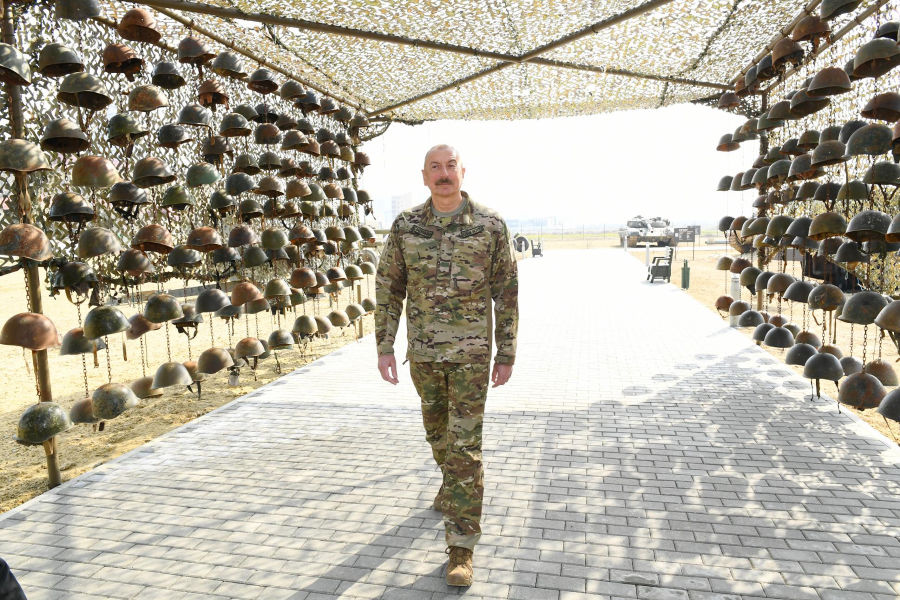
The War Trophies Park, opened in May 2021, displays hundreds of Armenian helmets taken from fallen soldiers. At its entrance, a sign declares: “Karabakh is Azerbaijan.” Originally, it included wax mannequins of Armenian soldiers posed in grotesque caricatures — faces twisted, hands raised in fear — until international condemnation led to their removal. But the helmets remain, and so does the message: Armenian lives are not to be remembered, but mocked, dehumanized, erased. 

President Ilham Aliyev posed for photos amid the helmets; the spectacle was not about remembering the dead but about glorifying their erasure. The park targets both domestic and international audiences: to Azerbaijanis, it constructs a narrative of righteous victory; to outsiders, it asserts territorial legitimacy by physicalizing the slogan “Karabakh is Azerbaijan.” Even NATO officials, visiting in October 2024, honored Azerbaijani martyrs while ignoring Armenian losses, reinforcing the one-sided narrative.

One might ask why it matters so much to me or my friends. My friends deserve to go to church without having anti-Armenian words vandalized on their place of worship. I deserve to drive my car around Pennsylvania without being verbally harassed by denialists who tell me that “there is no Artsakh” after spotting my magnet. I have the right to feel safe attending an Armenian event in a big city without fear that an extremist, inspired by this hatred, might commit an act of gun violence. Seeing those helmets reminded me of protests and encounters in the U.S. — people shouting at us during demonstrations, casual derogatory comments at school or on the street when I wore an Armenian flag.

The hostility, erasure, denial and propaganda follow us everywhere, and the consequences extend far beyond this park.

Over 10,000 khachkars were destroyed before the war, and countless more now face the same fate. Churches and homes in Artsakh have been razed. Displaced Armenians have nowhere to return and many face discrimination as refugees on their own land. This is propaganda taking shape in its most insidious form. The hostility follows you no matter the distance — a reminder that denial and erasure of Armenian history are not confined by borders.

Yet, war trophy displays are not unique to Azerbaijan. Ukraine, under siege from Russia, has staged its own exhibition of destroyed Russian tanks and equipment, toured by leaders like Boris Johnson alongside President Zelenskyy. Iraq’s Victory Arch, with its giant crossed swords, incorporates Iranian soldiers’ helmets at its base. Iran’s Holy Defense Museum commemorates a million dead with artifacts and casket-like displays. 

These memorials raise a complicated question: when does commemoration become propaganda? Is it only wrong when the enemy does it? If the helmets were removed from the Victory Arch, would it then be acceptable? If Azerbaijan removed the wax figures but kept the helmets, has the propaganda truly changed? The difference lies in intent and ideology. Ukraine’s displays highlight defense against invasion, framing Russians as aggressors. Iraq and Iran’s memorials emphasize national suffering. 

Azerbaijan’s park, by contrast, celebrates the destruction of an ethnic group and the cleansing of their homeland. The dehumanization is not subtle; it is staged, photographed and broadcast. As one humanitarian group noted, even cosmetic changes to the park do not undo its central message: that Armenian life is disposable. 

Azerbaijan has destroyed Armenian towns and cultural crosses, tossing the debris into rivers. Satellite images have revealed that churches in Nakhichevan and Artsakh have been destroyed. Azerbaijani flags are raised on Armenian monuments; homes in Artsakh homes are demolished so that even if Armenians are ever allowed to return, there will be nothing left to return to. Turkey, Armenia’s greatest aggressor in the past and the perpetrator of the Armenian Genocide, has supported Azerbaijan. Yet, some Armenians continue to live within Turkey’s borders — churches, schools and hospitals remain open. Still, Turkey refuses to recognize the genocide while manipulating global politics to its advantage, navigating between the demands of the United States and Russia. The citizens of Artsakh do not have the privilege of returning to their homeland. 

President Trump attempted a peace deal in August, but it was framed largely in economic terms rather than humanitarian — at least, for Armenia. Trump lifted sanctions on Azerbaijan, and his proposed corridor plan, connecting Azerbaijan to its Nakhichevan exclave through Armenian territory, was celebrated as a major win for Baku, granting direct access to Turkey and European markets. While presented as a concession to Armenia, the corridor fulfilled a longstanding Azerbaijani demand and strategically undercut Russian influence, particularly as Moscow remained focused on Ukraine. 

Another casualty of this agreement was the Minsk Group, created in 1994 and co-chaired by the United States, France and Russia, which was dissolved in the process. Meanwhile, Armenian prisoners of war remain in Azerbaijani custody and, under this peace deal, will not return home. Propaganda often hides behind the guise of commemoration, but Azerbaijan’s War Trophies Park strips that pretense bare. It shows how memorials can become weapons — not of history, but of ideology: artifacts that erase rather than remember. 

The question it forces us to ask is not just where the line is between remembrance and propaganda, but how long the world will allow that line to be crossed before it is too late. I have always wanted to visit Auschwitz, to confront the stark reality of atrocities committed there. When visiting a site of genocide or war, we must come with intention: to learn, to bear witness, to honor the victims. Refuse the lure of “cool” relics of violence. Refuse to treat death as a spectacle. 

Do not allow history to be erased, trivialized or celebrated. Visit to remember. Visit to understand. Visit to ensure that what was done cannot be repeated.

Grace Yacobe

Grace Yacobe is an Armenian-American student passionate about strengthening community and unity within the diaspora. She writes on identity, faith and the future of the Armenian people.

One Comment

  1. Honestly? How can peace be even possible with Azerbaijan, when the Aliyev regime continues to propagate Armenophobia from kindergarten onwards and in their 100% state-controlled media, and continues to regard Armenians as the “eternal enemy” and uses them as the “scapegoat” to whip up the Azeri population?

    The grotesque wax figure caricatures of Armenian soldiers with hooked noses in that offensive Baku museum, are like a copy of grotesque anti-Semitic caricatures in Nazi Germany. The fascist mindset and indoctrination in the almost totalitarian dictatorship of Azerbaijan, is not really different from Nazi Germany.

    And irony is what dictators like Aliyev don’t understand, because he has such a hooked nose and hooked noses are also quite common among Azeris.

Leave a Reply

Your email address will not be published. Required fields are marked *


Back to top button