



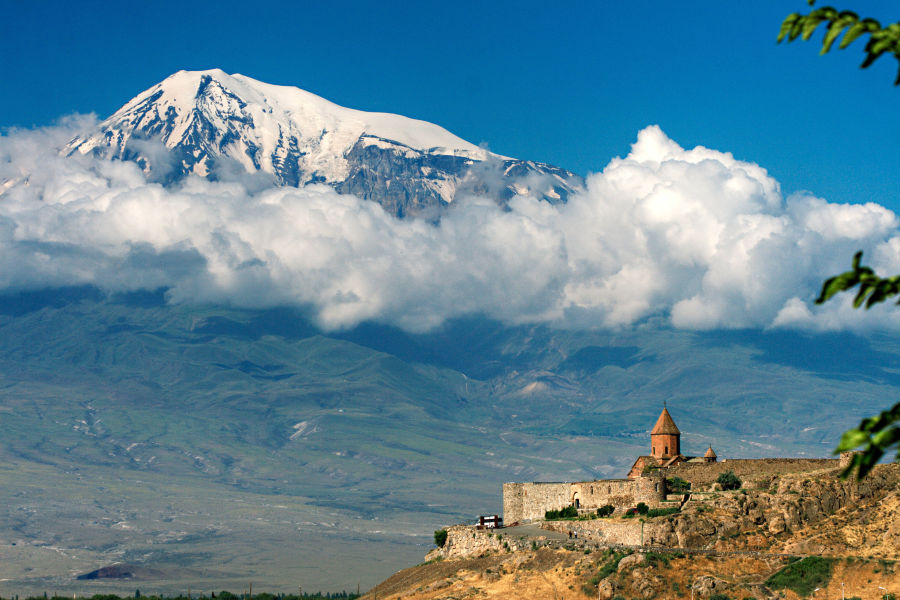
Ararat, the Biblical testimony of the existence and eternity of the Armenian people
Seven years after the so-called Velvet Revolution, we find ourselves not celebrating with inspiring dreams but burdened with painful realities. Day by day, heavy with new anxieties and bitter revelations, we are left wondering: Where is the Armenian state going? Where are you leading our people? Defeat must not impoverish our souls with threats of surrender and submission.
The year opened with a new image of Armenia’s Prime Minister posted on Facebook. He appeared clean-shaven — “without moustache, without beard” — presenting himself as renewed, as if to declare the end of the revolution. Behind him stood Mount Aragats, not Ararat, and a new map of Armenia — without Artsakh. This was, perhaps, the government’s version of a New Year’s greeting card: a new Armenia, symbolized not by our eternal Ararat but by Aragats and accompanied by a shallow slogan:
“Here is the state, here is the bread, here is the homeland, stay here.”
Instead of inspiring confidence, such imagery strips away national memory. For centuries, the Armenian people have suffered more defeats than victories. Yet every defeat was turned into a vow, a renewed commitment. Our leaders and commanders rekindled hope in the people’s hearts, urging them to continue the march toward a brighter future, anchored in the promise of eventual victory.
Poets and singers transformed loss into songs of struggle. They passed down to new generations the vision of ultimate triumph. With burning words, they vowed: “We shall reach you, sacred mountain — your summit!” And with the spirit of belonging to Ararat, Armenians endured on foreign shores, keeping Komitas’s melodies and Narekatsi’s prayers alive on their lips.
Even the defeat of Vartan became a victory when he declared, “Christianity is the color of my skin.” Against invading Persian forces, he preserved the spiritual balance of the Armenian people and turned Christianity into a guiding pillar of their existence.
From the gallows and death marches, our martyrs cried “Vengeance!” with their final breath. And from the deserts of Deir-el-Zor, our people took revenge by surviving — living, multiplying, building and creating.
How can one deny faith in the homeland? How can one be unfaithful to the vow of commitment?
Open our literature of the last century, and you will hear the cries of poets and writers calling for vengeance: not to forget, not to deny, not to despair, not to lose hope, but to continue the struggle — the struggle for homeland, for land, for the purity of the Armenian golden language, for freedom, for identity and for the indestructibility of the nation.
Generations rose, inspired by the cry, “A voice echoed from the Armenian mountains of Erzurum.” With weapons in hand, they swore: “We, your children, will forge a new dawn of glory.” And they kept that vow, liberating Artsakh and placing it in our hands, as the first step on the long road leading to Van, Moush, Sassoun and Ararat.
And yet, see what has become of Artsakh — before even three decades of independence were completed.
Listen to our music, and you will hear the reproach of our poet:
“Shall we still be silent when our rocks, our cliffs speak? Statesmen are not the owners of the homeland. They have no right to put it up for sale.
Have they not said that Armenians deserved the shameful slave’s condition?”
Do not destroy the millennial pillars of our existence — our faith, our culture, our symbols — that empower us and lead us to victory.
When two women once came before King Solomon to decide who was the true mother of a child, Solomon declared he would divide the child in two. The true mother cried: “Let him remain with her; only let my son live!” (1 Kings 3:5).
We are crying today as did the real mother: let Ararat remain in Turkish hands for now, as long as we cannot “bring it home.” But let it remain alive — in our souls, in our dreams, in our vision. Do not kill, for a second time, the victories that beat within our hearts. Do not take away Ararat — our symbol of national pride, our identity, the meaning of our existence. It is ours, even if captive. Sooner or later, we will bring it home.
Ararat is the biblical certificate of our existence, the divine testimony to our history and identity. It is the symbol of divine forgiveness, the starting point of humanity’s rebirth and the beginning of civilizations. It cannot belong to a genocidal enemy. God Himself chose where the new beginning of mankind would arise — and He gave us this gift, one which many nations would have desired for themselves.
And yet, how easily now, without pain, without remorse, without conscience, we surrender — giving away millennia of pride, of victories, of property to the enemy.
This is dreadful ignorance. It is the denial of God’s gift.
Are our leaders truly unaware of what they are losing? Or have wealth and power blinded them to all dignity and pride? Even in defeat, there is honor — there is dignity in preserving the awareness of one’s nation, one’s rights, one’s heritage, one’s worth. But not in flattery to the enemy, not in surrender, not in subjugation.
“Know well,
He who denies the word of God,
For throne, fear, glory,
Weakens from the bond of the vow,
Worms squirm his body
Before descending
Into the bosom of the earth…
Drying, like a thunder-struck
Mighty oak—
Its height, from its own root.”
Zionists demolish Palestine and slaughter Palestinians, but cannot steal from their souls the determination to reclaim their homeland.
But the Velvet Revolution has stolen the Armenian people’s trust. It now steals our hope, destroys our identity, kidnaps our vision — and threatens to erase the future of generations.
How else to explain constitutional amendments, the revision of our Declaration, the erasure of the Armenian Genocide and the Armenian Cause, the dismissal of “national ideology and national unity” as false categories, the isolation of the diaspora, the removal of Artsakh from textbooks, the shouts from rooftops that “Artsakh is Azerbaijani territory” or the declarations of a “Real” Armenia above a historical one?
And beyond this: history deleted from schools, teachers silenced, the Church endlessly slandered, the Armenian language distorted, our symbols erased, our culture emptied of meaning and denationalized, new borders drawn, victories surrendered — what remains?
The millennial pillars of our history, our culture and our identity are collapsing.
“Forgive us, Ararat…”
With blind eagerness to please the enemy, will we lose all dignity, all awareness, all values? Do we not see what we are losing?
This is where the “marchers” of the Velvet Revolution are leading us.
“I lament you, Armenia…”
Let all statesmen remember: the homeland belongs to the people. It has been preserved for centuries, passed down generation after generation and entrusted to you. Governments are but temporary guardians, tasked with protecting, safeguarding and developing this sacred inheritance.
And let all who deny their faith and break their vows not forget:
“New and old regimes all come and pass, with their presidents and secretaries, their prime ministers and ministers. But what remains are the true deeds of history, the creators and the eternal landmarks of our journey — Ararat, Etchmiadzin, the manuscripts, Hripsime, Narekatsi, Komitas.”
And once again, as the poet says:
“Like the sun, my country, you burn.”

This article was written originally in Armenian. The English version was translated by Dzovag Tutelian.


Eternity?! Don’t blaspheme, the Lord is eternal,
Seta, I will point to you that the citizens of Armenia have enshrined “Ararat, the Biblical testimony of the existence and eternity of the Armenian people” in their constitution since 1995, by stating in article 2 1, the following: “the Coat of Arms of the Republic of Armenia shall be as follows: in the centre, a shield with the representation of Mount Ararat with Noah’s Ark”. Mount Ararat is not a real estate on Armenia’s coat-of-arms, but with Noah’s ark, it symbolizes what you rightfully state.
As to “where there is a bread, that is where you stay”, you probably know that it is an old Armenian saying that rhymes beautifully in Armenian, “oor hats, hon gats-ուր հաց, հոն կաց», which has driven most of us onto the four corners of this round globe. Yes, its imperative that we help Armenia be where there is bread, from where Armenians need not depart. There is nothing derogatory in questing for bread and having Armenia be the state where there is bread, Yes for “Here is the state, here is the bread, here is the homeland, stay here” and not immigrate in quest of bread. We do pray in reciting the Lord’s prayer to “give us this day, our daily bread.”