

ANC of Illinois hosts Armenian Legal Center leaders

Glenview, Ill. — The Armenian National Committee (ANC) of Illinois organized a weekend of advocacy and community engagement dedicated to strengthening support for the Armenian Legal Center for Justice and Human Rights. All proceeds from the weekend’s programs went directly toward the Center’s vital work — advancing Armenian claims in international courts, documenting human rights violations, advocating for the release of Armenian prisoners of war (POWs) and pursuing accountability for genocide and crimes against humanity.
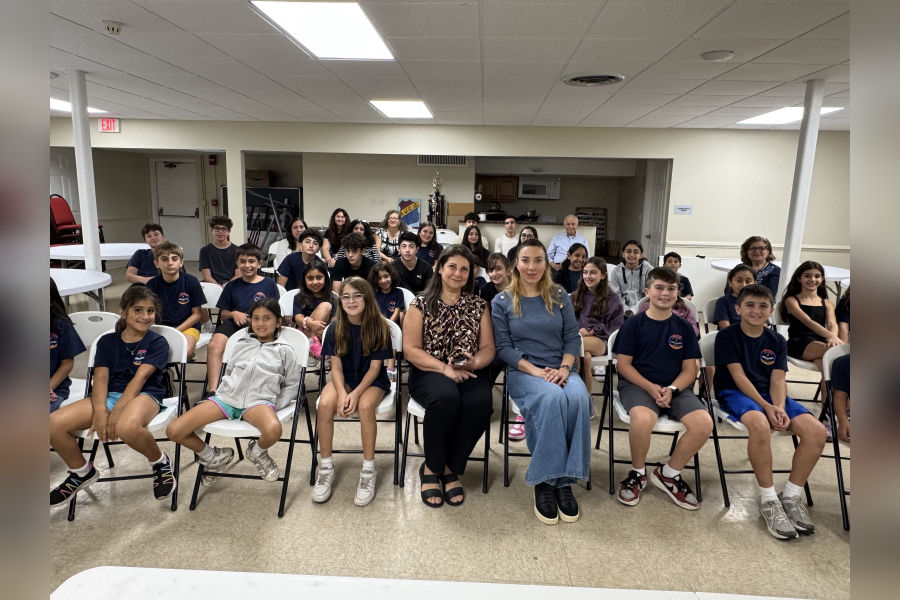
The weekend featured three major components. On Saturday afternoon, the ANC of Illinois sponsored a luncheon for the students and staff of the Taniel Varoujan Armenian School, followed by a program in Hudaverdian Hall where Unger Ken Hachikian, Chairman of the Armenian Legal Center, and international human rights lawyer Siranush Sahakyan, President of the International Comparative Law Center (ICLaw-Center) and Executive Director of the Armenian Legal Center, engaged more than 50 students and faculty in an interactive discussion about the Artsakh Genocide and the continuing plight of Armenian POWs. That evening, Sahakyan and Hachikian met with the Armenian Revolutionary Federation (ARF) membership of Illinois for an in-depth exchange on the current state of advocacy efforts and the responsibilities of organized Armenian structures.
On Sunday, the broader community gathered for a keynote discussion led by Sahakyan, who has dedicated nearly two decades to advocating for Armenian POWs and addressing humanitarian concerns stemming from Azerbaijan’s ongoing violations. Sahakyan, whose legal work has directly contributed to the return of over 100 Armenian POWs from Azerbaijan, outlined the troubling humanitarian situation still facing those unlawfully detained. She emphasized that no international torture prevention bodies were granted access to detainees until September, despite urgent calls from human rights organizations. In July 2024, the Council of Europe’s Anti-Torture Committee issued a rare public statement condemning Azerbaijan’s practices. Meanwhile, the International Committee of the Red Cross was expelled, with its last visit conducted in June, further limiting outside oversight. She described the denial of legal representation, noting that Armenian detainees are denied access to lawyers while Azerbaijani attorneys are selectively allowed. She also explained that international requests for trial monitoring have been rejected by Azerbaijani officials.
Equally troubling, she said, is the absence of consular services. Despite clear obligations under international conventions, Azerbaijan has refused consular access for Armenians. Sahakyan reminded the audience that consular services are a core protection mechanism for detainees, pointing to precedents where third-party states such as Algeria, Switzerland and Sweden have represented the interests of foreign nationals abroad.
Through her work at ICLaw-Center and in partnership with the Armenian Legal Center for Justice and Human Rights, Sahakyan has been at the forefront of bringing Armenia’s cases before international bodies. For the first time, she and her colleagues engaged the European Court of Human Rights to intervene on humanitarian grounds. The Court granted interim measures, ordering Azerbaijan to protect the life, security and safety of Armenian prisoners, while also imposing a reporting obligation. Despite repeated attempts by Azerbaijan to have this requirement lifted, Sahakyan and her team successfully preserved the mandate.
She also discussed ongoing proceedings at the International Court of Justice, where Armenia has argued that Azerbaijan’s decades-long policy of Armenophobia constitutes state-sponsored discrimination, ethnic cleansing and violence against Armenians. These violations, she explained, persist even after the November 2020 ceasefire. Armenia has requested remedies including an end to hate speech and propaganda against Armenians, protection of Armenian identity and cultural heritage, accountability for state and private acts of discrimination, reparations and guarantees of non-repetition and the safe and dignified return of displaced Armenians.
Sahakyan reminded the audience of the provisional measures already granted by the International Court of Justice in 2021, 2023 and 2024, which ordered Azerbaijan to protect Armenians in detention, ensure free passage along the Lachin Corridor and facilitate the safe return of those displaced. Yet, she emphasized, these rulings remain largely unfulfilled.
She further contrasted this with the Trump Peace Deal, noting its failure to include any provisions for POWs or the right of return, instead mandating the withdrawal of all legal complaints between the parties. Despite immense challenges, including resistance from certain Armenian government bodies withholding records necessary for casework, Sahakyan has pressed forward. Out of the more than 200 Armenian POW cases, nearly half were her clients, many of whom have since been returned home. With mounting evidence, she expressed confidence in the likelihood of success in ongoing international cases.

The Armenian Legal Center has also pursued Magnitsky sanctions against Azerbaijani officials implicated in abuses. Their work is about justice and accountability, ensuring that Armenian prisoners of war are not forgotten and that international law is upheld.
The ANC of Illinois expresses its deep gratitude to Sahakyan and Hachikian for their tireless commitment, to the Taniel Varoujan Armenian School for its active participation and to the ARF membership and community members who came together in solidarity. This weekend of programs not only raised crucial funds for the Armenian Legal Center, but also reaffirmed the unity of the Illinois Armenian community in standing for justice, human rights and the protection of Armenia’s future.