


Giving voice: How Armenia’s first ‘talking’ app is transforming communication
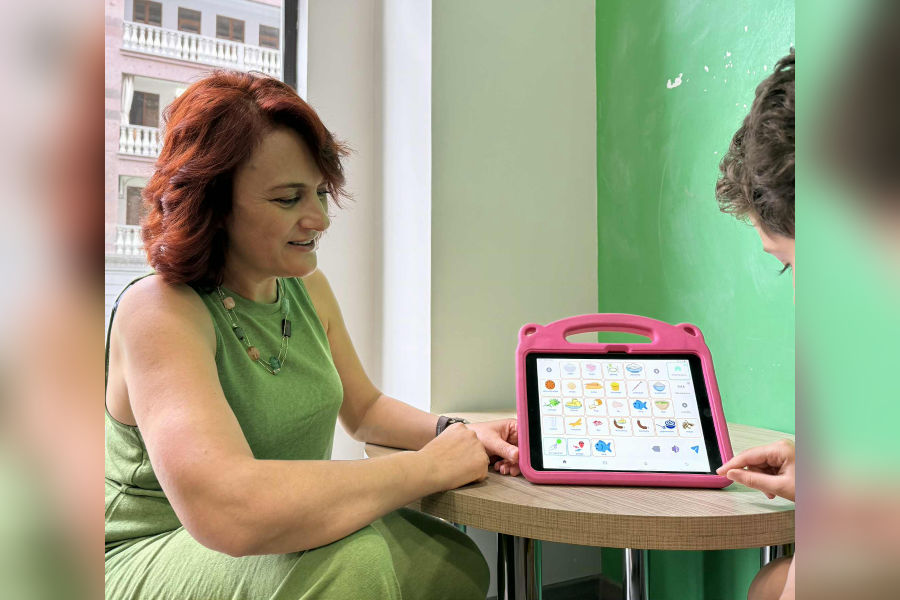
A couple of years ago, during a UNICEF partnership visit to Minnesota, speech therapist Armenuhi Avagyan witnessed a moment that would change her life.
“At a community center, I saw a guy in a wheelchair join the choir,” she told the Weekly. “When the conductor gestured to him, he pressed a button on his communication device and it sang in his place.”
That moment planted a seed. Avagyan realized that true belonging meant more than just being included — it meant being able to fully participate in a shared space by singing, creating and dreaming. She returned home with a dream of her own, determined to build something her country lacked: an augmentative and alternative communication (AAC) tool in Armenian.
In 2019, Avagyan co-founded the “Armav” Center for Continuous Education. Today, the team of around 20 specialists works with a large number of children, helping them communicate and grow. While translating Sharon Draper’s book, Out of my Mind, she found herself imagining the protagonist’s “eyes full of words” and thinking about Armenian children similarly trapped by silence. She thought of how life-changing it can be to finally have the tools to express yourself — at any age.

Her determination only deepened after the 2020 Artsakh War, when she met young people who had lost their ability to speak due to trauma. “If not me, then who? If not now, then when?” she asked herself.

A grant from the U.S. Embassy enabled her to begin developing Armenia’s first AAC app. The process was long, full of trials and breakthroughs. During the pilot phase, 14 participants used the app daily for three months. One major change came directly from feedback: more than 2,000 images were replaced to make communication clearer.
“It’s highly personalized,” Avagyan explained. “Even small adjustments — like moving the sentence bar to the top or bottom of the screen — can make a huge difference for someone.”
Now in use for three years, the Armav app has over 689 active users, including specialists and children with communication needs. It features an extensive vocabulary of approximately 1,782 words and is available both in Eastern and Western Armenian. Users can also record and add new words to fill in missing links.
The team at the Armav Center has not yet conducted a full demographic study of users by age, gender or disability, though preliminary data has been collected for future research. In Armenia, there are currently no official statistics on alternative communication use. Many parents and even specialists worry that using an app could hinder a child’s verbal development. But Avagyan’s experience — and numerous international studies — show otherwise.
“There is not a single study proving that AAC hinders speech development,” Avagyan emphasized. On the contrary, research increasingly demonstrates that AAC actually supports verbal growth. Avagyan explained that skepticism usually comes from a lack of familiarity with evidence-based methods.
The speech therapist highlighted that if a child is capable of speech, then AAC will actually accelerate their verbal expression. And if a child is unable to speak, they will still gain something equally valuable: a way to express themselves.
One compelling example is Mariam, an Armenian girl living in Italy. While she uses English and Italian AAC tools for schools, she reserves the Armav app for personal conversations with her mother. “When she wants to say something private to her mom that no one else will understand, she uses an Armenian app,” Avagyan recounted. “Imagine someone who has never spoken, or has lost the ability to speak, sharing secrets with her mother.”
Among children with autism, 25–30% are nonverbal, making AAC tools critical. “These aren’t just numbers — they represent thousands of children and adults with thoughts they need to express,” Avagyan stressed.
“Psychological inclusion means feeling a sense of belonging. If you don’t have the ability to speak in a group where everyone is speaking, then you cannot fully participate or feel that you belong,” she added.
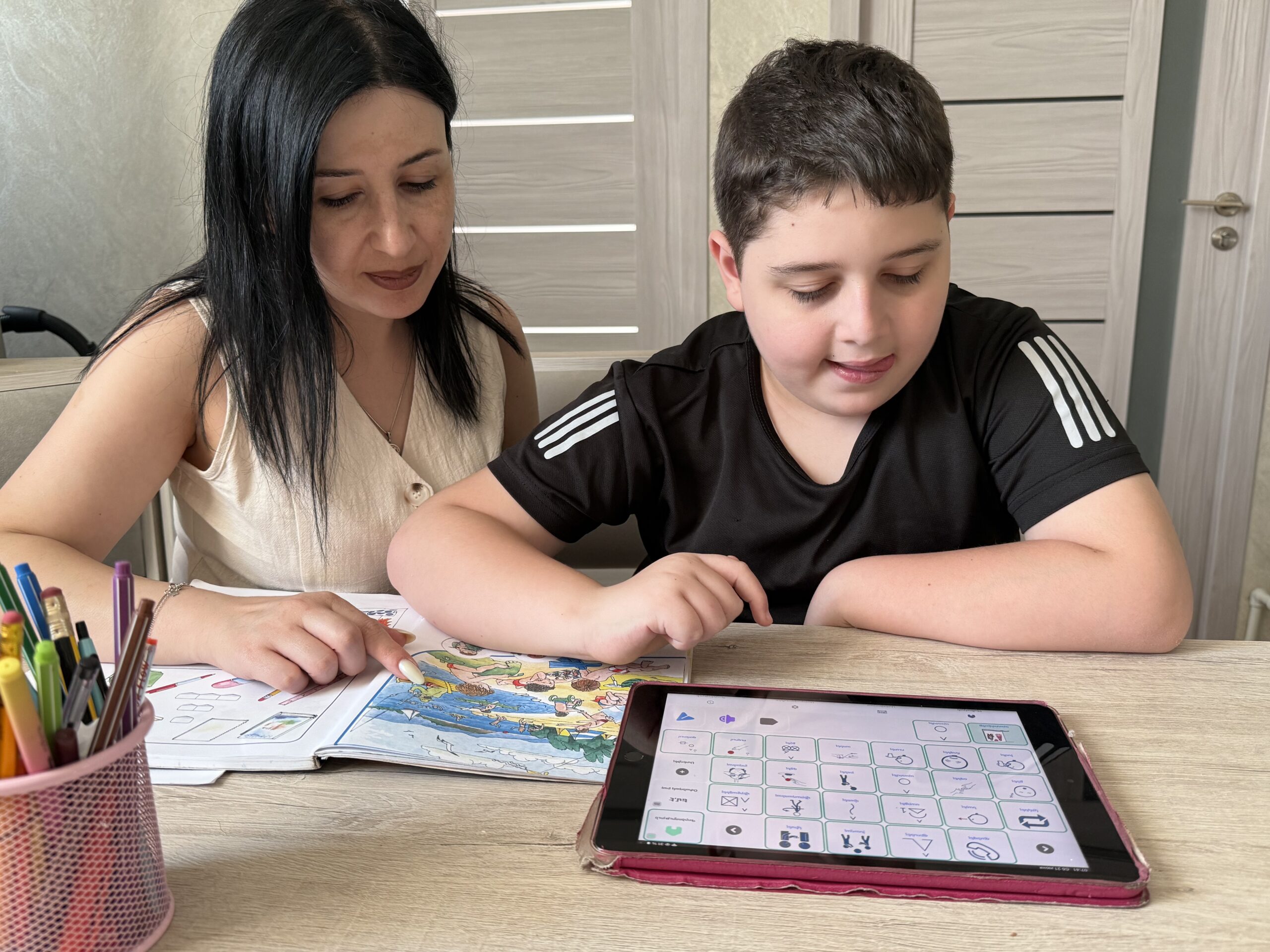
A powerful example of this comes from 10-year-old Artashes Khachatryan, who uses the app to type phrases like: “We are going to the sea during our vacation,” or “I want to play with Mary.” His mother, special education teacher Margarita Karapetyan, has been helping him communicate since he was diagnosed with autism at age three.
At first, Artashes’s parents taught him how to use the tablet for basic needs. Even at home, Karapetyan would tell him, “Say it through the app,” then “Say ‘fruit.’” The first thing they downloaded was the food section because the boy enjoys eating.
“I was honestly amazed at how quickly he learned to say all his favorite foods,” Karapetyan reflected.
Beyond basic needs, the app helps children express emotions. Karapetyan recalled moments when Artashes would stop his activities and they could not understand why. “Through this app, he knows how to ask for a break. That simple ability to express his needs reduces frustration and prevents behavioral outbursts.”
The app is also used outside the home. “We took it to school, and even to the store,” Karapetyan recalled. “We had a bit of difficulty in the store because, as you know, children are used to just grabbing whatever they want. But I wanted him to tell me what he wanted using the tablet.”
At first, he was confused and wanted to grab candy, but he remembered to use the device to ask for it. It taught him life skills for navigating daily environments independently.
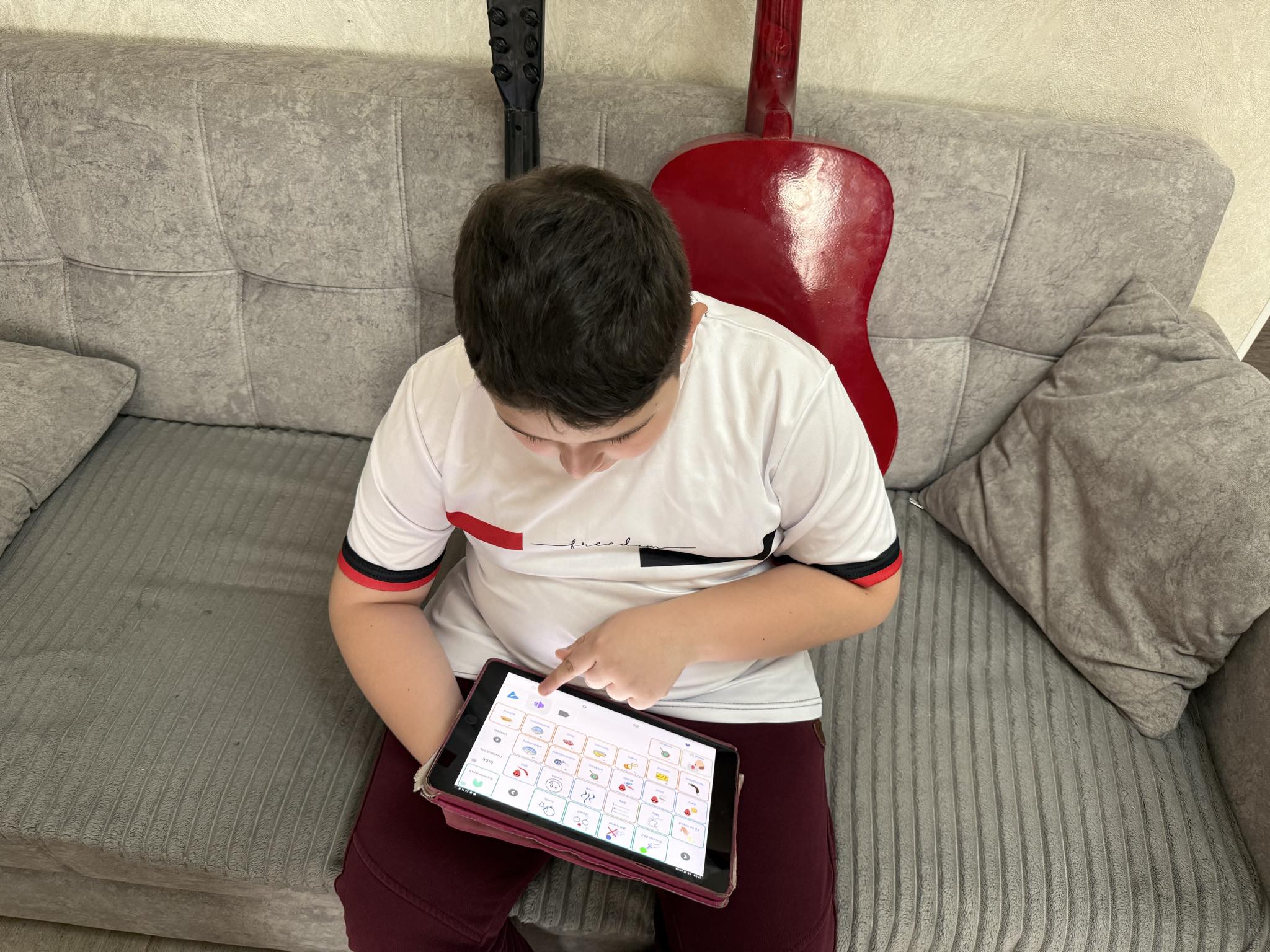
His mother shared that Artashes uses the app less at school, perhaps because teachers initially didn’t fully understand how to work with it or doubted whether he could use it effectively.
“But because we were doing consistent, structured work with the app at home, his speech began to improve. Maybe not full three- or four-word phrases yet, but he could at least form two-word sentences,” Karapetyan said.
At school, Artashes types words like “water” when he is thirsty or “outside” when he wants to go out. The goal, she noted, is to help him eventually construct full sentences. Some specialists initially advised against using the app, claiming that it might make his speech robotic or slow his verbal development. His mother now confidently disagrees, saying that if a child doesn’t understand something — or doesn’t wish to say anything — no app in the world can force them to speak.
She recalled a simple yet powerful moment: “It was evening, and we wanted Artashes to go to sleep. He took his tablet and started typing: ‘I want to play on the phone.’ I was so happy that he got an alternative to say what he wants.”
Armineh Babayan, director of Yerevan Special Educational Complex for Children with Hearing Impairments, which serves 116 students, first learned about the Armav app three years ago. At the time, the school relied solely on gestures for communication.
“Alternative communication methods help an individual to be seen and heard,” Babayan explained. She noted that while the app is accessible in the classroom, its full potential is realized when used across various environments. Despite the growing use of new technologies, some parents remain skeptical, fearing that an alternative method could discourage speech.

“I confidently say that this concern doesn’t have any basis,” Babayan asserted. She added that when children are given the tools to communicate, their nervous systems relax. The school works closely with parents and other family members to explain these details and ensure consistent use. While results are still emerging, she is optimistic about the future.
Babayan shared the example of a student who previously could not speak through gestures. “This app can be a great assistant for expressing feelings,” she said. “That is why we are focused on working with parents — their permission is needed to use an alternative communication method.”
Behind every effort toward inclusion are countless emotional stories. Imagine having a storm in your mind, but being unable to express it. Avagyan shared one that captured this noisy silence so vividly:
“There was a child I was working with. When he started using our app, his parents told me that, for the first time in their lives, they realized what their child was dreaming about. He pressed the airplane button on the app and said, ‘My dream is to travel by airplane.’”
To download the Armav AAC app, click here.