



The new urban reality of Yerevan’s newest parks
A conversation with Anna Urnova and Vanane Ararktsyan on heritage and design
For decades, the “playgrounds” of our cities have been defined by cold concrete and rusted metal. But in the heart of Yerevan, a quiet revolution is unfolding, led by two visionary women: Vanane Ararktsyan, executive director of the Keron Development Foundation, and Anna Urnova, CEO and founder of UrUrban Agency.
Together, they are proving that a park can be a bridge between a child’s boundless wonder and their ancestors’ deepest roots. This is more than urban planning; it is an emotional homecoming designed to ensure that the next generation of Armenians grows up on soil that finally speaks their language.
Milena Baghdasaryan: Who are the minds behind this project? And, Vanane, in your own heart, what was the specific moment or sight in Yerevan that made you realize this project was no longer a dream, but an urgent responsibility?
Vanane Ararktsyan: As people who care deeply about the city, we recognized the long-standing lack of public playgrounds that meet international standards. Yerevan often offers outdated, unsafe spaces that do not invite imagination or social interaction. With the growing demand for modern, educational environments, we felt we had to respond with solutions accessible to all children, regardless of physical or cognitive abilities. That is when it shifted from an idea to a responsibility.
Anna Urnova: Keron invited our team, UrUrban, to design a new generation of children’s playgrounds — or rather, family parks — unlike anything previously built in Armenia, giving residents access to an entirely new standard of urban environment. Our team then developed the idea of children’s imagination as the unifying theme. Our vision was to focus on children’s imagination because it has no borders. We decided to split that umbrella concept into different “imaginary worlds” for each location.

While we work on master plans and large-scale urban strategies — from master planning to vibrant public spaces — playgrounds have become a primary track for this partnership because we believe play is an ethical architectural tool. Although our team is international, we are all based in Armenia for this project. We pride ourselves on exploring the “Armenian DNA” to ensure every design is culturally rooted rather than an outside intervention.
Baghdasaryan: Anna, looking back at your early posts, the content focused on broader concepts like the Goght Urban Valley and Hrazdan Gorge. Was this recent shift toward a younger audience a deliberate pivot, or was that always the core mission?
Urnova: We do strategic territorial development and artistic public spaces globally. For us, working on playgrounds isn’t just another direction — it’s a natural part of our mission: Development starts with children, and by creating spaces where they can play and explore, we help build a stronger, more vibrant urban environment.
For this specific contract, the focus on children came from the initiating partners at Keron. They are more than just “clients”; they are deeply involved partners. It was their vision to focus on children’s imagination because it has no borders. We then decided to split that umbrella concept into different “imaginary worlds” for each location.
Baghdasaryan: Vanane, by bringing an international team like UrUrban to live and breathe Armenian life, you’ve created a unique synergy. Does this reflect a broader mission for Keron to turn Armenia into a vibrant hub where global experts don’t just visit, but stay to contribute to our national story?
Ararktsyan: Yes, absolutely. Through our Talent Pool program, we aim to bring global experts to Armenia not as short-term contributors, but as active participants. It is not simply about importing expertise, but about a meaningful exchange — where global standards are combined with local identity. This synergy allows us to develop solutions that are both world-class and deeply rooted in the Armenian context. We want Armenia to become a place that attracts and retains talent.
Baghdasaryan: One of the major projects is Vishapagorg. It has such a specific cultural tie. How did you develop this idea, and what features make it interactive?
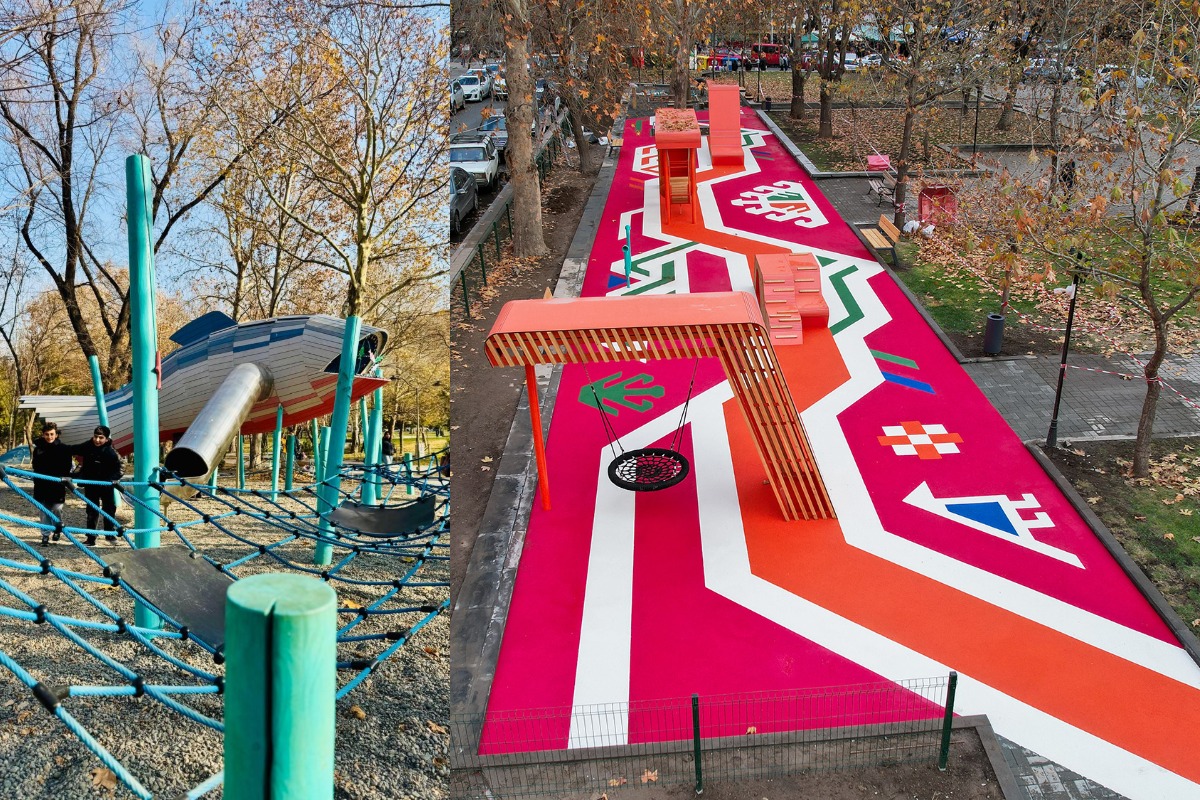
Urnova: Vishapagorg (Dragon Carpet) is in Khachkar Park in central Yerevan. The site was previously a rectangular parking lot, which signaled something to us: Parking lots have the same shape as a carpet. The core narrative is the Vishap, the mythical dragon associated with water. We created a woven dragon motif on the ground from which sculptural elements emerge. We even integrated a flower bed with plants historically used in Armenia for dyeing wool, such as pomegranate and madder, allowing children to explore their heritage while they play.
Baghdasaryan: Vanane, from the Saryan Steps to the AOKS building revitalization, Keron touches many layers of history. How do you see a child’s climb on a Vishapagorg connecting to the preservation of our architectural monuments? Is there a single “thread of heritage” that ties all these diverse projects together?
Ararktsyan: Heritage should not exist only as something we observe from a distance; it should be lived. When a child interacts with forms inspired by Armenian symbols, they form an intuitive connection with their identity. A playground and a historical building are part of the same story — one introduces heritage through emotion, the other preserves it in its original form. The “thread” is the idea that culture should be embedded in our daily environments, shaping how we experience the city from an early age.
Baghdasaryan: Another important project was the Karmrakhayt playground. It is much larger. How did you secure such a central location, and what makes it unique?
Urnova: Karmrakhayt is in Circular Park and covers 2,000 square meters. Since Armenia is landlocked, we wanted to give children a way to “play with water” through metaphors. We named it after the Armenian mountain trout — the river fish, not the Ishkhan people usually mention — to reconnect the city with the memory of the Getar River. The central feature is an 8-meter trout sculpture connected to 27 meters of nets that mimic waves. We used 160 tons of natural river pebbles and focused heavily on lighting — not just for safety, but as part of a game scenario for “stubborn kids” who want to play into the night.
Baghdasaryan: Vanane, how did you navigate the bridge between your private vision and municipal reality to ensure these spaces remained “ours”?
Ararktsyan: Partnership with the Kentron Administrative District was key. Its role was crucial in integrating the project into the city’s fabric. We maintained a clear role in defining the standards, ensuring the playgrounds meet international safety rules and carry a distinct Armenian identity. This balance allowed the playgrounds to be perceived not as externally imposed, but as natural parts of the city that belong to everyone.
Baghdasaryan: Anna, you aren’t Armenian, yet you’ve integrated so much local culture. What does your research process look like?
Urnova: We conduct extensive research by collaborating with local experts from the History Museum of Armenia Research Lab and the Matenadaran. We are also developing a third playground focused on Armenian scientists like Victor Ambartsumian and many others, translating their groundbreaking work into clear, engaging “pop science” narratives that children understand.
Baghdasaryan: People today are mostly on their gadgets. Are you primarily reaching out to them for insights, or are people now reaching out to you because of your social media presence?
Urnova: Together with the foundation, we organized focus groups with parents, asking what they felt was missing and what they truly wanted for their children. That made the projects more realistic and grounded.
After the opening of the first playground, Karmrakhayt, in September 2025, people saw that it was real, and word of mouth changed everything. Now that the results are visible, I hope experts will be more open from the first call. For now, though, we still proactively reach out to find the specific expertise we need.
Baghdasaryan: What were the biggest hurdles you faced during construction, particularly as an international team?
Urnova: One of the main challenges was the language gap, which the Keron Foundation helped us bridge. Another was the availability of materials. For example, we didn’t want to bring an olive tree from Italy that wouldn’t grow; we wanted sustainable local plants. However, we often couldn’t find them in local greenhouses.
Technically, the Vishapogorg surface was incredibly difficult. Creating a “carpet” pattern with EPDM rubber is craftsmanship. It took three weeks of manual work, sometimes until 3:00 a.m., with our concept team on-site to ensure every line aligned perfectly. We were fortunate to work with a patient construction team and engineering partners DSVent, who understood that unique projects require unique efforts.
Baghdasaryan: How can Armenians globally get in touch with you and contribute? Is there a way for the diaspora to support these projects?
Urnova: We have 15 more thematic concepts ready for areas like Kapan and Goris. If someone wants to invest, they can email us or reach out on Instagram. Supporting foundations like Keron or COAF is also a great way to ensure donations turn into concrete projects on the ground.
Baghdasaryan: What is your long-term vision? Do you plan to expand beyond Yerevan?
Urnova: Absolutely. We have many ideas that go far beyond playgrounds — from family public spaces to large recreational landscapes and even national parks. My goal is to bring this approach to residential and rural towns like Jermuk or Stepanavan because well-designed environments shape behavior and build pride in place. My dream project is a large, nature-driven recreational park — something on the scale of Central Park — focused on vegetation and living landscapes rather than concrete and rides.
Baghdasaryan: For Armenians globally who dream of this for their children, what is the most meaningful way to join this mission? Are you seeking funding or specialized expertise?
Ararktsyan: Both. Financial support enables us to scale, but the contribution of knowledge and professional expertise through our Talent Pool is equally valuable. We welcome partners who are ready to take responsibility alongside us for long-term, systemic impact.
Baghdasaryan: Finally, what advice would you give urban planners and architects working in Armenia today?
Urnova: Think about functionality and scenarios first, and “decoration” last. Understand the sun, the wind and the underground pipes before you start. Most importantly, work with trustworthy partners like Keron. When you see children from across the country playing in a space you created, it proves that this “new reality” is possible.

Thank God for these two women who are reshaping Armenia’s parks that were a dreary mess! Uninspiring, dangerous, cold, and even “sus” (suspicious) looking, Armenia’s old parks are being reborn into inviting, colorful, safe, and dreamy play areas!