

Not your typical Armenian wedding — and that’s the point
There are love stories that begin with a meeting, and there are those that begin with a question. When Sirarpi Khojabaghyan and Hayk Yeranosyan met in 2014, people in Armenia were celebrating Barekendan. They began meeting at Armenian national dance classes and participating in discussions. When they eventually decided to marry, one question stood out: How had their ancestors held weddings? How were they celebrated? Was it true that Armenian weddings lasted seven days and seven nights?
What started as curiosity about what an Armenian wedding once was grew into a search for memory, identity and meaning — one that would eventually reshape not only their own lives but also the way others return to their roots. In 2017, they established Tonir Wedding.
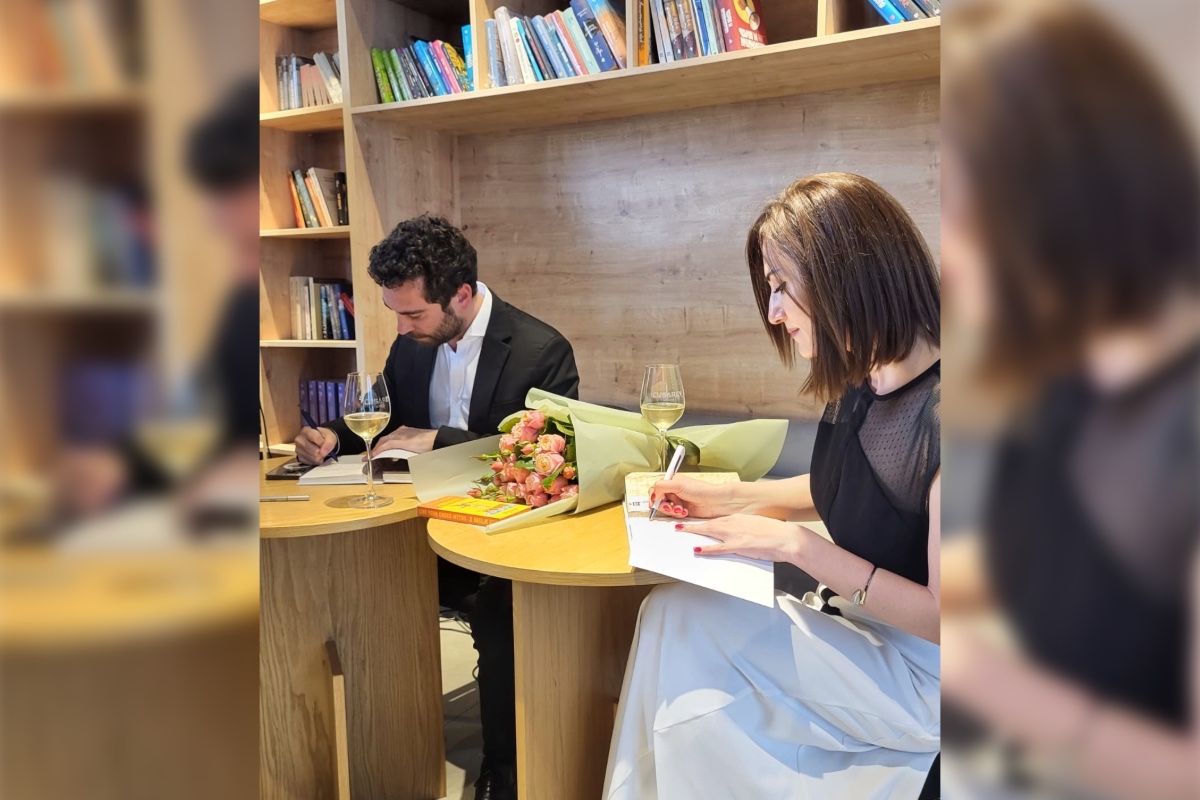
“We were curious — if it were a traditional Armenian wedding, what would it look like?” Sirarpi recalls. “At that time, my colleague told me about a book by Gayane Shagoyan, ‘Seven Days, Seven Nights: The Panorama of an Armenian Wedding,’ and we started reading it together with Hayk.”
“We decided to meet Gayane Shagoyan back in 2015. Then we met other people, discovered new patterns and fell in love with the phenomena of Armenian traditional wedding,” Hayk tells the Weekly.
Hayk says that many factors have negatively affected the preservation of cultural heritage, including weddings: external political influences, wars and 70 years of Soviet rule. At times, it is hard to imagine how people managed to preserve so many traditions.
Important, valuable components have simply disappeared. When you rediscover them, you feel that we deserve to be their carriers and to preserve them. Armenians have been scattered all over the world, and every community has tried to preserve at least something. The goal of Tonir Wedding is to bring together all the traditions that were once characteristic of Armenian weddings and make them applicable again.
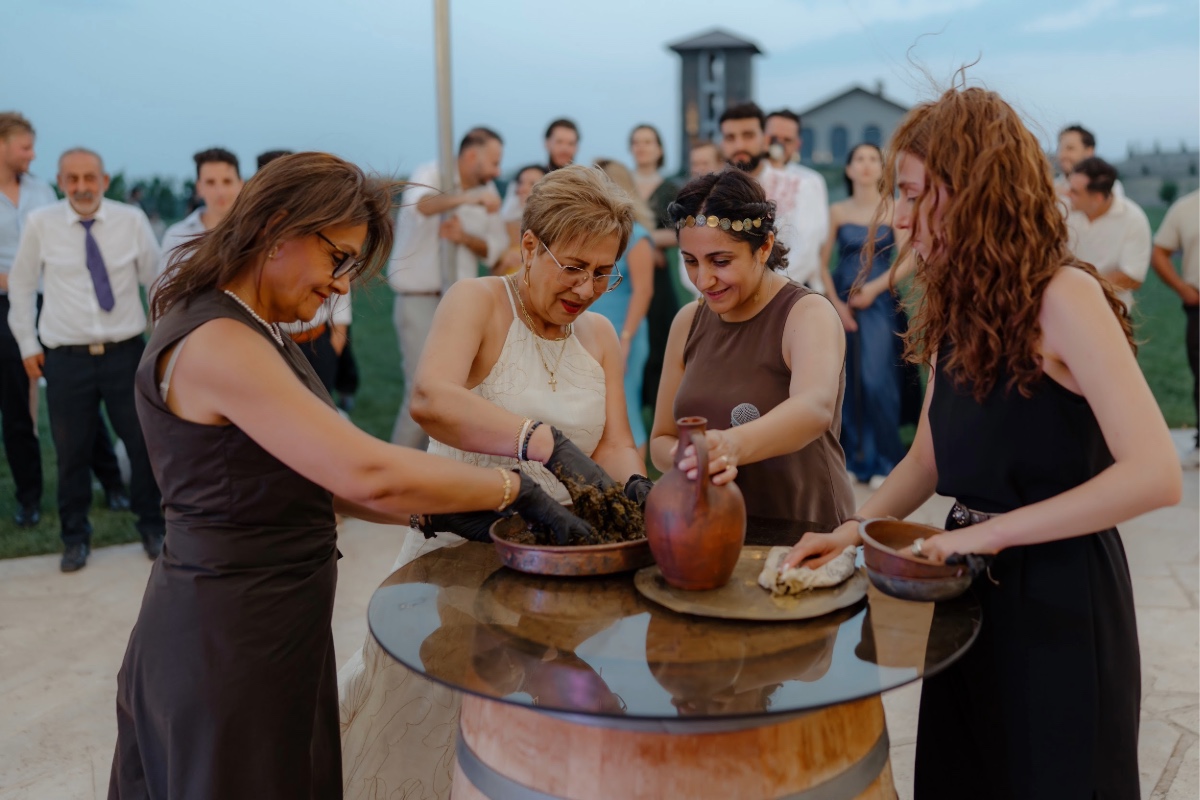
During a Tonir Armenian wedding, all guests wear traditional costumes; they are participants in the entire story. The traditions and ceremony do not revolve only around the couple but around everyone involved, because Armenian weddings have always been about unity. When a couple approaches Sirarpi and Hayk, they work together for a year — sometimes longer — discovering the couple’s roots, on which the entire logic of the wedding is built.
For example, if the couple is from Karin and Lori, the entire vision — from costumes and jewelry to games and traditions — is woven around those two regions. Sometimes, the couple themselves do not know where they are from. In that case, Hayk and Sirarpi take on investigative work.
“Sometimes people ask us, isn’t it hard to stage all of this? But in our weddings, there is no staging; everyone participates in the experience in an organic way,” Sirarpi says.
“Sometimes the couple worries that guests won’t participate, but all of this is in our genes. There is nothing artificial about it. People just need to be inspired, and then everyone participates spontaneously, because it is about them — it is neither strange nor artificial.”
“Even if 10 people say they will not wear a costume, half an hour later they are already wearing one,” Hayk says with a laugh. ‘It may be natural that many things transform and many phenomena die out, but if something is truly ours, it only needs a push to be revived. Years ago, no one celebrated the Barekendan ritual; now there are events, and people participate. Continuity can lead to the natural revival of rituals, games and traditions.”
Sirarpi and Hayk say that most of the couples who approach them are from the Armenian diaspora, though there are also locals among their clients. Often, diaspora guests who hold their weddings with them later bring in their friends and relatives. There have even been cases where an Armenian wedding became the reason for an elderly family member — born in Western Armenia, who had migrated and had never been to Armenia — came to the country for the first time in their 90s. For many, organizing a traditional wedding may seem like an added expense. However, based on market research, Hayk says there is no real financial difference; the difference is mainly ideological. There is no question of better or worse — it is simply a choice.
When a couple decides to have a traditional wedding, Hayk and Sirarpi begin by asking questions, knowing that in more than 90% of cases, the couple is not fully familiar with their own roots. They turn to parents, grandparents and relatives, make inquiries and search for information, becoming active participants in the research phase of their own wedding. If they are from Van, they create a Van costume and explain why it is not appropriate, for example, to mix Van and Sassoun costumes.
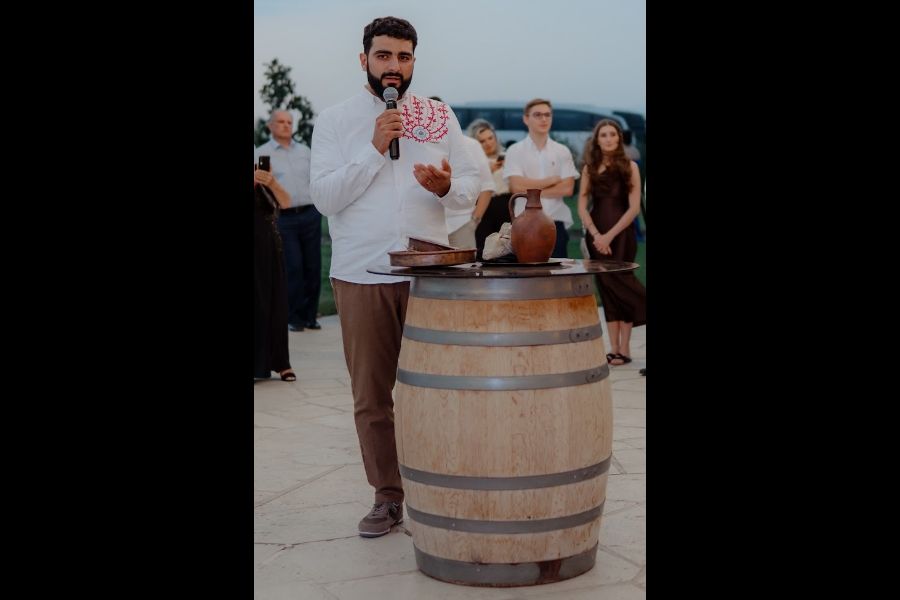
“When you justify everything and present facts, no problem arises,” says Hayk.
“We once had a bride who had danced for years in one of the Armenian dance groups in Moscow. She used to say she hated the costume — that it irritated her when it touched her body. I asked her, ‘have you ever seen real velvet?’ We went to a fabric shop, I showed her the velvet, and when we made her costume, she was moved. She said, ‘Thank you so much for insisting until the end that I at least try,’” Sirarpi recalls.
At the core of Tonir’s Armenian traditional wedding is also a mission to educate, inform and study the national. This does not mean rejecting anything foreign, but to choose the national, one must first become familiar with it, understand how close it is to you and how much it reflects them. People who use their services usually arrive in Armenia seeking a cultural or tourist experience, and they also need to structure their time beyond the wedding itself. For such clients, this becomes a day filled with rituals, where they can present traditions to their guests and more.
They also choose their clients. It must be clear that this is not simply a matter of paying money and receiving a service in return. The question is whether the client is ready to stand before a thousand-year-old culture and approach every detail with respect. This is a path that both they and the client walk together, hand in hand. Being value-based on both sides is essential in this work.
“We once had a groom who had attended three weddings that we organized, including his own. He said that at first it seemed like it would be the same traditional wedding each time, but after participating, he realized that none of the three were alike. We have more than 2,000 games that have been played at weddings across different regions. Traditions also vary from region to region, so no wedding can ever be the same as another. This is exactly the charm of the traditional,” Hayk emphasizes.
When they founded the organization in 2017, the first couple to approach them was Gohar and Manuk from Germany. A wedding between a Sassountsi and an Artsakhtsi was a great responsibility, but as they began to study everything in detail, they realized they had to continue.
“We once had a Sebastatsi bride, and thanks to getting to know her, we later found an item in the Sardarapat Museum that turned out to be a musical instrument produced in Sebastia. We sent the photo to our bride and told her we had discovered it was a Sebastia instrument. She said she wanted it to be her ‘tarosik’. We then found Sebastia dances, and during the wedding we performed with this rattling instrument, later giving it as a ‘tarosik’ to the guests.”
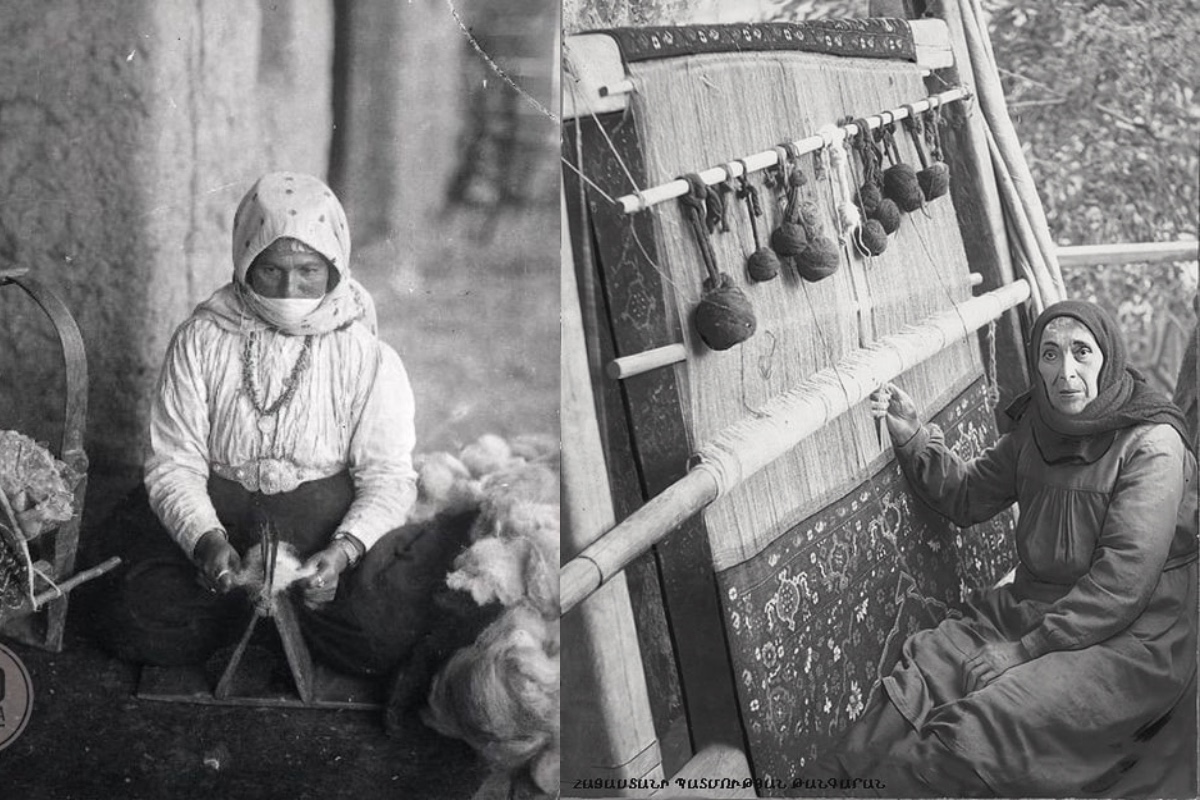
Now, Hayk and Sirarpi are working on a project called Vorotnaberd, which will be built in the likeness of the famous fortress. It will be a so-called wedding district — a wedding museum consisting of several sections. One part will include costumes and various attributes, another a blacksmith’s house, as well as sections for pottery, carpet weaving, food and more.
In Sisian, there are Vorotnavank and Vorotnaberd, a fifth-century fortress that was destroyed. Now, not far from it, they are building Vorotnaberd from scratch as an exact architectural replica. The goal is to preserve cultural heritage, raise awareness and share these beautiful traditions with the world. All of this is being done in cooperation with state institutions, as well as with the support of private investors.
It all started as a personal search but has gradually turned into something bigger. Through each wedding, they are not only organizing an event but also piecing together fragments of a tradition that had, in many ways, been lost or scattered. And maybe that’s the point — not to recreate the past exactly as it was, but to understand it well enough to carry it forward in a way that still feels real today.