



The June 7, 2026, parliamentary election may prove to be one of the most consequential in Armenia’s post-independence history. Coming less than three years after the loss of Artsakh and amid continuing regional instability, many Armenians viewed the election as a defining choice regarding the country’s future security, sovereignty and geopolitical direction. Yet despite widespread public dissatisfaction over national security, territorial concessions and governance, Prime Minister Nikol Pashinyan’s Civil Contract party secured another parliamentary majority.
To many observers, the outcome appeared surprising. However, a careful examination of the available evidence suggests otherwise. Drawing upon official Central Electoral Commission (CEC) results, two nationwide preelection public opinion surveys conducted during the winter and spring of 2026, and the broader political environment in which the campaign unfolded, this analysis argues that the opposition’s defeat was largely predictable months before election day. The surveys consistently revealed an incumbent advantage, a fragmented opposition, persistent demographic disparities and an absence of the voter mobilization necessary to overcome Civil Contract’s structural electoral strengths.
This article examines the official election results, analyzes the underlying voter trends, evaluates the political environment in which the election was conducted and considers the strategic decisions that shaped the final outcome. More importantly, it explores what lessons the opposition, and Armenia more broadly, must draw if future elections are to produce a genuinely competitive contest capable of offering voters a credible alternative vision for the country’s future.
An overview of the election results
The June 7, 2026, parliamentary election in Armenia resulted in a victory for Prime Minister Nikol Pashinyan’s Civil Contract party, which secured roughly 50% of the votes cast and retained a parliamentary majority. According to official CEC reports, of the 2,503,976 eligible voters, 1,476,769 cast ballots, for 58.9% turnout. Civil Contract received 726,819 votes, or 49.75%, ahead of the Strong Armenia Alliance, led by Samvel Karapetyan, with 340,006 votes, or 23.27%. The Kocharyan-led Armenia bloc won 144,983, or 9.92%, surpassing the 4% threshold, while Prosperous Armenia, led by Gagik Tsarukyan, did not cross the threshold with 58,287 votes, or 3.99%. No other party cleared the threshold. See Figure 1.
Figure 1. Results of the 2026 Parliamentary Elections in Armenia, according to the CEC


| Party or Alliance | Votes | % Share |
|---|---|---|
| Civil Contract | 726,819 | 49.7456% |
| Strong Armenia Alliance | 340,006 | 23.2710% |
| Armenia Alliance | 144,983 | 9.9231% |
| Prosperous Armenia | 58,287 | 3.9893% |
| Wings of Unity | 33,537 | 2.2954% |
| Meritocratic Party | 30,642 | 2.0972% |
| Democracy, Law & Discipline | 25,758 | 1.7630% |
| New Force Reformist Party | 25,551 | 1.7488% |
| I Am Against Everyone | 21,181 | 1.4497% |
| Republic Party | 15,808 | 1.0819% |
| Bright Armenia | 7,439 | 0.5091% |
| In the Name of the Republic | 6,754 | 0.4623% |
| Pan-Armenian National Dem. Pole | 5,481 | 0.3751% |
| Democratic Consolidation | 5,269 | 0.3606% |
| Armenian National Congress | 3,143 | 0.2151% |
| Christian Democratic Party | 2,671 | 0.1825% |
| Kochari National Revival Party | 1,986 | 0.1359% |
| Reformist Party | 1,425 | 0.0975% |
| Invalid/blank votes | About 7,453 | 0.51% |
| Total valid votes | 1,456,740 | 98.68% |
| Turnout (total ballots) | 1,476,769 | 58.90% |
One of the most contentious issues following the election involved the narrow failure of Prosperous Armenia to surpass the 4% parliamentary threshold. Official CEC results placed the party just below the threshold with 3.99% of the vote, excluding it from parliamentary representation by a razor-thin margin. Opposition representatives subsequently alleged that the invalidation of a small number of ballots and disputed vote-counting decisions at several polling stations effectively prevented the party from entering parliament, thereby preserving Civil Contract’s three-fifths parliamentary majority. Those allegations remain disputed, but they have fueled continued debate over the transparency of the postelection certification process and whether the composition of the National Assembly accurately reflected the will of the electorate. At the same time, despite retaining a governing majority, Civil Contract fell short of the two-thirds constitutional supermajority required to unilaterally amend Armenia’s Constitution, leaving that important constitutional safeguard outside the control of the governing party.
Reflecting on the election results, only 29.3% of eligible voters in Armenia voted for the incumbent party, meaning the significant majority of the electorate, 70.7%, either did not vote for the incumbent or chose to sit out the election. By the same token, only 19.6% of the electorate voted for the collective opposition that passed the threshold. Collectively, the remaining 15 parties garnered 16.8% of the votes cast, representing 9.9% of the country’s electorate, of whom more than half were there solely to dilute non-incumbent votes, most likely at the behest of the incumbent party.
Evaluating the performance of the three main opposition parties, the Strong Armenia Alliance secured support from 13.6% of the electorate, the Armenia Alliance 5.8% and Prosperous Armenia 2.3%. Collectively, the three principal opposition forces received support from 21.7% of Armenia’s eligible voters, compared with 29.3% for Civil Contract.
This perspective also illustrates the magnitude of the opposition’s challenge. To merely equal Civil Contract’s vote total, the opposition would have needed an additional 183,543 votes, representing 7.3% of the entire electorate, 12.4% of all participating voters or nearly 18% of eligible citizens who did not vote. This would have meant election turnout of 66% or more. Such a shift would have required an extraordinary level of voter mobilization that was not evident in either the winter or spring preelection surveys. Consequently, the election outcome reflected not only Civil Contract’s ability to retain its electoral coalition but also the opposition’s inability to expand its support beyond a relatively limited segment of the electorate.
Analysis of voter trends leading up to the elections in June
Perhaps the most revealing aspect of the 2026 parliamentary election is that the final outcome should not have come as a surprise. Months before Armenians went to the polls, two nationwide MindGauge surveys conducted during the winter (February) and spring (April-May) had already identified the political trends that ultimately produced Civil Contract’s victory. These survey studies were carried out by Armenian Project Research and Education NGO. While public discussion during the campaign often focused on large opposition rallies and growing dissatisfaction with the government, the survey data from the second and third waves of the Nationwide Public Opinion Survey painted a more nuanced picture: The opposition was energized but fragmented, whereas Civil Contract maintained a broader, more stable electoral coalition across Armenia.
Consolidation of the incumbent vote
The clearest trend between the two survey waves was the continued consolidation of support for Civil Contract. Support among all adult respondents increased from 18.6% in the winter survey to 25.8% in the spring survey, while respondents who believed Armenia was moving in the “right direction” increased from 30.2% to 39.9%.
Government acceptability also improved substantially during this period. See Figure 2. These parallel trends suggest that, despite widespread criticism of the government’s handling of national security and Armenia’s geopolitical position, a growing portion of the electorate believed the country was stabilizing sufficiently to justify continuity rather than political change.
Figure 2. Civil Contract momentum prior to the election
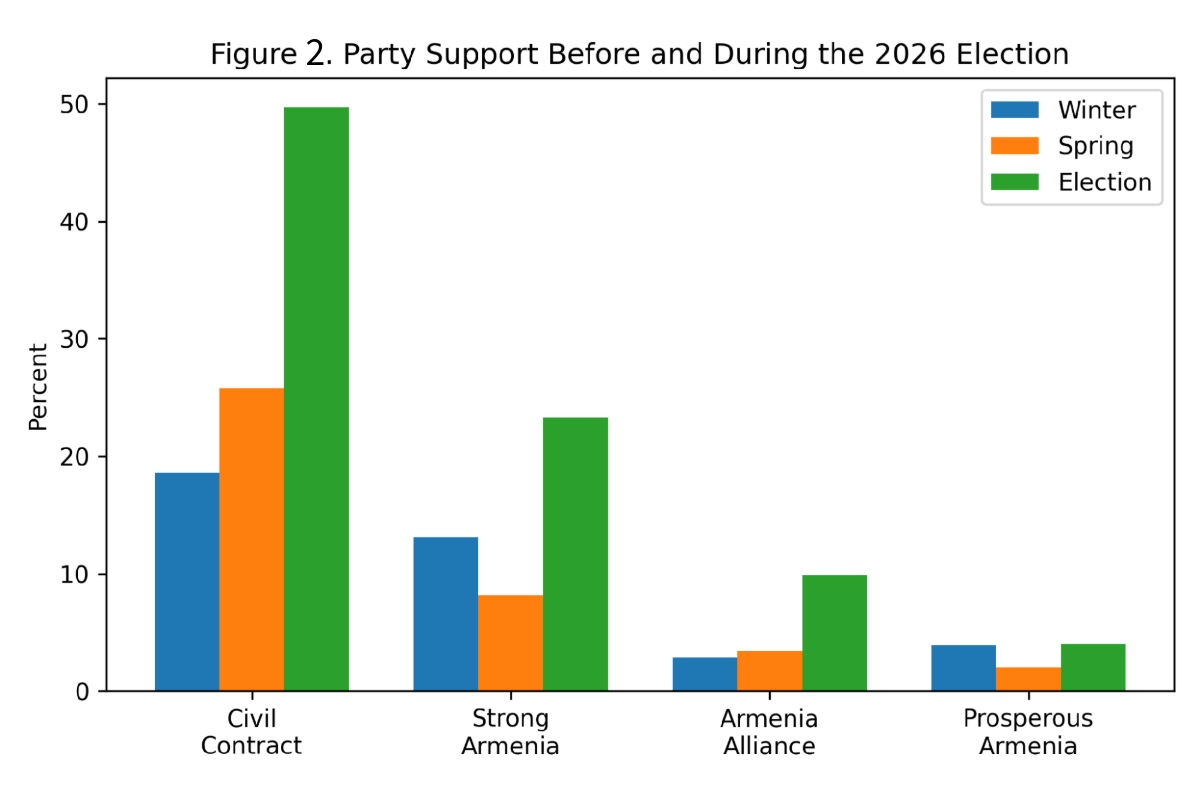
Although the survey percentages appear substantially lower than the official election results, this difference largely reflects the survey denominator, which included undecided respondents, abstainers, refusals and invalid-ballot intentions, whereas the official election results include only valid votes.
The hidden importance of undecided voters
One of the most important findings of the surveys was not party support itself but the extraordinary size of the undecided electorate. Nearly half of respondents in the spring survey had not committed to any political party or indicated that they might abstain, refuse to answer or cast an invalid ballot. Importantly, this uncertainty changed very little between survey waves. Rather than disappearing, it persisted almost until election day. See Figure 3. At the same time, declared nonvoting declined while refusal rates increased, suggesting that many voters remained politically cautious or delayed revealing their preferences until the campaign’s final weeks.
This distinction is critical. The election was determined less by persuading committed supporters to change parties than by which political forces most effectively converted uncertain citizens into actual voters. Civil Contract appears to have achieved this conversion more successfully than any other opposition party, benefiting from both incumbency and a more reliable electoral base.
Figure 3. Electoral uncertainty prior to the election
| Category | Winter | Spring |
| Undecided | 26.5% | 26.9% |
| Refused | 8.5% | 13.8% |
| Declared nonvoters | 14.3% | 9.7% |
| Total uncertain or nonvoting pool | 53.3% | 55.1% |
Demographic divides favored Civil Contract
The surveys also revealed demographic patterns that consistently favored the incumbent. Age emerged as the strongest predictor of voting behavior. Civil Contract’s support increased steadily with age, reaching more than one-third of respondents age 60 and older in the spring survey, while support among younger voters remained substantially lower. Younger respondents were also far more likely to remain undecided or indicate that they would not vote, reducing the opposition’s ability to translate its relative popularity among younger Armenians into electoral success.
Geography reinforced these trends. Civil Contract was weakest in Yerevan but strongest in rural communities, where it exceeded 32% support before the election. Strong Armenia performed comparatively better in the capital, reflecting the visibility of urban opposition activity. However, Armenia’s elections are decided nationally, not solely in Yerevan. The incumbent’s broader geographic reach across smaller cities and villages provided a decisive structural advantage that the opposition struggled to overcome.
Education revealed a more complex picture. Civil Contract performed best among respondents with secondary or vocational education, while opposition parties generally attracted relatively greater support among university-educated voters. Yet higher-education respondents also demonstrated the highest refusal rates, suggesting greater political caution rather than consistent opposition mobilization.
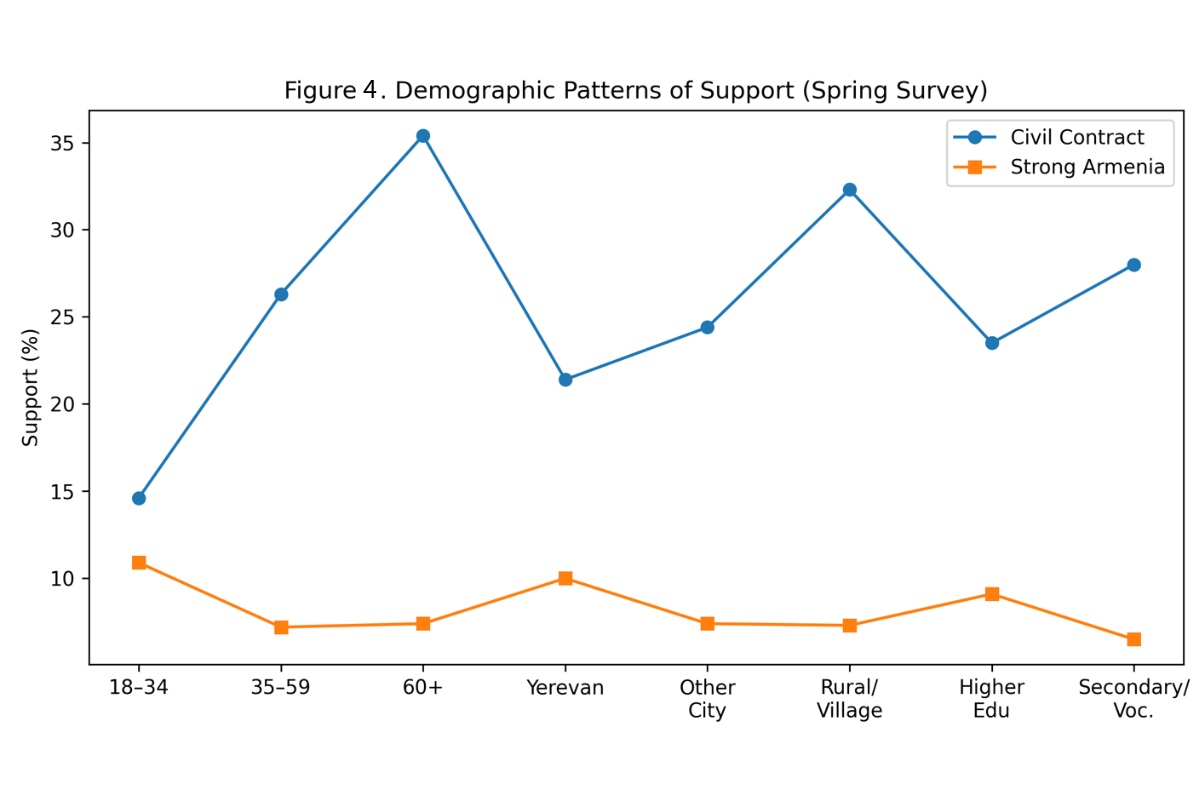
Figure 4. Civil Contract’s core electoral coalition
Why the opposition was unlikely to win
Perhaps the most significant conclusion from the survey data is that no opposition party demonstrated sufficient electoral strength to defeat Civil Contract independently. Strong Armenia improved during the campaign but remained well below the threshold necessary to overcome the incumbent. Armenia Alliance remained in single digits, while Prosperous Armenia hovered near the parliamentary threshold. Collectively, opposition support was divided among multiple competing parties, none of which demonstrated the ability to build a nationwide coalition comparable to Civil Contract’s.
Even if late-deciding voters disproportionately favored opposition parties, as appears to have occurred to some extent, the opposition’s fragmentation severely limited its ability to capitalize on public dissatisfaction. The surveys consistently suggested that Civil Contract possessed the broadest and most geographically distributed electoral coalition, while opposition parties competed for overlapping constituencies rather than expanding the overall opposition vote.
The central lesson
In retrospect, the election outcome reflected long-term structural trends rather than a sudden campaign breakthrough. The winter survey identified an incumbent advantage. The spring survey demonstrated further consolidation of Civil Contract’s support, improving public evaluations of the government’s performance and perceptions of performance, and persistent demographic advantages among older and rural voters. Although the exact vote shares were affected by turnout, late-deciding voters and campaign dynamics, every major indicator pointed toward the same conclusion: Absent an unprecedented level of opposition unity and voter mobilization, Civil Contract was the clear favorite to retain power. The election itself largely confirmed what the underlying data had already been signaling for months.
Opposition suppression by the incumbent party
Beyond the vote itself, the 2026 parliamentary election unfolded in a political environment marked by significant pressure on opposition figures and institutions. While international observers concluded that voters were generally able to cast their ballots freely and that election-day procedures were largely orderly, they also documented an uneven preelection landscape characterized by criminal proceedings against prominent opposition leaders, pretrial detentions, legal and administrative pressure, an increasingly polarized political climate, and concerns regarding media balance and online manipulation.
The most consequential development involved the government’s actions against businessman and opposition leader Samvel Karapetyan and members of the Strong Armenia Alliance. Karapetyan’s arrest, subsequent criminal charges and prolonged house arrest prevented him from actively campaigning during the critical months leading up to the election. In addition, the arrest of six Strong Armenia candidates on the eve of the election, without publicly disclosed reasons at the time, further disrupted the opposition’s campaign and reinforced perceptions among many supporters that backing the principal challenger carried significant personal and political risks.
International observers and human rights organizations also expressed concerns regarding the broader political environment. These included reports of extensive use of pretrial detention, allegations of selective justice against opposition figures, tensions between the government and the Armenian Apostolic Church, concerns over police conduct during demonstrations, expanded surveillance authorities and an uneven media environment that favored the incumbent government. Although these factors did not constitute evidence of widespread election-day ballot fraud, they likely influenced the campaign environment by limiting opposition visibility, discouraging political participation and reinforcing the government’s central campaign narrative, which emphasized stability over uncertainty.
After the election, additional allegations emerged regarding the Central Electoral Commission’s handling of several polling stations and the exclusion of Prosperous Armenia from parliament by a narrow margin. It is not unreasonable to assert that these decisions altered parliamentary representation and violated constitutional requirements.
The uneven playing field: State resources and external influence
In addition to campaign messaging and electoral strategy, the 2026 parliamentary election also raised broader questions about the neutrality of the political environment. As in previous Armenian elections, the incumbent government benefited from the advantages inherent in controlling the state’s machinery. The use of administrative resources, including the visibility and reach of government officials, public communications, institutional influence and other advantages associated with incumbency, has long been identified as a recurring challenge in Armenian elections. While international observers generally concluded that election day itself was orderly, they also noted concerns regarding unequal campaign conditions and the advantages enjoyed by the governing party.
The election also unfolded amid unprecedented international engagement in Armenia’s information environment. In recent years, the European Union and several Western governments and organizations have funded initiatives to strengthen democratic resilience, combat disinformation and reduce foreign influence, particularly Russian influence, over Armenia’s political and media landscape. Supporters argue that these efforts help protect democratic institutions and improve the integrity of public discourse. However, such initiatives inevitably shape the domestic political environment and raise a fundamental question of consistency: If external influence in Armenia’s democratic process is considered problematic when originating from one foreign actor, should it be viewed differently when comparable political, financial or informational resources are provided by another? Regardless of one’s answer, the presence of significant foreign-funded influence programs during an election underscores the increasingly internationalized nature of Armenia’s political landscape.
The influence of external actors extended beyond financial support and “democracy” assistance programs into the broader narrative through which the election was interpreted. Much of the international media and commentary portrayed the campaign primarily as a geopolitical contest between a pro-European, “reform-oriented” government and a pro-Russian opposition. This framing, echoed by the incumbent government throughout the campaign, transformed a complex national election into what outside observers described as a choice between “East and West.” Yet for many Armenians, the central question was neither ideological nor civilizational. It concerned Armenia’s long-term security, sovereignty and ability to pursue an independent national strategy in an increasingly hostile regional environment. By reducing the election to a binary geopolitical choice, external narratives often overlooked the more fundamental debate over whether Armenia could maintain strategic autonomy while navigating relationships with Russia, the European Union, the United States, Iran, India and other regional powers. This framing benefited the incumbent by allowing the election to be viewed internationally as a referendum on geopolitical alignment rather than as a broader assessment of governance, national security, territorial sovereignty and Armenia’s long-term national interests. Conversely, the opposition struggled to articulate a coherent Armenia-centric alternative, enabling political competitors and external observers alike to characterize the election primarily through the lens of great-power competition rather than the pursuit of an independent Armenian national strategy.
Taken together, the structural advantages of incumbency and the growing role of external actors led many voters to perceive that the electoral contest was not conducted on an entirely level playing field. Even in the absence of widespread election-day fraud, these broader dynamics have become an important part of the political context in which Armenians made their electoral choices and continue to shape public debate over the legitimacy and fairness of the country’s democratic institutions.
Why the opposition lost
Any analysis of the opposition’s defeat must begin with an important caveat: Elections are rarely won or lost because of a single tactical mistake. The 2026 parliamentary election reflected a combination of structural demographic trends, voter perceptions, campaign strategy, incumbency advantages and the broader political environment. Nevertheless, one strategic conclusion stands above all others: Despite presenting the election as an existential moment for Armenia, the opposition failed to organize itself in a manner consistent with winning national power.
The most consequential strategic failure was the inability, or unwillingness, to construct a single, credible national alternative to Civil Contract. Instead of presenting voters with a single, unified governing coalition, the opposition entered the election divided into several competing alliances. As the winter and spring MindGauge surveys demonstrated, no individual opposition force possessed sufficient electoral support to defeat Civil Contract independently. The surveys consistently projected support for the Kocharyan-led Armenia Alliance within a range roughly similar to that observed in the previous two parliamentary elections, while the Strong Armenia Alliance emerged as the principal challenger only in the months preceding the vote. Yet rather than consolidating around a single electoral vehicle capable of challenging the incumbent nationwide, opposition forces competed against one another for many of the same dissatisfied voters.
Perhaps the clearest illustration of this strategic dilemma was the ARF Supreme Body of Armenia’s continued participation in the Armenia Alliance. Since 2021, that coalition had repeatedly demonstrated a relatively stable electoral ceiling, attracting approximately 8 to 12% of the vote in successive national elections. Whether viewed as a consequence of public perceptions surrounding former governing elites, limited appeal beyond its core constituency or broader political dynamics, there was little empirical evidence that this coalition alone could realistically secure national victory. Nevertheless, the alliance remained largely unchanged heading into what opposition leaders themselves repeatedly characterized as Armenia’s most consequential election since independence. From a strategic perspective, one must ask whether maintaining a familiar coalition that had repeatedly fallen well short of victory represented the optimal path when the stated objective was to replace the incumbent government.
Equally important was the opposition’s failure to present a unified governing alternative. Much of the campaign centered on criticism of Prime Minister Nikol Pashinyan’s record, particularly regarding Artsakh, national security and territorial concessions. Those criticisms resonated with many Armenians. Yet elections are ultimately decided not only by dissatisfaction with the incumbent but also by confidence in the alternative. Many undecided voters appeared unconvinced that the opposition had resolved fundamental questions regarding leadership, governance, economic policy, foreign relations and post-election stability. Faced with multiple opposition parties offering overlapping criticisms but no common governing framework, many voters may have concluded that uncertainty outweighed the desire for political change.
The election also demonstrated the costs of fragmentation in practical electoral terms. Even if the three principal opposition forces are combined, they received 543,276 votes, approximately 21.7% of Armenia’s eligible electorate, compared with Civil Contract’s 726,819 votes, representing 29.3% of eligible voters. Closing that gap would have required an additional 183,543 votes, or more than 7% of the entire electorate. Such a shift was unlikely without broad opposition unity, coordinated voter mobilization and a compelling national campaign capable of reaching beyond each party’s traditional support base.
Significantly, this conclusion was echoed after the election by Strong Armenia leader Samvel Karapetyan, who publicly acknowledged that the lack of opposition unity had been a major contributor to the defeat. His observation reinforced what many in the diaspora had argued throughout the campaign: Defeating an entrenched incumbent would require a coalition built around electoral mathematics rather than historical loyalties or ideological preferences.
None of this diminishes the other factors that influenced the election. The incumbent benefited from the advantages of office, a more favorable media environment, the ability to frame the campaign around peace and stability, extensive external support and resources, and a fragmented opposition competing against itself. Concerns regarding unequal campaign conditions, administrative resources, criminal proceedings against prominent opposition figures and broader political pressures also shaped the electoral environment. Yet even if every one of those disadvantages is acknowledged, as was to be expected in any situation in Armenia, the opposition still faced a strategic reality that was evident months before election day: It entered a winner-take-all contest without first building the broad, unified political movement necessary to win it.
If, as many opposition leaders argued, the 2026 election represented a defining moment for Armenia’s future, then strategic decisions should have reflected that assessment. Instead, longstanding political rivalries, organizational loyalties, lack of trust and competing partisan interests prevented the formation of a unified national coalition capable of presenting voters with a single governing alternative. Whether that opportunity can be recreated before the next parliamentary election remains uncertain. What is clear, however, is that repeating strategies that have consistently produced defeat is unlikely to produce a different outcome. For many Armenians concerned about the country’s security, sovereignty and long-term national trajectory, that lesson may prove to be one of the most consequential legacies of the 2026 election.
Where does the opposition go from here?
If the 2026 parliamentary election teaches one lesson above all others, it is that opposition to the incumbent government, however passionate or well-founded, is not by itself an electoral strategy. Armenia’s next election will not be won through larger rallies, stronger rhetoric or greater criticism of the government’s record. It will be won only if the opposition fundamentally rethinks how it competes for national power.
First, the opposition must recognize that electoral mathematics cannot be ignored. The winter and spring surveys, as well as the final election results, demonstrated that no single opposition party currently possesses the nationwide support necessary to defeat Civil Contract independently. Building another collection of competing alliances that divide the same electorate is unlikely to produce a different outcome. If the objective is to change the government, opposition parties must begin working years, not months, before the next election to establish a broad national coalition based on shared strategic objectives rather than historical loyalties or organizational interests.
Second, that coalition must present voters with credible leadership capable of governing from the first day after an election. Armenia requires respected public servants, security professionals, economists, legal experts, technologists, educators and younger political leaders who are viewed not simply as critics of the current government, but as competent stewards of the Armenian state. The election cannot become another referendum on past political figures or historical grievances. It must become a contest over who is best equipped to govern Armenia in an increasingly dangerous regional environment.
Third, the opposition must move beyond primarily reactive politics. A successful campaign cannot be built solely around what it opposes; it must persuade voters of what it intends to build. That requires a comprehensive, Armenia-centric national strategy that addresses security, economic development, demographic resilience, education, technological innovation, judicial reform, energy security and foreign policy. Such a program should reject false geopolitical binaries and instead articulate a doctrine grounded in Armenian sovereignty, diversified strategic partnerships, military regeneration and the long-term strengthening of the Armenian state. Every proposed policy should ultimately answer one question: Does this strengthen Armenia?
Finally, the opposition must invest in the organizational foundations of modern elections. Data-driven voter identification, precinct-level organization, sustained grassroots engagement, professional communications, digital outreach and an extensive get-out-the-vote operation cannot be assembled during the final weeks of a campaign. They must be developed continuously throughout an electoral cycle. Equally important, messaging must extend beyond traditional supporters and engage undecided voters, young Armenians, rural communities and citizens whose primary concerns revolve around economic opportunity, security, health care and the future of their families. Winning elections requires not only motivating existing supporters but persuading those who remain unconvinced.
The 2026 election should therefore be viewed not merely as another opposition defeat, but as a catastrophic failure and as a strategic warning. If those who seek a different future for Armenia continue to campaign as separate movements pursuing parallel objectives, the outcome is unlikely to change. This is especially true for the ARF in Armenia, which represents 135 years of continuous, dedicated service to the Armenian nation and is the very reason we have an Armenia today.
If the opposition can unite around a common national vision, recruit a new generation of capable leaders, present a practical program for governing and build the disciplined electoral infrastructure necessary to mobilize voters across the country, the next election could present a very different political landscape. The future of Armenia may ultimately depend not only on the choices made by those in power but also on whether the opposition learns the lessons that the 2026 election made impossible to ignore.
Source:
All survey data obtained from the Armenian Project Research and Education NGO: Armenian MindGauge-2: Nationwide Public Opinion Survey. Armenia, February 5-17, 2026. CATI survey, n = 1161, weighted results; and Armenian MindGauge-3: Nationwide Public Opinion Survey. Armenia, April 24-May 9, 2026. CATI survey, n = 1,805, weighted results.