


What stand-up in Yerevan says about Armenia — and us
There is a specific kind of loneliness in being the only person in a crowded room who doesn’t get the joke. For years, my relationship with Armenian humor was defined by a three-second lag. Hearing a joke, I would frantically try to bridge the gap between the words I knew and the heavy cultural shorthand I didn’t: the local references, the neighborhood slang and those specific societal frustrations that an outsider can’t simply study. To be a diasporan in Yerevan is often to live in that delay, forever a few beats behind the rhythm of the street. It is a struggle compounded by the constant need to decipher the Russian loanwords everyone here thinks are actually Armenian and which they assume I should naturally know. I spent half my time trying to recall vocabulary I never learned in 15 years of Armenian school in Toronto.
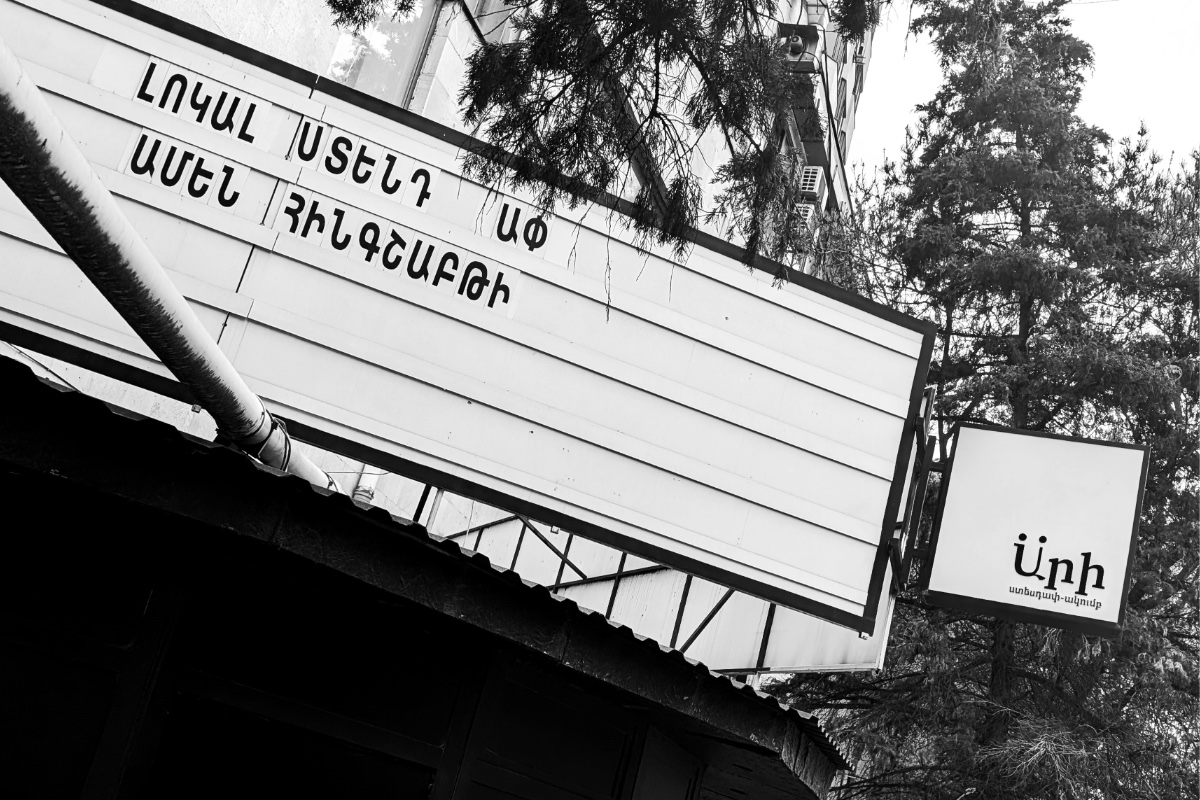
But the other night, sitting with my wife, Araz, at the Ari Stand Up Club, something changed: I realized I was laughing in real time. It only took six years of living here, a mountain the size of Ararat of patience and countless linguistic humiliations (often internalized) for me to finally understand (at least most of) the punchlines before they became history.
We were there for a pay-what-you-can open mic night — a concept that in the comedy world is often called ‘workshopping.’ It is the most vulnerable, unvarnished stage of the craft, where mostly up-and-coming comics take half-baked thoughts and throw them against the wall of a live audience to see what sticks and what falls painfully flat. My previous exposure to stand-up was a short-lived stint watching sets in Toronto years ago. Back then, it was a hobby with friends that never quite flourished. In Yerevan, however, watching these comics felt less like entertainment and more like a diagnostic test for the country’s soul.
There were 12 comics on the bill that night. 11 were men; one was a woman. Each had five minutes to command the room. That 11-1 ratio is a stark reminder of where the social needle currently sits. Stand-up, at its best, is an act of public vulnerability and the subversion of norms. In Armenia, the stakes for a woman to stand on a stage and be ‘unfiltered’ or ‘crass’ remain significantly higher than they are for her male counterparts. We are missing half the story of this republic if only one gender is speaking into the microphone.
The venue itself represents a revolution (a word I don’t use lightly in this country) in both style and substance. If you grew up in Armenia, or in the diaspora with ties to Armenia, or spent any time here in the early 2000s, your idea of Armenia’s comedy scene was likely shaped by the ‘collective’ model. It was the KVN legacy: a high-energy team sport of sketches, musical parodies and synchronized wit. My own foray into the comedy of the Republic began with the movie Mer Bak in the late 1990s and the legendary sketches of Kargin Haghordum. I know I am likely skipping a dozen other cult classics; I’m no expert on Armenian comedy, but even to my diasporan eyes, the trajectory is clear. While those shows were essential, they relied on costumes and archetypes to mirror post-Soviet life.
Then came the televised era of 32 Atam and its slicker successor, Vitamin Club. These were flashy spectacles where comedy was a choreographed team sport. More recently, Women’s Club brought female voices to the stage, but often in a polished, glamorous ‘evening gown’ package that felt more like a variety gala than anything else.
What is happening at Ari is something else entirely. It is a departure from the ‘team’ and a move toward the individual. This is the North American approach: the lone person, a microphone and a brick wall (or is my North American self imagining the wall?). There are no backup dancers, no laugh tracks and no wigs to hide behind. It is low- to no -budget, intimate and intentionally raw. It marks the transition from comedy as a choreographed performance to comedy as a confession.
However, that rawness reveals some jagged edges that are harder to laugh off. While much of the set was refreshing, there was a persistent, casual undercurrent of homophobia; at least half the performers that night leaned into it, ranging from lazy punchlines to pointedly sharp barbs. It wasn’t the aggressive, ‘angry’ variety of gay-bashing, but rather a series of slights — the kind of jokes that use a person’s identity as a convenient punchline. Some may reflexively say, “This isn’t North America; things are different here,” but that excuse is starting to feel like a crutch. If the goal of the new Armenian stand-up scene is to be a space for truth and modern reflection, it cannot rely on the lazy tropes of the past. Homophobia is unacceptable, yes, but in comedy, it’s also unoriginal; it’s the low-hanging fruit of a performer who hasn’t yet found a clever way to be provocative and clever. For this scene to truly mature and reflect a 21st-century Armenia, the slights have to stop.
Despite these growing pains, I would argue that a comedy club is the best place to feel the actual ‘pulse’ of the people. To the many diasporans visiting Armenia this summer, I would encourage you to find a venue like Ari. During your stay in the city, don’t just frequent the trendy, Instagrammable cafes across Yerevan. Go sit in the dark and listen to what 20-somethings are complaining about in the most unfiltered way. It is a litmus test for your connection to this society. Do you actually understand the jargon? Do you catch the slang being birthed in the heat of a rant? It isn’t a judgment on your ‘Armenianness’ if you don’t, but I will say it is an illuminating experience. It highlights the gap between the Armenia we imagine in our community centers in Toronto or Boston and the Armenia that is currently trying to figure itself out over a beer in Yerevan.
Comedy in Armenia is currently ‘workshopping’ its own identity. It is testing its limits, failing occasionally and trying to find a voice that is authentically its own. It is a messy, imperfect process. But for the first time in six years, I’m just happy to be in on the joke.


Your stand-up experience mirrors mine from two years ago at another venue. The locals (and one visiting European who was allegedly an actual comedian) all relied on the same lazy tropes and bawdy humor that wouldn’t be out of place in a middle school, but only in a middle school. It reflects for me a degree of stunted growth when it comes to being more sophisticated in the kind of humor and comedic risks they’d take. The only guy who was funny, and he was really funny, was a visiting Iranian who was trying it out on a whim. He used his experience of being a fish out of water in Armenia to make light of his experience and it was truly well done. I hope with practice the local comedians can grow out their own stale attempts at humor.
You don’t know what VSYO means in Armenian?? What’s the matter with you? :)