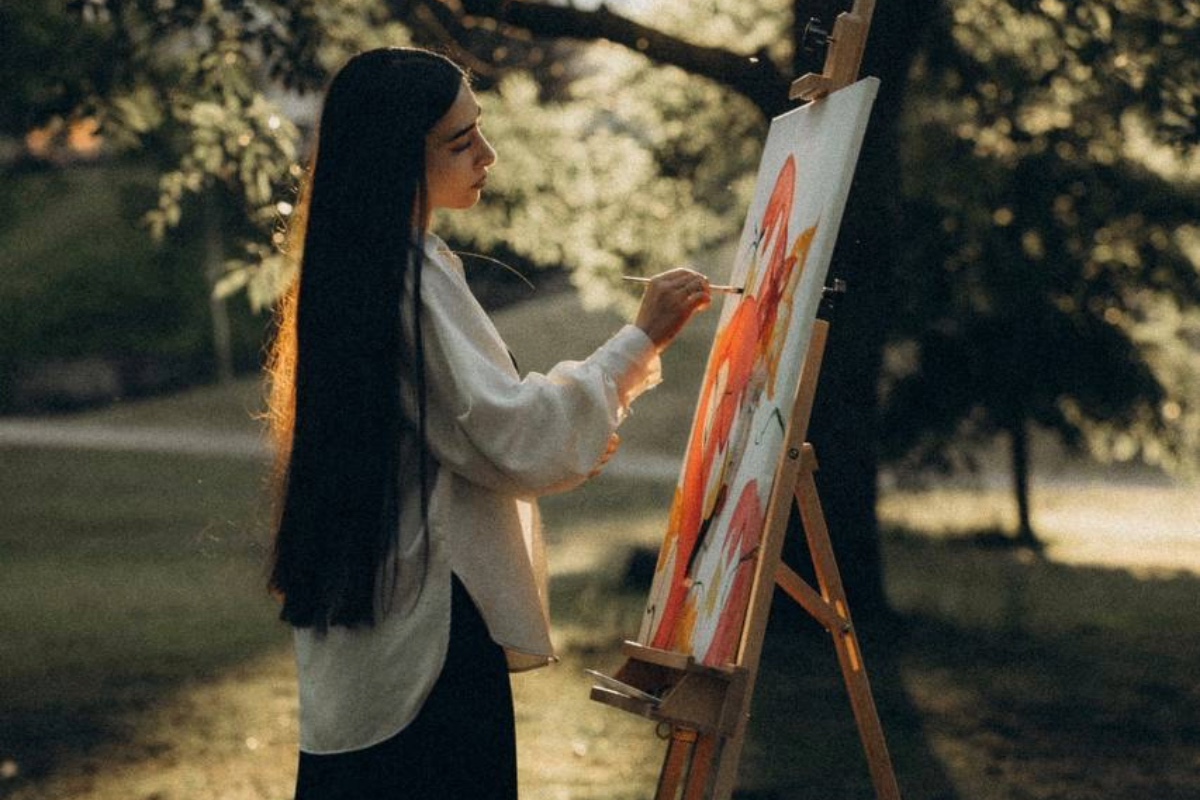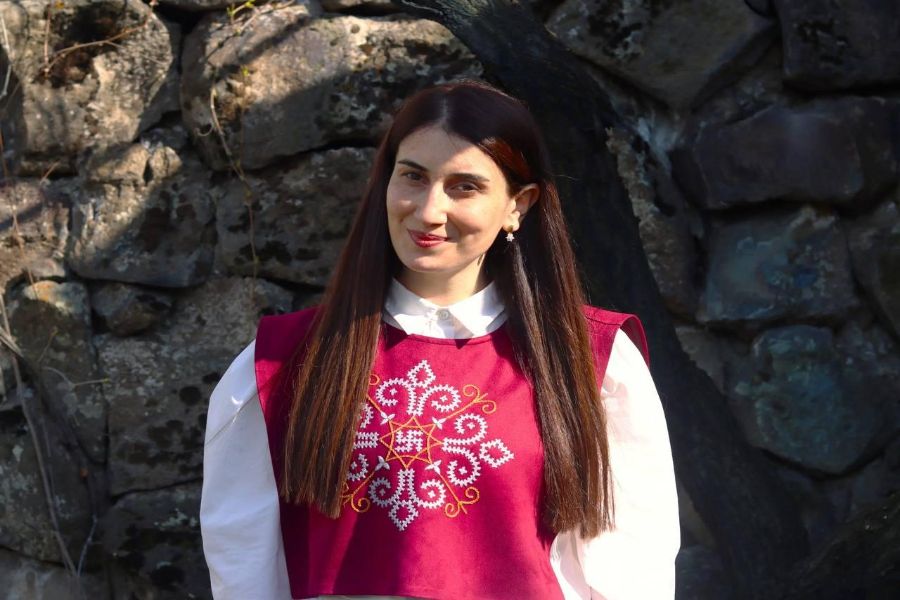
In the life of artist Heriqnaz Khachikyan, the roles of painter, designer, educator and master of applied arts do not compete for priority. Instead, they are woven together like the sturdy threads of a gobelin tapestry. In her world, there are no cold squares or sharp angles; everything is natural, soft and luminous. Despite the demands of family and childcare, which sometimes take precedence over her teaching, Heriqnaz’s various roles exist in peaceful balance, guided by a singular creative mission.
From a border village dream to the glad tidings of Van
Heriqnaz’s journey into the world of pumpkin art began in a border village, where creating was an act of quiet heroism. She recalls gathering natural materials with her sister to make collages on pumpkins. In those years, simply having hot glue was a source of great happiness. While pumpkin art was flourishing in other parts of the world, they were taking their first small steps in their remote village, cherishing the fruit without even knowing how to cut or use it.
During her university years, Heriqnaz began developing this art independently, embroidering, engraving and weaving carpets onto the surface of the pumpkins. She discovered that while it is an ancient art form with roots in Africa, it also carries deep Armenian origins. She found a moving story in the book “Folk Games and Rituals: in 19th-century Van,” where ancestors would cut pumpkins in the shape of a cross, place a lamp inside and carry them through the village while singing Avetis (glad tidings). “My grandmother’s stories and this discovery made me realize: this is my mission,” she told the Weekly.
From defect to effect: A conversation with nature
Working with pumpkins is a long and meticulous ritual that begins with sowing the seed. Heriqnaz waits a month for the “miracle” of the sprout and cares for the plant as if it were a young child. Because the pumpkin is a climbing plant, she helps it grow upward, tying it to trellises so the fruit can hang in the air — if it touches the ground, it will rot.
“The pumpkins themselves suggest what they will become,” Heriqnaz said. Sometimes nature produces broken or misshapen fruit, but she transforms these “defects” into “effects.” She values the honest, perfect state of nature and tries not to impose her will on the material but rather to listen to it.

The mathematics of gobelin and the pulse of tufting
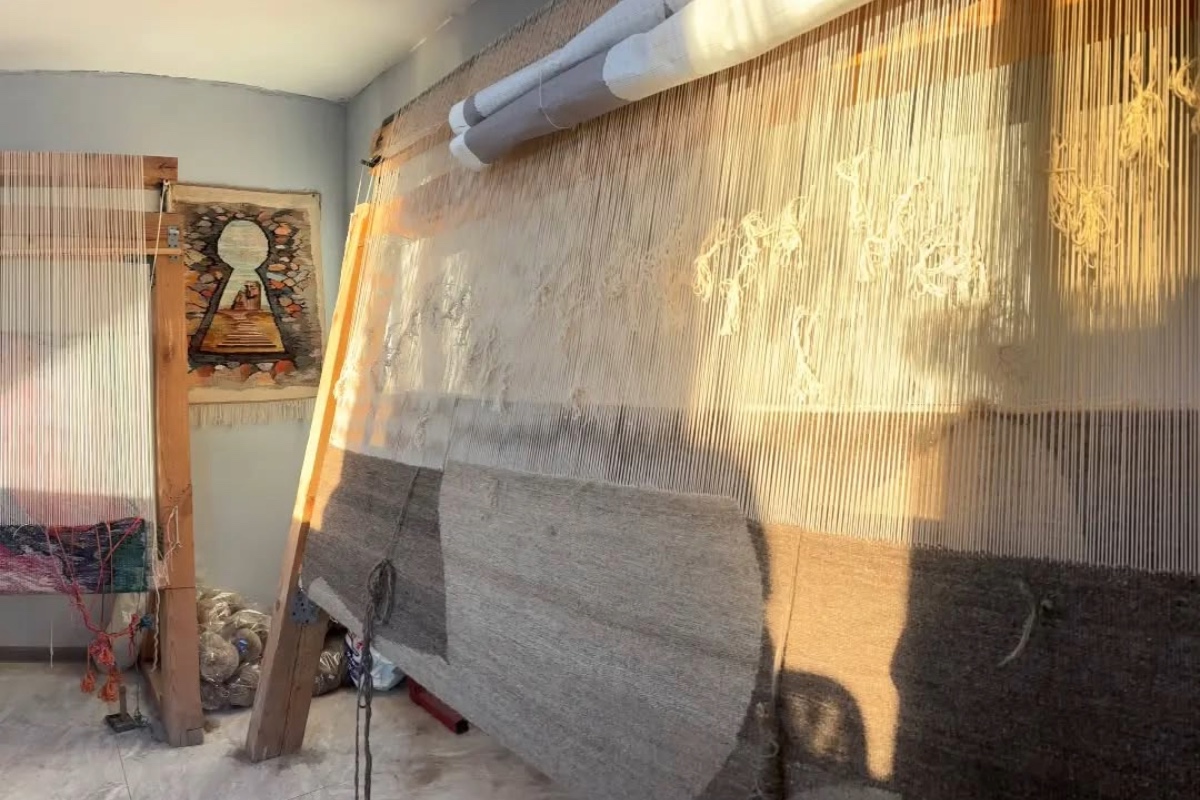
If pumpkin work is a direct conversation with nature, gobelin weaving is, for Heriqnaz, akin to a complex mathematical problem. It requires a precise preliminary sketch and complete silence. She still remembers the sleepless night before weaving her first carpet at the university: “It was so moving… I felt so Armenian at that moment.” She believes every Armenian girl should learn these crafts to stay close to their roots and “live as an Armenian.”
Alongside these traditional crafts, she has embraced tufting, a new and dynamic direction in embroidery. It is a faster and technically simpler process that allows her to create decorative elements impossible to achieve through other forms of art.

Following the light
As an educator, Heriqnaz instills a sense of patriotism and responsibility in her students. She appreciates discipline but values freedom in art. She shares her experiences and the long journey she has traveled, serving as an example for young people. Her primary lesson is simple: to see the light in every difficult situation and to leave only kind footprints behind.
When her students leave, Heriqnaz “becomes a child” again. In her mind, she soars over mountains and flower-filled fields, conversing with ancestors and the great figures of history. Her greatest dream is entrusted to the universe, and her advice remains the same: “Love, do not be disappointed and be sincere with the world you create.”
You may follow Heriqnaz Khachikyan and her art online on Facebook or Instagram.
All photos are courtesy of Heriqnaz Khachikyan unless otherwise noted.