



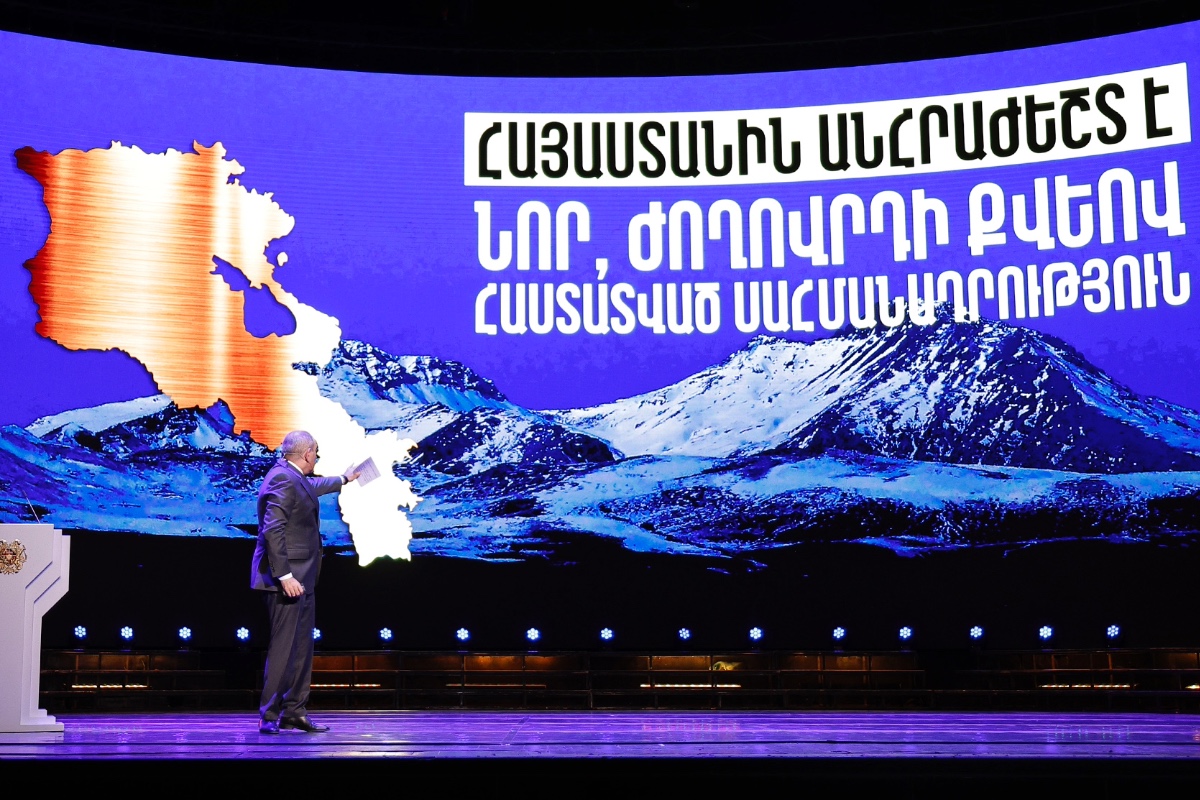
YEREVAN — The draft text of Armenia’s new constitution has been finalized and will next be reviewed by the ruling Civil Contract party leadership and its parliamentary faction, Justice Minister Srbuhi Galyan announced during the inaugural session of the Public Council under the Ministry of Justice.
Galyan said the Constitutional Reform Council has been working actively, holding weekly sessions, and confirmed that the draft text is ready. However, its public release remains pending until the ruling party and its parliamentary faction complete their internal review.
She said the new draft builds on developed conceptual provisions, framing governance around the individual and the citizen while maintaining the current parliamentary structure. Galyan said the reforms aim to decentralize powers and strengthen checks and balances, including legislative oversight of the prime minister.
Regarding the judiciary, the draft introduces provisions for sworn referees, two-tier appeals, written case reviews and challenges to decisions of the High Council of Justice — mechanisms not currently in place.
Galyan stressed the process surrounding the new constitution is being conducted transparently. “We have held sessions attended by media representatives, and it is important to show that we are not working behind closed doors,” she said.
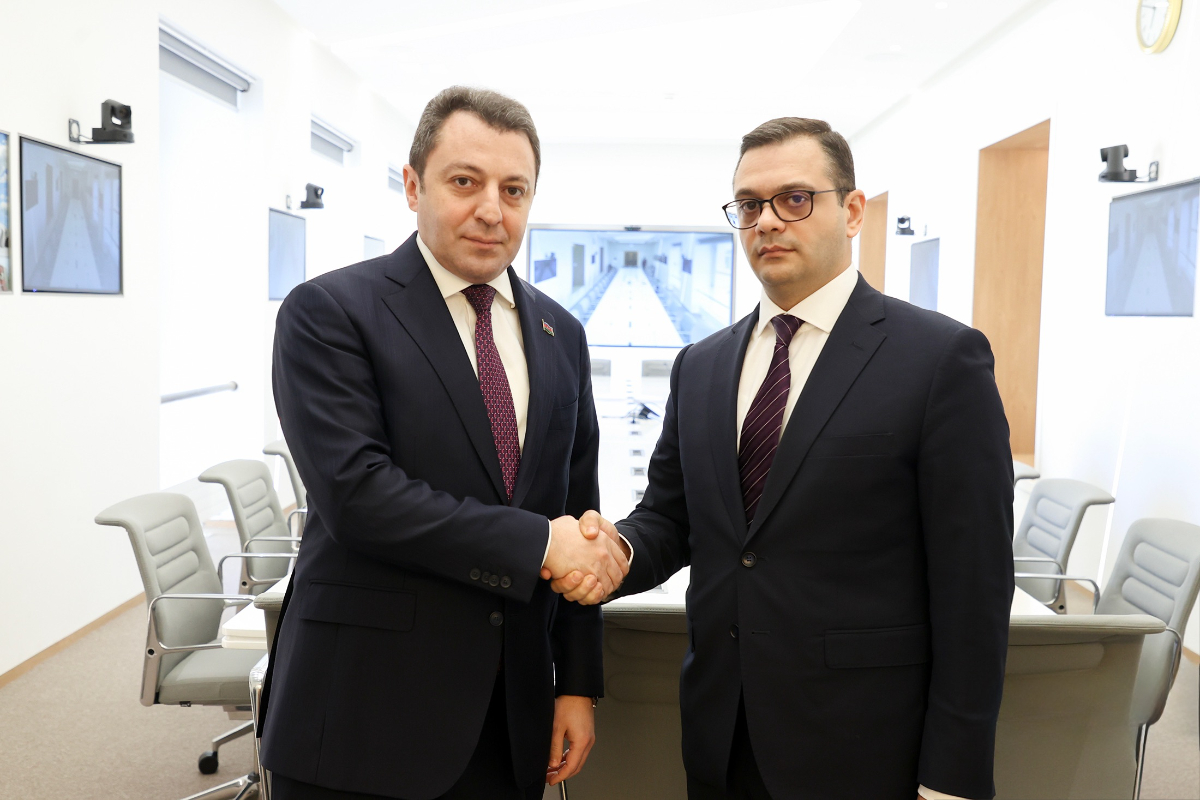

Addressing concerns about broader public discussion, Galyan said no referendum date has been set. “If a date had been fixed, I could understand concerns about timing, and we might have postponed the publication of the draft. But the referendum has not been scheduled, and there is no delay from our side at this moment,” she said.
Galyan said sufficient time will be provided for citizens to review the draft and make informed decisions during the referendum. “I believe the draft constitution will be published before the elections. While I cannot comment on internal deliberations at this stage, we are committed to full transparency once the text is finalized,” she said.
However, the staggered process, with multiple party and parliamentary reviews before public access, raises questions about transparency and timing, particularly as the changes are likely to remove or revise key constitutional references to Nagorno-Karabakh, currently enshrined in the preamble to Armenia’s Declaration of Independence.
The preamble of Armenia’s current constitution, adopted in 1995, explicitly references the country’s historical and legal ties to Nagorno-Karabakh, reflecting the territory’s significance to the Armenian nation. It is linked to the Declaration of Independence, affirming the rights of the people of Nagorno-Karabakh and acknowledging Armenia’s commitment to the region’s security and self-determination. This preamble has long been a symbolic cornerstone in Armenia’s legal and political framework, shaping both domestic policy and international negotiations on the region.
Azerbaijani President Ilham Aliyev has repeatedly emphasized that any lasting peace agreement between Armenia and Azerbaijan depends on the removal of these references from Armenia’s constitution. In public statements and diplomatic meetings, Aliyev has described the preamble as evidence of alleged territorial claims, saying it must be revised before normalization or broader economic cooperation can proceed.
Observers say the current constitutional draft, while framed as a broader effort to modernize governance, decentralize power and strengthen checks and balances, reflects these regional pressures. The timing and focus of certain amendments — particularly those affecting the preamble — suggest that considerations related to reconciliation with Baku are a key factor shaping the proposed changes.
In this context, political maneuvers within Armenia’s institutions have drawn increased scrutiny.
After eight years as a senior Civil Contract party member, Vladimir Vardanyan recently resigned from the party to become an independent, enabling his nomination to the Constitutional Court by President Vahagn Khachaturyan. Vardanyan said the appointment was a professional duty to “serve the preservation and development of democratic values.” It would also require him to relinquish his parliamentary seat, where he led the Standing Committee on State and Legal Affairs and supported key party initiatives, including legislation aimed at nationalizing the Armenian Energy Corporation.
Legal experts have criticized Vardanyan’s appointment as politically motivated, saying it undermines the independence of the Constitutional Court. Lawyer Nina Karapetyants argued that placing a ruling party loyalist on the Constitutional Court reinforces mechanisms that could protect the administration’s power, potentially affecting future rulings on parliamentary elections, the Nagorno-Karabakh peace agreement and the new constitutional draft.
Analysts say even minor revisions to the constitutional text could have wide-ranging implications. Reports suggest that the current government’s push to amend the constitution aligns with expectations from Ankara and Baku, particularly regarding the removal of references to Nagorno-Karabakh. The initial draft is expected to be published this month for public discussion, though observers say restoring preamble references would likely require a significant political shift in Yerevan.
The government has also acted in other areas to signal alignment with perceived external expectations. The dismissal of Edita Gzoyan, director of the Armenian Genocide Museum-Institute, followed her presentation of a book on Nagorno-Karabakh history to U.S. Vice President J.D. Vance was described as “contrary to government policy.”
Meanwhile, Prime Minister Nikol Pashinyan has continued to raise concerns about alleged foreign influence within the Armenian Apostolic Church, describing clergy as agents of outside intelligence services and portraying himself as a guarantor of peace and security — a position observers say supports both electoral strategy and international signaling.
Armenia’s newly established Foreign Intelligence Service has also warned of potential foreign interference in the upcoming parliamentary elections, implicitly pointing to Russian involvement. Following this, the Investigative Committee opened a criminal case into alleged electoral manipulation, raising concerns that opposition participation may be restricted and diaspora voting obstructed — methods seen in other post-Soviet states.
The European Union announced it will send a hybrid rapid-response team to Armenia to help address security and interference threats ahead of the June 7 parliamentary elections. Speaking at a press conference, High Representative for Foreign Affairs and Security Policy Kaja Kallas said the deployment followed a request from the Armenian government: “Supporting resilience in democracy in our neighborhood remains critically important. Armenia will not face external interference alone. Democracies under pressure can rely on Europe.” Earlier, EU Enlargement Commissioner Marta Kos said 12 million euros ($13.8 million) will be provided to strengthen safeguards against hybrid threats.
Critics say Pashinyan’s appeals for European involvement reflect both the fragility of his domestic mandate and his reliance on external validation. Armen Hovasapyan of the Republican Party wrote that Pashinyan’s repeated references to “KGB agents,” “Russia-aligned” and “Belarus-aligned” were “carefully chosen tactics” to appeal to European audiences.
According to Hovasapyan, the EU deployment carries several implications. First, it introduces a supervisory and political dimension, with the EU extending beyond observation into a role embedded within the electoral process, potentially shaping perceptions of legitimacy.
Second, it affects the information environment, as support against hybrid threats could translate into influence over media narratives and filtering of dissenting voices. Third, it carries a geopolitical dimension, signaling to other external actors, particularly Russia, that Armenia is an area of strategic European interest.
Finally, Hovasapyan said the intervention serves as a source of external validation for the incumbent government. In contested elections, international monitoring could be used to counter domestic criticism. However, he warned that the presence of foreign actors could exacerbate domestic polarization, creating the perception that electoral processes are increasingly influenced by external powers rather than grounded in Armenian sovereignty.


We all know what this will entail. This will not be an Armenian constitution, but a capitulationist Pashinyan constitution, drafted by Pashinyan, and amended and corrected by Aliyev. A constitution that will dilute the essence of Armenian nationhood and weaken Armenian statehood, weaken the separation of powers, weaken the National Assembly and the Constitutional Court by accumulating all power to himself whether as prime minister or as an executive president, or by fusing the two posts, remove Mount Ararat and the four historical Armenian states from the coat of arms and other Armenian symbols, weaken the provisions of territorial integrity and allow the cession of Armenian territory without a national referendum and by bypassing the National Assembly (the latter two especially in order to appease and please the two aggressive and expansionist Turkic archenemies), remove the Armenian Apostolic Holy Church as the national church and from the constitution, remove the reference to the Armenian Diaspora and restrict the naturalization of Diaspora Armenians. As long as this Turkic-butt-kissing traitor and saboteur remains in power, this is the trajectory awaiting Armenia.
There has got to be somebody somewhere who can stop Pashinyan.
There’s the June 2026 elections, of course, but I am going to say that we’ve all got the depressing feeling in our hearts that Pashinyan is going to rig the elections.
I do not know what will happen.
But I do know that Revolution is Armenia’s only hope for a better future.
There has to be an acknowledgement of reality. Armenia despite its constitution preamble referring to Arktash, never recognised it as independent nor as part of Armenia and no UN recognised nation recognised Arktash. With the loss of control in 2020 and the conquest of what remained and Armenia recognising it as part of Azerbaijan, continuing to refer to Arktash is absurd and futile.
Removal of Mt. Ararat from the coat of arms is basically whitewashing the identity of Armenians everywhere. I do not understand why this should make any material difference to the Turks or Azeris.