


Reflections

Finding our way back to Kaghand’s tranquil light
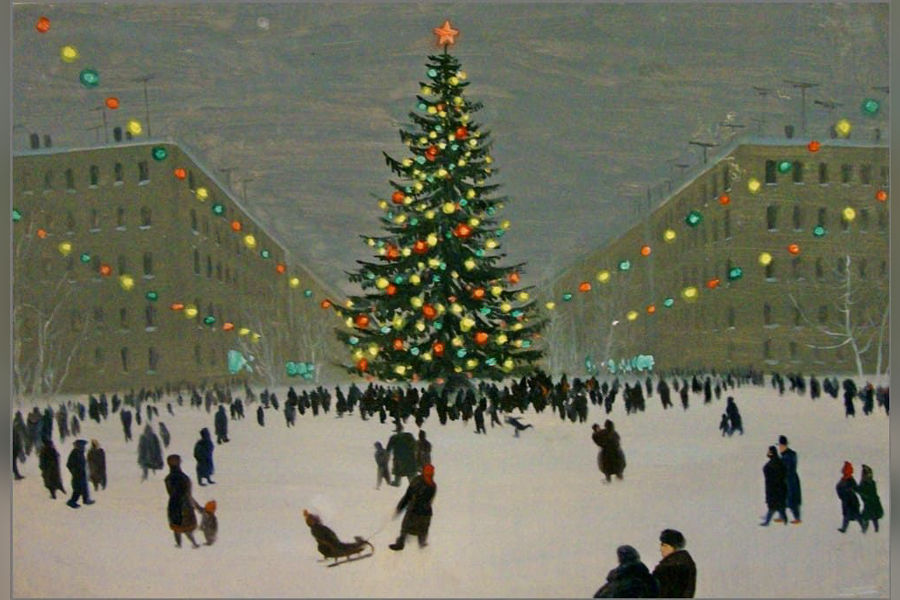
Outside, the December rush is in full swing: the noise of performative extravagance and the frantic pace of the season. But in my room, time seems to slow. I am sitting beside my 73-year-old grandmother; the warmth of a teacup and the calm resonance of her voice pull me away from the turmoil beyond the window. 

In this moment, I realized that everything we call a “holiday” today pales in comparison to the true essence of what my grandmother calls Kaghand. Listening to her stories, I try to remember and weave together the simple, wise layers of our identity that are slowly being pushed out of modern life.

Sometimes, when I find myself amid the bright lights and clamor of foreign cities on New Year’s Eve, I close my eyes and try to remember our true celebration — the one that lived in our grandparents’ homes. There, the air didn’t smell of expensive perfume, but of freshly baked bread and dried grass.

Our good old Kaghand. In those days, New Year’s was not a display of luxury, but the peace of gathering together as kin. Imagine our grandmothers, their hands dusted with flour, preparing the Tarehats with love and warmth. To us, it wasn’t just food; it was the symbol of our family’s unity. We all would hold our breath as the bread was sliced, waiting to see whose piece would reveal the hidden coin or bean. In that heartbeat, we were connecting with our fate and our land. It was a beautiful ritual where everyone felt their place within the great embrace of the family.

And then, there was Kaghand Pap — far removed from today’s commercialized, glittering Santas. He was our wise forefather, a grandfather in whose eyes lived a thousand years of peace. He did not bring material gifts. Instead, he offered something far more precious: values: values.

Related Articles

He taught us that the greatest gifts are kindness, diligence and standing back-to-back as one. His counsel formed the very foundation of our home.

Instead of a Christmas tree, our grandfathers brought simple dry branches into the house. But those branches, decorated with our own hands using walnuts and sun-dried fruits prepared by Grandmother, gave off more light than all the toys in the world ever could.

Though we are now scattered to different corners of the globe, this story belongs to us all. It is the warmth we carry within us, wherever we go. Perhaps this year, as you sit around a festive table, take a moment to remember our good old Kaghand. Feel the scent of that bread and the quiet peace of Kaghand Pap settle in your heart. After all, that is what makes us who we are.

In earlier times, winter nights in the Armenian mountains were long and profoundly still. The New Year — Kaghand — arrived with that silence. It was a natural cycle of the earth, a time for awaiting the midwinter turning point and the rebirth of light. At home, the celebration began at the hearth. The elders baked the round Tarehats, hiding a small coin inside. On the morning of Jan. 1, we gathered around it in quiet anticipation. There was no unnecessary noise. The bread was shared not just with the family, but with the livestock and the earth itself — a gesture of gratitude for sustenance. To find the coin meant that prosperity would flow through your own hands in the year ahead.

Our tree was different, too. A simple branch from the garden — the “Kaghand Tree” — adorned with thread-bound walnuts, apples and dried fruits. It didn’t just shine; it carried the fragrance of our garden and the warmth of the summer sun. After the holidays, nothing was wasted; the decorations were eaten. No one competed over lavish tables or expensive gifts. Everything was humble, natural and real. There was bread, the harvest of the garden and a tranquility that feels increasingly rare amid today’s festive noise.

Our world has changed. It is faster, louder and filled with constant demand for our attention. There is no need to assign blame; such are the times. Yet, it is precisely in this rush that we begin to yearn most deeply for that ancient simplicity our elders spoke of.

It does not matter which corner of the world you inhabit or how far you are from our mountains, Kaghand is not a geography; it is a state of being.

 It is the warmth we carry in a quiet corner of the heart. No matter how foreign or glittering the world outside may be, we can always make room at home for that old, tranquil light.

Perhaps this year, we need not strive for the most extravagant table or the most expensive gifts. Instead, we might take a small step toward what is real: bring in a dry branch, decorate it with walnuts and apples or bake a Tarehats for the first time and share it with love. When a gentle silence settles over the home, our true essence returns.

What is the tradition or memory in your family that still warms your heart? We have lost nothing. We simply need to pause and remember who we are and where our light comes from.

Why this matters today

Today, many of us are searching for our true face once again. This isn’t just an interest in history; it is a delicate attempt to find our way back to ourselves. Identity has been dulled by noise and urgency, and now, we simply long to go home. For our compatriots living far away, Kaghand offers an opportunity to reconnect with an authentic Armenianness that knows no borders. It is a home carried within, wherever one may be.

You don’t need to be in Armenia to feel the light of Kaghand; it awakens the moment we remember the simplicity and peace of our roots.

And here in Armenia, this is an occasion to loosen the grip of stereotypes that turn the holiday into a display of obligatory luxury and false glitter. We can leave these exhausting habits behind and return to a wiser tradition — one where meaning lies not in the abundance of the table, but in genuine human warmth.

Perhaps this year, it is worth trying to live a little more “Kaghand-style”: with more silence, more sharing of bread and more love. We are not obligated to follow rules set by others. We can create our own peace. 

Amid festive clamor and burning lights, it is easy to overlook how the most essential things slip away. We fill our homes with objects and splendor, but in truth, it does not matter what is on the table or how much it aligns with modern trends. Even the most modest table can radiate warmth, if the old kindness of Kaghand is present.

When we consciously return to this simplicity, we are no longer alone. Behind us stands the millennia–old wisdom of our ancestors: their reverence for land, family and quiet joy. By returning to our (literal) roots, we are not retreating into the past, but rediscovering our strength and our true nature, which never fades. 

Our true celebration is always within us. We need only pause, breathe and make room for that old, kind light — ready to warm us still, wherever in the world we may be.

Armik Grigoryan

Armik Grigoryan is a freelance journalist from Yerevan. She studied at the Department of Journalism at the Armenian State Pedagogical University. Grigoryan has deepened her knowledge through various educational programs, including a three-month course at Factor TV. She has also participated in more than 10 professional training sessions and completed internships at leading TV stations in Armenia. Currently, she works in TV. Grigoryan enjoys writing about social issues, human rights, culture and arts, as well as tourism.

One Comment

  1. Turns out Armenia has its own equivalent of the “Nutcracker” ballet called “The Snow Queen”. The music was written by Tigran Mansourian.

Leave a Reply

Your email address will not be published. Required fields are marked *


Back to top button