



How a Hawaiian monument was mistaken for the first memorial to the Armenian Genocide
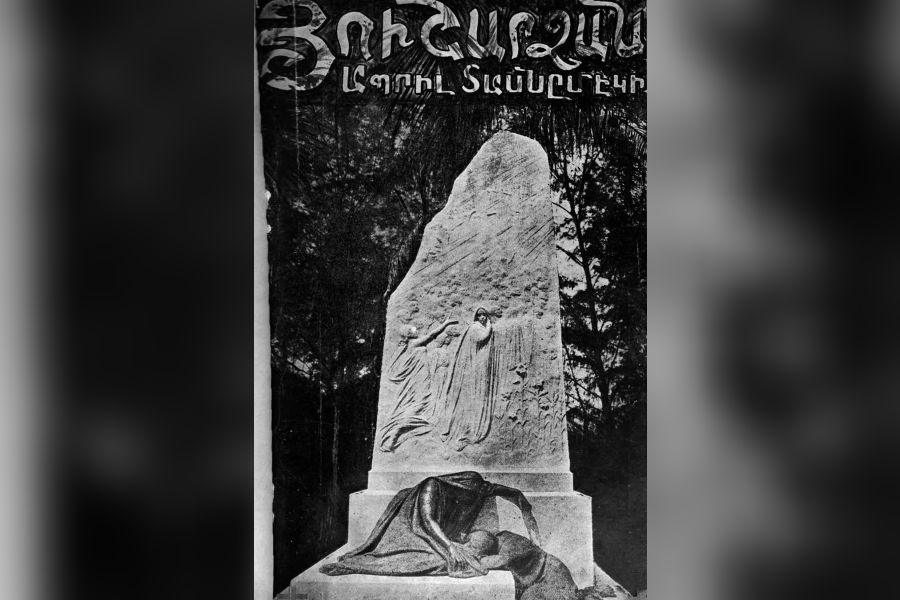
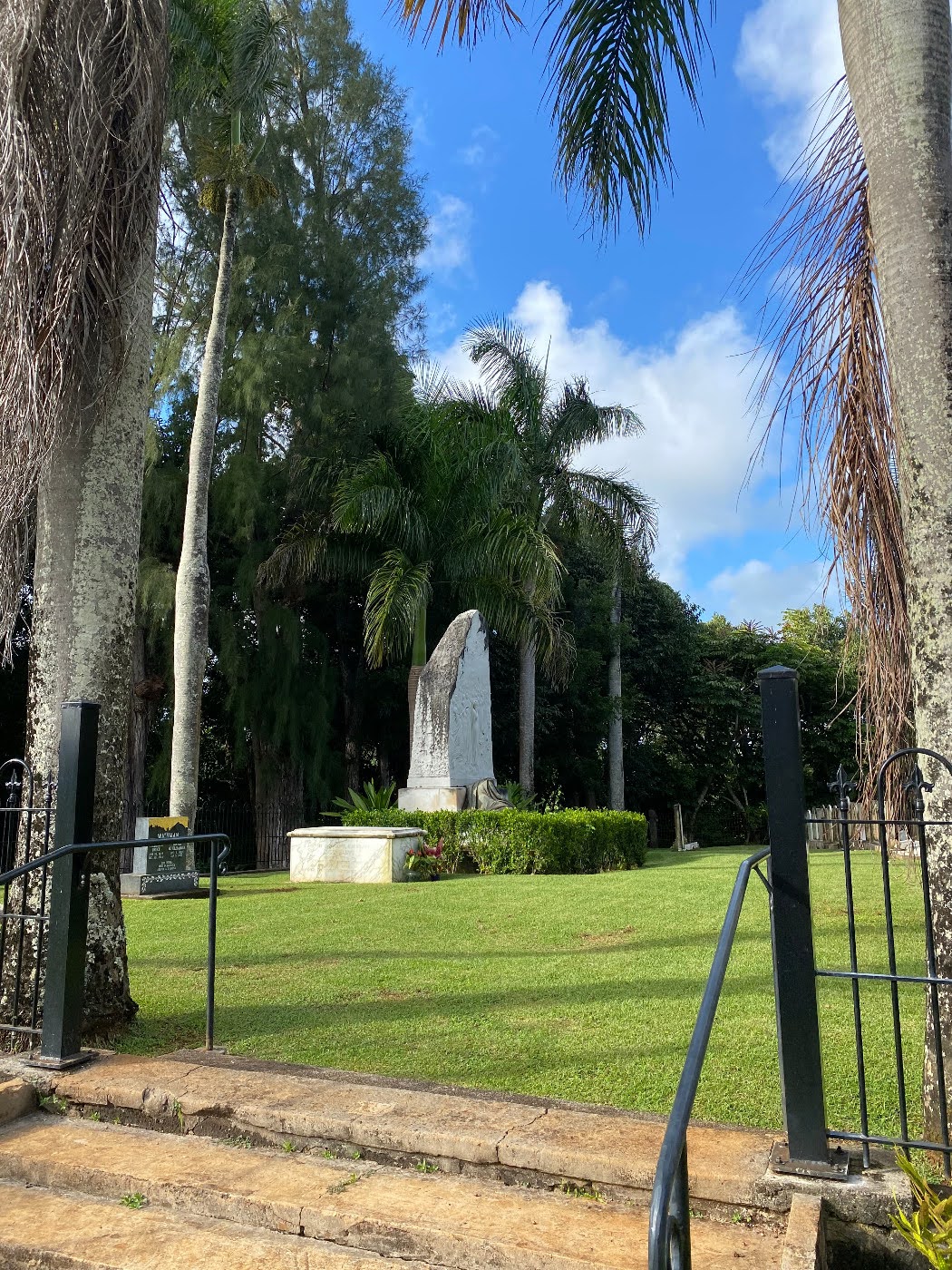
Many of us are familiar with the photograph often described as the “first Armenian Genocide memorial,” supposedly erected in Constantinople. At first glance, it seems to fit the bill: a lifeless woman lying down on the floor, ghostly figures rising behind her like resurrected deportees, and the tropical foliage and palm trees in the background. Wait, tropical foliage and palm trees? Now, that seems out of place, considering this was supposed to be Constantinople.
Turns out, this is not what we’ve been led to believe. In fact, this monument still stands, not in Turkey, but on the Hawaiian island of Kauai. The mystery of this memorial, which we will soon explore, can be declared resolved. The question does remain, however: How did a monument in the middle of the Pacific Ocean come to be mistaken for one in Constantinople?
For years, the monument was believed to have been erected in 1919 in what is now Gezi Park. At the time, Gezi Park was the Armenian Cemetery of Pangalti, belonging to the nearby Surp Hagop Armenian Hospital. In the 1930s, the cemetery was confiscated by the Turkish state and a park, along with several hotels, was built on its grounds.
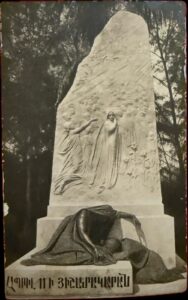
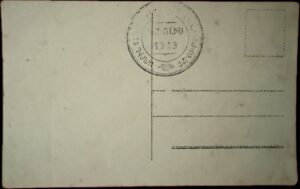
The photograph, which purportedly shows some kind of monument, was made famous because it appeared on the cover of Teotig’s Memorial to April 11 (Hushartsan), a book honoring and documenting the intellectuals who perished during the Armenian Genocide. Notably, this book was sponsored by the Committee for the April 11 Commemoration (Ապրիլ 11ի Սգահանդէսի Յանձնախումբ). Formed in Constantinople in 1919 and chaired by Patriarch Zaven Der Yeghiayan, the committee operated in the relatively freer environment created by the British occupation of the city, organizing events and commemorations for the victims of the Armenian Genocide. Among these activities were sponsoring Teotig’s book, holding a memorial service at Pera’s Holy Trinity Church, declaring days of remembrance at Armenian schools and publishing commemorative postcards, with proceeds dedicated to the families of the deceased.
It was this same committee that featured the photograph on Teotig’s book and on its commemorative postcards. As these materials circulated throughout the world, the image of the monument became nearly ubiquitous.

But something didn’t add up. If such a monument had truly been built, why was there no press coverage? In fact, we can safely say that no contemporary newspaper provides any record of its construction or unveiling.
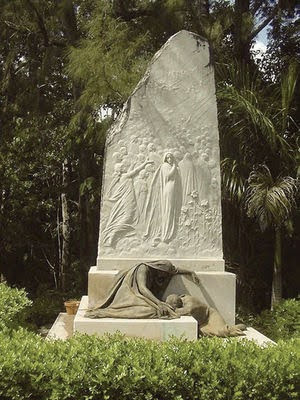
The reason, as we now know, is simple: the monument was never built. The image that captured global attention was not of a memorial in Constantinople at all, but of an actual monument standing thousands of miles away, on the Hawaiian island of Kauai.
Turns out, some people have devoted considerable time to unraveling this mystery. Two cultural historians, Dr. Gizem Tongo and Dr. Vazken Davidian of the University of Oxford, have traced the origins of this monument, and their research has established much of its true trajectory.
In fact, even a simple Google reverse image search — like the one conducted by my friend Harry Kezelian — can point in the right direction to the real story. It was actually Harry who first told me that the monument was in Hawaii, a revelation later confirmed in his conversation with Dr. Davidian.
Strangely enough, this revelation has not yet been made public outside scholarly circles, or published in an open-source article — until now.
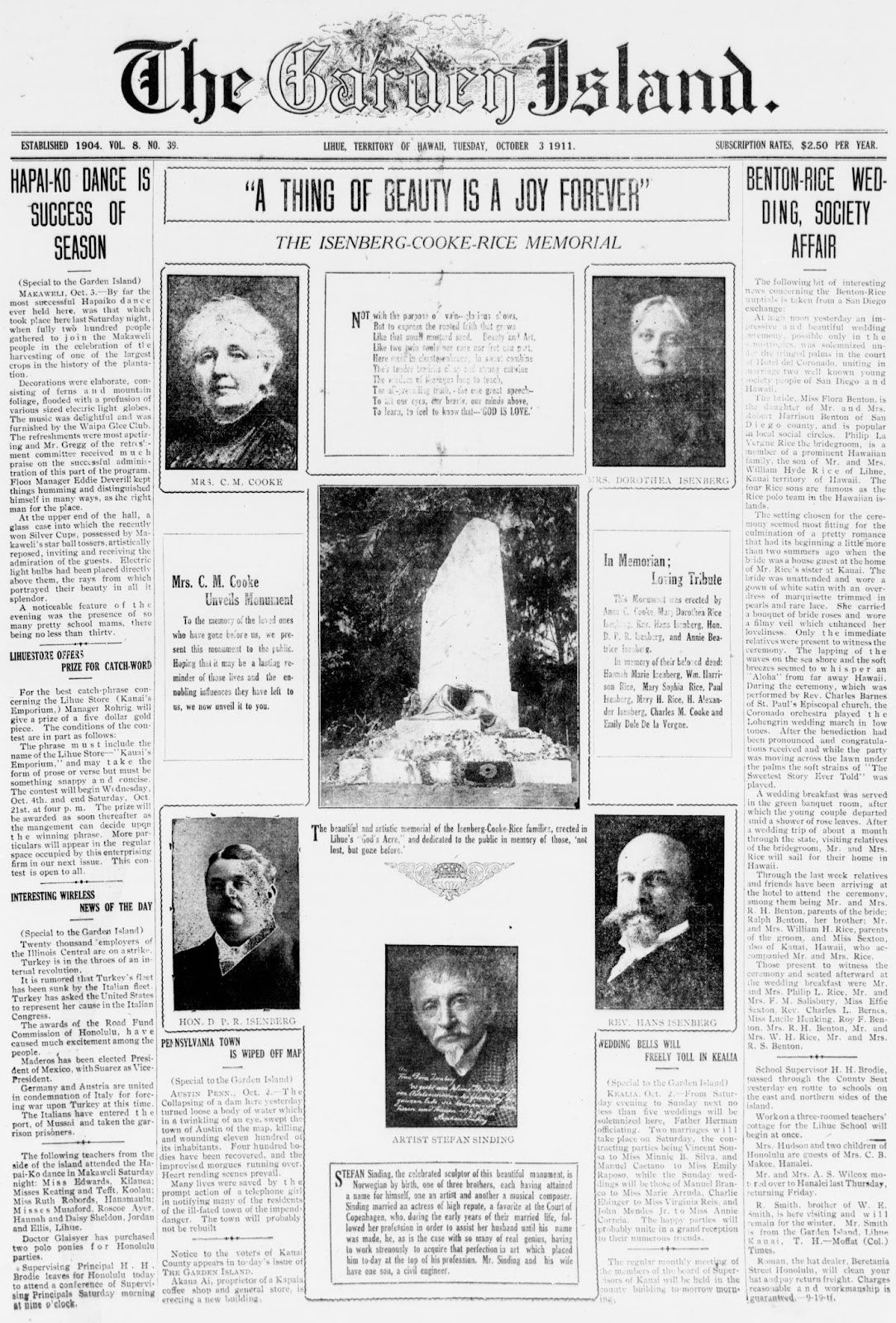
We may never know exactly when or how the committee came across the photograph of this Hawaiian gravestone. What we do know is that the earliest image appears in a local newspaper: the monument was unveiled on 1 September 1911, and the first published photograph appeared in the 3 October 1911 edition of The Garden Island.
The same image appeared in a 1922 issue of the paper announcing the death of the monuments sculptor — a key-figure whose story we will return to shortly. While the photograph used by the committee closely resembles the one in the newspaper in terms of shadow placement, it differs in notable ways: it is adorned with wreaths and flowers.
However, another photograph uncovered by Dr. Tongo of this monument appeared in the 15 June 1914 edition of The Studio, a London-based art magazine. This photograph matches exactly with the famous one Teotig and the April 11 Committee both used in Hushartsan publication and the commemorative postcards.
At the time of this magazine’s publication, Teotig was still in Constantinople, working diligently to publish the next Amenuyn Daretsuytse. The June edition of The Studio may have reached Constantinople at that time, though it may just as well have circulated there in the post-War period.
Moreover, it remains uncertain whether The Studio was the only magazine to publish this photograph — other periodicals may also have featured Sinding’s monument.
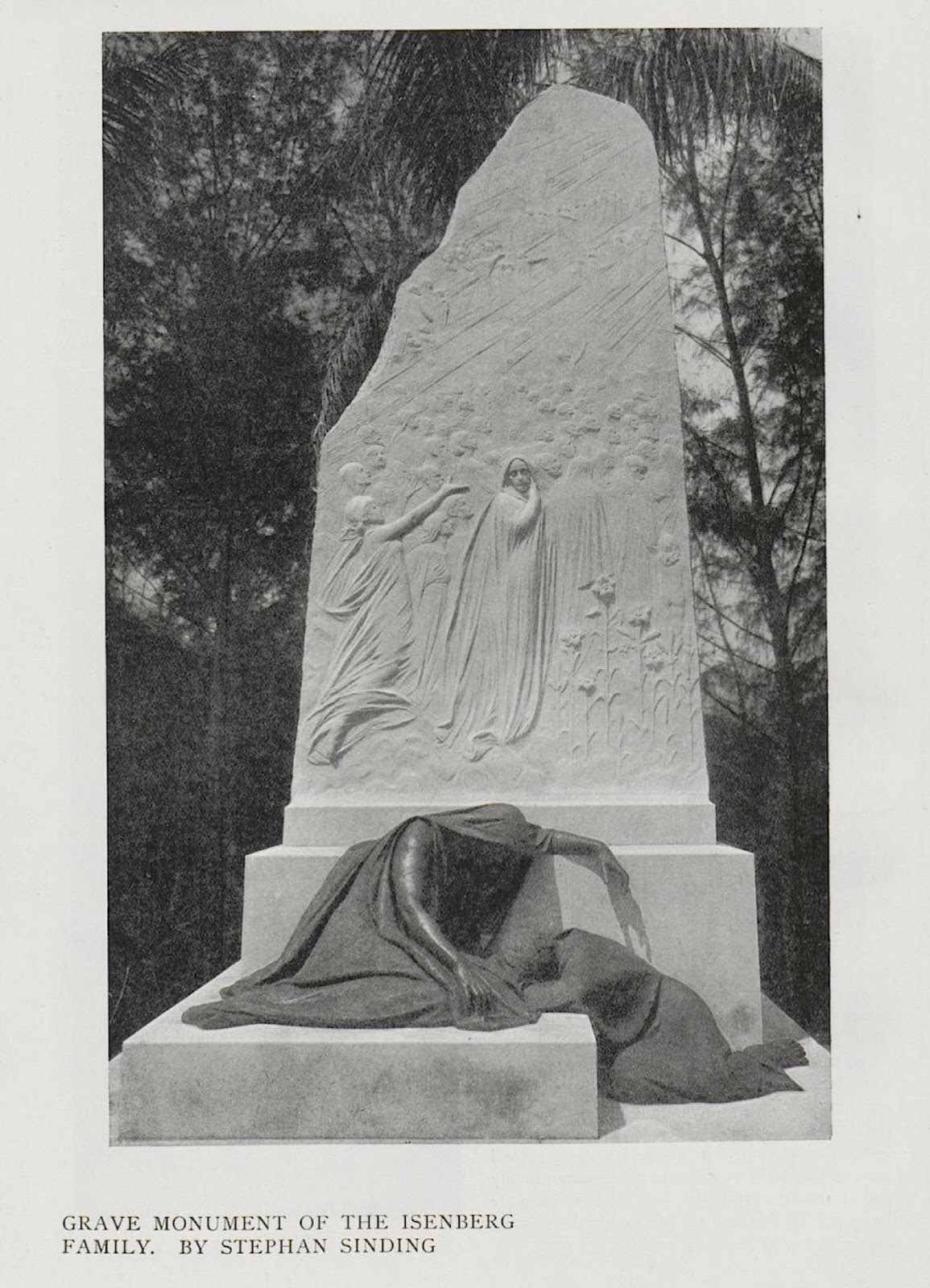
Therefore, before we venture further, the sculpture itself must be discussed to understand how this original photograph may have reached Europe in the first place.
The monument was created by Stephan Sinding, a renowned Norwegian-Danish sculptor who spent his final years working in Paris. It was commissioned in 1910 by the Isenburg and Rice families of Kauai, wealthy sugar plantation owners who sought to have a memorial dedicated to the deceased members of their family.
The sculpture, titled The Blessed Souls Wandering Toward Light, was exhibited in Paris and later in Bremen before this 10-ton slab of white marble was shipped to Kauai via the treacherous route around Cape Horn. It arrived safely and was installed in Lihue Cemetery, where it still stands today.
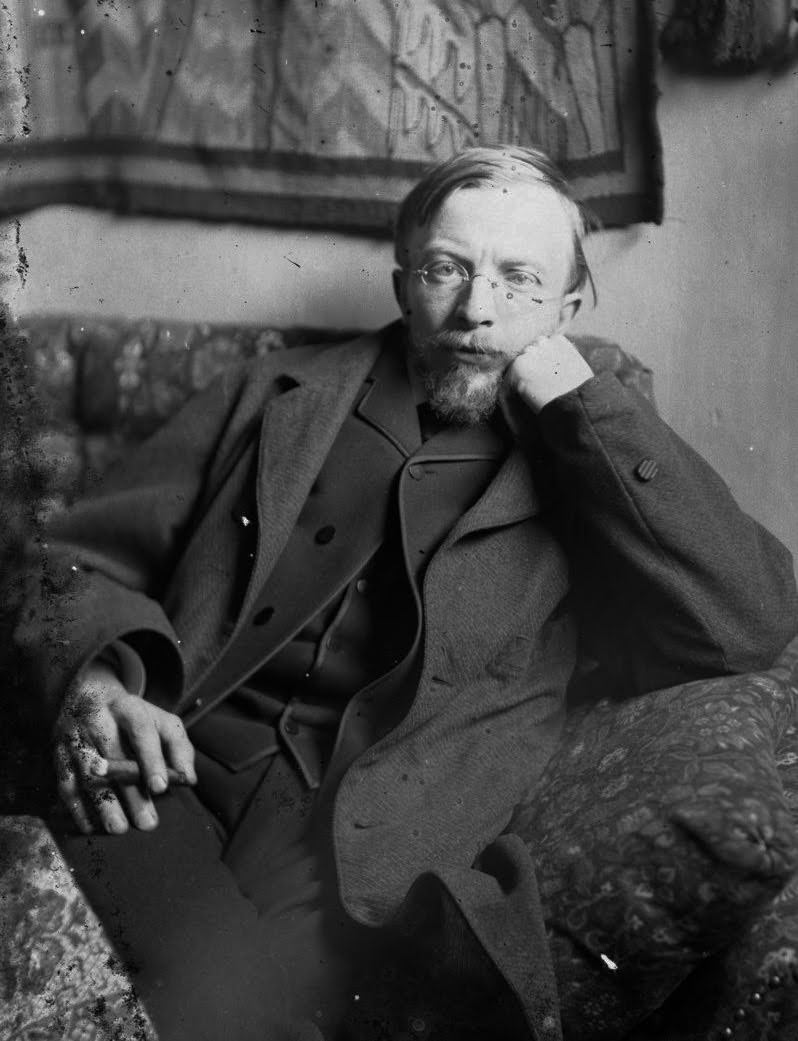
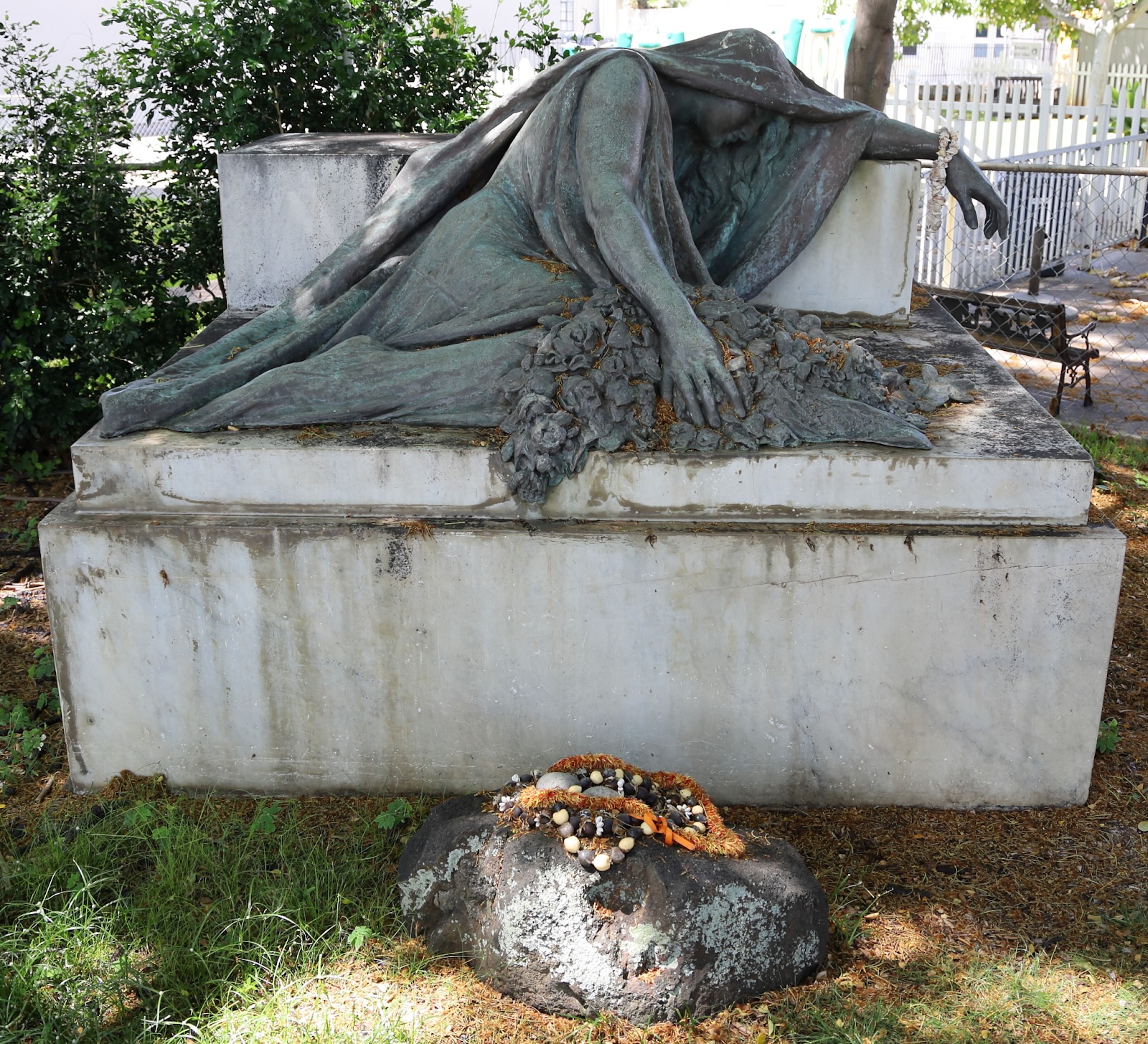
Carved upon the marble are shrouded figures with their faces turned toward heaven. Also carved upon it is the figure of a woman representing Hannah Maria Rice Isenberg (1842-1867), the mother of Paul Isenberg, one of the commissioners of the memorial. She has turned to look earthward at the bronze figures on the monument steps that depict her grieving children: Mary Dorothea Rice Isenberg and Paul Isenberg. The monument seamlessly bridges the earth with the heavens, while evoking separation from earthly matters and unifying the spectator with the divine. It is truly a work of art, one worth seeing next time you find yourself in Kauai.
How the photograph reached Europe may be linked to Sinding himself. He continued to live in Paris until his death in 1922, and a photograph of the sculpture was likely taken for him to review the final composition and placement of the memorial. In fact, given the success of The Blessed Souls Wandering Toward Light, he received another commission from Kauai for a similar sculpture called Weeping Woman just a year later. It was possibly during this period that Sinding received an original photograph of his masterpiece, which was later circulated abroad.
Whether the April 11 Committee or Teotig first encountered the image between 1911 and 1919 is unclear. We have no indication that Teotig ever went to Europe during those years. Indeed, he was one of the hundreds of intellectuals arrested during the genocide and deported, only returning to Constantinople in 1918. This leaves us with the possibility that the Committee members — or Teotig’s wife, Arshaguhi, who was actively involved in her husband’s publication efforts — came across the photograph themselves. Exactly how or when that happened, however, will likely remain a mystery.
It’s important to note that just because the monument was never built, that does not mean that remembrance of the genocide was absent or unacknowledged. On the contrary, the very formation of the committee, its organized events and the contemporaneous military tribunals all attest to a remarkable moment of recognition. Further, as Dr. Davidian notes, “the actual memorial-monument to the Genocide was never the one depicted on the cover of Teotig’s volume, but the actual publication itself that records the countless lives lost during the Genocide for posterity.
Hence, Teotig’s volume, a Houshamadyan, had become the Houshartsan.” In other words, the book itself became the monument.
Moreover, there was evidence of an actual monument planned to be built in the Şişli Armenian cemetery which was meant to be a kind of Tomb of the Unknown Soldier. The plan was briefly mentioned in the April 25, 1922 edition of the Jagadamard newspaper. What makes this further striking is that this monument was planned at a late and turbulent time — in April 1922, when the Kemalists were gaining ground against imperial powers. But all those hopes were dashed with the declaration of the Republic in 1923.
As for the so-called Gezi monument, it was not spoken about for a long time after Teotig’s publication. In fact, as noted above, it’s hard to say if it was ever talked about at all. The story of the Gezi monument is a relatively recent topic of discussion, revived first by Ragıp Zarakolu and later during the Gezi Park protests. The debates and speculations surrounding it continued since then. Much of the time and energy devoted to studying this monument — including academic papers, articles and even claims by historian Kevork Pamukciyan that he saw the pedestal of the monument in the garden section Harbiye Military Barracks — might have been avoided had more careful research or even a Google reverse image search had been done at the outset.
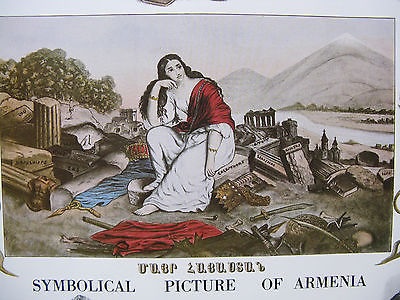
Yet, we should not view this misidentification with shame. The image of the monument on Teotig’s book cover and on the commemorative postcards was never intended to deceive. Rather, it was probably chosen because it so powerfully evoked loss, exile and mourning — sentiments that resonated deeply with the tragedy of the Armenian Genocide.
Indeed, the monument’s figure bears a striking resemblance to Mother Armenia (Mayr Hayastan), the enduring female icon embodying the suffering, resilience and trials of the Armenian people through those turbulent times and especially during their darkest period of the genocide.
Above all, Sinding’s monument was a funerary tribute, aligning perfectly with the purpose of honoring the fallen and those who perished during the genocide. Art never dictates how we should think or feel: it invites us to find our own meanings within it.
Just as the monument continues to captivate viewers today, the committee members of 1919, too, must have felt its haunting beauty without ever questioning its true origin.
It may feel disheartening to hear that the Armenian Genocide memorial was never built in Turkey, for it surely would have been quite the statement, especially in the face of Turkey’s ongoing denial of the genocide. But truth should always be the foundation of any cause, even if it’s inconvenient. Part of constructing a robust and enduring historical claim is the willingness to confront myths, even cherished ones, and replace them with fact.
The story of this mistaken monument reminds us that remembrance is not confined to stone or geography. Even if no monument was ever raised in Constantinople, the act of remembrance itself — by the commemorations, the establishment of a committee, the publications of books — became the true memorial. Each effort by Teotig, by Patriarch Zaven, by the committee members and the many others who sought to honor the fallen, was itself an act of resistance against erasure.
The Hawaiian monument may have been born of another family’s sorrow, yet through a strange twist of fate, it became entwined with the collective mourning of an entire people. In that way, it fulfilled a greater purpose than its sculptor could ever have imagined. And one can only hope that Stephan Sinding would have understood that art, once set free into the world, belongs to all who see themselves in it.



My thanks for this meticulous research.
As the author of an extensive article in Armenian in Hairenik Weekly in 2017 (https://www.academia.edu/121904281/%D5%8A%D5%B8%D5%AC%D5%BD%D5%B8%D5%B5_%D5%84%D5%A5%D5%AE_%D4%B5%D5%B2%D5%A5%D5%BC%D5%B6%D5%AB_%D5%B5%D5%B8%D6%82%D5%B7%D5%A1%D6%80%D5%B1%D5%A1%D5%B6%D5%A8_%D5%A1%D5%BC%D5%A1%D5%BD%D5%BA%D5%A5_%D5%AC_%D5%A9%D5%A7_%D5%AB%D6%80%D5%A1%D5%AF%D5%A1%D5%B6%D5%B8%D6%82%D5%A9%D5%AB%D6%82%D5%B6), where I showed that the monument to the genocide in Constantinople was a myth, I applaud this article for putting to rest any lingering doubts.
Teotig never traveled to Europe until he left Constantinople for Corfu in 1923. His wife Arshagouhi Teotig had studied in England, but I am unaware whether she went back in Europe before going to Switzerland for tuberculosis treatment around 1921 (she passed away in 1922). Whether the picture in the London magazine reached Constantinople weeks before or after the beginning of World War I, it is anybody’s guess. The lack of absolutely any reference to the cover picture of Hushartzan in the book should have been enough for anybody to refrain from claiming that it was the photograph of a monument. But it is easier to create myths than to uncover facts.
Շնորհակալութիւն Վարդան։ Այդ գրութիւնդ չէի տեսած։
We adopt symbols and imagery to speak for us. While this monument may not have been built for the Genocide, it conveys communal loss more so than one family’s grief. Why did this artist choose to display women with heads scarfs marching away with Easter lilies sprouting along their path? If the monument wasn’t built for the tragedy that fell upon the Ottoman empire in 1915, then it was fitting that the people who survived those years adopted this monument to not only represent their grief, but also their hope for a better future.
There are palm trees in Istanbul though, so that rather nullifies the first paragraph. I appreciate the debunking though in a world where few ever bother to question anything they see or read.
The author clearly is referring to Constantinople, not Istanbul in that particular sentence. It’s important to note that Palm Trees were never native to the Istanbul region and have only been imported en masse during the Republican Era.
Anonymous, palm trees were already being brought to Constantinople during the Ottoman times and certainly could be found there in 1922. The Cretan Date Palm in particular was native to the region and the trees were brought from the coasts to the city for decorate parks. So it’s not true that palm trees were a sudden phenomenon of the Republican Era, but either way this diverts from the main point of the article, which is important.
@PV
You are wrong about palm trees being native to Istanbul. Palm trees are definitely not native to Istanbul, which has a temperate climate with chilly winters, which prevents palm trees from thriving and growing tall, and many are often covered with sheets to prevent them dying off due to the cold in winter. Palm trees in Turkey, are only native to the Mediterranean and Aegean coastal regions, which have a subtropical climate. You are also wrong about the Cretan Date Palm being planted in Istanbul parks. The Cretan Date Palm exists only in southwestern Turkey, and was not planted in Istanbul, because it is not resistant to below freezing temperatures of -5 °C, which occur in the city every winter, let alone to below freezing temperatures of -10 °C, which occur once or twice every decade, which kills a lot of hardy palm trees and subtropical plants in the city. The first palm trees were indeed planted in Istanbul during the Ottoman era, but palm trees were planted en masse only in the Republic era, despite the city’s winters not being suitable for palm trees to thrive and not being able to survive for long.
I said native to the region, aka Turkey, not native to Istanbul. I even went on to explain how the trees native to the region were brought to the city, not that they grew there natively. Everything you went on to say by way of correction actually agreed with what I wrote. Again, much ado about nothing, the readers don’t need to parse through a dissertation about palm trees, just the fact that palm trees were indeed planted in Istanbul during the Ottoman era and thus could have appeared behind this monument photographed at the start of the Republican era, if it wasn’t actually in Hawaii.
@PV
Interestingly, as I mentioned above, when this monument was depicted in old photos as the long-vanished Armenian Genocide monument in Istanbul, it was never shown from afar and surrounded with tall palm trees, and tropical ones at that. Hence why this assumption persisted to this day, until this mistake was discovered and debunked. Had tall palm trees appeared in old photos of this monument and described as located in Istanbul, the mistake would have been discovered and debunked there and then. I am disappointed of course, that this Armenian Genocide never existed.
Sad that this monument never existed in Istanbul. When I went to Istanbul in April 2005, also visiting Taksim Square and Gezi Park, this monument came to my mind, thinking that it was destroyed in 1922 after the Kemalists took the city. I really wanted to ask local Armenians about this monument, about the Armenian Genocide, about life in Turkey, but I couldn’t, because the group also included Turkish officials, and asking these “dangerous” “taboo” questions, could have gotten me and the local Armenians into trouble with the Turkish penal code 301, for “denigration of the Turkish Nation”, which carries a prison sentence (and for foreigners like me, additionally deportation). Or if I asked just about life in Turkey, I might also have heard “Stockholm syndrome” answers from the local Armenians, “how wonderful life is in Turkey, how tolerant the Turkish state is towards Armenians, that they have no problems, etc…), because I had come across such Armenians from Istanbul, outside of Turkey, who are still “infatuated” with that nation.
P.S. A give away is that temperate Istanbul doesn’t have tall palm trees and are not native to this city. They are small and stunted, because its winters are too cold for palm trees to grow tall, that only the hardiest palm trees are able to survive, and most of them don’t even reach their fairly short lifespan of 40 to 50 years. I was told that palm trees are planted for decorative purposes, and that many of them die off after several years due to cold waves during winter, and are covered in sheets to prevent them dying off. If an old non-photoshopped black and white photo of this monument was shown with tall palm trees, and depicting it in Istanbul, it would immediately give away that it isn’t in Istanbul. The old black and white photos of this non-existing Armenian Genocide monument depicting it in Istanbul, never showed tall palm trees and were always taken from close up, hence why the truth wasn’t discovered until now.
So you were coward for talking with the Turkish Armenians about the Armenian genocide (in which they spoke without any limit, since it’s their history), and blame the “penal code” (which is not actively used as you imply) for your cowardice, and as if this isn’t enough you talk bad of Turkish Armenians who (inspite of whichever racialist crime they experience) still view the country they (and their ancestors) were born and raised in as their own (which is it). Do you think this is a normal mentality?
@H.
I don’t know what medicine you are on, because you are babbling nonsense. Your mouth moves faster than your brain, when you sprout nonsense.
The Turkish penal code 301, is very much used as a weapon to silence any criticism of the regime, not only for acknowledging the Armenian Genocide and mentioning those two “taboo” words, especially more so under the dictator Erdogan, in order to silence and imprison any critics and opponents of him. When I visited Turkey in 2005, Erdogan, who was prime minister then, was not a dictator yet and the country was a semi-democracy of sorts. However, mentioning the Armenian Genocide and acknowledging it as a genocide, would also then immediately cause a person to be charged, prosecuted and covicted under the penal code 301. The brave local Armenian journalist Hrant Dink, was charged, prosecuted and covicted under the penal code 301, for indirectly suggesting that the Armenian Genocide was a genocide, and was drowned with lawsuits and dragged from court to court. He was assassinated by a Turkish nationalist in 2007, who was later released and is celebrated as a “hero”. Today, article 301 is used much more frequently to silence and imprison anyone who criticises the regime. If I mentioned the Armenian Genocide in Turkey in front of Turks, I would have been arrested, charged, convicted and deported.
You must be one of those suffering from “Stockholm syndrome” or a Turk disguised as an Armenian for taking “offence” for talking the truth about Turkey and about the situation of Istanbul Armenians, which has gone downhill even further the past twenty years.
Turkey was never a democracy and your whitewashing it only further proves what kind of perspective you have. When Erdoğan was close with the west, his presidency was a semi-democracy, but when he is not, he is a dictator. Turkey has been a fascist dictatorship since 1925.
I never said penal code 301 isn’t used, I said you (as a foreigner) have no idea about its usage. Main Turkish-Armenian language Armenian newspaper, Agos, whose founder Hrant Dink was murdered by a fascist gunman, talks about Armenian genocide without any limits (and it’s shadow funded by state because the state owned Basın İlan Kurumu gives it ads, thus funding). By your logic, it would have been impossible for Turkish Armenians to talk about Armenian genocide, and Agos had to be shut down. But this isn’t the reality, and you can’t know it because you are foreigner who has no idea about the Turkish reality and the experiences of the Turkish Armenians. Thus, the assassination of Hrant Dink and the reaction it received, if anything, caused to 301’s weakening.
And what is your point? Would you like to Armenians leaving their ancestral lands, the lands they are living for hundreds of years, and settle in another country? Do you think that Turkish Armenians thinks Armenia as their country? Most of them has never even set a foot in Armenia! Just like what most of the Turks and Turkish nationalists thinks of Azerbaijan (“a brother country”), Turkish Armenians too at most view Armenia like that. They are of Turkey’s (or Anatolia’s, or whatever name you give to it) people, and naturally (even though all the hardships they experience due to increasing Turkish fascism) they view Turkey as their home. What you describe of “Stockholm syndrome” is just one’s loving their country. One doesn’t have to nationalist to love their country. Their hundreds of years presence makes it their country, not them ruling it. Around the world there are several minorities and nations that’s not ruling, yet they recognize the country they live as theirs. Turkish nationalists weren’t successful with destroying Armenian presence even with Armenian genocide. You wouldn’t get this tie. They are not acknowledging this country because they are afraid, they do because it’s their land. Your colonialist mind, however, dares to teach them about their lives.
Hrant Dink, who was (as you described) a courageous man, a progressive man also (he was leftist), considered the solution to be found in Turkey itself. Hrant, who never stopped its fight for the recognition of the rights of Turkish Armenian people, have also never thought that this lands not being theirs. Maybe you should think about these things.
@H.
You have demonstrated my point. Living among Turks, you are infatuated with them, which is typical of many Istanbul Armenians like yourself, even those who live abroad and are no longer Turkish citizens. It is a classic example of “Stockholm syndrome”, with the oppressed developing positive feelings for their oppressors. I have come across the likes of you in Istanbul and outside of Turkey. Your and your fellow Istanbul Armenians’ infatuation with Turkey and the Turks is nauseating. By the way, Istanbul is not the “ancestral land” of Armenians, it is Western Armenia, which was violently ethnically cleansed of Armenians and destroyed during the Armenian Genocide, and is currently under Turkish occupation. Istanbul is outside and far from the Armenian homeland, and counts as part of the Armenian Diaspora. Also, Istanbul, originally Byzantion, is the ancestral land of the Greeks, who founded it in the 7th century BC, in case you forgot. Your beloved Turks are distinctly not native to Istanbul, Asia Minor and Western Armenia, but interlopers, who ruined these places after they conquered them between the 11th century and 1453, and have almost wiped out its native inhabitants, the Armenians, Greeks and Assyrians. Finally, the 35,000 Armenians who live in Istanbul, have no future there, not only because it is Turkey, where a September 1955 pogrom targeting non-Muslims could always occur again, but especially because they live on a ticking tectonic time bomb. Istanbul is expected to be destroyed by the long-awaited 7-8 magnitude earthquake in this decade or in the next decade at the latest according to many prominent seismologists, with a predicted death toll ranging from hundreds of thousands to even 1-2 million. The vast majority of the Armenians in Istanbul live in the worst possible places, namely in the low-lying coastal districts of Bakirkoy and Zeytinburnu, which is built on an alluvial plain and is vulnerable to tsunamis. The calamity is coming and Armenians should leave that doomed city, if they want to live. There is no future for Armenians in Turkey by default, especially in Istanbul, which will turn into Tangshan, when the earthquake strikes. Snap out of your Stockholm syndrome and come to your senses!
The earliest recorded commemoration (սգահանդէս) in Constantinople of what we now call the Armenian Genocide was held at the Armenian Catholic St. John Chrysostom Church on 8 December 1918, just a few weeks after the armistice in Mudros on October 30, 1918, and the entry of Allied troops to the Ottoman capital. Representatives of the latter were present at the church service. The sermon delivered on that occasion by Bishop Hovhannes (Jean) Nazlian was soon published in Constantinople; see Ճառ դամբանական ի յիշատակ հայ նահատակաց: Խօսեցաւ Յովհաննէս եպիսկոպոս Նազլեան առաջնորդ Տրապիզոնի Ս. Յովհան Ոսկեբերան եկեղեցւոյն մէջ կատարուած սգահանդիսին առթիւ 8 դեկտեմբեր 1918: Կ. Պոլիս, տպ. Կ.Արձագանքի, 1918: 23 էջ, շարվ. 15X11 սմ, գ. 10 դհկ.:
Garen, this was such a good and genuinely helpful piece of research. This whole question has puzzled so many of us for years, and you finally laid it out in a way that makes sense. As a kid, I was always fascinated by the ‘first genocide monument,’ but the myth surrounding it first caught my attention almost ten years ago when I read Vartan Matiossian’s article in Armenian. It was great to see the story come together here. Thank you for bringing to light the Hawaii connection.
While reading, I also thought about the old Musa Dagh monument on the mountain, the one that was apparently blown up by Turkish authorities. I only know buts and pieces of that history, and your piece reminded me that I should revisit Vahram Shemmassian’s writings and reread that part of our story.
Really appreciate the work that went into this.
Palm trees 🌴 whilst primarily tropical such as the coconut 🏝️🥥 and oil palm have many subtropical and warm temperate species thus this doesn’t mean that the scene can’t be in Istanbul on those grounds since it’s climate will allow many species although some might die when periodic cold snaps occur. It’s ironic that Turkey went through a contrite period including prosecutions but made an about turn when kemal took office and abolished the ottoman empire .
@Charles
Except that Istanbul has no tall palm trees – the emphasis here is “tall”, because they are not able grow to their full normal height, exactly because of the chilly winters, that they remain typically stunted, don’t reach maturity, and die off after several years, because of the cold snaps as you pointed out. The same palm tree species are only able to grow tall in the southern and western subtropical coastal regions of Turkey, not in temperate Istanbul. Any old photo of this monument with tall trees depicting it as an Armenian Genocide monument in Istanbul, would have debunked this mistake, long ago.