Karen Khurshudyan preserves light through darkness
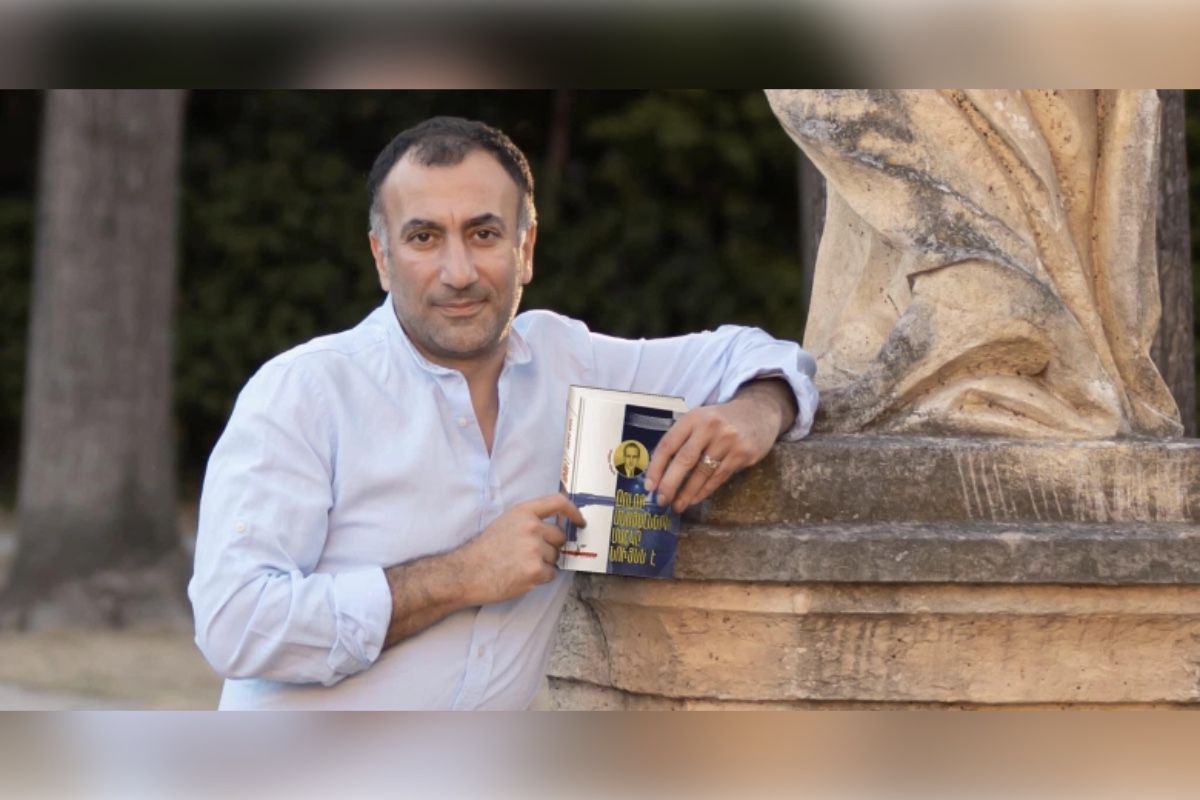
Within the Marseille Armenian community, where Armenianness can often be perceived as an exotic memory or emotional inertia, Karen Khurshudyan’s presence stands out as uniquely singular. His biography is not a linear progression but an ongoing accumulation of layers. A lawyer, a poet and translator, and since 2025 a Knight of the French Republic’s National Order of Merit, Khurshudyan’s greatest trial has never been success itself, but the preservation of light through his own darkness.
Khurshudyan’s story begins in 1979 in Vagharshapat, Armenia, yet his true formation occurred at the point of loss. At age 6, the death of his father became the watershed moment that deprived him of what he calls “the invisible support of childhood.” It was the moment when a child stopped simply living and began to observe the world as a place where nothing is guaranteed.
This personal tragedy coincided with a national crisis. For many in Armenia, the early 1990s are remembered as years of cold and darkness, but for Khurshudyan, they became a school of resilience. He clearly distinguishes the physical darkness of that time from today’s intellectual darkness.
“Studying for us was not merely education — it was a form of resistance, a remarkable kind of faith in the future,” he told the Weekly.
Today, when technological advancement has made information easily accessible, Khurshudyan sees a new danger: the decline in the quality of thinking. In his view, people have become quick to react but slow to reflect deeply, turning society into a consumer rather than a creator.
The duality of law and literature
Many people combine different professions, but in Khurshudyan’s case, law and literature are not parallel lines — they are complementary systems. Law provides him with discipline of thought, clarity of rules and awareness of boundaries. His honors degree and postgraduate studies were not merely academic milestones but deliberate attempts to systematize the world.
Yet reason alone does not make a person complete.
“Law teaches us how to judge; literature teaches us how to understand,” he said, expressing a principle guiding all his work.
The lawyer constructs systems of justice, while the poet explores the inner human world, where justice and guilt are often inseparable. Today, he is also a researcher at the National Academy of Sciences of the Republic of Armenia’s Manuk Abeghyan Institute of Literature, examining the intersections of surrealism and contemporary Armenian poetry.
Poetry: A word born of silence
For Khurshudyan, literary work is not a skill but a mode of existence. His poems — from “God’s Domain” to “The Sound of Silence” — emerge not from external themes but from moments when not writing becomes impossible. Rarely does he aim to “have something to say”; instead, he seeks to free himself from accumulated silence.
His creative method is based on cleansing language of excess.
“If you ask what I am truly searching for in my lines, I would say — not beauty, not form, but that rare moment of truth when a person suddenly recognizes themselves and, at the same time, fears that recognition.”
It is precisely at this boundary — between fear and recognition — that the true space of his poetry emerges.
Translation as linguistic humility
In his work as a translator, Khurshudyan serves as a bridge. For him, translation is not merely a linguistic skill but an “existential encounter.” Paul Éluard, Boris Vian and Voltaire are among the complex authors he chooses to give Armenian new flexibility and nuance.
He recalls a humorous yet deeply meaningful moment during his French translation of Avetik Isahakyan’s “Abu-Lala Mahari”: Exhausted, he imagined the master approaching him with a cane and asking, “Did I really write something like that?” The memory illustrates the profound responsibility he feels toward the original text. The “Kantegh” award, he received in 2023, and the Hovhannes Maséhian award, which he received in 2026, confirm that this dialogue has been successful.
The Marseille School: The last fortress of identity
For Khurshudyan, public engagement and his leadership of the Khachatur Abovyan School in Marseille are far more than administrative duties. During his presidency, enrollment grew from 12 to 200 over a decade, a testament to community engagement and cultural programs. As he puts it, this is “the preservation of a spiritual structure not made by hands.” In the diaspora, the school is not just an educational institution — it is the final refuge of identity.
He observes the quiet tragedy of diasporic life: trying to pass on values that people themselves do not fully live by.
“Children do not believe in words if those words are not embodied in a person,” he told the Weekly.
Khurshudyan’s approach to community work avoids charitable pathos. His aim is to give people strength and opportunity, as he demonstrated during the 44-day war, when he coordinated large-scale humanitarian aid to Armenia.
Although he no longer dances, dance remains a cornerstone of his inner world. For Khurshudyan, dance is humanity’s oldest language, a space where the mind falls silent and the body speaks. It taught him to trust the uncontrollable aspects of creation and to exist fully “here and now.” This same harmony is what he seeks in poetry, through rhythm and balance.
Medals not made of steel
Regarding awards, Khurshudyan maintains a clear perspective. External honors cannot define a person if the inner foundation is absent. His highest reward is not state decoration but the living breath of language.
“The best and most incomparable medal I have received is the moment when an Armenian parent is able to speak to their child in their native language.”
He recounts a father who thanked him, saying he could now hold meaningful conversations in Armenian with his child on the way to school. This, Khurshudyan believes, is his true achievement — a handmade medal that will resonate across generations.
Rather than offering a conventional conclusion, Khurshudyan’s guidance to younger generations stands out, free of didacticism:
“Follow your inner voice, do not seek external validation, and do not be afraid of asking questions — even when the answers hurt.”
Karen Khurshudyan’s life reminds us that a creator is not only a writer, but anyone who, through life and work, strives to make the world a little kinder and more humane. His path continues along the subtle boundary between silence and word, law and dream — where a true human being is formed.