

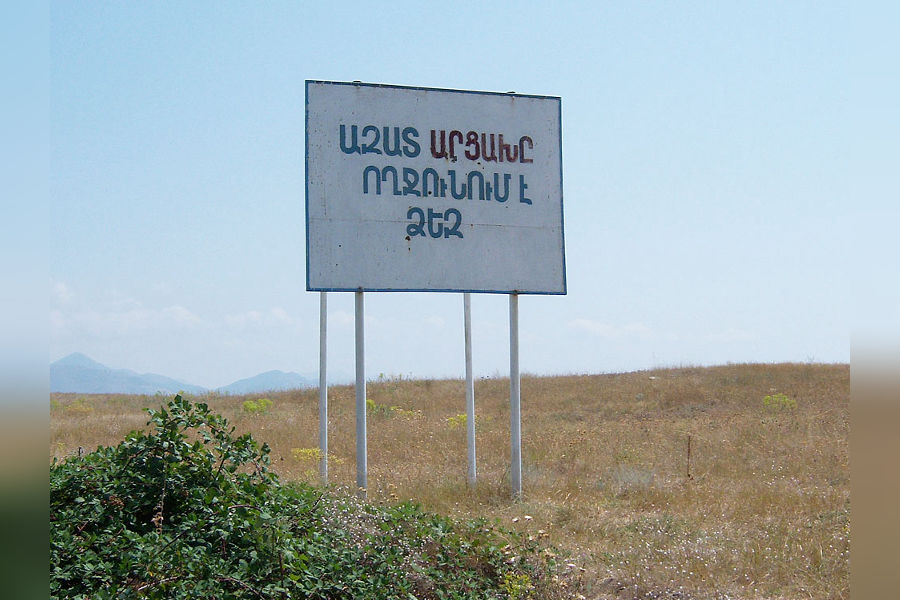
No sun rose that morning over Artsakh. Only the echo of fatal shells tore through the sky. No warm rays reached its houses; only deadly fire left yet another heartbreak in its wake. For now, the ancestral Armenian lands of Artsakh cannot be sown. But as one father once told his firstborn, “I would give up my life for you. You are destined to lead.”
The forced exodus of Artsakh Armenians from their native land in 2023 left hearts knifed with sorrow. The cross may no longer rise every morning, and its illumination may have been dismantled, but its fiery faith continues to inspire Armenian identity. Central to that identity is the Artsakh Armenian dialect — a language intertwined with history, culture and faith. Its song, “Horovel,” carries the hope of a people who dream of once more filling the houses of their native land with warmth and sunlight.
Christina Maranci, Ph.D., professor of Armenian Studies at Harvard University, began focusing more closely on Artsakh after the 44-day war. “When the war broke out in 2020, I realized how little I knew about that region. I don’t think that many Armenologists knew much about it,” she explained. “Suddenly, a lot of us started to learn about the landscapes, histories, monasteries and traditions.”
“In the next 10 years, I think there will be massive changes in the way we think about this region. New projects and initiatives will be part of that. There is going to be much more attention on Artsakh, its history and its monuments,” Maranci continued.

She stressed the urgent need to safeguard the rich cultural and linguistic heritage of the Artsakh Armenian dialect, spoken in the region until 2023. “It is so fundamental to know who we are as Armenians. It’s not just how we communicate, but how we relate to the world, how we shape ideas with that language,” she stated.
“It’s not simply a tool; it is something much more deeply ingrained in us. And in that sense, I think it’s comparable to the heritage that I work on — the architectural heritage or the artistic heritage, which aren’t just stones and simple buildings. They are deeply connected to history, to religion, to identity.”
Maranci emphasized that saving the dialect is critical for future generations. “The question of language survival is deeply connected to being human and to knowing who you are, who we are,” she stated.
In 2023, the Artsakh dialect faced peril due to the mass exodus of its native speakers following the region’s geopolitical developments. The potential disappearance of the language is deeply concerning, as centuries of cultural heritage could be lost to oblivion. Preserving and revitalizing the dialect is crucial, both culturally and linguistically.
“The Western Armenian parallel, during and after the genocide, shows that there were many efforts to collect and commemorate the volumes that documented regions of Ottoman Armenia and their songs, poetry, jokes and their dialects,” Maranci explained.
“You’re never going to go back in time and there will be things that are lost. But there are ways to make sure that we don’t lose everything.
Armen Sargsyan, president of Artsakh State University in Stepanakert before the forced exodus, has spent the last 30 years raising public and academic awareness of Artsakh’s unique linguistic and cultural heritage. “It is the heritage of our ancestors, but also the rich cultural and literary legacy of the Artsakh people. Their ethnography and folklore enrich the whole [of] Armenian culture,” he explained, recognizing the status of Artsakh Armenian as a cultural and linguistic code of its native speakers.
According to Sargsyan, previous attempts to establish an Artsakh university, school or cultural center in Yerevan did not receive support. Now, the Armenian diaspora must decide how to ensure Artsakh’s preservation. Sargsyan suggests starting by translating academic works on Artsakh folklore and linguistics into English, promoting interest within academia and securing the language’s legacy. Although some institutions in the diaspora are taking steps to promote Artsakh Armenian studies and center the voices of those displaced by Azerbaijani aggression, the work has just begun.
Further steps could include digital and mass media initiatives producing content in the dialect, raising awareness in universities with Armenian studies or linguistic programs and conducting field research to document the personal narratives of Artsakh Armenians. Ultimately, establishing an Artsakh cultural center to host performances, conferences and exhibitions celebrating the region’s unique traditions could help prevent this invaluable heritage from falling into oblivion.