


Soprano Isabel Bayrakdarian kicks off East Coast, Canada tour
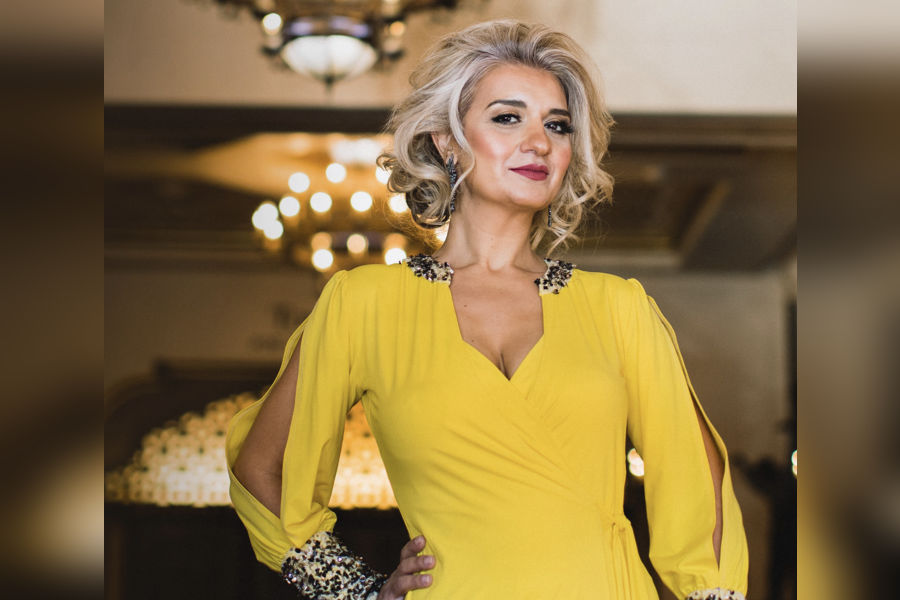
NEW YORK — Soprano Isabel Bayrakdarian will present an innovative program at her upcoming concerts in New York City (Nov. 13), Boston (Nov. 15) and Toronto (Nov. 22).
Titled “Ancestral Songs, Prayers and Lullabies,” the collection draws on a tradition established by Gomidas and carried forward by his students Parsegh Ganatchian and Mihran Toumajan.
Speaking with Lisa Terrizzi of the Friends of Armenian Cultural Society, the presenter of the Boston performance, Bayrakdarian shared insights on her journey from choir girl to internationally renowned artist, as well as her ongoing mission to discover, probe and present Armenian musical gems.
Lisa Terrizzi (L.T.): Did you grow up in a musical household, and what drew you specifically to voice?
Isabel Bayrakdarian (I.B.): My first love was, and continues to be, Armenian sacred music. Singing and discovering our beautiful and ancient hymns has been a path forward, inward and upward, making for a uniquely personal journey.
I grew up playing the piano and singing in our Armenian church choir in Lebanon. The only reason I wanted to take voice lessons, in my late teens in Canada, was to communicate freely with God through fearless singing that comes with a solid technique. I wanted to do justice to the beautiful melodies of our sharagans, without having the limitations of the body dictate my spiritual expression, hence the long legato that I had to develop early on in my technique.
Classical Armenian (or Krapar) — the language of our prayers — challenged me to work on breath control, as sometimes half a page of music is placed on a single word. The believer and perfectionist in me couldn’t interrupt a sacred word like Asdvadz (God) or Surp (Holy) to take a breath, break[ing] the energy of the word.
L.T.: How did you maintain your musical development while studying biomedical engineering, and did you always envision pursuing a performance career?
I.B.: I took singing lessons and kept singing in our church choir in Toronto during my undergrad years. The “aha” moment came between my second and third year of engineering, when I took one year off to do an internship at IBM. That year gave me the time and resources to pursue singing lessons more regularly, rigorously and with more dedication, which meant that my vocal growth shot up to a completely new level. I was hooked and I wanted more! I must admit, returning to my junior year of engineering was very difficult, because the passion wasn’t there anymore, and I couldn’t wait to finish my degree and jump into music-making.
L.T.: How does interpreting and performing ancestral music differ from a more classical music repertoire?
I.B.: Trust is the key word here. Trusting that your soul, heart and DNA already know this repertoire on an elemental level, and all that is needed is an unobstructed path. This means not imposing any standard performance expectations on it, nor trying to fit it into a classical model; otherwise, it will sound operatic and classical and not at all ancestral.
The breath control, legato and technical mastery is still there, but their mission is to free up the whole instrument so that the essence of my soul, which is connected to my ancestors, can emerge through melody and words. Coincidentally, that’s also when audience connection happens.
L.T.: You bridge many musical genres. What’s next for you? Are there new directions that you would like to explore?
I.B.: I have a very curious mind, which has meant a diverse and interesting discography — and obscure projects, too. I’m still curious, but now I contemplate a lot, too. It’s very important for me to choose projects that resonate and align with my identity and ever-evolving mission. I have two different passion projects that I’ve been curating and both share the common denominator of having the Armenian essence. Stay tuned!
For tickets and information about the Boston concert, please visit http://www.FACSBoston.org