Vigen Aghayan: A young poet grows from a border village
“My name is Vigen Aghayan. I am from the village of Chakaten in Kapan, Syunik Province,” begins the young poet. For him, the homeland starts from the village — its soil, trees, even its shortcomings — all of which turn into literary inspiration.
Aghayan grew up surrounded by his grandparents, always close to nature. He says that nature and God became his first muses. “If I hadn’t been born in a village, if I hadn’t been so close to the land and the village, I could not have become a writer,” he told the Weekly.
The landscape of Chakaten — green fields, wildflowers, mountains and trees — shaped his worldview from an early age. At 10 or 11, he wrote his first poem and fairy tale, enrolled in art school and discovered theater. From that moment, creativity became not just an interest but a defining part of his identity.
From poetry to stage
Aghayan’s path has never been confined to books. Today, he studies directing at the Armenian State Pedagogical University and performs at the Kapan Drama Theater. “I like to be honest with my audience — whether on stage or in the pages of a book. If there is no emotion, no line will be born.”
He recalls once being asked to write lyrics for a love song, but refused: “My heart wasn’t in love, and I couldn’t fake it. When I feel it, I will write. Until then, I won’t.” For him, honesty is as important as literary skill.
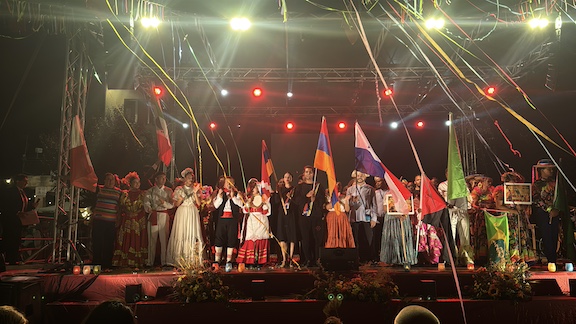
His love for theater has also brought him achievements. In 2022, his group performed Hovhannes Tumanyan’s tales in Armenian at a theater festival in Georgia. Though the jury didn’t understand the language, Aghayan says they laughed, cried and admired the performance. The Armenian troupe won top honors.
Life in the shadow of a border reality
After the 2020 war, Aghayan’s village became a border settlement. Before the war, the enemy was more than 100 kilometers away. Now, Azerbaijani positions stand just meters from village homes, and the road leading into Chakaten is under constant surveillance.
“We have learned that behind every step lies the danger of a gunshot. But protecting the land is a matter of identity for us,” he explained.
The war brought not only physical danger but also a heavy psychological burden on the entire community. Villagers work their fields quickly and cautiously, knowing they might become targets. “Before, we were free to go out at night. Now, every step is accompanied by fear.”
This reality has also left a deep mark on Aghayan’s writing. Many of his poems carry lines born from the pain and hope of war.
“Homeland is not only land — it is also people. When I write about my village, the greatest hero is the villager with calloused hands from the soil.”
Poetry collections: A ray of hope in the reader’s heart
Vigen Aghayan has already published two collections. The first, Towards Victory, My Chakaten, was released with the support of the Syunik regional administration. Its presentation was held in the village itself. “For years, such an event hadn’t taken place here,” he stated. “I wanted the first to be right here.” Copies of the book were donated to fellow villagers, schools and libraries.”
The second, The Beat of My Heart is You, Homeland, is his most personal work. It was published at his own expense, with only 50 copies. Though he has planned to donate them all to the Kapan community libraries and several village schools.
“I don’t like shouting about patriotism. I prefer to remain silent and act. With this book, I want to light a ray of hope in the reader’s heart, to show that everything can still be all right.”
Aghayan does not hide the difficulties he faced in publishing. The first collection came out with state support, but the second was financed from his own budget. “It was a big expense, but I wanted the book to be published — especially since it is my heartbeat.” A presentation is planned in Kapan, both as a literary event and a community gathering.
Dreams for the future
Despite the hardships, Vigen Aghayan has big goals. He hopes Armenia will one day have creative centers where young writers can publish their work: “Many young people have potential but cannot publish. They should not be discouraged.” He expressed the belief that talented youth, especially in border villages, need opportunities to develop.
Not everything should be published, he says, but sincerity must be valued above all: “I don’t like when someone edits my poems. They are my feelings, my way of expression. If there is sincerity in a line, it is already worth publishing.”
For Aghayan, the future lies not only in books and on stage, but also in people: “Homeland is not just land. Homeland is also my relatives, my fellow villagers. I want to live and work in a way that my work is useful to my people. I do what I can, trying with my steps to bring honor to my country.”
One of his dreams is to continue writing and raise Armenia’s flag on international stages: “I’ve already managed it two or three times. I want this not to be an exception, but a rule.”