


Our holy translators
Every year on the second Saturday of October, Armenians everywhere celebrate the Feast of the Holy Translators, in commemoration of those intellectual and spiritual giants who laid the foundations of Armenian literature, and of those who followed in their footsteps and further enriched our culture.
The movement started in the fifth century A.D. with the invention of the Armenian alphabet and the translation of the Bible into Armenian.
Whether or not there was an Armenian alphabet prior to the fifth century A.D. is a matter of discussion among Armenian scholars. One thing is obvious: there were no workable Armenian alphabetic characters and Assyrian and Greek letters were in use for the church liturgy and literature. This constituted a fundamental obstacle to the development of the intellectual, social, cultural and religious life of the Armenian nation.
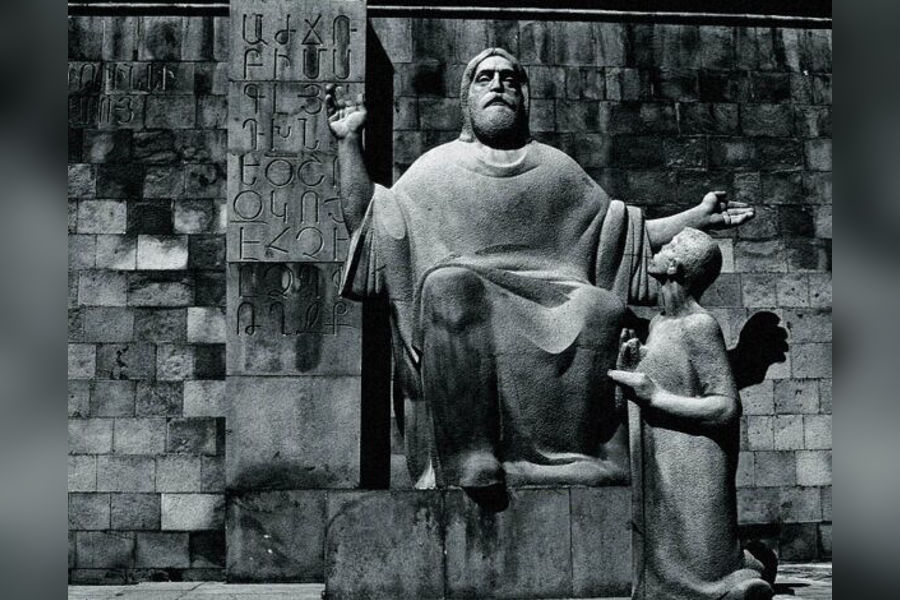
St. Mesrop Mashtots (c. 362-440), a former secretary of the Armenian king and a vartabed (priest), conceived the idea of inventing an original alphabet. He had the blessing and support of Catholicos Sahag and King Vramshabouh.
These three Armenian titans of the fifth century realized the difficulties of preaching the Gospel in Armenian without the use of the indigenous Armenian language. They were conscious of the pressing need to translate the Bible into Armenian to put the Bible in the hands of the people. Both the king and the Catholicos encouraged Mashtots to research the development of an Armenian alphabet. Mashtots dedicated himself to this sublime task and invented the Armenian alphabet in 405 A.D. Thus, by inventing the 36 letters (later two more were added), Mashtots gave the most lasting and indestructible gift to the Armenian nation: a granite rock foundation upon which our culture was built.

Soon after the invention of the Armenian alphabet, St. Sahag and St. Mesrop, recruiting a select team of translators, embarked upon the translation of the Bible into Armenian. Some of the prominent members of this team were Hovsep (later elected Catholicos), Ghevont (the famous priest of the Vartanantz War), Eznik of Goghp, Koriun and others.
The first translation of the Armenian Bible was made from the Syriac version, called Peshitta. It was not a complete translation. It omitted some books of the New Testament which were not yet a part of the Syriac Canon.
A second translation, known as the Pootanagi (which means “done hurriedly”), was made between 408 and 415 A.D. from the Greek Septuagint version and adjusted to the Peshitta.
Finally, a third translation was done in 431 A.D. under the direction of Catholicos Sahag, from the Greek text. It was officially approved and became the authorized version of the Armenian Bible in 438 A.D.
The Armenian translation of the Bible started an unprecedented educational and literary movement, as well as a religious awakening for the Armenian people. It provided the long-awaited impetus for literary activity, culminating in the unparalleled “Golden Age” of the fifth century. The translation of the Bible in the most magnificent style of the classical language, Krapar (Classical Armenian), was followed by similar translations of codices both in Syriac and Greek, procured from such centers of learning as Edessa, Athens, Constantinople, Alexandria, Antioch, Caesarea in Cappadocia and elsewhere. Besides, they left several historical works, including the works of Faustus of Byzantium, Elisha Vartabed and Lazar of Pharp. In successive centuries, the works of numerous Armenian scholars, whose studies included history, hymnals, canonicals, philosophy, medicine, astrology, calendrical works, philology and lexicography.
The invention of the Armenian alphabet ushered in a new age of intellectual and spiritual enlightenment.
Mesrop Mashtots, the chief architect of the Golden Age and his venerable colleagues, the Holy Translators, have been a source of inspiration, generation after generation, to numerous Armenian intellectuals throughout our history.