




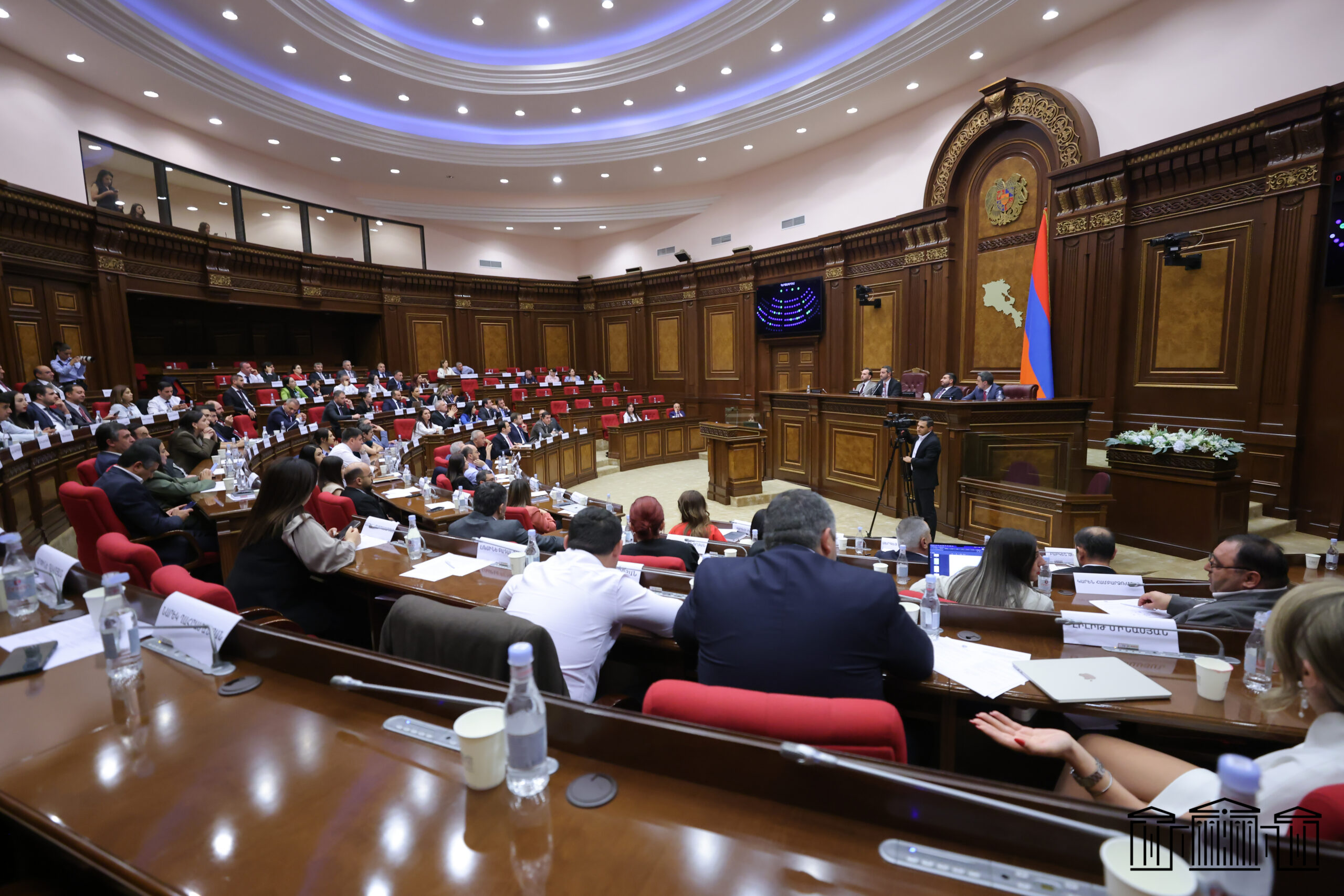
YEREVAN — The opposition “Hayastan” (Armenia) faction has introduced a bill in Armenia’s National Assembly seeking to criminalize the denial of the Armenian Genocide, sparking a heated political debate that underscores deep divisions within the legislature over national identity, historical responsibility and the direction of current government policy.
The proposed legislation calls for more precise language in the law, explicitly naming the Armenian Genocide rather than referring to genocide in general. The opposition also seeks to criminalize not only the public denial or minimization of genocide but also public approval or justification of such statements.
Presented during the first reading, the proposed amendment to the Criminal Code would impose penalties for denying the Armenian Genocide, including fines ranging from 100 to 300 times the minimum monthly wage, public service of 150 to 250 hours or restriction of freedom for terms ranging from one month to four years.
In his address to parliament, Artsvik Minasyan, Secretary of the “Hayastan” faction, argued that the legislation is essential for safeguarding historical truth and national dignity. “This bill is not just about the past — it’s about our future, our national identity and ensuring that future generations understand the weight of historical justice,” he said.
However, the bill met resistance from the ruling “Civil Contract” party. Alkhas Ghazaryan, speaking on behalf of the Standing Committee on State and Legal Affairs, advised voting against the proposal. She argued that Article 136 of the current Criminal Code already criminalizes denial of genocide, making the new bill redundant. “There is no legal gap to fill,” she stated, “and no citizen of Armenia has denied the Armenian Genocide, nor will they.”

Minasyan pushed back, choosing not to cite statistical evidence but instead quoting Prime Minister Nikol Pashinyan’s controversial remarks on the Armenian Genocide, delivered earlier this year during a meeting with the Armenian community in Switzerland.
“How have we perceived this? Through whom have we perceived it? How is it that in 1939, the Armenian Genocide was not on the international agenda, and by 1950, it was? Should we understand this or not?” Pashinyan had asked rhetorically during that meeting, questioning the evolution of genocide recognition on the global stage.
Without directly naming the Prime Minister, Minasyan presented the quote to illustrate what he sees as an alarming trend toward relativizing or reframing the historical narrative of the genocide. Opposition MPs argue that such rhetoric contributes to a broader governmental shift away from prioritizing the Armenian Genocide in domestic and foreign policy discourse.
Opposition MP Artur Khachatryan accused the government of downplaying the genocide for geopolitical convenience. Citing recent criticism from the Lemkin Institute — an international genocide prevention organization — regarding Prime Minister Nikol Pashinyan’s April 24 remarks, Khachatryan argued that the current administration has adopted a policy that “diminishes the gravity of genocide.”
MP Gegham Manukyan defended the timing of the bill, claiming it responds to alarming signs that the Armenian Genocide is being deprioritized in international forums. “Until recently, it was unimaginable that Armenia’s own Ministry of Foreign Affairs could allow the Genocide to be excluded from the agenda of international conferences,” he said. “Now that it’s become a reality, we must take legal action to prevent such erasure.”
Tensions escalated as more MPs took the floor. Kristine Vardanyan, another member of the opposition, questioned the ruling party’s motives:
“I cannot understand why any Armenian would oppose this bill. The only ones who might take issue are those who question whether the recognition of genocide serves a strategic purpose — the same individuals who, when the Prime Minister of Israel recognizes the Armenian Genocide on live television, respond the next day by asking: ‘What problem does that solve for us?’”
Opposition leader Seyran Ohanyan delivered a forceful critique from the parliamentary podium, accusing the current government of fostering a political climate that threatens both Armenia’s present and future. “Through manipulations and contradictory policies, this administration has created an environment of national uncertainty,” he said. “This bill is not merely symbolic. It addresses matters of national security and prevention. The Armenian Genocide was a sequence of atrocities that must be acknowledged in full.”
Ohanyan also linked the historical genocide to contemporary events, suggesting that the forced displacement of Armenians from Nagorno-Karabakh constitutes a continuation of genocide under Azerbaijan, carried out with the silence — or complicity — of the current Armenian leadership. “Instead of Turkey and Azerbaijan being held accountable,” he said, “they have become the ones pointing fingers.”
Referring to Armenia’s 2020 National Security Strategy, Ohanyan cited Clause 4.25, which outlines Armenia’s obligation to prevent the forced displacement of the people of Artsakh. He criticized the government’s failure to act, calling it a breach of national responsibility.
Critics argue that the government’s reluctance to fortify genocide denial laws is part of a broader pattern — a deliberate distancing from historical narratives that have long defined Armenia’s foreign and domestic policy. Nowhere is this shift more apparent, they say, than in the government’s approach to Artsakh.
Earlier this week in Strasbourg, Prime Minister Nikol Pashinyan made international headlines by declaring that the issue of Artsakh is “closed,” and that the right of return for forcibly displaced Armenians is “unrealistic” and threatens the ongoing peace process. His remarks have provoked sharp backlash from across the political spectrum, none more forcefully than from Armenia’s former Foreign Minister, Vartan Oskanian.
In a strongly worded statement, Oskanian accused the Prime Minister of abandoning a fundamental pillar of Armenia’s national cause. He warned that framing the right of return as a threat to peace is not only politically expedient but dangerously misleading.
“Just days ago, the U.S. administration officially affirmed that the right of return for Artsakh Armenians is a core component of any just solution,” Oskanian wrote. “Washington also highlighted the need to release Armenian political prisoners and safeguard cultural heritage. To reject this is to deny a truth already enshrined by the international community.”
According to Oskanian, Pashinyan’s urgency to finalize a peace agreement stems from personal political motivations rather than national interest.
“He has made so many concessions to Azerbaijan that reopening the issue now seems politically impossible to him,” Oskanian asserted. “He fears that if the right of return returns to the agenda, it could delay the signing of a ‘peace treaty’ — a treaty he hopes to showcase ahead of upcoming elections. In this calculus, one man’s survival is placed above the rights of an entire people.”
Oskanian emphasized that genuine peace cannot be brokered at the expense of historical justice and ethnic dignity. “Peace built on ethnic cleansing is not peace — it is capitulation,” he wrote.
International support for the right of return, he argued, is only growing. The International Court of Justice has already ruled that Azerbaijan must ensure the safe and unimpeded return of displaced Armenians. Lawmakers and officials from France, Belgium, Switzerland, the European Parliament and beyond have echoed this principle, affirming that peace cannot be sustainable if it legitimizes the erasure of an indigenous population.
“The issue is not closed,” Oskanian declared. “It lives on — in international law, in diplomatic resolutions and in the hearts of all who seek truth and justice.”
Looking ahead, he expressed confidence that a future Armenian government would once again center the right of return within international negotiations, bolstered by broad international backing.
“In a post-Pashinyan Armenia, I have no doubt that the right of return will return to the negotiating table. The international community understands this: real peace will only come when the Armenians of Artsakh can return home in safety and dignity.”
As Armenia grapples with questions of historical memory, state responsibility and regional security, the debates unfolding in the National Assembly and beyond suggest a nation at a crossroads — not just between past and future, but between the political expedience of forgetting and the moral imperative to remember.


I am speaking as a diosporan Armenian. While I find Armenian Genocide denial dishonest, revolting, and unpatriotic, criminalizing free speech is a slippery slope. The opposition may be better served in using their freedom of speech to point out out how the current prime minister is jailing political opponents and capitulating to the enemy. Call him Pashinoglu and question why he is potentially colluding with Aliyev to keep his political opponents and critics in Azeri prisons for political purposes.
It is up to the Armenian people if they wish to get rid of the current Prime Minister at the ballot box in 2026. If the current government refuses to hold free and fair elections, then the opposition will need to rise up. If there are free and fair elections, then the results need to be respected by the losing side.
They really like Russia…
We really don’t like Turks…
This corrupt failed former journalist Pashinyan, of all people, should know that in 1939 the term “genocide” did not yet exist and it was invented in 1944 by Lemkin and adopted by the UN in 1948 and that is why the Armenian Genocide was not on international agenda in 1939 and was in 1950. He is truly a disgrace and an embarrassment to our nation in every which way one can imagine. The law on Armenian Genocide denial must definitely be amended and toughened even if such law already exists that criminalizes its denial. The amended law without any exception must apply to all from general public to those in position of power in particular as well as foreign nationals.
Can I ask, Mr “Ararat”, under your “amended and toughened” proposal, am I to be criminalised in Armenia because of amateurish Armenian scholarship (originating with Dadrian, who took at face value a typo in Ural’s propaganda work that inserted an extra 5 at the end of the hitherto accepted 234 that Ural in turn got from Armenian works) that states that a total of 2,345 Armenian notables were detained and deported in April 1915? Or am I to be limited to only receiving the usual death threats for pointing out the mistake? Exactly what unquestionable orthodoxy regarding the Armenian Genocide do you want to be protected by Law, and what aspects of the study of it are to be criminalised heresy?
Being 3rd generation of Armenian Genoside (from both mother & father), what’s happening with current government is nothing short of another Genoside for all Armenians, the Armenians have to stand up and demand to be heard and saving the Mother Land from it, we owe 1,500 millions to our ancestors to be noted and calibrated (our future is the youth, to live an prosper and incaraged without politics (or gain of wealth)