The Region in Brief
Armenia
The defense council representing Samvel Karapetyan sharply criticized Armenia’s Anti-Corruption Court for extending his detention by another two months, calling the ruling “illogical” and a sign of the absence of true justice in the country.
Despite the decision, the council affirmed its commitment to justice in Armenia, stating that “judges must be free to carry out their professional duties without fear, guided solely by the law.” It also thanked the thousands of supporters who gathered outside the courthouse or followed the proceedings online, expressing appreciation for their solidarity.
Looking ahead, the council confirmed that all previously announced plans remain in effect, including the launch of Karapetyan’s new civic initiative, the “Mer Dzevov” (Our Way) movement. Set to begin at the end of August, the initiative is described as a long-anticipated turning point in Armenia’s political landscape.
Artsakh
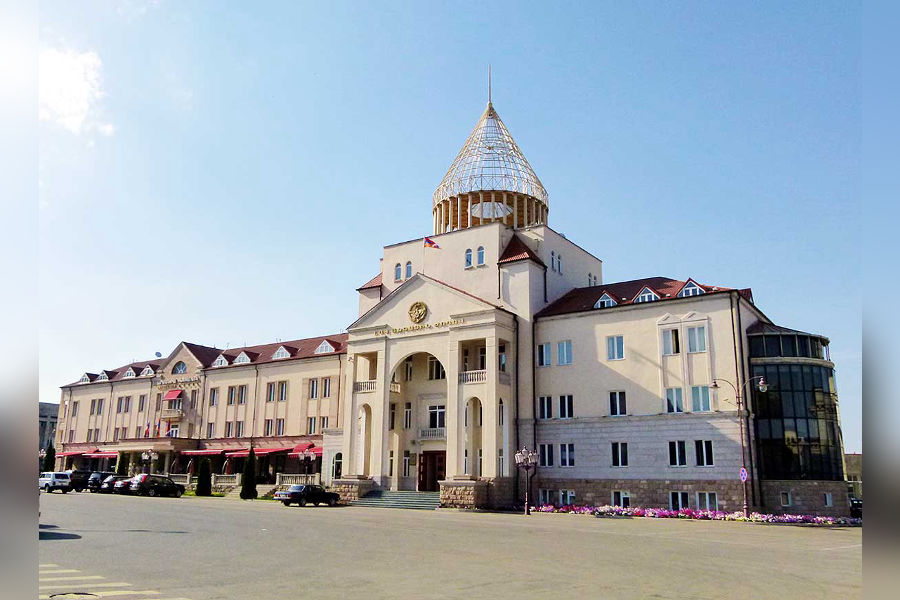
As part of an ongoing campaign to erase the region’s historical and cultural identity, Azerbaijani forces have reportedly dismantled all 25 statues and busts dedicated to prominent Armenian and international figures in occupied Stepanakert, according to the Artsakh Cultural and Tourism Development Agency.
Among the demolished monuments were those honoring Soviet-era war heroes Marshal Hovhannes Bagramyan, Admiral Ivan Isakov (Hovhannes Isakyan) and pilot Nelson Stepanyan. Memorials dedicated to key cultural figures—Henrik Barkhudaryan, Hovhannes Tumanyan, Khachatur Abovyan, Vahram Papazyan, Charles Aznavour, Hovhannes Aivazovsky and Andrei Sakharov—were also removed. Monuments to participants of the Karabakh liberation movement, including Ashot Ghulyan, Kristapor Ivanyan, Anatoly Zinevich and Yuri Poghosyan, were among those destroyed, as were statues of revolutionary figures such as Stepan Shahumyan, Alexander Miasnikyan and Alexander Tsaturyan.
Iran
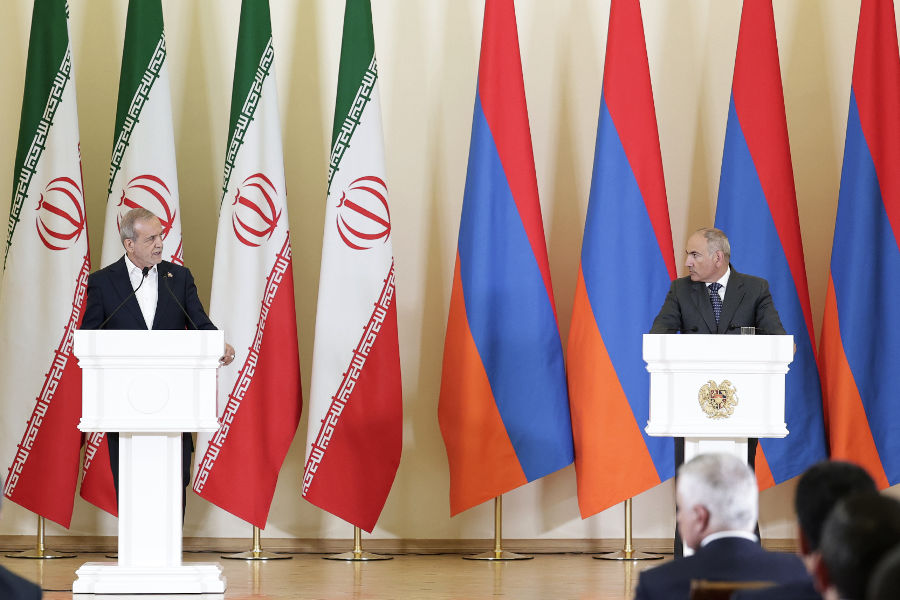
During Iranian President Masoud Pezeshkian’s official visit to Yerevan, Armenia and Iran signed 10 bilateral agreements spanning political, economic and cultural sectors. A key focus of the visit was strengthening cooperation in transport and infrastructure. Iranian Minister of Roads and Urban Development Farzaneh Sadegh met with Armenian Minister of Territorial Administration and Infrastructure Davit Khudatyan to discuss major regional transit routes, particularly the North-South and Persian Gulf-Black Sea corridors.
Both sides agreed to construct a second bridge at the Meghri–Norduz border crossing, upgrade the existing one, modernize terminals and adjust freight fees to facilitate smoother cargo movement. They also confirmed plans to reopen the Julfa-Yerevan-Georgia railway and complete its extension through Nakhichevan to Yerevan. The initiatives are expected to boost regional transit and trade. Additionally, draft agreements on air transport cooperation are being finalized and will be signed in the near future.
Russia/Azerbaijan
A series of drone strikes launched by Russia targeted an oil depot in Odessa operated by the Azerbaijani state oil company SOCAR, igniting a fire on site, according to Azerbaijani state media. The APA news agency reported that the strikes caused significant damage and assessment efforts are currently underway to evaluate the full extent of the destruction.
In response, Azerbaijani Member of Parliament Rasim Musabekov strongly condemned the attack, calling it a direct provocation against Azerbaijan’s economic interests and energy security. He urged the Azerbaijani government to move beyond official statements and respond with concrete actions, including the potential sale of weapons to Ukraine.
“This is clearly a provocation aimed at undermining Azerbaijan’s economic assets and strategic energy infrastructure,” Musabekov stated.


What Azerbaijan is doing in Artsakh, is exactly the same what the Taliban and ISIS did: Cultural Genocide. The only difference is, that Azerbaijan’s crimes have not caused any outrage internationally and hardly even make news internationally. Worse, the Pashinyan government is shamefully silent on this.
The Azeris have destroyed the vast majority of Armenian heritage in Artsakh, including statues, monuments, government buildings symbolizing Artsakh, churches, monasteries, even cemeteries, apartment blocks and whole villages, since they grabbed all of Artsakh in 2023. They already started destroying every Armenian heritage, when the periphery of Artsakh was awarded to them in 2020.
The only Armenian church and two monasteries, that were not demolished outright, are the Shushi Cathedral and the Gandzasar and Amaras monasteries. These have been expropriated by Azerbaijan as “Caucasian Albanian”, and have been desecrated inside and outside, by changing the appearance of the cathedral and destroying Armenian writings, paintings and khachkars inside and around these buildings. With this act of vandalism, these three desecrated buildings are symbolically as good as destroyed.
Azerbaijan continues with this cultural Armenian Genocide, until no trace of Armenian heritage is left, and has made it clear that Armenians will never be allowed to live and be buried in Artsakh. On top of that, with the vast building projects and new settlements, Artsakh is becoming unrecognizable and alien, in preparation for settling 600,000 Azeris, who are rabidly Armenophobic and would lynch an Armenian on sight.
Can the supporters of the so-called “peace treaty” and of Pashinyan explain, how on earth is peace possible with such a genocidal regime?