


Trading places: How Armenia risks becoming a pawn in the U.S.-Russia-Turkey game
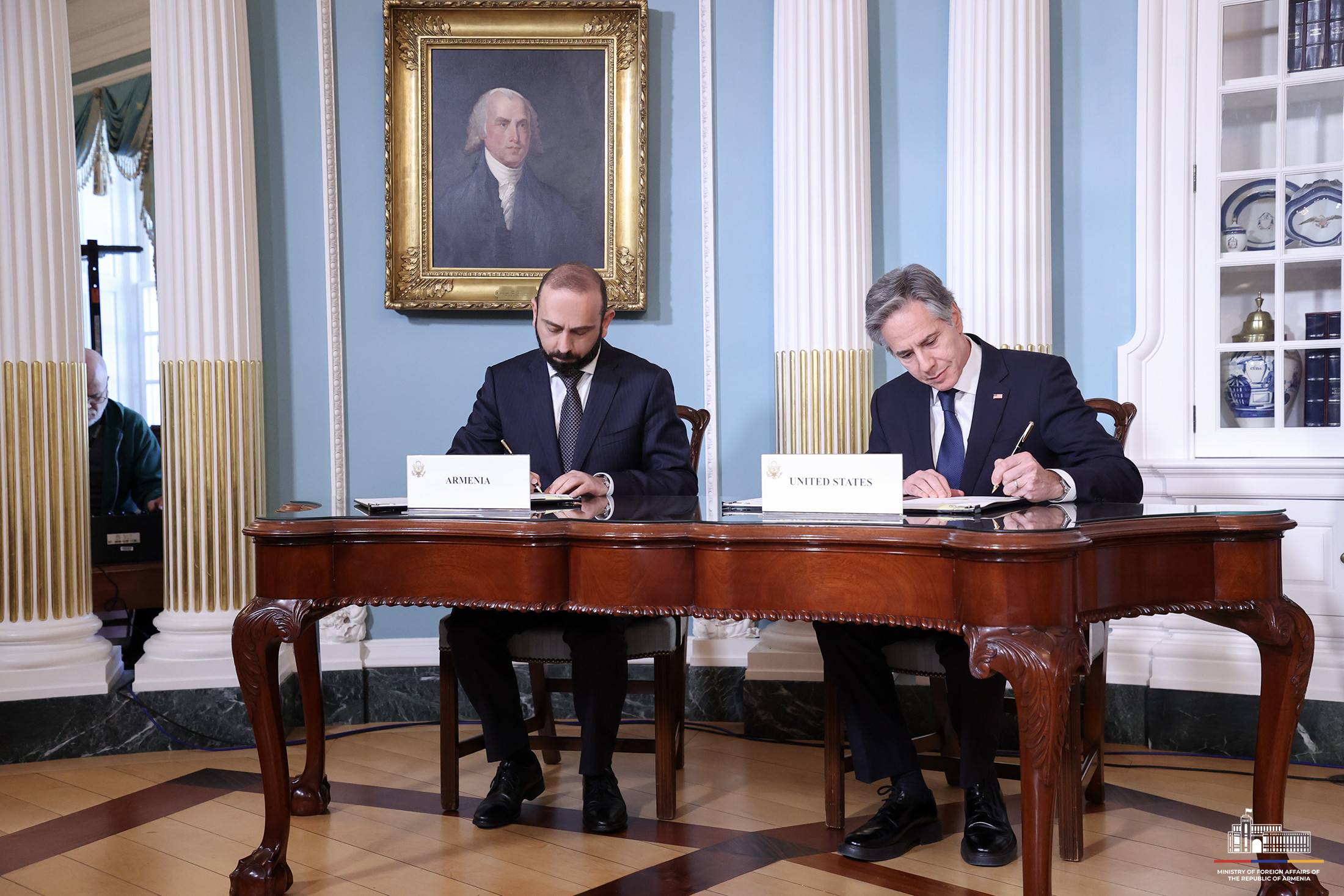
For decades, Russia has been Armenia’s principal security guarantor, projecting power through its Gyumri military base, its border guards along the Turkish and Iranian frontiers and its role in brokering ceasefires in 1994, 2016 and 2020. But the August 8, 2025, U.S.-brokered Armenia-Azerbaijan deal at the White House signals more than a peace effort—it marks a potential shift in the geopolitical tectonics of the South Caucasus.
Coincidentally, this development comes as the Trump administration has turned a blind eye to Russia’s recent transgressions and suddenly scheduled a meeting with President Putin in Alaska on Friday, amid reports of a potential land swap.
In Moscow’s eyes, the Armenia-Azerbaijan deal was no ordinary mediation. It was a calculated intrusion into what Russia sees as its exclusive sphere of influence, timed to exploit its distraction in Ukraine. Kremlin strategists may worry about precedent: If Washington can push Moscow out of the Caucasus, what’s to stop similar moves in Central Asia or other post-Soviet regions?
What if a quiet quid pro quo is at play—a “grand bargain” in which Russia tacitly concedes influence in the South Caucasus in exchange for U.S. tolerance of its territorial gains in Ukraine? The logic is cold but familiar: Ukraine’s strategic importance to Russia dwarfs Armenia’s. For Washington, the Caucasus offers a chance to counter Iran, influence Caspian energy flows and reinforce Turkey’s regional role. For both powers, Armenia is not the prize but a bargaining chip, given Armenia’s pedestrian foreign policy vision and implementation.
That reality becomes sharper when factoring in Turkey’s status as a NATO ally and Washington’s reliance on Ankara for Black Sea access, countering Russia and controlling migration into Europe. Any U.S.-led settlement will likely bend toward Turkish and Azerbaijani red lines—particularly on the “Zangezur Corridor”—leaving Armenia with minimal leverage, especially as it drifts from Moscow without securing alternative defense guarantees.
Turkey’s neo-Ottoman ambitions and the prospect of the Istanbul Canal—a Bosphorus bypass that would dilute the Montreux Convention—offer Moscow a new maritime valve as a side deal that will further project Turkey’s independent foreign policy, creating a larger lever over the South Caucasus and further assertion of dominance in global affairs.
If the U.S.-Turkey-Azerbaijan alignment solidifies, Armenia could face a dangerous mix: erosion of territorial integrity under “peace” frameworks, the creation of a security vacuum without Russian troops or NATO protection and economic dependency on its historic adversaries. Culturally and politically, this integration would reopen historic wounds—from the 1915 genocide to the 2023 Artsakh ethnic cleansing—risking deep internal destabilization.
The lesson is stark: replacing one unreliable patron with another whose interests may diverge from Armenia’s survival is not a strategy—it is surrender in slow motion.
Europe, meanwhile, alternates between moralizing and inertia: quick to bless “stability” that ratifies aggression and ethnic cleansing in the South Caucasus, skittish about similar trade-offs in Ukraine and rarely willing to underwrite either stance with power. In this landscape, Armenia will be negotiated over, not with, unless it asserts agency—diversifying partnerships, rebuilding credible deterrence and locking in enforceable guarantees that no corridor or “grand bargain” can casually unwind. The choice is blunt: become a corridor others patrol, or a country that sets its own terms.
If the possible U.S.-Russian “grand bargain” over Armenia is indeed the plan, it would result in an informal understanding in which Russia tolerates a U.S.-led settlement in the South Caucasus in exchange for U.S. accommodations of Russian gains in Ukraine. Russia and the U.S. would benefit from “territorial control”—Russia would consolidate occupied Ukrainian territories and potential unimpeded access through Canal Istanbul, while the U.S. would gain influence over the Armenia-Azerbaijan peace process and reduce the Russian footprint in the Caucasus. Armenia, however, would lose its primary security guarantor without a guaranteed replacement.
Russia and the U.S. would also gain energy leverage, with the U.S. maintaining control over European-bound gas through occupied areas and Russia expanding access to Caspian energy via Azerbaijan and the TRIPP corridor. Armenia, meanwhile, would be sidelined from major energy projects. At the same time, Turkish influence in the region would grow, Russia could redirect resources from the Caucasus to Ukraine and the U.S. would strengthen its cooperation with Turkey while enhancing NATO’s posture in the Black Sea.
Finally, the diplomatic narrative would favor the U.S. and Russia. The latter would maintain its image of a great power managing spheres of influence, the U.S. would demonstrate its ability to reshape post-Soviet spaces and Armenia’s sovereignty would be negotiated without its full agency.
The bottom line: If such a bargain exists, Armenia risks being squeezed out of both alliances—losing Russian protection without securing NATO membership or other enforceable guarantees, while facing increased economic and political dependency on Turkey and Azerbaijan.


How is it that a 10 year old child looking at a map of the South Caucasus can immediately know what Armenia must do but other, seemingly intelligent adults do not?
The key to what is happening lies in a building in Yerevan.
Just take a walk in Yerevan and have a look at the American Embassy there.
It is immense!
What is it for?
What are the Americans doing in there?
It should be obvious that the Americans intend to manipulate Armenia against both Iran and Russia.
Pro-Westerners are geographically illiterate Turk lovers.
Shame on the Armenian Americans and their decades of Russophobia! They are more of a curse to Armenia.
Geography cannot be defied and must be obeyed.
Meanwhile, the 10 year old child will simply point to the ome country that is Armenia’s only salvation – Russia!
Robert Whig, I agree 1000%