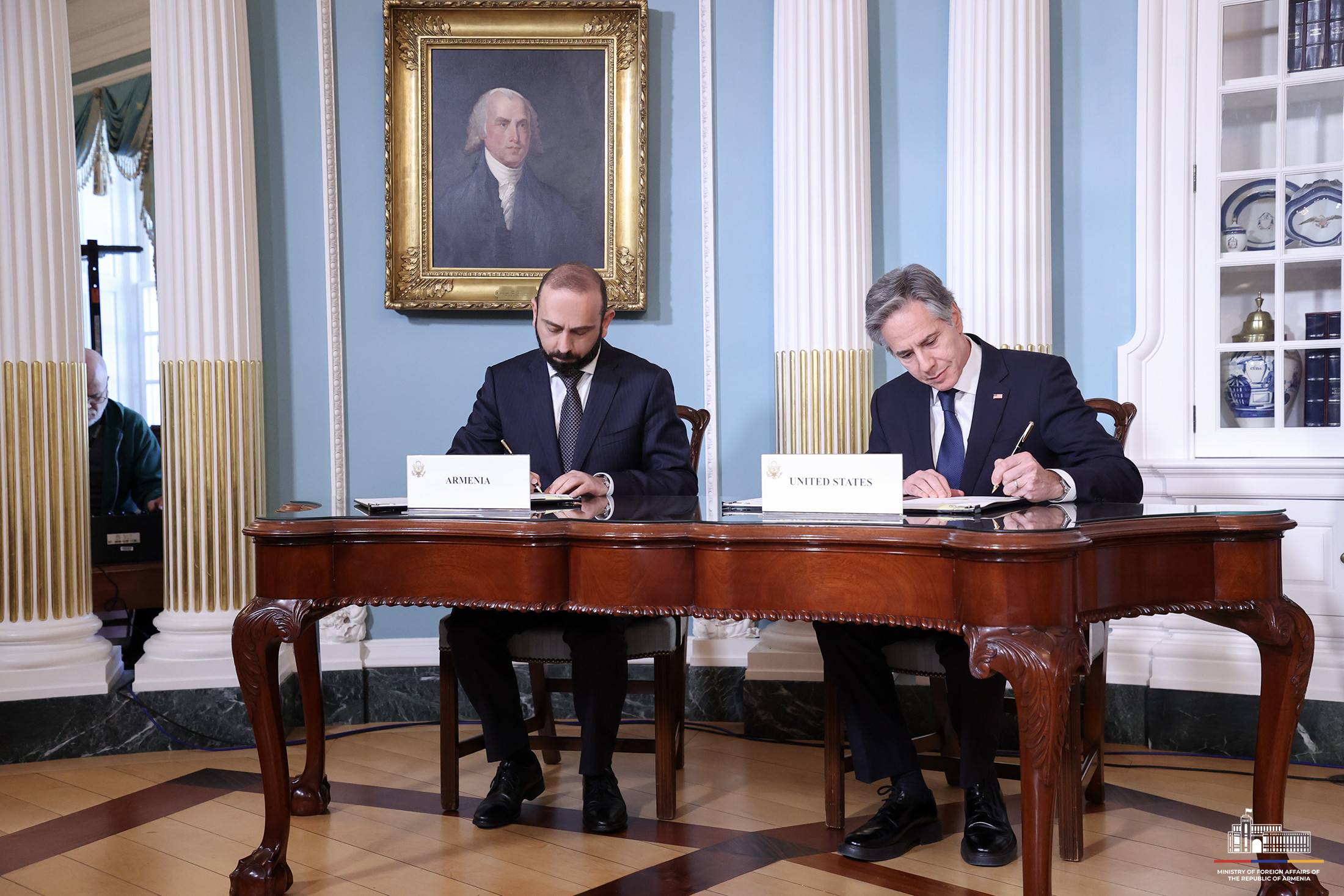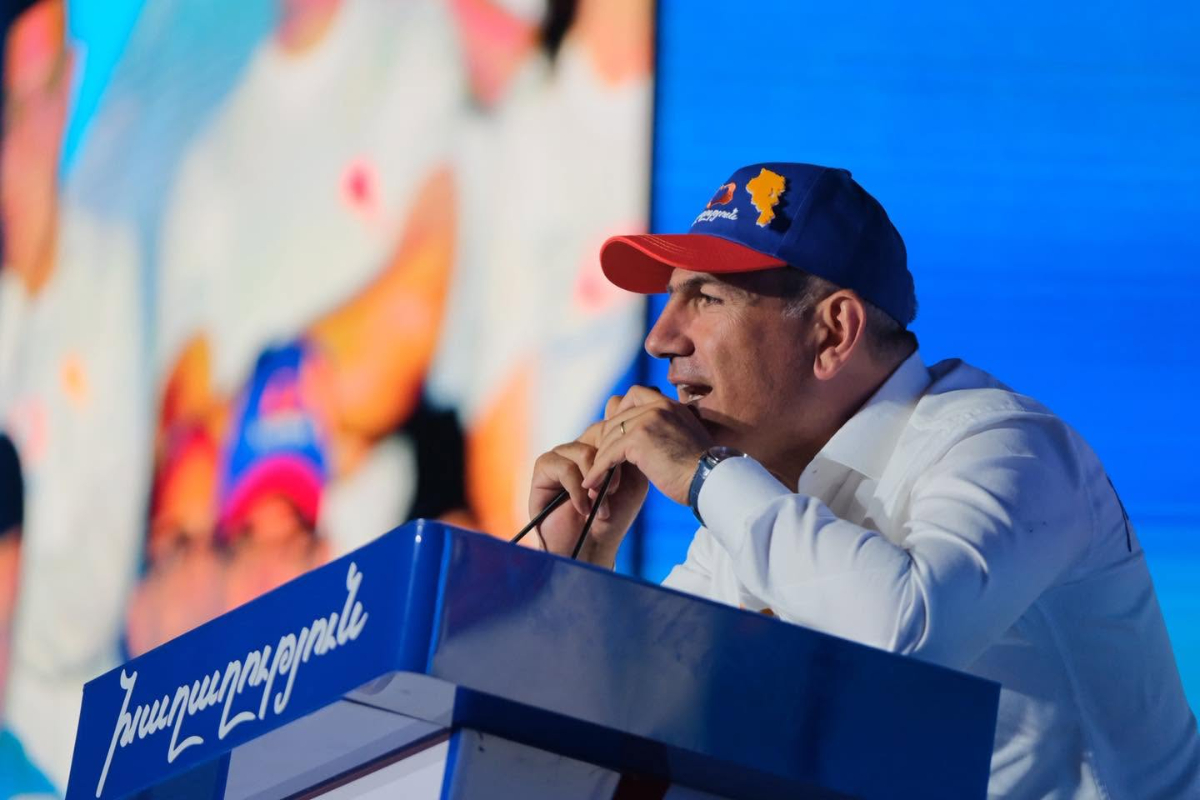



The so-called historic visit of Armenia’s Prime Minister Nikol Pashinyan to Türkiye, and his subsequent meeting with President Recep Tayyip Erdoğan, might serve as a symbolic means of normalizing the countries’ relationship and achieving regional peace. However, the event’s historic significance is questionable, given that only Pashinyan has consistently pursued peace, while Türkiye was the first to close its borders in 1993.
Many have labeled the visit ‘historic,’ but the real question that we should pose is—what was the purpose of initiating it? Was it to show the world that Erdoğan supports a peace deal between Armenia and Azerbaijan, or to pressure the Pashinyan administration into reconciliation without first addressing its own internal political issues? Had Erdoğan explicitly committed to signing a peace treaty with Armenia, the visit could have carried genuine historic weight. However, these big fancy words do not help the case.
This meeting was not about reconciling Armenian-Turkish relations, but rather, it was Erdoğan’s way of reminding the international community—and Armenia—that Azerbaijan remains a key partner and Armenia must sign peace deals to maintain better relations. Türkiye has long taken a distant and uninterested stance towards Armenia, starting with its 1993 border crossing, siding with Azerbaijan on the Artsakh matter.
But that action was not simply support for Azerbaijan—it was a message: Türkiye and Azerbaijan could make their way in the region with or without relations with Armenia. This precedent is rarely seen elsewhere. For instance, despite long-standing tensions between India and Pakistan over Kashmir, neither country closed its borders to third-party countries in response.
The challenge goes deeper than foreign policy. Both Pashinyan and Erdoğan are criticized by most of their citizens. Instead of winning the hearts of their people and creating a healthy relationship between the state and citizens first, they have shifted their focus to attempting to finish the so-called normalization process. Neither side has addressed what makes it so difficult for these two countries to remake their relationship on a diplomatic level in the first place.
Both Pashinyan and Erdoğan are heavily dominated by public opinion, not because they have opponents, but because their terms are in critical stances. For instance, Pashinyan’s commentary on diaspora, church and Artsakh affairs has resulted in receiving less public support and criticism towards his regime; meanwhile, Erdoğan is highlighted for politicizing Türkiye’s economy and eradicating the will of the people in exercising secularism. Massive youth-led protests in Türkiye—particularly in support of opposition figure Ekrem Imamoğlu—signal growing unrest under Erdoğan’s rule. Both leaders have lost public support and arguably no longer represent their people’s values, yet they insist they can broker peace between two historically opposed states.
Some claim this is the first official high-level meeting between the two parties, but it is important to recall the 2008 “football diplomacy,” between then-Armenian president Serzh Sargsyan and Turkish president Abdullah Gül. That exchange also carried symbolic weight, yet progress was limited, perhaps ineffective—largely due to unresolved political and historical tensions.
What makes this Pashinyan and Erdoğan visit unique is its branding: the Pashinyan administration portrayed Armenia as the initiator of peace, seeking nothing in return. But positioning Armenia as the sole actor willing to reconcile reinforces a pattern of appeasement rather than mutual engagement.
The power dynamic in the region further complicates matters. Türkiye and Azerbaijan as one power bloc, while Armenia is a trapped actor in the region, often resorting to concessions and appeasement politics to survive, all while trying to balance relations with Russia and the West.
Importantly, the failure of normalization does not stem from Pan-Turkism, religion or even the historic grievances of both parties—but an attempt at realpolitik. By maintaining a distant relationship with Armenia, Türkiye has successfully framed Armenia’s geopolitical stance as constrained and dependent—trapped between closed borders and unreliable alliances.
It is naïve to view national development through the lens of obedience or open-border diplomacy. Armenia’s future cannot be dictated by flattering diplomatic language that lacks sustenance or permanence.
What common political actions do Pashinyan and Erdoğan share? Arresting citizens and political figures for criticizing the government, hindering competition, undermining diversity of opinions, not addressing the issues internally or externally, applying abstract terms, such as normalization, to complex cases like the Armenia-Türkiye relationship, etc. Neither party has addressed what objective or purpose normalization has when Türkiye closed its borders in 1993 and never attempted to reopen them—apart from a brief stint after the 2023 earthquake, to receive aid from Armenia? Why does the current government of Armenia act as if they are breaking new ground, when other Armenian figures like Hrant Dink and Serzh Sargsyan have already paved that path?
Indeed, Armenia may reap the benefits from cooperation with Türkiye, but portraying Armenia’s development and potential growth only in relation to Türkiye and Azerbaijan poses a geopolitical threat. A nation’s development should not be contingent on compliance with regional bullies.
Armenia should first assess its weaknesses and internal capacity for growth. Relying on stronger partners or chasing so-called peace deals will not make Armenia better. As long as Armenians are not the key players in Armenia—and as long as the wishful and unproductive normalization talks are not questioned and addressed—then we will not understand why Armenia is the only country that needs peace, but not the other parties.


Why are Armenian authors using the name “Türkiye” for Turkey in Armenian Weekly articles? This name change was imposed by Turkish dictator Erdogan in 2021, who insists that the “international community” uses the Turkish name for the country in international communiqués and that the foreign media uses it too. This name change is purely an ideological propagandistic motive by Erdogan, and foreigners, and annoyingly even Armenians are using it in Armenian communiqués and in Armenian media. The ideological aspect of the usage of the Turkish name is obvious, and one can even easily guess in Turkey, who is an Erdogan supporter and who is not, because Erdogan supporters use “Türkiye” in other languages, whereas Erdogan opponents definitely do not. Armenians should also not use the Turkish name for Turkey, for this reason.
Turkey requested it’s national title be known as Turkiye internationally as a nation may wish to do. Other countries may have their own toponyms to the Turks Armenia is Erminstan for example.
As for criticisms Armenia which Russia had a monopolistic and abusive relationship with Armenia and betrayed in favour of to it more important interests with Turkey and Azerbaijan although realistically Armenia couldn’t expect to control Russia foreign policies. Turkey and Azerbaijan have a strong relationship built on racial and religious and cultural communalities. Indeed for these reasons Armenia an idiosyncratic peoples with no close kin although Greek is considered the closest can never have the communal kind of relationship with Russia a predominantly Slavic peoples .
The defeat in 2020 exposed weakness which was actually there all along. As matters stand Turkey and Azerbaijan can manage along as it is. Armenia is dependent on the borders with Georgia and Iran for communication otherwise it’s literally besieged.
Why on Earth does Armenia need to have any relation with either Turkey or her puppets regime in Baku? Armenia can have relationship with 450 million people in Europe through Georgia, 250 million in Russia through Georgia and Iran, and 3 billion people in India and China through Iran. For God sake, stop your obsessions’ with normalizing relation with Ankara and Baku or even talking about them, instead spend your time and energy to improve your relation with the rest of the world. Armenia is not going to benefit by having relation with them, Ankara and Baku badly need peace deal with Armenia in order to improve their stand in the European union, this is exactly what Erdogan had in mind for meeting the prim minister of Armenia.