


A mother’s daily path to the cemetery
Images by Ani Gevorgyan
Editor’s note: This interview is the fourth in a series conducted by Shushan Papazyan and Ani Gevorgyan documenting the stories of children killed by Azerbaijani aggression in Artsakh. The series will be featured in the Armenian Weekly throughout the coming weeks.
***
From 2016-2023, various phases of the Artsakh conflict—from the Four-Day War to the mass displacement—claimed the lives of many civilians, including children.
The exact number of children killed is difficult to determine due to conflicting reports. According to a report compiled by the Tatoyan Foundation, 21 civilians, including six children, were killed as a result of Azerbaijan’s attack on Artsakh on Sept. 19, 2023.


Documenting the stories of children killed by Azerbaijani aggression in Artsakh reminds us that behind every statistic is a human life—with dreams, hopes and visions of a future cut short by violence.
Goharine Grigoryan shared her heartbreaking story in an interview conducted by the author.
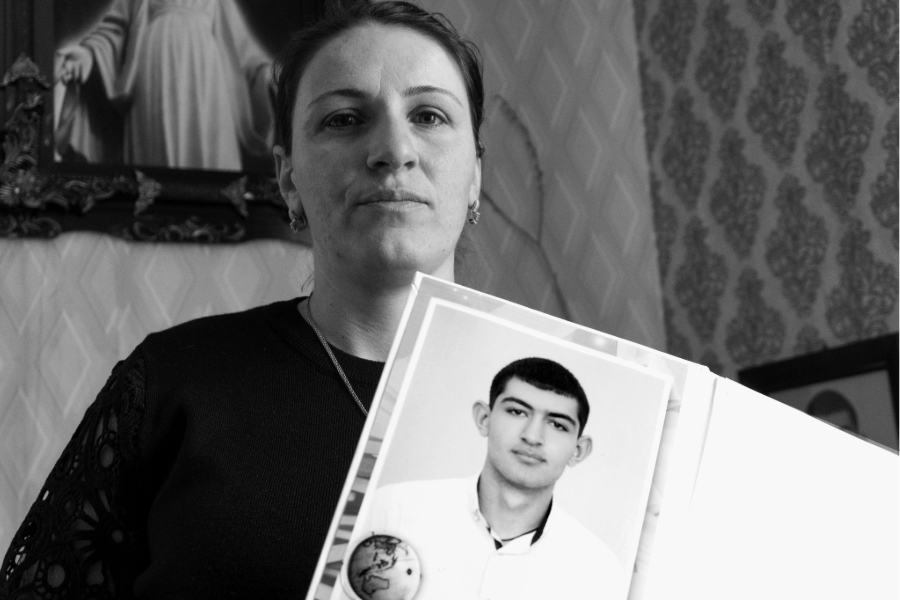
“The village cemetery is a short distance from our house. I visit Sergey every day. I try to ease my longing. I feel his absence very much,” says Goharine Grigoryan, who lost her son on September 19, 2023, as a result of a drone attack on their house in Artsakh.
When talking about her eldest son, Goharine unconsciously touches her finger, which still holds shrapnel fragments. “He was only 16 years old. He had many dreams—wanted to become a programmer. The day before the war, we were supposed to leave the village. We were waiting for news. Everything would have been different if we had made it in time.”


The family briefly settled in Armenia after the 44-day war of 2020, in the village of Mets Mantash. Before that, they had lived in Dadivank village in Artsakh. Goharine worked in the local church as a candle seller. But in Armenia, her sons couldn’t adapt. Sergey constantly asked to return to Artsakh.
So, they did—settling in Kolatak village. “My boys attended school. My husband and I also went to work. I was working again as a candle seller in Hakobavank, and my husband, Vahag, was a guard. My younger son, Mkrtich, loved church life very much. He wanted to become a deacon, but after his brother’s incident, he abandoned that idea,” Goharine recounts.

The unrealized departure: Morning of September 19
Life in Kolatak proceeded normally until the blockade. Goharine began to worry about her sons’ future. She and her husband decided to remove Sergey from school and send him to Armenia. With help from the Red Cross, paperwork began for his transfer from Artsakh to Armenia. By September 15, everything was nearly ready. In Stepanakert, Goharine was told they needed to wait for an official order to be transferred to Armenia with the help of Russian peacekeepers.
“After writing the application, we went to Vank village—to Father Hovhannes’ house—because there was no connection in Kolatak, and if they called, we wouldn’t know. On the evening of September 18, we reached Vank village. We settled in and waited, because we were told that the order would come on the 20th,” she recalls.
On the morning of September 19, Goharine organized the family’s luggage. Then, she started preparing lunch.
“I was in the kitchen when I heard loud sounds. I thought it was the weather. My husband went outside and said they’re shooting. Around 1 p.m., it exploded right inside the house. There were six of us inside. My husband shouted, ‘Serozhik, help!’ My hands were covered in blood, as if they had become heavy. I realized that my son needed me, and despite being wounded, I reached the living room.”
The explosion had thrown everyone aside. Goharine first saw her eldest son, Sergey—unconscious. Her husband, younger son and Father Hovhannes were on the floor, covered in blood. One of their neighbors was also in the yard—unconscious.

“My husband tied my hands with a curtain so the bleeding would stop. I went out to the yard to call for help. I was very weak, and I fell. Mkrtich came to me, completely covered in blood. Soon, one of the neighbors came to help. I somehow managed to say, ‘Save my Serozhik.’”
With help from fellow villagers, Goharine and the others were transferred to the hospital in Vank. She heard that her eldest son’s condition was serious. “They said, ‘Send him to Stepanakert quickly. It’s his heart. He won’t survive.’”
They were among the first wounded transferred to the hospital in Stepanakert. Doctors quickly provide first aid. “Sergey was in front of me, unconscious. I was lying on a stretcher, looking at him. We were told that my younger son needed to be transferred to the children’s hospital. I looked at him and said, ‘Daddy is with you. Don’t be afraid.’ At that moment, they took me in for examinations.”

Goharine awoke on September 20 after surgeries lasting about nine hours. She thought it was still the previous day. “My husband came to me. I asked how the children were. He said everything was fine. I asked him to take a photo so I could see.”
Vahag returned shortly after. He only showed her a photo of their younger son, Mkrtich, who was 13 at the time. “He told me that Sergey’s condition was very serious and that he would take a photo in a few days. My little boy’s condition was also serious. There was no medicine. After surgery, he remained with open wounds for a long time,” she remembers.
On September 22, when representatives came from the Red Cross office to Stepanakert hospital to transfer those in critical condition, Goharine learned that her eldest son’s life could not be saved. “My husband was shouting throughout the hospital for us to be transferred to Armenia. Our condition was very serious. That’s when I heard him say that one of the boys had died—at least, the other’s life might be saved.”
“We somehow found a coffin”
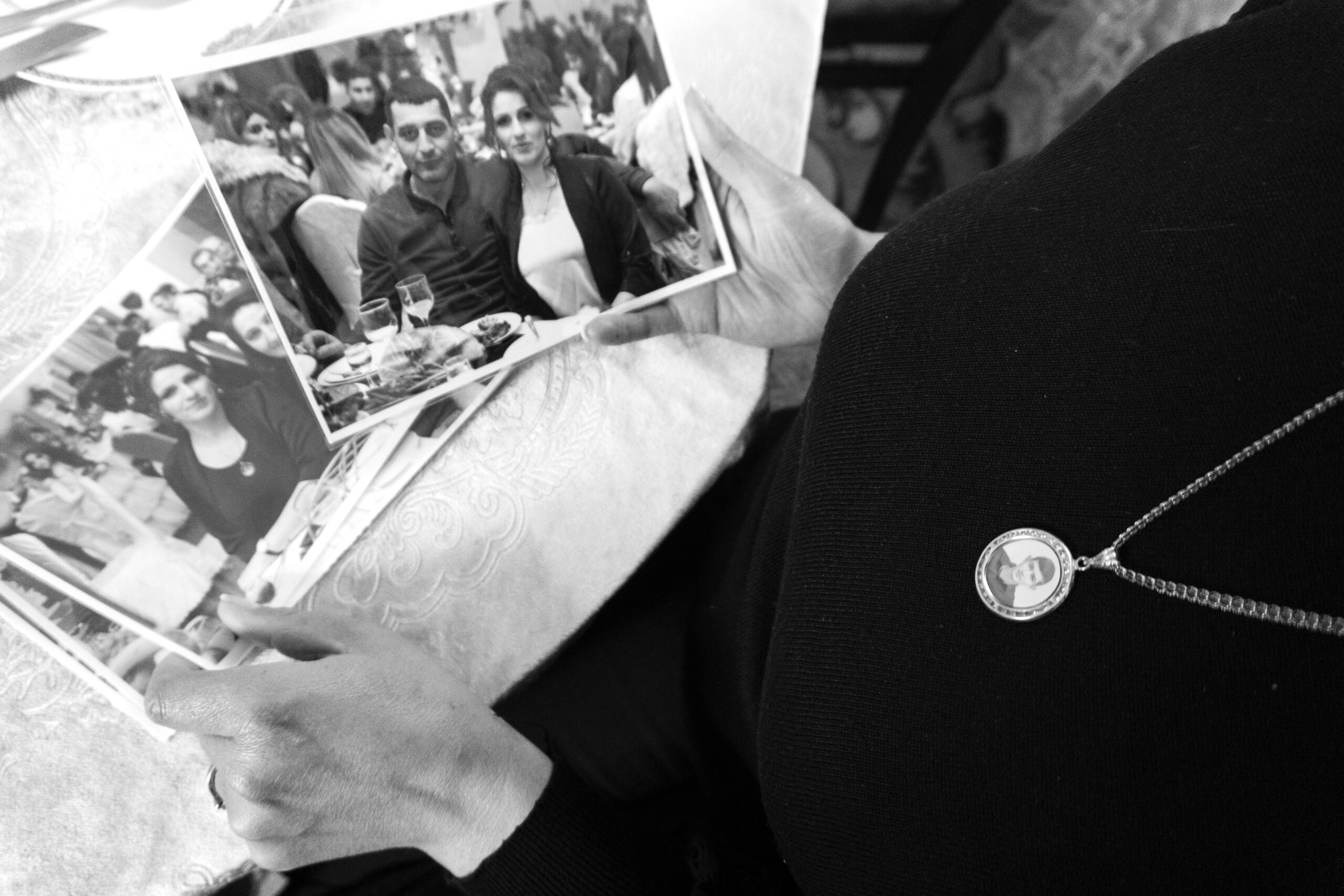
In Sergey’s memorial corner are personal items and family photos. His mother says he did not like large gatherings or being photographed. He preferred being at home with his parents and brother.
“I still can’t prepare his favorite pastries. My hands won’t do it,” she says. “He always said he loved my pastries very much—especially when we all were at home and sitting around the table. Now, everything is half-empty—both our health and the house.”
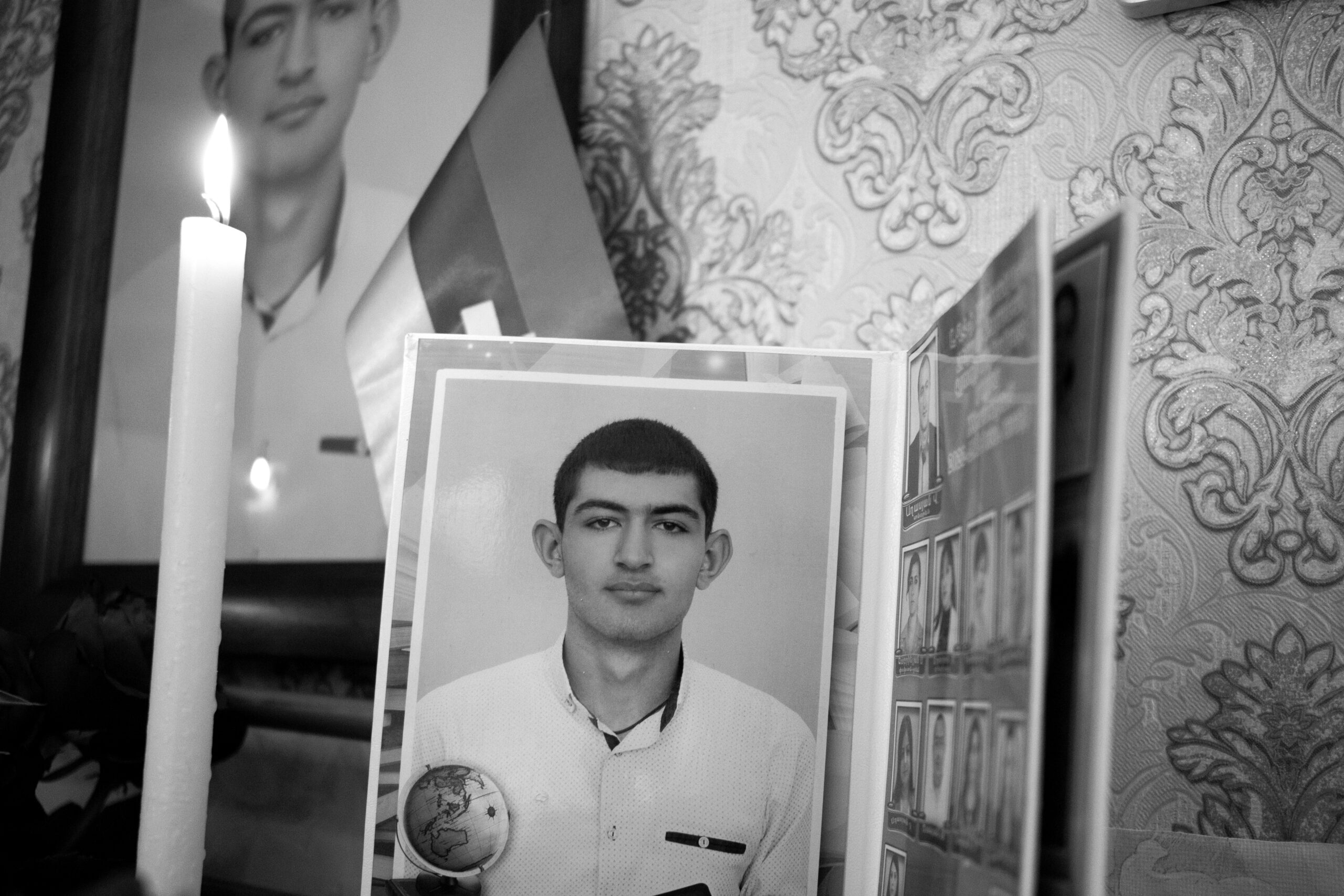

Goharine pauses as she describes how they transferred her son’s body to Armenia. There was no coffin of Sergey’s size. They managed to find a small coffin, folded the body and sent it to Armenia by Red Cross vehicle. Relatives handled the funeral arrangements. Sergey’s grave is in Mets Mantash, where the family now lives. The funeral took place on September 26.
“On September 24, we left Artsakh in Red Cross vehicles. They took Sergey to the morgue and took me and my little boy to different hospitals. Mkrtich never spoke about how he learned about his brother. My husband tells me he often cried and asked where Sergey was.”
In Armenia, Goharine underwent complex surgery—five operations in total—because she had shrapnel injuries in her stomach, as did her son. She saw her little boy on October 19, when her husband brought him to the hospital. “That very day, I understood that he knew everything. He started crying loudly. He hugged me. I wanted to tell him that Sergey was dead, but my relatives didn’t let me. I’m sure he already knew. That same night, he asked my husband why they couldn’t save Sergey.”

Forty days after the funeral, Goharine visited her son’s grave for the first time. “After the surgeries, I started taking care of Mkrtich. Our family changed a lot after losing Sergey. Now, I’m trying to stay by Mkrtich’s side so he doesn’t withdraw too much into himself.”
Before the war, it was a family tradition to celebrate birthdays. April 19 was the birthday of Goharine, Vahag and Mkrtich. “When the incident first happened, I absolutely didn’t want to get out of bed. We didn’t even talk about it at home. Then gradually, for Mkrtich’s sake, we started celebrating. My heart can’t bear that he took my other son on the same day, but I continue to live for my family’s sake.”
Mkrtich returns from school. Goharine is in the kitchen preparing the dinner table. She struggles. “Mkrtich is Sergey’s opposite. He doesn’t always eat at home, though he used to love it when I cooked. I often get angry because he’s not allowed to eat fast food, since half of his stomach was removed. I can’t convince him to eat at home. I try to do everything with his heart so he doesn’t get too upset. Neither my husband nor I talk about what happened. We want to help him achieve his goals,” she says.

This piece is translated from the original Armenian, which was published on MediaLab.am.