


Hayk Arsenyan and the stratum of a life in music
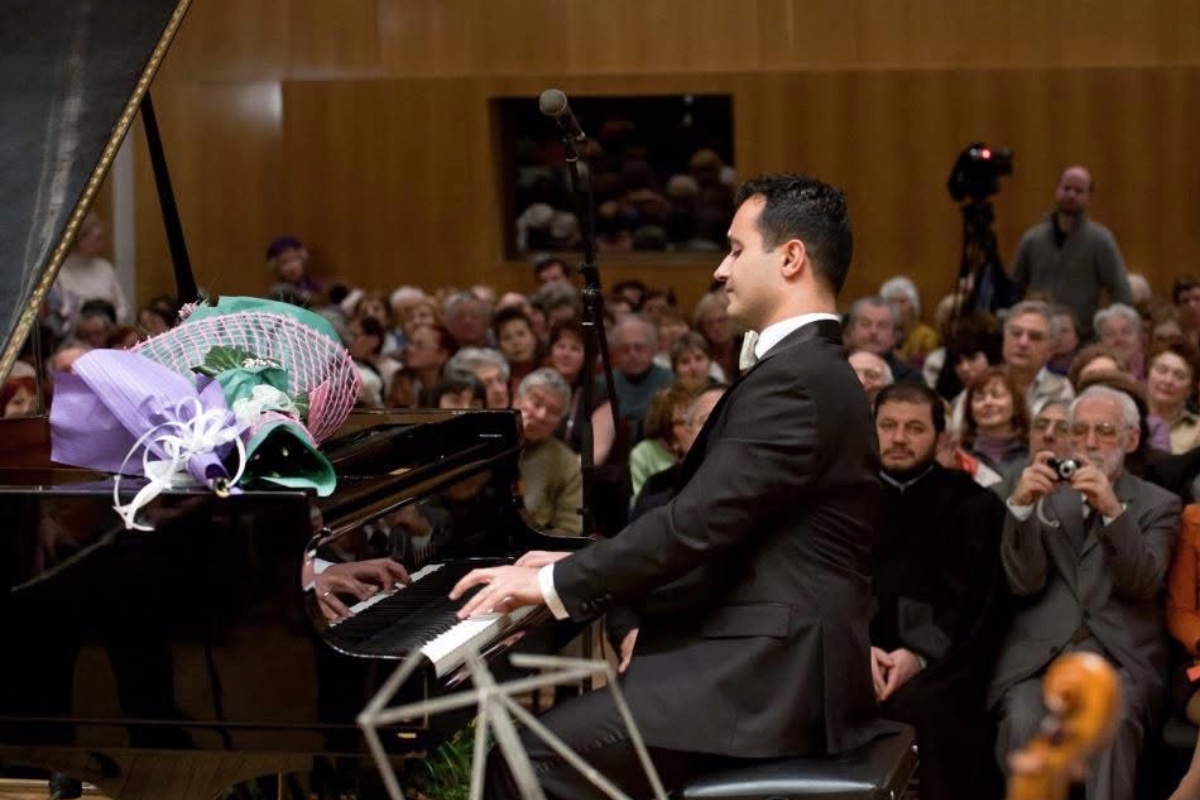
Hayk Arsenyan’s journey began in the dimly lit classrooms of the Tchaikovsky Music School in Yerevan during the “dark and cold” 1990s. It is a path that wound through the prestigious conservatories of Paris and Moscow before finding its modern pulse in the restless, avant-garde streets of New York City.
As a pianist, composer and Director of the AGBU Arts Department, Arsenyan occupies a unique space in the cultural landscape. He is an artist who refuses to let his roots be erased by globalization; instead, he treats his Armenian identity as the very rhythm that guides his hands across the keys. Whether he is performing at Carnegie Hall or a basement club in Brooklyn, Arsenyan approaches his craft with meticulous care and a rich stratum of emotion.
A scholar of Iberian early music and a longtime faculty member at the NYU Tisch School of the Arts, Arsenyan’s career is defined by high-level mentorship — from his studies with the legendary Solomon Mikowsky at the Manhattan School of Music to his own work teaching dancers and musicians the art of collaboration.
We recently sat down with Arsenyan to discuss his path, the cross-continental layers of his music, and his belief that life — much like a river — knows exactly where it needs to flow.
Milena Baghdasaryan: You’ve had a fascinating journey, from Yerevan to New York, and now you are working as the artistic director for AGBU. Let’s start at the very beginning: What brought you into the world of music?

Hayk Arsenyan: I believe I was born into it. Music is a natural force; in a sense, everyone is a musician because we dance and sing long before we speak. However, developing the specific skills required is what truly makes you a professional. My formal studies began at the Tchaikovsky Music School in Yerevan as a violinist, though I also studied piano and composition.
At 13, I moved to Paris to study piano at the École Normale de Musique de Paris Alfred Cortot and the Conservatoire National de Région D’Aubervillier-La Courneuve. Those years were a whirlwind: I became a member of the French Society of Authors, Composers and Publishers of Music (SACEM), published two collections of original works, and made my debut with the Radio France Philharmonic Orchestra, receiving a platinum medal from the City of Paris.
Later, I earned a master’s degree from the Gnessin Academy in Moscow, studying composition with Kirill Volkov — a student of Aram Khachaturian — before moving to the U.S. for my doctorate at the University of Iowa. My dissertation on Antonio Soler was published by the University of Iowa Press and later translated into Spanish by Mònica Pagès, a biographer of Alicia de Larrocha, and published by the prestigious Boileau Editorial de Música in Barcelona. It is now available in music stores throughout Spain.
In 2007, I received the full-tuition Yevgeny Kissin Scholarship at the Manhattan School of Music. I studied under the legendary Solomon Mikowsky, one of the most sought-after pedagogues in the world. Since then, my career has taken me across the globe — from the Tchaikovsky Concert Hall in Moscow and Carnegie Hall in New York to prominent stages in Asia and Australia. Today, I lead the AGBU Arts Department, serve as the New York representative for the Ararat International Academy of Sciences in Paris, and sit on the board of the Piano Teachers Congress of New York, which celebrates its centennial this year.
Baghdasaryan: Moving from Armenia to Paris as a teenager in the 1990s could not have been easy. How did that transition happen?
Arsenyan: It was a difficult time in Yerevan. I won a competition that led to an invitation to perform at UNESCO headquarters in Paris. What was meant to be one concert turned into a tour of Marseille and Grenoble. I fell in love with Paris instantly.
I asked my host mother from the Kerkiacharian family — who generously took me into their home and became like family to me — if I could stay to audition for the conservatory. I was admitted with a full scholarship.
Throughout my education, from Paris to Moscow to Iowa and finally the Manhattan School of Music, I was fortunate to have scholarships cover my tuition entirely. Receiving the Yevgeny Kissin Scholarship was particularly symbolic because he was such an inspiration to me growing up.
Baghdasaryan: Let’s talk about your work, “Stratum.” It deals with the notion of fatherhood, but more specifically, someone else’s fatherhood. How did you translate someone else’s emotions into your music?
Arsenyan: The piece was commissioned by my dear friend, bassist Matt Hare. We have been friends for nearly a quarter-century since our doctoral days in Iowa. Years later, while I was touring in California, Matt reached out. He had just lost his father and wanted to use the inheritance to honor him with a new work for us to perform together.
At that moment, it clicked. My own grandmother had recently passed away, and I had a well of emotions that needed an outlet. We connect with someone else’s loss through our own love; we can mourn a person we never met because the experience of grief is universal.
The story came full circle 10 years later. Matt decided to orchestrate the work, and just as he finished, my own father passed away. Matt dedicated the orchestral version to him. So, while our fathers never met and did not speak the same language, they became “friends” through this music. We recorded it in Boston with another old friend from Iowa, Loren Stata, who served as the recording engineer of the “Stratum” CD. The title refers to these layers: friendship, memory and the shared bond of fatherhood across generations.
Baghdasaryan: Given that history, is the primary emotion of the piece loss, or is it a celebration of a life lived?
Arsenyan: It’s both. Mourning is not just about the absence; it is about reliving the life and memories of that person. In a way, there is no loss as long as the memory remains.
While the work is dedicated to Matt’s father, my Armenian identity is woven into it. I am an Armenian composer; I cannot separate my roots from my art. There are sound images in the piece — echoes of our churches, landscapes and the collective suffering and resilience of our people. Those ethnic “flavors” characterize the identity, but at the core, we all share the same human heartbeat of pain and happiness.
Baghdasaryan: How does your Armenian identity impact your work as a global artist, and how does it weave into your signature as a composer?
Arsenyan: It is impossible to erase. Just as you cannot separate the “Spanishness” from Manuel de Falla or the “Germanness” from Johann Sebastian Bach, you cannot separate my identity from my music. Globalization often makes our cities look the same — the same cafes, the same stores — but we need our differences to remain unique. I do not set out to use folk themes directly, but my melodies and rhythms naturally turn out to be Armenian. I do not want to control it; I let it be.
Baghdasaryan: You had a classical education, but New York is famously experimental. Was that transition difficult?
Arsenyan: My foundation is strictly classical, from my master’s degree at the Gnessin Academy to my studies at the Manhattan School of Music. However, New York encourages you to think outside the box. It gives you the freedom to pursue unconventional projects because there is an audience for everything.
I have collaborated with dancers, singer-songwriters and even actors. I once performed Bach’s “Goldberg Variations” with a German actor reading poetry between movements. New York is an evanescent city, constantly changing, and that energy pushes you to try things you might not attempt elsewhere.
Baghdasaryan: You have performed in historic halls and basement clubs. Does the location influence your performance?
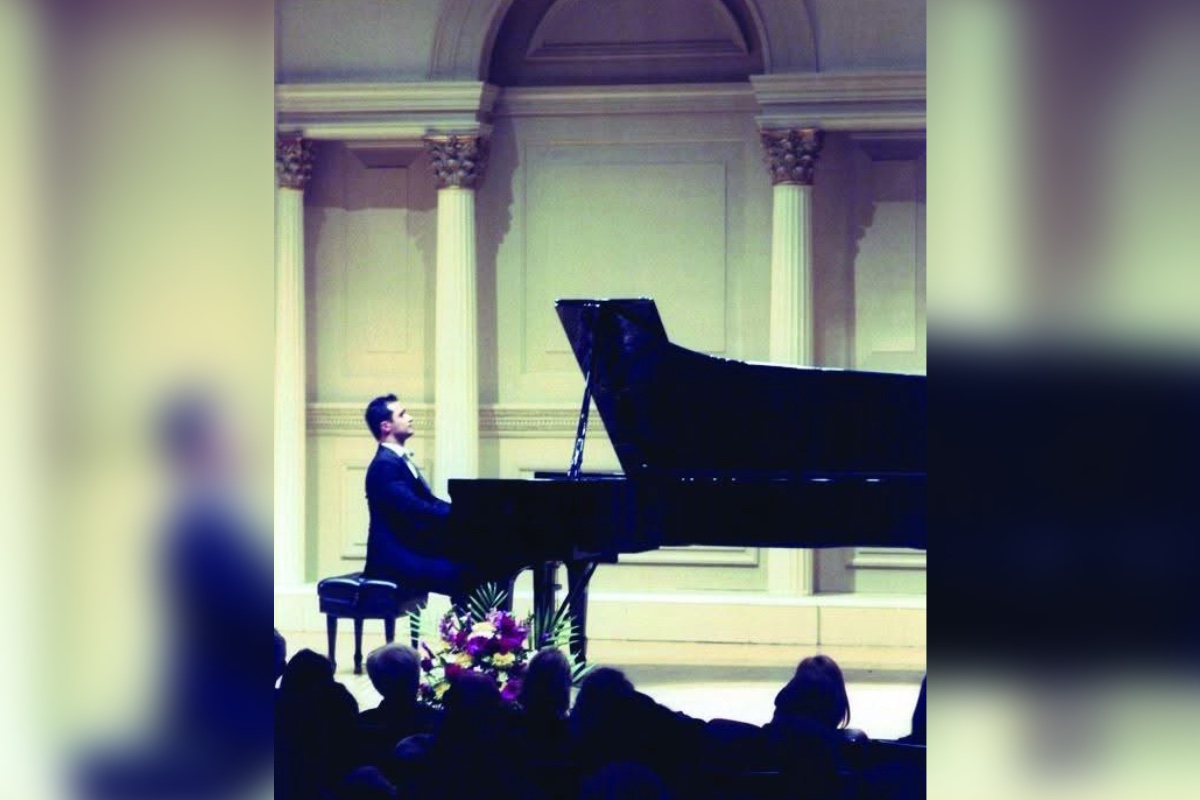
Arsenyan: Performing in a place where Vladimir Horowitz once stood is a profound honor; you feel the energy left behind by great artists. However, my respect for the audience remains the same whether there are 3,000 people at Carnegie Hall or 30 people in a basement.
In New York, venues like Le Poisson Rouge, or LPR, and Galapagos have bridged that gap. You might be playing the “Goldberg Variations” or works by Alan Hovhaness in a space that feels like a bar, but it has a state-of-the-art sound system. It attracts a younger, diverse crowd. While the setting is less traditional, the connection to the music is just as deep.
Baghdasaryan: How does the digital recording process with Navona Records compare with performing live?
Arsenyan: This is my first collaboration with Navona, and I am very much looking forward to it. Recording allows you to make a moment “immortal,” but it lacks the exclusivity of a live performance. A live concert is precious because it only happens once.
However, a recording is like a book; it allows the listener to go back, pause and dig deeper. Imagine if we had recordings of Ludwig van Beethoven or earlier music preserved in this way — musical history would have unfolded differently. Both are essential: one captured for the present, the other for the future.
Baghdasaryan: Finally, is there any artistic dream or goal that you have not achieved yet?
Arsenyan: I have never been a goal-driven person in a global sense, in terms of having an artistic goal or what I would want to become or achieve. Even education was not a goal for me; it was a necessity to reach a professional level in order to express my artistic or musical thoughts. I have daily goals — preparing for a concert, completing a commission or taking my daughters somewhere — but I do not have a grand final destination.
I see my inspirations as a river. I am swimming in the current and letting it take me to different shores. Some are beautiful, some are difficult or painful, but I do not want to artificially change the direction of the flow because everything can have the power to be inspiring, challenging, enriching and definitely giving birth to something absolutely new. I’m just keeping my head above water, soaking in and embracing the waves, open to more and enjoying the journey.
All photos courtesy of Hayk Arsenyan unless otherwise noted.