



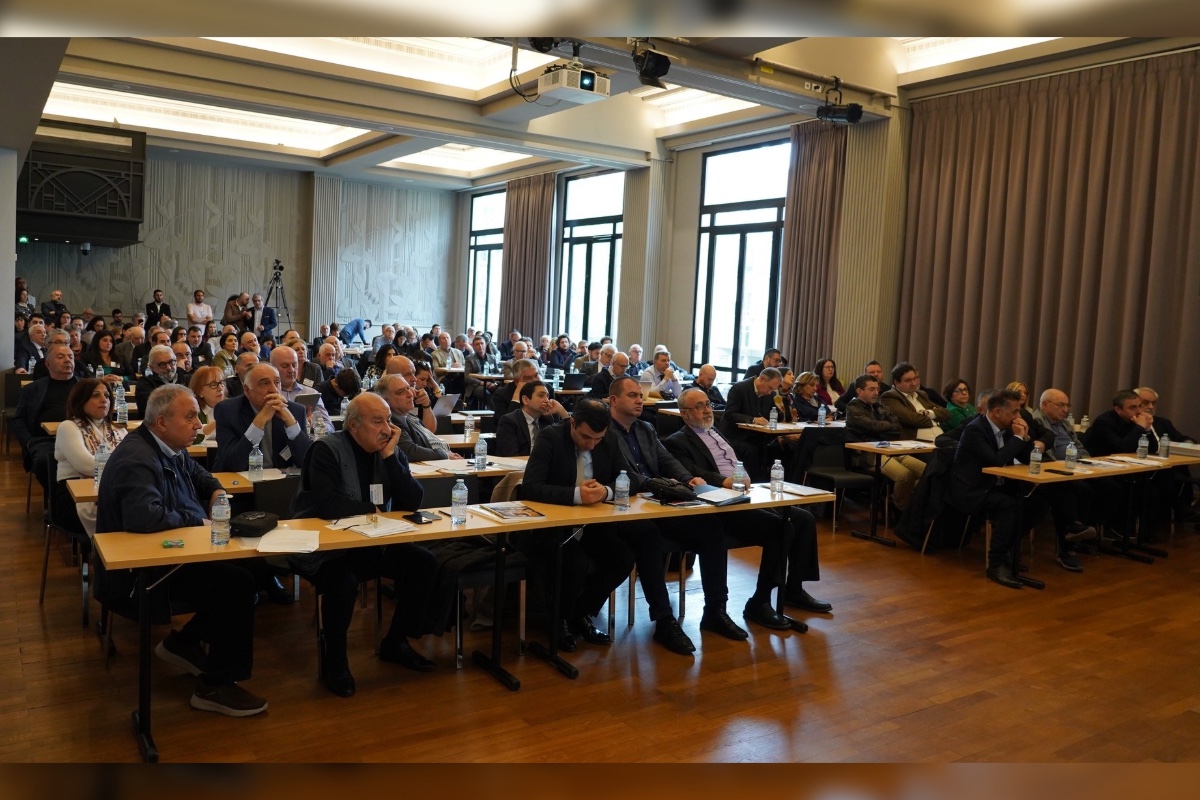
The Diaspora National Mobilization Conference took place April 11-12, 2026, in Paris, bringing together more than 150 distinguished intellectuals, political leaders, and public and community figures from Armenia, Artsakh and 26 countries across the diaspora. The conference provided a comprehensive assessment of Armenia-Diaspora relations amid ongoing national challenges and evolving geopolitical realities, highlighting the urgent need for coordinated mobilization around a unified pan-Armenian agenda.
At the opening session of the conference, welcoming remarks were delivered by His Holiness Karekin II and His Holiness Aram I, as well as by the speaker of the National Assembly of the Republic of Artsakh and acting president of the Republic of Artsakh, Ashot Danielyan. Best wishes for the success of the conference were also conveyed by ARF Bureau Representative Armen Rustamyan.
Following discussions on the four-point agenda, the conference adopted relevant decisions, outlined key priorities, and identified the steps to be undertaken in that direction.
1. The strategic role of the diaspora and the political agenda
The role of the diaspora in addressing the challenges facing the Armenian people holds strategic importance. Today, as Armenian statehood faces serious security threats and the foundations of national identity are being targeted, a pan-Armenian mobilization around national agendas has become imperative. The national and state interests and goals of Armenia, Artsakh, and the Armenian people are inseparable.

At the current stage, the key priorities of the Diaspora’s political agenda are:
Strengthening Armenian statehood: Developing and implementing a comprehensive strategic program aimed at reinforcing the Republic of Armenia’s strength and security.
Recognition and reparation of the Armenian Genocide: Despite the policies pursued by the current authorities of Armenia, the international recognition of the Armenian Genocide and the pursuit of reparations remain imperative.
The Artsakh issue: The issue of Artsakh remains on the agenda and includes the following practical steps:
- Pursuing the immediate release of prisoners of war
- Protecting the rights of the people of Artsakh and internationalizing the right to collective return
- Safeguarding the Armenian cultural heritage of occupied Artsakh
- Providing full support to the functioning of Artsakh’s state institutions
- Working to protect the civil rights and address the socioeconomic challenges of forcibly displaced Armenians from Artsakh currently residing in Armenia
2. The role of national values and the Armenian Church in preserving Armenian identity in the diaspora
Armenian identity is rooted in Armenian history, the Armenian Church, language, culture and national values, which constitute the fundamental pillars of the diaspora’s existence. In the current critical circumstances, the Armenian Church, as in the past, continues to serve not only as a spiritual anchor but also as a cornerstone of the Armenian people’s national and spiritual identity.
Condemning the campaign unleashed by the authorities of the Republic of Armenia against Armenian values and the Armenian Apostolic Church, it is necessary to take into account the following priorities:
- Resistance: Any step or action directed against national identity must be met with organized and unified resistance.
- Unity: Prevent division and establish strong unity around the Church.
- Education and upbringing: Strengthen and expand the educational, cultural and spiritual systems of the diaspora to ensure the preservation and transmission of Armenian identity to larger numbers of future generations. Foster in the younger generation a sense of awareness of national collective interests and the will to uphold and take ownership of them.
3. Key issues and the future directions of Armenia-Diaspora relations
The national value system is the primary source of strength for the Republic of Armenia and the Armenian nation as a whole. It must serve as the indispensable foundation for shaping Armenia-Diaspora relations and the pan-Armenian agenda. Following the 44-day war, as well as the most recent war in Artsakh and the subsequent ethnic cleansing, the policies pursued by the Armenian authorities have led to deep disappointment and disillusionment among the diaspora, giving rise to concerning tendencies of internal detachment from the homeland.
The policy of the current Armenian authorities — marked by the neglect, division and disregard of the organized diaspora and its support for the homeland — is strongly condemnable. Equally concerning is the inaction of the Armenian authorities toward Armenian communities in the Middle East facing existential threats.
Accordingly, the priorities of Armenia-Diaspora relations are:
Strategic Armenia–Diaspora cooperation: Restore and elevate institutional ties with the Diaspora to a new qualitative level.
Effective mechanisms for utilizing pan-Armenian capacity and networks: Ensure the broad participation of Diaspora professionals across various state projects and sectors, with the prospect of assuming responsibilities.
Formation of a unified Armenia–Diaspora framework: Develop and implement a unified policy across political, diplomatic, economic, scientific, military-industrial, informational and educational-cultural spheres. In this context, the Diaspora’s professional potential plays a significant role in the application of Armenian soft power.
Western Armenian is endangered: The protection and development of Western Armenian requires an active role not only from the Diaspora but also from the Republic of Armenia.
Enhancing the role of the Diaspora: Initiate professional discussions on the possible models of Diaspora participation in the governance of the Republic of Armenia and in advancing pan-Armenian issues, with the aim of achieving national consensus and legal solutions within Armenia’s political system.
4. Diaspora mobilization and revitalization for pan-Armenian goals
The need for unity, strengthening and reorganization of the diaspora around pan-Armenian agendas is indisputable.
It is imperative to consolidate the diaspora around national goals, modernize Diaspora structures and overall modes of operation, foster direct cooperation between communities and consistently strengthen collective capacity. In this process of reorganization, the full engagement of youth is especially vital.
Diaspora mobilization must be carried out around strategic programs, taking into account the following priorities:
- Strengthening the global Armenian nation and the Republic of Armenia as two components of one nation
- Supporting the process of building a strong national state
- Advancing the Armenian Cause and pan-Armenian objectives
In light of the above conclusions and outlined priorities, the Diaspora National Mobilization Conference emphasizes that, in today’s complex geopolitical environment, the vitality and strength of the diaspora are inseparably linked to the homeland.
Our unity must be anchored in enduring national values and a vision of strengthening statehood as a shared agenda. The national and state interests and goals of Armenia, Artsakh and the Armenian people are inseparable.
We reject the divisive and alienating approaches adopted by the current authorities of the Republic of Armenia.
Instead, we call for the establishment of healthy, coordinated and balanced relations, which are the only guarantee for strengthening the Armenian nation and preserving Armenian statehood.
With a strong sense of national responsibility, our collective potential must serve exclusively pan-Armenian goals, ensuring a secure and guaranteed future for the Armenian people.
To this end, we emphasize the importance of the participation of all citizens of the Republic of Armenia — regardless of their place of residence — in National Assembly elections. We call on all citizens of the Republic of Armenia, including those abroad, to travel to Armenia by their own means and take part in the elections.
It is necessary to change the current authorities’ anti-national course and establish a national state-oriented path of development.

Can someone please realistically explain how Armenians are supposed to return to Artsakh and live there under Azerbaijani rule and among Armenophobic Azeris who would kill an Armenian on sight, after being besieged, bombed, starved and totally ethnically cleansed from their homeland by the very same genocidal Azerbaijan; and can someone please explain how Armenian heritage (churches, monasteries, cemeteries, monuments) is supposed to be safeguarded, when more than 95% of it has already been destroyed and with the rest next on Azerbaijan’s destruction list, not to mention the homes, apartment blocks and villages of Armenians razed to the ground by Azerbaijan?
As I posted here yesterday about Azerbaijan’s destruction of Armenian heritage in Artsakh, on the same day the Artsakh Diocese of the Armenian Apostolic Church in exile announced that genocidal Azerbaijan has razed the Surb Hakob Church in Stepanakert. How can Armenians live among these barbarians who are erasing every trace of Armenian presence in Artsakh?
https://arminfo.info/full_news.php?id=100057 (press Eng at the top of the page)
— Evidentemente fue una reunion politica , una reunion que no salvaguarda a ninguna de las partes ; El deterioro entre las partes fue muy dañado desde que la Rca politicamente libre olvido por convenincia los asesinatos , masacres y genocidios de sus hermanos turcahay y nosotros tomando la emotiva herencia , tal vez podemos perdonar pero nunca olvidar ; Puesta la Rca en papel de enemigo de la diaspora , vemos muy lejano y casi inexistente la pósibilidad cierta de aplicar los 4 fundamentos debatidos en la conferencia ; Un pais que fue soguzgado durante años por la union sovietica mansillando las tradiciones de 2 o 3 generaciones agravado por politicos formados y convertidos en rusahay , se torna imposible que transcurridos 4 o 5 generaciones diasporicas se habituen a los avatares que conlleva radicarse en la Rca …
If 150,000 Armenians return to Artsakh, they will need 150,000 soldiers to protect their lives.
Anybody here want to entrust a Turk with their life?
Armenians left Artsakh because they know fully well what the Turks are like.
Artsakh is gone.
But Artsakh is not gone for ever.
One day, perhaps, Armenia will regain the military superiority that it enjoyed in the 1990s and then Artsakh will be recovered but for that to happen, there must be both population and economic growth.
That must be the priority not senseless lunacy of sending Armenians to live under the tender mercy of the Turks.
Armenians left Artsakh because their so-called Armenian leader, the guarantor of their security, abandoned them and left them on their own to fend for themselves against a vengeful criminal and racist enemy with full backing of terrorist Turkey. The current situation in Artsakh is only a temporary setback because we neither forget nor forgive our racial enemies ever and in due time they will get a big dose and a bitter taste of their own medicine. But this time I’m sure we will have no mercy on them. Artsakh is “gone” only in the minds of our enemies both external and internal.
Militarily incompetent artificial Azerbaijan is not the problem and they don’t have any military superiority over the Armenians as proven many times over the last three decades and in the April 2016 4-day war in particular. The problem is Armenia’s current defeatist leadership and terrorist Turkey. Dogs bark the loudest in their backyards in their owner’s presence and it is Turkey’s full and unconditional backing, i.e. the enemy of my enemy is my friend, that has emboldened that chicken-hawk pseudo-Turkish mutt Aliyev traumatized and still suffering from inferiority complex while personally being witness to his KG father’s devastating and humiliating defeats. He knows firsthand what we Armenians are capable of doing to them on level playing field despite their petrodollar wealth and three times the population.
Armenians will return to Artsakh sooner or later. It is just a matter of time. No one realistically considers the Artsakh case as closed other than our enemies and their collaborators the current losers “running” Armenia temporarily. Not even the so-called international community considers the Artsakh case closed because, based on international norms and laws, you can never permanently remove the native population of a territory by force and justify your actions purely based on your hatred of that population. It is for this very reason that opportunist coward Aliyev wants Armenia’s constitution changed at the hands of our unpatriotic loser-in-office by giving up on and abandoning our rightful claim to Artsakh. That can never happen!
Artsakh has suffered the same horrible fate of Western Armenia and Nakhichevan, which are now desolate and dystopian wastelands ethnically cleansed of Armenians and denuded of Armenian heritage – in the latter totally. Of the original Armenian homeland outside the borders of the Republic of Armenia, only Javakhk remains with its Armenian population and heritage. There is no guarantee that even this region might not suffer the same horrible fate. The Republic of Armenia is the last refuge, and with cowardly appeasing traitors like Pashinyan and Co. in charge, Armenia itself is at stake.
The people of Armenia are the ultimate guarantors and protectors of the Nation. They have failed miserably by allowing pashoglu to sell parts of the homeland for his silver coins.
Nothing can be done while Armenia is under occupation by western globalists
There seems to be no comprehension here that Azerbaijan is demanding that Azeris and their descendants who left Armenian SSR from 1988 be allowed to return with Azeri protection to current day Armenia with language rights and own curriculum as conditional to any potential return of Armenians to Arktash where they don’t intend to afford anything of the sort. Besides with Arktash being Azerified and dearmenianised it would have lost its soul that made it home it would be the same place geographically but that is all.
It is a common practice that after a conference, or a symposium, proceedings are published consisting of a collection of the presentations. No such thing has come forth from this conference, not even the papers the panelists presented were published.
Diaspora and Diaspora Armenia relations are complex matters. The absence of proceedings makes hard for me to accept that 150 attendees, from 25 counties unilaterally concluded what Daron Der-Khatchadourian in Armenian stated in his FIRST sentence, that- “The Diaspora demands that Armenia’s policy be guided by national interests”. (Սփիւռքը կը պահանջէ, որ Հայաստանի քաղաքականութիւնը առաջնորդուի ազգային շահերով” – and also what this Declaration concluded in its LAST sentence that “It is necessary to change the current authorities’ anti-national course and establish a national state-oriented path of development”.
These conference wrapping posts appear to me a myopic, politically leaning, a priori conclusions to pivot Diaspora against the Nikol Pashinyan government under the guise of mobilizing it.