


‘Capturing Eternity’: A landmark volume on Armenian photography in Jerusalem is published
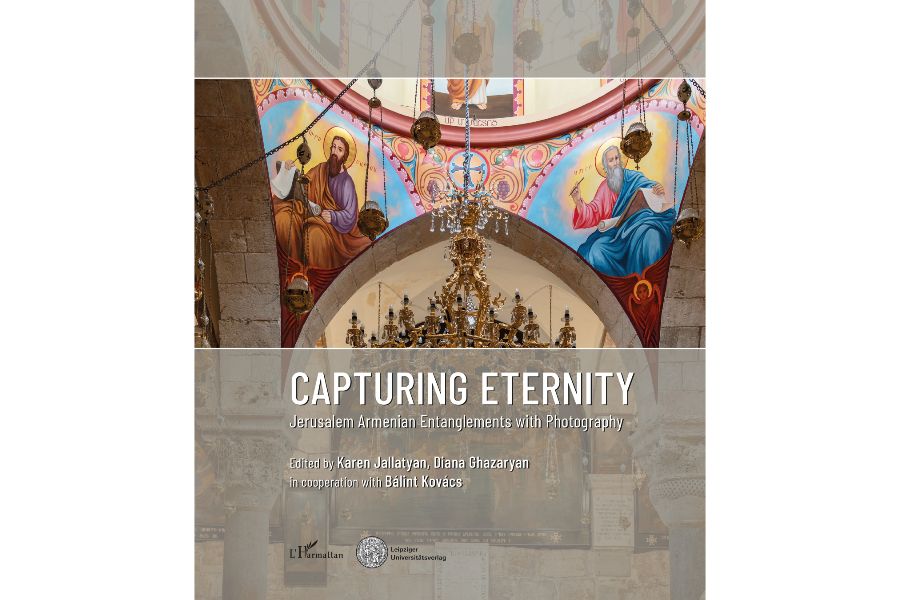
Capturing Eternity: Jerusalem Armenian Entanglements with Photography, edited by Karen Jallatyan and Diana Ghazaryan in cooperation with Bálint Kovács (L’Harmattan, Budapest and Leipzig University Press, 2026), brings long-overdue attention to a vital yet underexplored dimension of Armenian cultural history.
While the Armenian Quarter in Jerusalem’s Old City is widely recognized as a custodian of Biblical sites, many aspects of its millennia-long artistic and cultural legacy remain understudied. Photography is one such area, despite Armenians having played a pioneering and consistently influential role in the medium since its earliest days. Addressing this gap in both scholarship and public awareness, this volume brings together a collection of essays alongside an exhibition catalogue that foregrounds Armenian contributions to the photographic history of Jerusalem. The volume can be ordered from the websites of both publishers, here and here.
The volume offers scholarly contributions by Karen Jallatyan, Postdoctoral Scholar at the Leibniz Institute for the History and Culture of Eastern Europe (GWZO), Leipzig; S. Peter Cowe, UCLA Narekatsi Distinguished Professor of Armenian Studies; Arman Khachatryan, Researcher at the Institute of Archaeology and Ethnography of Armenia and the Armenian Genocide Museum-Institute; Diana Ghazaryan, Doctoral student of History in the Department of Armenian Studies at Pázmány Péter Catholic University, Budapest; Issam Nassar, Professor of History and the Head of the History Program at the Doha Institute for Graduate Studies; Hazal Özdemir, Manoogian Postdoctoral Fellow in the Center for Armenian Studies at the University of Michigan, Ann Arbor; Armen T. Marsoobian, Professor of Philosophy at Southern Connecticut State University; Hanga Gebauer, historian of photography in the Hungarian Museum of Ethnography; Aikaterini Gegisian, visual artist and researcher teaching at the London Metropolitan University; and Marie-Aude Baronian, Associate Professor in Visual Culture and Film at the University of Amsterdam.
Chapters range from addressing the history of early Armenian photography in Jerusalem by situating it in various longue-durée institutional and transimperial contexts, turning to the transregional legacies of prominent Armenian photographer families, to missions and expeditions in shaping visual histories and include interventions that interrogate archival practices from critical feminist and post-catastrophic stands.
The volume also offers the catalogue of the exhibition “Capturing Eternity: Jerusalem Armenian Photography in the 19th and 20th Centuries” held at the Hungarian University of Fine Arts, Budapest, in September-October 2024. The exhibition emerged from a collaboration between the Department of Armenian Studies at Pázmány Péter Catholic University and the Hungarian University of Fine Arts, Budapest, together with the Leibniz Institute for the History and Culture of Eastern Europe (GWZO), Leipzig, the Armenian Embassy in Hungary and the Transylvanian Armenian Roots Cultural Association.
It features photographs from major collections, including the Armenian General Benevolent Union (AGBU) Nubar Library, Paris; the Armenian Genocide Museum-Institute, Yerevan; the Library of Congress, Washington, D.C.; the Project Save Photograph Archive, Boston; the Malikian Collection, New York City; the Gulbenkian Archives, Lisbon; and the Archive of the Armenian Patriarchate of Jerusalem.
All in all, Capturing Eternity: Jerusalem Armenian Entanglements with Photography presents both striking photographic examples and critical scholarly analyses, aiming to situate the living heritage of Jerusalem Armenian photography in historical, transgenerational and diasporic contexts.