


G. Hovannisian Talks About ‘Family of Shadows’ at NAASR
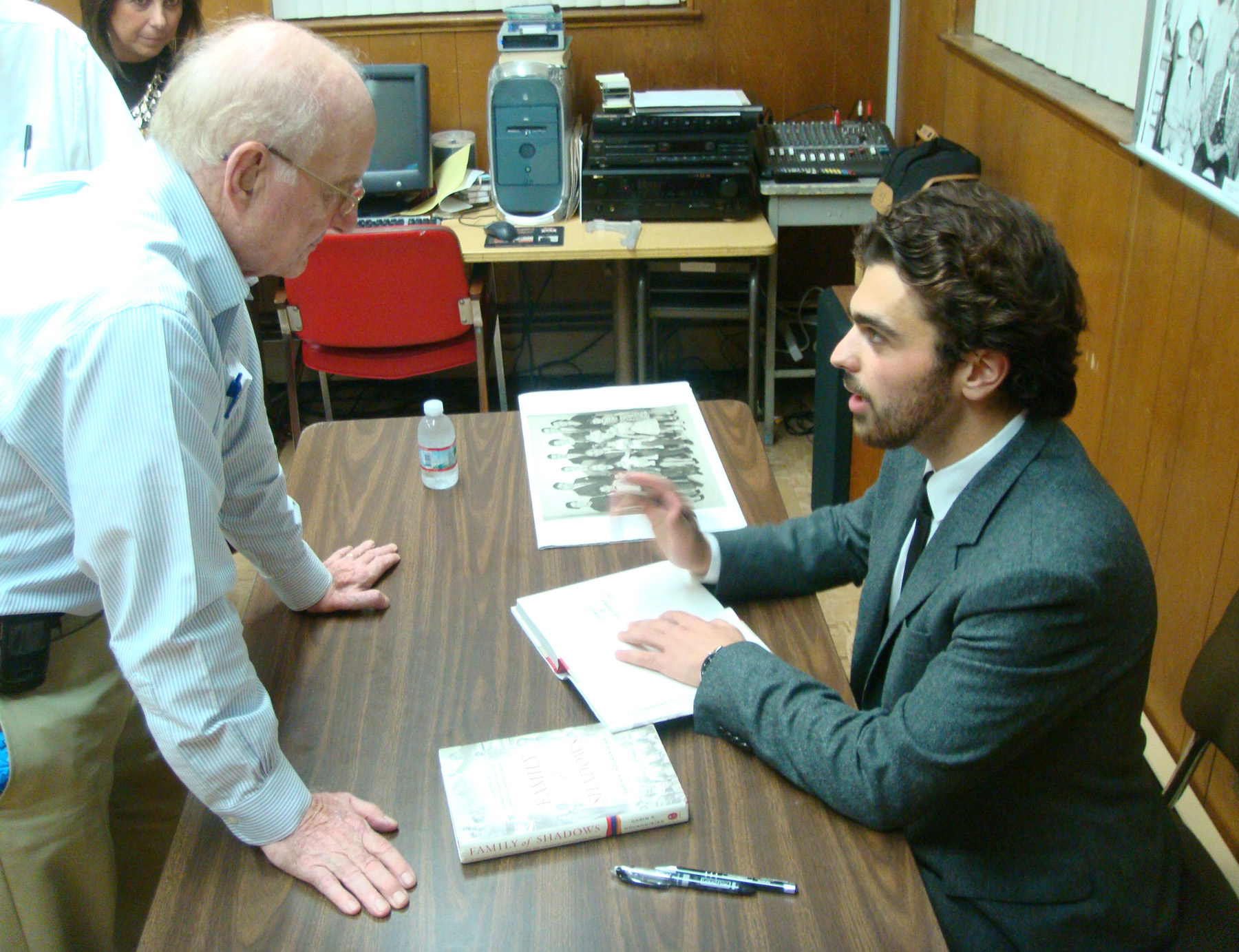
BELMONT, Mass. (A.W.)—On Sept. 30, Garin Hovannisian, author of Family of Shadows, presented his work at the National Association for Armenian Studies and Research (NAASR) Center in Belmont.
Marc Mamigonian, NAASR’s director of academic affairs, introduced the guest speaker and his work. “The story of three generations of the Hovannisian family—Kasbar, Richard, and Raffi—provides a window into the last century of Armenian and Armenian American history. Of course, this is true to some extent for every Armenian American family… But in the persons of Kasbar Hovannisian, a genocide survivor, Richard, pioneering historian of Armenia and of the Armenian Genocide, and Raffi, the first foreign minister of the newly independent Armenia, you have a remarkable story, and a terrific book!” said Mamigonian.
Garin Hovannisian, in full command of his words and the room, talked about the process of writing the book and the challenging task of interviewing family members, interjecting his talk with readings from passages of the book.
“Family of Shadows is to me an epic Armenian story, a story about ideas, a story about genocide and dispersion, and denial, the creation of diaspora, problems of assimilation, and a yearning for a free homeland. And yet at the same time—at a more important level even—it is a story about individuals,” began Hovannisian.
“It is a highly intimate, sometimes secret portrait, of three generations of my family. And at its best, I think Family of Shadows represents the point at which these two narratives clash, where individuals confront these great ideas, these great forces of history, where individuals try to cope with their past, to cheat their destiny, in the words of a professor of mine from UCLA…when individuals try to jump over their own shadows.”


Hovannisian’s first childhood memory is of a strange family tradition. Every Christmas morning, his father, Raffi, would take the young boy to the Ararat cemetery in Fresno, Calif. There, they would stop at a statue of an eagle slaying a snake. “This is the resting spot of Soghomon Tehlirian, the Armenian hero who assassinated the mastermind of the Armenian Genocide, Talaat Pasha,” his father would say.
They would visit the graves of family members, relatives young Garin had never met, and the grave of his great grandfather. “I remember the epitaph there, on my great grandfather Kasbar’s gravestone. It read: ‘If such great wrongs our sons forget…’ and then there were three dots, an ellipsis, a promise to a second half, a conclusion, and of course I did not know what that conclusion was.”
The book was born in the winter of 2007 at Columbia University’s Journalism School, in a book class taught by Samuel Freedman, a columnist at the New York Times and the author of six books.
Family of Shadows begins with the end, said Hovannisian, “The end of our history, the great genocide of 1915.”
Hovannisian learned about his great grandfather Kasbar’s story through the words of Kasbar himself, recorded years ago by his son Richard, who was eager to have a record of his father’s experiences, no matter how hard the telling would be on the old man.
“He remembered everything—the path through the mountains…the taste of the white roses, which he would eat to survive. It was as if a part of him had stayed behind in 1915. Stayed to die with his own people, with his own family,” said Hovannisian, who proceeded to read a passage from the book that described a march from Kasbar’s village, Pazmaashen in Kharpert, during which the young Kasbar was separated from his family and taken by a Kurd.
Kasbar would never see his family again. He eventually joined the volunteer Armenian army under the leadership of General Antranik. Kasbar made his way to the land of opportunity, working in a shoe factory in Chelsea, Mass. But the Armenian yearned for the simple farm life of his youth, and so he moved to Calif., worked at a barbershop, owned the barbershop, planted vineyards, opened a farm, and began investing in real estate.
Kasbar achieved the American dream, said Hovannisian, and raised his kids to respect that dream.
For his book, Hovannisian interviewed his grandfather, Richard Hovannisian, “the master interviewer,” and his father, Raffi Hovannisian, the first foreign minister of Armenia.
His first interview with his father took place at an LA post office, while waiting in line, and did not yield much. In fact, the only words that came out of Raffi’s mouth were, “Posterity scares me.”
Hovannisian had concerns when he approached his politician father. “I was not sure he would be honest with me,” he said. “Not because he wouldn’t try to be honest—I knew he would—but because after spending decades in politics, I felt at least that he had acquired what many politicians do—this almost coded political diplomatic language—and I thought that history would be lost, could not be conveyed through that language. Speaking, the act of speaking itself is the greatest ordeal for my father. [It] has always been. If you’ve spoken to him, you know that he invests his words with so much of himself, so much meaning, so much responsibility…”
The time Garin’s family spent in Armenia had its share of challenges. But his father had been resolute in moving to the ancestral land, quitting his California law firm, and hauling his family halfway across the globe in 1989. In two years’ time, Armenia had become independent, and Raffi was appointed as its first Foreign Minister. After only one year, his father resigned. Garin gives the “complicated” explanation for it in the book.
“What are we doing here,” his mother would ask at times in desperation. Like all Armenians living in the newly independent state, Garin’s family had to endure the cold, the lack of electricity and heat, the scarcity of water and bread. They would eat mostly potatoes, cheese, and apricot jam. But Garin was fortunate to split his time between Armenia, where his parents resided, and California, where his grandparents lived and where he received most of his education.
“Through the book I’ve tried to understand my past, to find my future, and I have at the end of it found the conclusion of my great grandfather Kasbar’s epitaph, which I found at the Ararat cemetery so many years ago: ‘Ayskan charik te moranan mer vortik, togh voghch ashkharh hayin garta nakhadink,’ (‘If such great wrongs our sons forget, may the world’s curses the Armenians beget’).”
When asked about the title of the book, Hovannisian confessed to being “a collector of shadows, or quotes about shadows… I remember in college I read a Greek poet, Pindar, and he said ‘What is a man? What is he not? Man is what a shadow would dream to be.’ And to me, it was instantly familiar and very native to my soul,” he said.
The idea of shadows being reflections of dreams, trying to have identities of their own, to be greater than what they are, “[has] been the struggle of our diaspora,” said Hovannisian. However, the actual shadow reference is in the beginning of the book, in the form of two quotations. “One from Genesis, ‘And on the seventeenth day of the seventh month the ark came to rest on the mountains of Ararat’ [Genesis 8:4]. The second quotation, which I found as I was writing the book, is this from Judges: ‘You mistake the shadows of the mountains for men’ [Judges 9:36].”