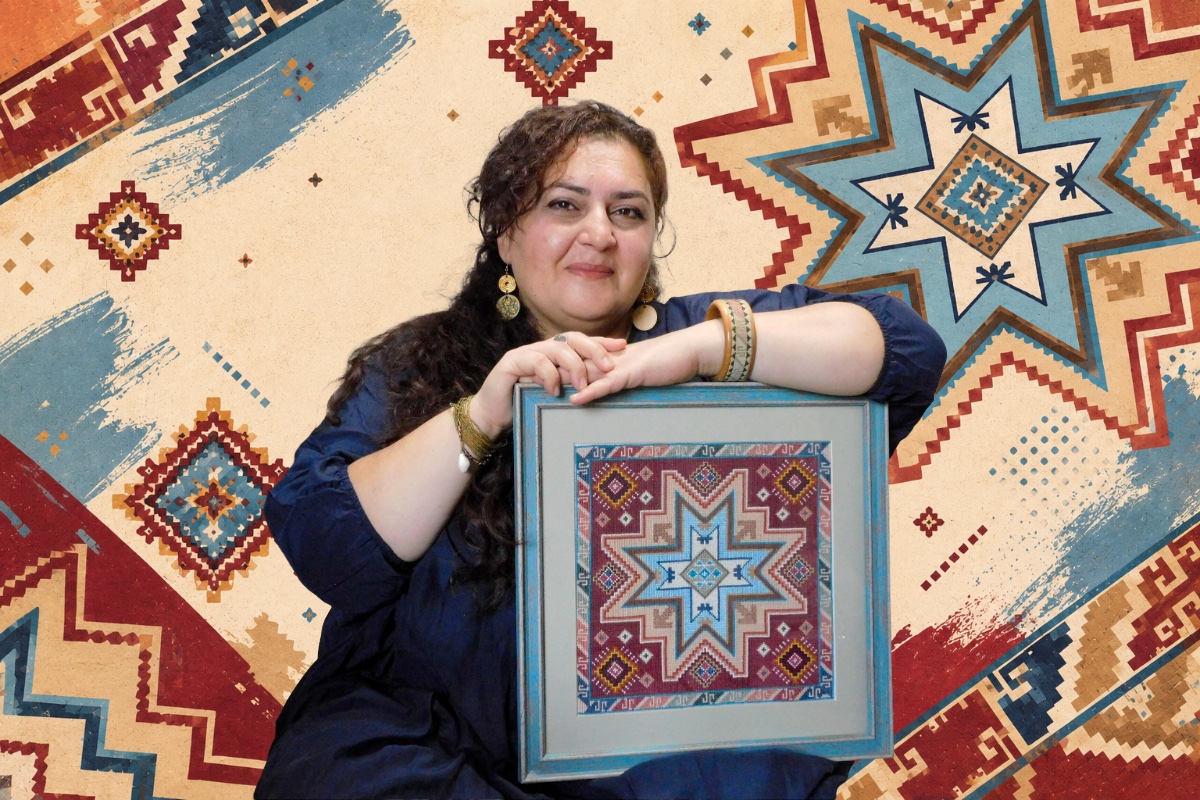
When talking to Vergine Smbatyan, you first notice the warmth and dedication with which she speaks about her work. For her, Armenian carpet art is not merely a museum exhibit or a tapestry hanging on a wall, but a living language meant to be worn in everyday life. As a fashion designer, embroiderer and carpet scholar, Smbatyan has been breathing new life into traditional ornaments for decades, offering people a simple idea of carrying “a piece of carpet with you.”
Born and raised in the village of Kasakh in the Kotayk region, Smbatyan is a fashion designer by profession who initially taught herself embroidery and studied Armenian carpets independently.
“Then I realized I knew nothing about those ornaments and needed deep knowledge,” she said.
To discover the secrets of Armenian carpets, she enrolled in specialized courses, and, after years of hard work, saving money and winning a grant, her dream of owning a workshop came to fruition.
Today, Smbatyan’s routine is packed with custom orders and collaborations with various brands. Most importantly, she brings her own artistic ideas to life.

Smbatyan said the main challenge of self-study was the lack of information—specialized books were scarce, expensive and hard to find. For those wishing to explore Armenian carpet art on their own, she advises starting with museum visits, reading specialized books and scientific publications and watching cultural programs. “I always say: if you want to read a single Armenian carpet, you have to study history starting from the Stone Age up to our present day,” she said.
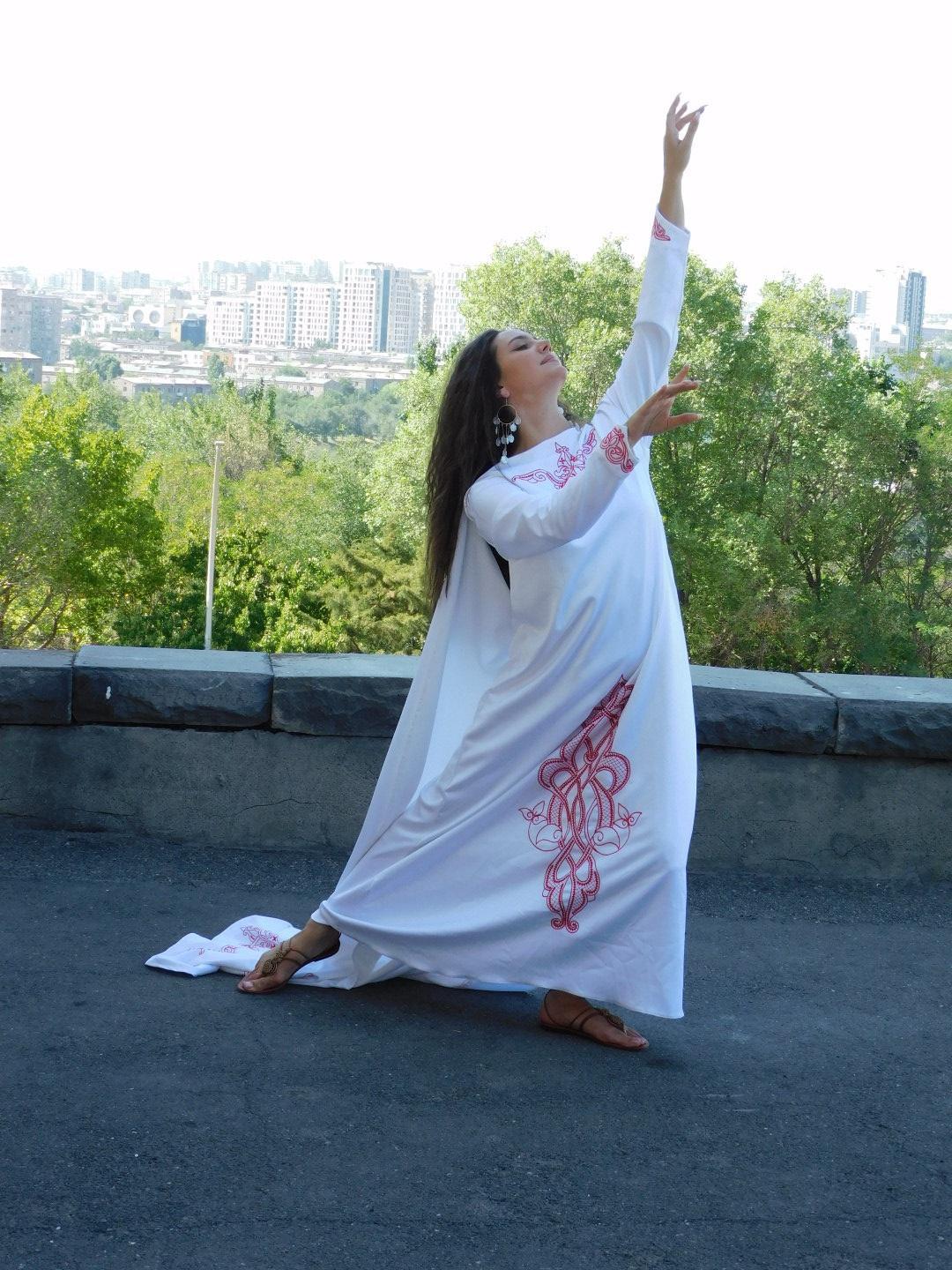
Smbatyan develops all the patterns for her work independently. The process is demanding: selecting the ornament, making precise calculations, matching the right shades of thread, and only then beginning to embroider. She recalls one of her most complex projects, involving a Tree of Life symbol depicted in a book as a tiny black-and-white sketch measuring just over an inch. Working out that pattern alone took an entire week.
“Not only was drawing the chart difficult, but so were the color solutions. When the pattern was ready, I couldn’t find the thread in the exact shade I wanted anywhere in the shops,” she said. “I had to unravel what I had already embroidered and rework it in a different shade. When I saw the final result, I knew my effort wasn’t in vain.”
Smbatyan embroiders carpet patterns on almost everything except clothing. Instead of garments, carpet motifs cover bags, bracelets and accessories, turning them into modern, wearable and tasteful pieces.
For her, Armenian ornaments carry powerful energy. Her personal “talisman” is the Armenian dragon motif. Smbatyan admits she is simply passionate about dragon patterns and wears an embroidered dragon bracelet herself. In all her works, she also subtly incorporates small crosses as symbols of protection and light.
With 26 years of embroidery experience, Smbatyan has built a vast archive. In recent months, she has been digitizing her original patterns using specialized software, aiming to publish a book in the near future. Another upcoming release is already lined up: wooden rings featuring tiny embroidered ornaments.
Smbatyan’s entire creative journey remains rooted in her love for Armenian designs. She simply says, “Let us love, appreciate and preserve what is ours — Armenian.”