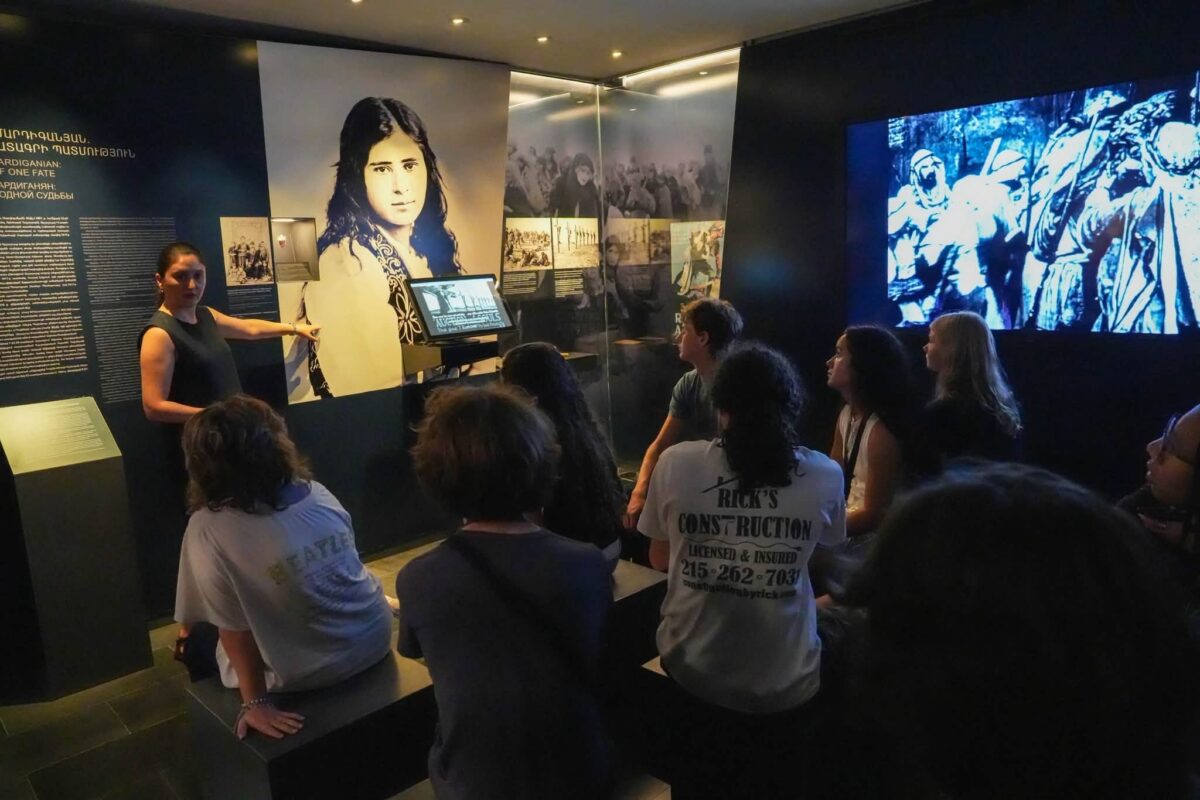
For decades, Armenian Genocide studies centered on deportations, massacres, political responsibility and denial. That work was necessary. It documented the crime and responded to those who tried to erase it. But some voices remained harder to hear. Women who survived abduction, rape, forced marriage or forced religious conversion often kept silent. Children taken into Turkish households sometimes grew up without knowing their Armenian names, families or origins. Their stories were present in fragments, family memory, archives, literature, old photographs and, at times, on the body itself.
That is the field of questions behind “Between Silence and Memory: Women and Children during the Armenian Genocide,” a seminar organized by the Armenian Studies Chair at the Faculty of Philosophy and Letters of the University of Buenos Aires. The course ran from June 2 to July 7 and was coordinated by historian Nélida Elena Boulgourdjian, one of the leading scholars of Armenian history in Argentina. Speaking with The Armenian Weekly, Boulgourdjian explained that the seminar came from a need to widen the frame of genocide studies. “We needed to deepen a dimension that historically had a limited presence in studies of the subject,” she said.
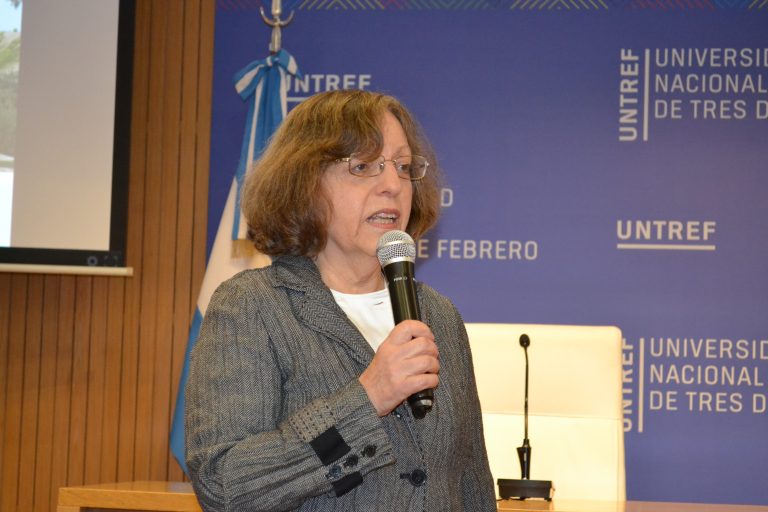
The Armenian Studies Chair at the University of Buenos Aires has worked on contemporary Armenian history since its creation in 1992, with a special focus on the Armenian Genocide. This year’s seminar placed gender at the center of that inquiry. It asked what changes when you look at genocide through the experiences of women, children, family bonds, forced assimilation and the transmission of memory.
“The incorporation of the gender perspective into the study of the Armenian Genocide made it possible to understand that genocidal violence did not affect the entire population in the same way,” said Boulgourdjian.
Men were often targeted first, especially those who could resist or transmit communal authority. Women and children then faced other forms of violence: sexual assault, forced marriages, religious conversion, appropriation, changes of identity and separation from their families. These were not secondary events; they were part of the destruction of Armenian identity.

“Throughout the seminar, we sought to demonstrate that genocide aimed to eliminate the Armenian population and to prevent the biological, cultural and symbolic continuity of the Armenian people,” said Boulgourdjian.
The genocidal process also attacked kinship, memory, names, language, religion and the possibility of Armenian life continuing through future generations. Boulgourdjian described these policies as “technologies of power aimed at dismantling family bonds, erasing collective identities and favoring the forced assimilation of survivors.”
“Armenian women survivors who had suffered violent acts, rape, abductions, forced marriages, changes of identity, remained silent for decades because of the traumatic nature of the experiences they had lived through and because of the need to rebuild their lives in their new destinations,” she said.
Many survivors arrived in new countries carrying pain that families did not know how to name. Some spoke in fragments. Others said nothing. Shame and stigma often surrounded sexual violence, even when women had survived crimes committed against them.
Children faced a different rupture. “Appropriated children or children raised in Turkish families grew up without knowing their true identity. Some were able to learn it after several decades,” noted Boulgourdjian.
Then came another silence: denial.
“To the silence of the victims, voluntary or involuntary, was added denialism, a silence imposed by the Turkish state to the present day, which includes the elimination of the traces of the Armenian presence in the region of Anatolia,” said Boulgourdjian.
The work of memory, in this context, means more than remembering the victims of mass killing. It means recovering stories that were pushed out of the main narrative because they were painful, intimate or difficult to document.
“To the silence of the victims, voluntary or involuntary, was added denialism, a silence imposed by the Turkish state to the present day, which includes the elimination of the traces of the Armenian presence in the region of Anatolia,”
When memory takes different forms
In recent decades, scholars, artists and filmmakers have returned to those stories. They have asked new questions of old archives. They have looked at family memory, testimonies, missionary records, humanitarian documentation, photographs, literature and oral history.
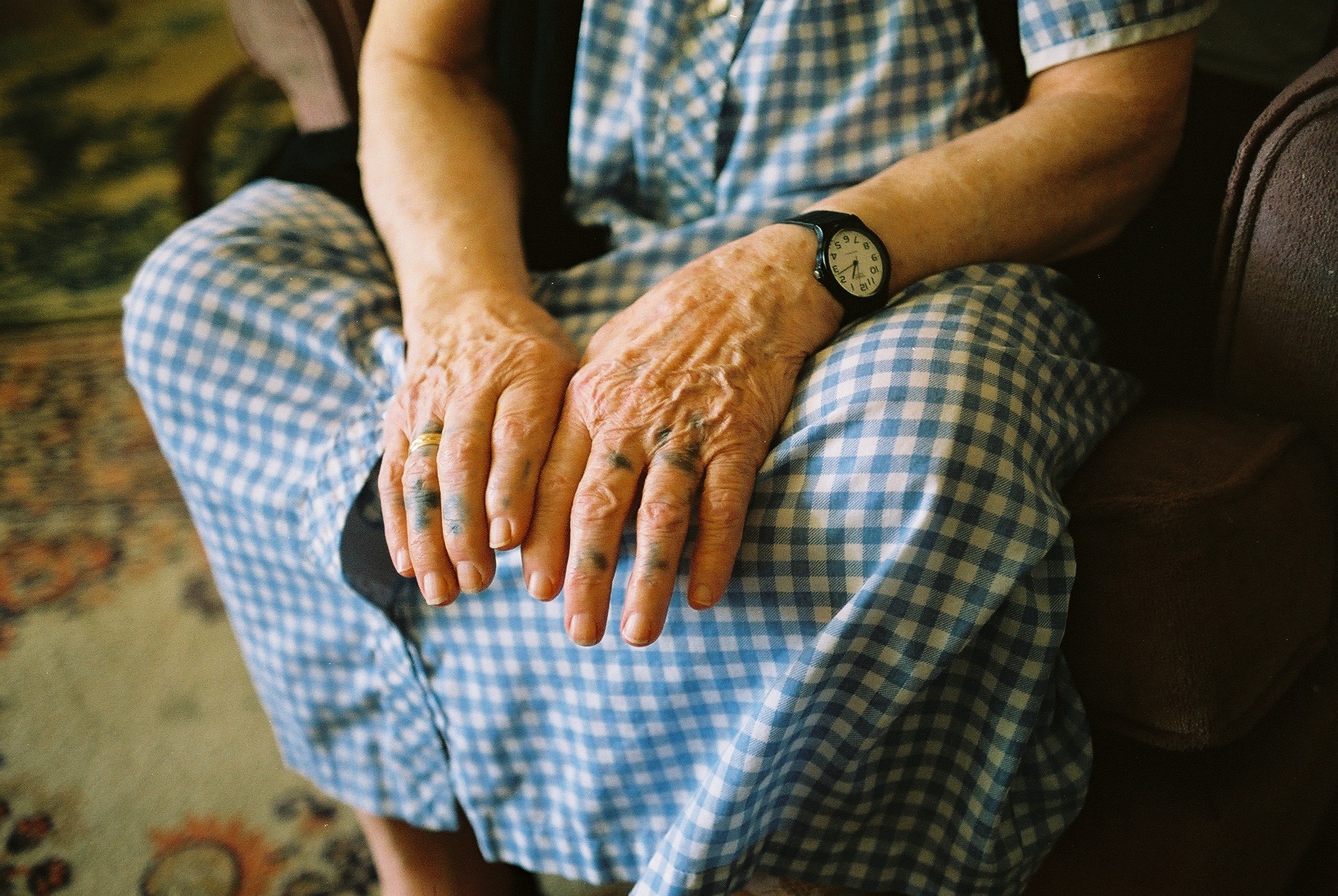
Suzanne Khardalian’s 2011 documentary “Grandma’s Tattoos” begins with a family secret: the marks on the face and hands of the director’s grandmother, Khanoum. The film turns those tattoos into evidence. They become signs of abduction, captivity, sexual violence and a shame that did not belong to the victim, yet was passed down through the family.
Inna Sahakyan’s 2022 film “Aurora’s Sunrise” takes another path. It returns to the life of Aurora Mardiganian, the Armenian Genocide survivor who told her story in “Ravished Armenia” and appeared in the 1919 film “Auction of Souls.” Through animation, oral history and surviving film fragments, “Aurora’s Sunrise” brings back the voice of a young woman who became a witness before the world.
The two films show that evidence does not always look like a government document: sometimes it is a tattoo, sometimes a voice recorded decades later and sometimes a grandmother who frightened her family because no one knew how to speak about what had happened to her.
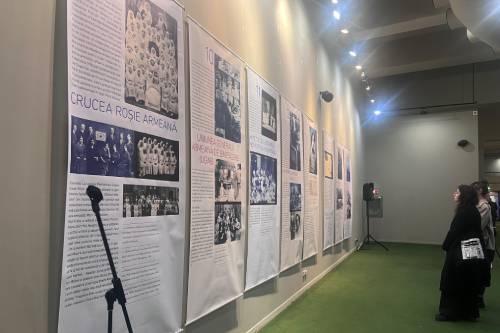
In 2025, as Armenians around the world marked the 110th anniversary of the Armenian Genocide, the Armenian Genocide Museum-Institute presented in Bucharest the exhibition “The Armenian Woman: Victim and Heroine of the Genocide” with photographs, narratives and testimonies about Armenian women who survived violence, displacement and loss while trying to protect their families. The event also included “Strunga: A New Home for Armenian Orphans,” connecting the fate of women with the fate of children who survived the genocide and rebuilt their lives in exile.
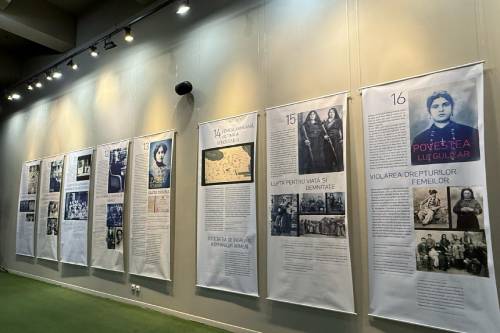
The same approach appeared in the traveling exhibition “Women and Genocide: From Persecution to Empowerment,” presented at Arizona State University through a collaboration between the Armenian Genocide Museum-Institute and the Zoryan Institute that same year. The exhibition placed Armenian women’s experiences alongside those of Jewish women during the Holocaust and Rwandan women during the Rwandan Genocide. Its focus was not only persecution, but also resilience, survival and the ways women carried memory after mass violence.
Evidence does not always look like a government document: sometimes it is a tattoo, sometimes a voice recorded decades later and sometimes a grandmother who frightened her family because no one knew how to speak about what had happened to her.
Elyse Semerdjian’s “Remnants: Embodied Archives of the Armenian Genocide,” published by Stanford University Press in 2023, addresses themes closely tied to this field: tattooed Islamized Armenian women, forced assimilation, memory, bodily traces, archival fragments and the place of women and children in Armenian communal memory. The book’s description presents these marked bodies and scattered records as ways to approach stories that often remained quiet or difficult to recover through traditional archives alone.
The seminar at the University of Buenos Aires followed that broader movement in the field. It included discussions on forced assimilation, sexual violence, memory, literature and testimony. It also addressed figures such as Zabel Yesayan and Aurora Mardiganian, whose lives and works opened ways to read the genocide through women’s experiences and political intervention.
Expanding Armenian Genocide studies
For Boulgourdjian, earlier studies had a different priority: establishing that the Ottoman state’s policy toward Armenians was planned, premeditated and genocidal. Researchers documented deportations and massacres, established political responsibility and gathered evidence against denial. That focus left less room for other questions.
“Historically, the experiences of women and childhoods were not treated in a specific or differentiated way in studies on the Armenian Genocide,” she said.
The sources existed, at least in part. Official archives, foreign diplomatic reports and early memoirs mentioned the suffering of women and children. But those experiences were often absorbed into a general history of the genocide.
“The historiographical renewal of recent decades and the publication of memoirs by children and women survivors recovered voices and managed to reconstruct their stories, allowing us to better understand the multiple forms that genocidal violence assumed and the strategies of survival and resistance,” said Boulgourdjian.
This research also raises difficult questions about the Armenian community itself. What happened to women who returned after captivity? How did families receive them? Which stories entered communal memory, and which ones remained hidden? How did descendants inherit trauma that was never fully talked about? Boulgourdjian said one of the main challenges is that many experiences remained silent for decades. Survivors often avoided speaking because of trauma, stigma or the desire to protect their families. In the case of children, the problem could be even deeper because many had been renamed, converted or absorbed into other families.
Which stories entered communal memory, and which ones remained hidden? How did descendants inherit trauma that was never fully talked about?
Research from Argentina faces another obstacle: access to archives. Many collections are located in Europe and the United States. Still, Boulgourdjian noted that online access to major libraries, especially in the United States and France, has opened new possibilities.
“To study these issues, it is necessary to work with a great diversity of sources. Oral testimonies and published memoirs are fundamental, but so are diplomatic archives, records of missionaries and humanitarian organizations, League of Nations documentation, photographs, correspondence, institutional records and the press of the time,” she said.
Argentina’s own memory of violence
Argentina also brings a recent and powerful human rights experience to this discussion. In the trials for crimes against humanity committed during the country’s last military dictatorship, from 1976 to 1983, sexual violence was long present in survivor testimonies but often remained legally and publicly absorbed into broader categories such as torture.
In recent years, that began to change, as Argentine prosecutors, judges and human rights groups pushed to name sexual violence as a specific crime, with its own logic, its own judgment, its own victims and its own impact on memory.
That context helps explain why a seminar on women, children and the Armenian Genocide can resonate strongly in Argentina, where the feminist movement gained major public force after the Ni Una Menos (“Not one less”) movement, which began in 2015. It became even more visible during the rallies for legal abortion, particularly during the 2018 congressional debates and the law’s approval in 2020.
Boulgourdjian said studies in Argentina have examined how memory passed through Armenian families across generations. Some stories were preserved. Others changed. Others were silenced.
“From a gender perspective, giving visibility to the violence suffered by women and children during the Armenian Genocide contributed to a more comprehensive memory,” said Boulgourdjian.
“Recovering these stories means understanding that women and children occupied a central place in genocidal policies. On their bodies, their identities and their family bonds, mechanisms were exercised that were intended to prevent the continuity of the Armenian people.”