


Introduction: Creation of the Armenian Alphabet (405)
The creation of the Armenian alphabet allowed for the Christian faith to be disseminated more widely among Armenians. Up until the fifth century, the Armenian people were exposed to the Gospel through the oral tradition, while liturgical services were conducted in Syriac and Greek. Therefore, Catholicos Sahak and the monk Mesrop Mashtots set out to create an alphabet to make Christian scripture more widely accessible. The creation of the alphabet helped to unite a people that had been split between two empires.
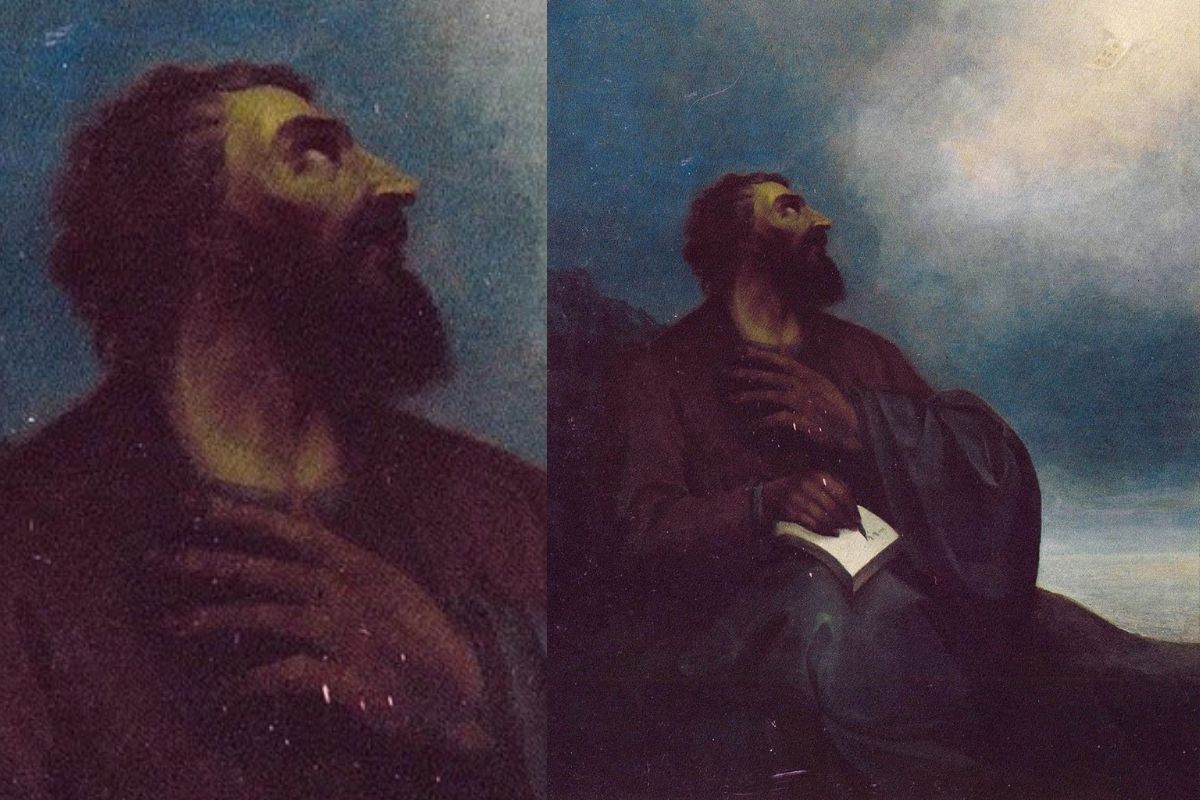
Mesrop was a military man prior to becoming a monk. He was from the village of Hatzegatz in Daron, present-day Turkey. He and several of his pupils, such as Yeznik Koghbatzi, Hovsep Baghnetzi and Goryun the Wonderful translated the Bible into what is now known as Classical Armenian. These figures became known as the Holy Translators and are commemorated as saints in the Armenian Apostolic Church. Their feast day is celebrated in October. It is said that the first verse they translated is from the book of Proverbs 1:2, “For gaining wisdom and instruction; for understanding words of insight.”
The fifth century became known in Armenian history as the Golden Age. Prior to Mesrop’s invention, the Armenian Church used Greek and Syriac in its liturgy.1Tiran Nersoyan. (1996). In V. Nersessian (Ed.), Armenian Church Historical Studies: Matters and doctrine and Administration (p. 67). essay, St. Vartan Press. After Mesrop created the alphabet, liturgy began to develop in the Armenian language as several monastic schools were opened and literacy became more widespread. This led to a monastic movement that allowed for education to be accessible to the peasantry of the Armenian feudal system.
Armenian cultural and religious identity began to take shape around the alphabet. Goryun, a pupil of Mesrop’s who is credited with writing Mesrop’s biography (“Vark Mashtots”) writes, “At that time our blessed and desirable land of Armenia became truly worthy of admiration, where, by the hands of two colleagues, suddenly, in an instant, Moses, the law-giver, along with the order of the prophets, energetic Paul, with the entire phalanx of the apostles, along with Christ’s world-sustaining gospel, became Armenian speaking.”2Vrej Nersessian, The Bible in the Armenian Tradition (Los Angeles, CA: J. Paul Getty Museum, 2001), p. 14.

The First Council of Constantinople (381)
The Church was experiencing a tumultuous time in battling the heresy of Arianism. The heresy threatened the understanding of the unity of the Trinity in one Godhead by supposing that God created Jesus, thus placing him within the context of finite time.
The emperor, Theodosius, entered Constantinople in November 380 and sought to enforce Nicene doctrine within the empire. He was unsuccessful in gaining the support of Bishop Demophilus. At the Council of Constantinople, there were no bishops from Egypt or Nicene and no heretics were present.3Charles Freeman, “Constantinople, 381: The Imposition of Orthodoxy,” in AD 381: Heretics, Pagans, and the Christian State (London: Vintage Digital, 2011), pp. 92-104. The doctrine of Nicaea (325) regarding the divinity of the Son is reaffirmed and applied to the Holy Spirit, thus anathematizing Arianism at the Council of Constantinople.4Justo L. Gonzalez. (2010). In The story of Christianity: The Early Church to the Dawn of the Reformation (Vol. 1, p. 218). essay, HarperOne.
The Armenian Church, represented at Nicaea by Arisdages, a Parthian, participated in neither the Council of Constantinople nor in the Council of Ephesus, which followed it in 431. The decisions of the latter two councils were accepted under the leadership of Catholicos Sahak (354-439).5Ibid., p 16. It may be surmised that the reason for the Armenian Church’s absence from this council is that the nation had already accepted Christianity in 301 under King Tiridates III and accepted Nicene doctrine in 325. Additionally, the Armenian Church firmly believes in the immutableness of Christ (Hebrews 13:8), which is a theme apparent throughout its liturgy.
Armenia partitioned between Persia and Eastern Rome (387, 390)
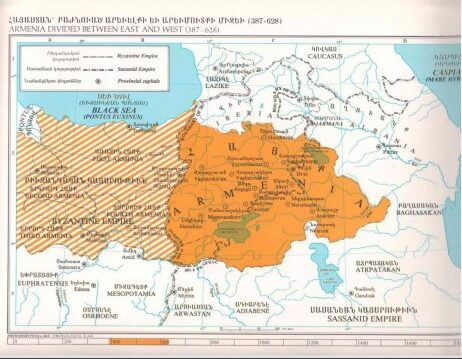
The Persian King, Shapur III, agreed with Emperor Theodosius I to officially separate Armenia. This had a devastating impact on the Christian Armenians.6Vahan Hovhannessian, History of the Armenians 3rd edition (St. Lazarus, 1975), p.52. Under Zoroastrian Persia, the need to unite the Armenian people through written text became more pressing because Persian governors did not allow people to learn Greek, but only Syriac. In the Byzantine portion, Armenians used Greek as they were subject to the See of Caesarea. According to historian Maghakia Ormanian, Armenians acquired their educational training at the schools of Caesarea in Cappadocia and Edessa in Osroene.7Maghakia Ormanian, The Church of Armenia and Her History, Doctrine, Administration, Inside Structure, Liturgy, Literature, Present, trans. G. Marcar Gregory (Yerevan: Ankyunacar Publishing, 2015), p. 43.
Furthermore, the Armenian Arshakuni (Arsacid) dynasty diminished during the partition. Armenia was relegated to provincial status between the two empires with Western Armenia being overtaken in 390 and the larger eastern portion falling under the Persians in 428.8Boghos Levon Zekiyan, “Christianity to Modernity,” in The Armenians Past and Present in the Making of National Identity, ed. Edmund Herzig and Marina Kurkchiyan (New York: RoutledgeCurzon, 2005), pp. 41-65.
First Translation (407-412)
Armenian literature begins with the translation of the Bible. In Armenian, the Bible is referred to as Asdvadzashoonch (Աստուածաշունչ), a compound word meaning God’s breath, like theopneustos (θεόπνευστος), in Greek. The first translation of the Bible was done using the Assyrian Peshitta script. Peshitta in Syriac means common or simple. After this first trial, a few of the early translators were sent to Edessa and Constantinople to be trained in literary translation.
Council of Ephesus (431)
The Council of Ephesus convened in the summer from June 7 to Aug. 31, 431. It was led by Cyril of Alexandria and summoned by Emperor Theodosius II. It centered around the debate of the designation of Mary. Nestorius believed she had to be called Christotokos, Christ-bearer, and not Theotokos, God-bearer. The Council of Ephesus relied upon Cyril’s assertions and affirmed the term Theotokos to describe Mother Mary.9Florin Curta and Andrew Holt, Great Events in Religion: An Encyclopedia of Pivotal Events in Religious History (Santa Barbara, CA: ABC-CLIO, 2017), p. 287. The Armenian Apostolic Church accepts Ephesus and uses the term Asdvadzadzin (Աստուածածին) meaning “one who gives birth to God.”
Translation of the Holy Bible (434)
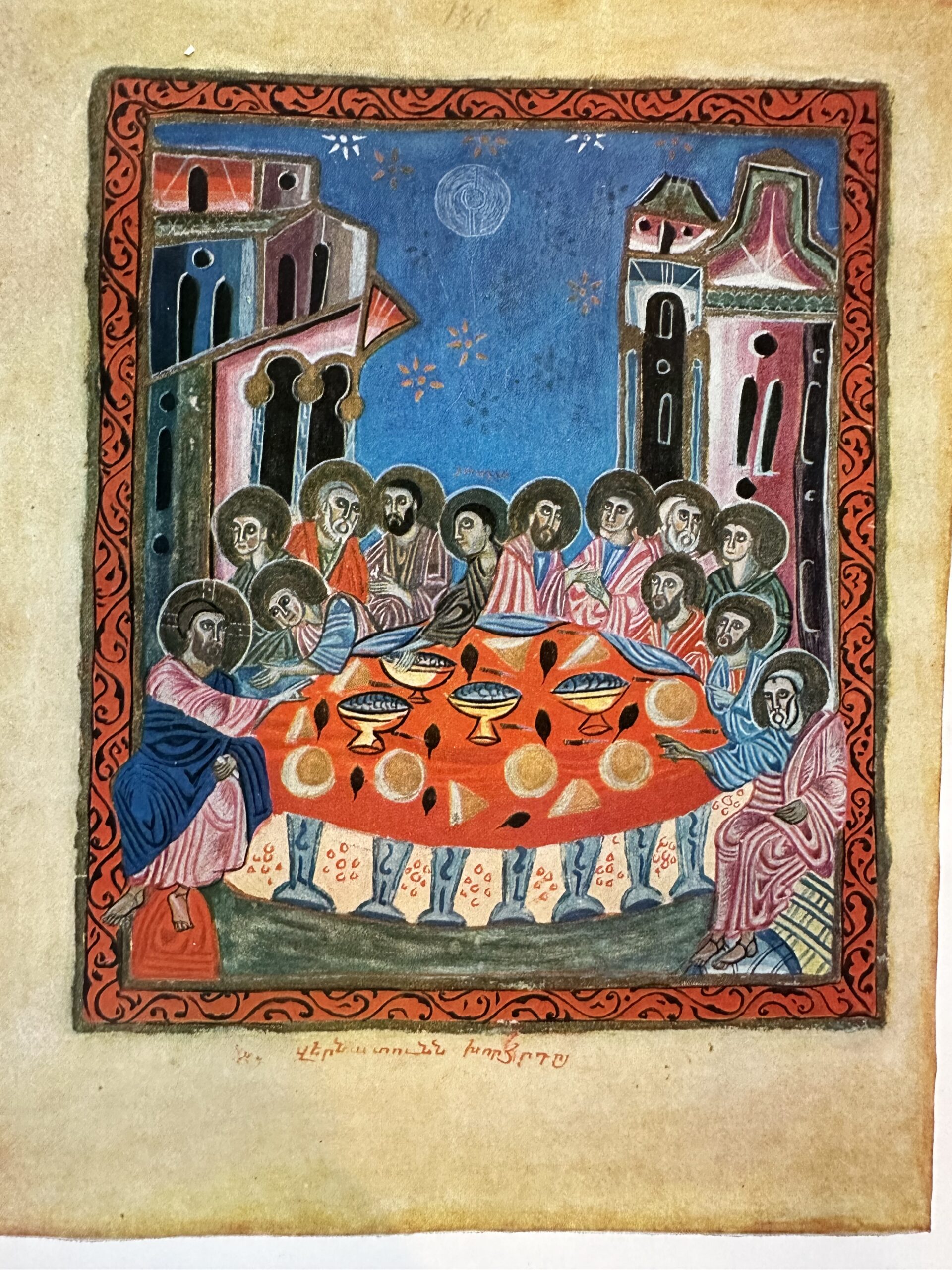
Following the Council of Ephesus, the translators that were sent to Edessa and Constantinople returned to Armenia in 432. They brought Greek manuscripts back with them and initiated a second translation of the Bible, which was completed in 433. Following the conclusion of this important project, the translators began to prepare the translation of liturgical texts, such as the “Divine Liturgy” and the sacramental rituals.10Ormanian, p. 48-49. Several works by early church fathers, along with philosophical texts, were also translated and have been preserved to this day in the Matenadaran of Armenia.
Conclusion
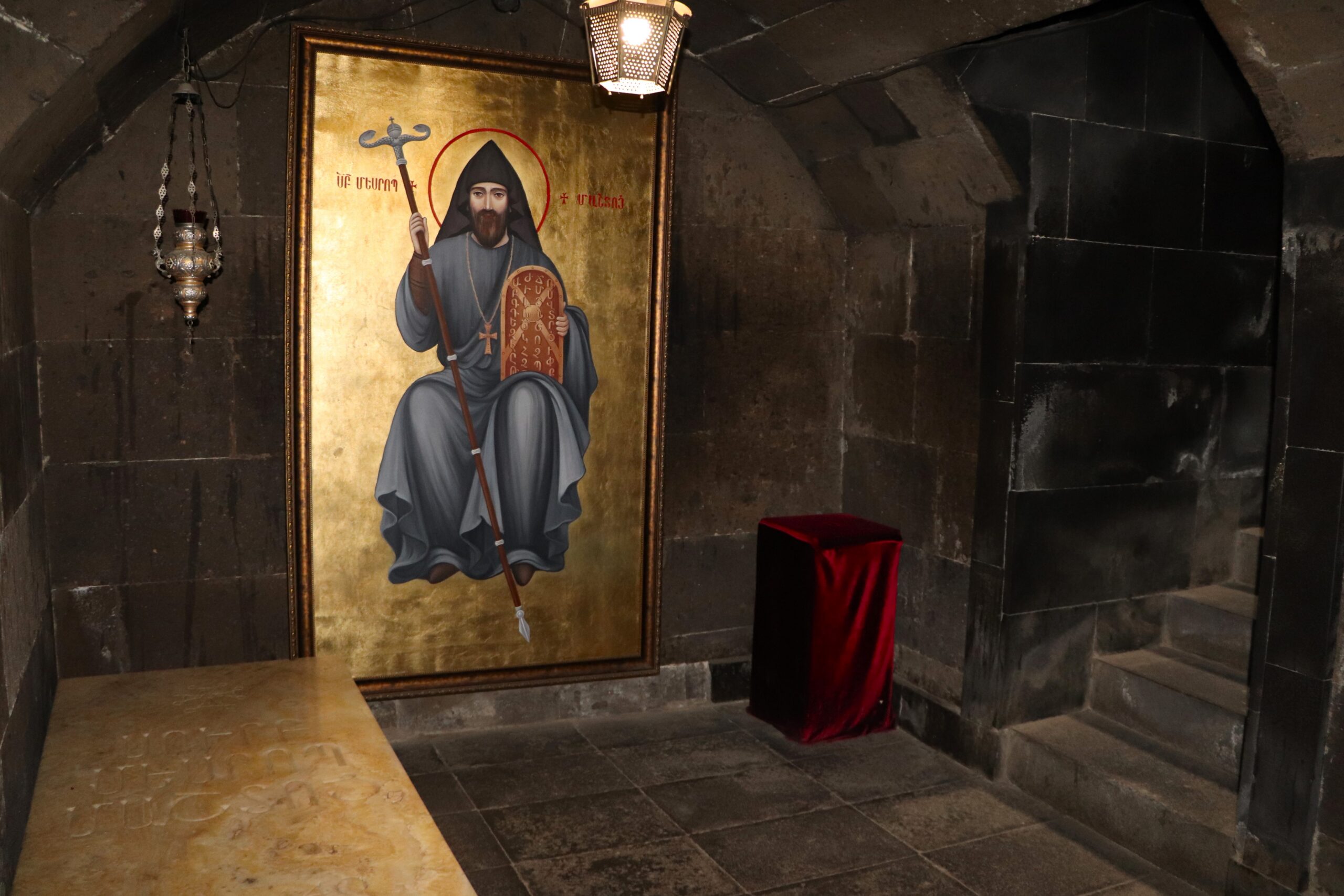
The creation of the 36-letter Armenian alphabet by Mesrop Mashtots helped to unite a separated Armenian people through the Christian faith. For nearly 600 years, until the creation of the first independent Armenian Republic in 1918, the Armenian people lived under foreign powers as a subjugated Christian minority. The Church and language played a critical role in educating, uniting and, at times, even governing the Armenian people. Visitors to Armenian Churches today will likely find consecrated icons depicting Mashtots’ alphabet alongside the Holy Translators. Mashtots was known as a vartabed, a doctor of the Church. Today, Armenian clerics receive their snake-headed staff signifying vartabed status in the monastery of Oshagan, where Mesrop Mashtots is buried, upon defending their thesis before a jury and the students of Gevorgian Seminary in Etchmiadzin, Armenia.
Sources
Armen, Garbis, and Vrej-Armen Artinian. Historical Atlas of Armenia. Armenian National Education Committee, 1987.
Curta, Florin, and Andrew Holt. Great Events in Religion: An Encyclopedia of Pivotal Events in Religious History. Santa Barbara, CA: ABC-CLIO, 2017.
Freeman, Charles. “Constantinople, 381: The Imposition of Orthodoxy.” Essay. In AD 381: Heretics, Pagans and the Christian State, 92–104. London: Vintage Digital, 2011.
Gonzaĺez Justo L. Essay. In The Story of Christianity: The Early Church to the Dawn of the Reformation 1, 1:218. HarperOne, 2010.
Nersessian, Vrej. The Bible in the Armenian Tradition. Los Angeles, CA: J. Paul Getty Museum, 2001.
Nersoyan, Tiran. Essay. In Armenian Church Historical Studies: Matters and Doctrine and Administration, edited by Vrej Nersessian, 16. St. Vartan Press, 1996.
Ormanian, Maghakia. The Church of Armenia and Her History, Doctrine, Administration, Inside Structure, Liturgy, Literature, Present. Translated by G. Marcar Gregory. Yerevan: Ankyunacar Publishing, 2015.
Zekiyan, Boghos Levon. “Christianity to Modernity.” Essay. In The Armenians Past and Present in the Making of National Identity, edited by Edmund Herzig and Marina Kurkchiyan, 41–65. New York: RoutledgeCurzon, 2005.