


Interview: Dana Mashoian Walrath on genocide and art
Dana Mashoian Walrath is a Vermont-based author, artist, anthropologist and educator. She is known for her unique style of creative writing and comic art, as exemplified by “Aliceheimer’s,” a graphic memoir about her mother’s journey with dementia, and “Like Water on Stone,” a verse novel about the Armenian Genocide.
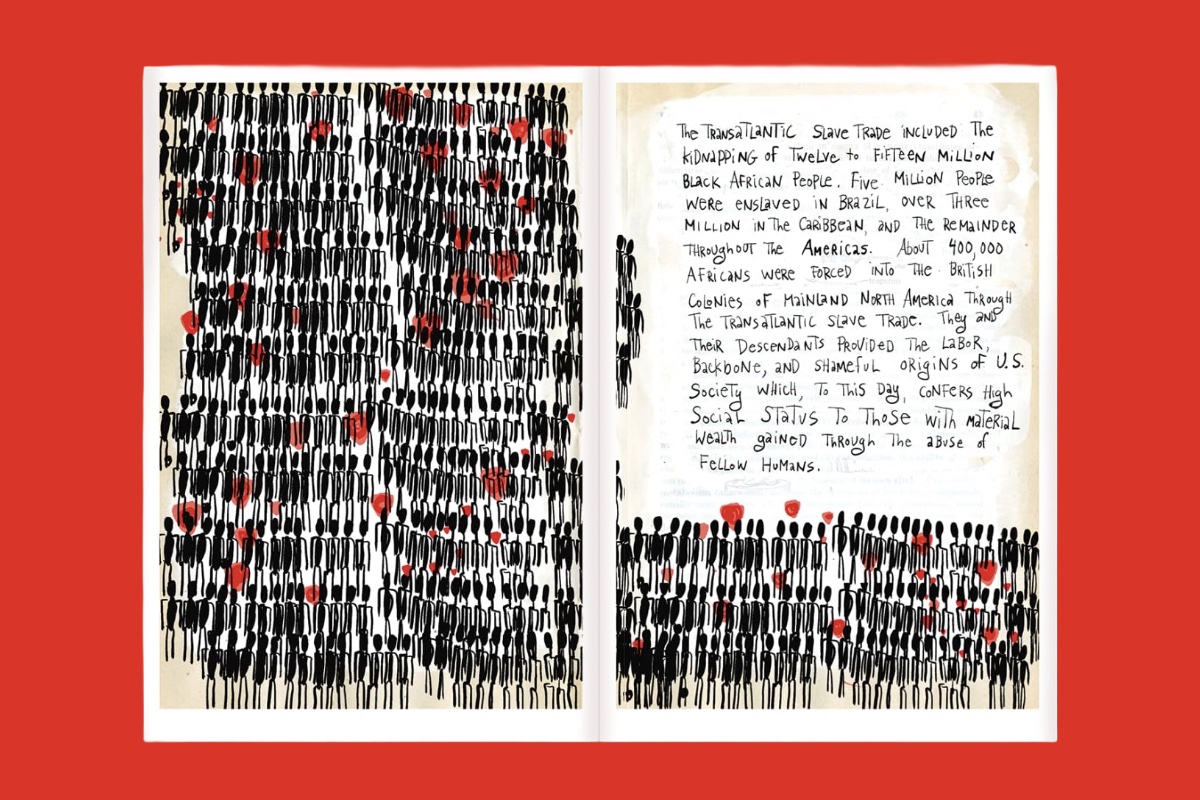
Her latest work is “The Book of Genocides.” Though it first began as an interactive art installation, this immersive graphic novel draws readers into some of the most horrific events in world history through a variety of artistic styles and methods, including collage, drawings, blackout poetry, zoology texts and more.
The book explores the history and context of 10 genocides that span time, geography and cultures: the Genocide of the First Peoples of the Americas, the Genocide of Black Americans, the Genocide of Aboriginal Australians and Torres Strait Islander Peoples, the Armenian Genocide, the Genocide of Jews in the Holocaust, the Palestinian Genocide, the Cambodian Genocide, the Tutsi Genocide in Rwanda, the Bosnian Genocide and the Rohingya Genocide.
We caught up with Mashoian Walrath following the release of “The Book of Genocides” to talk about her process of creating this interactive work, the underlying symbolism in her artistic choices and her point of view as a descendant of Armenian Genocide survivors.
This interview has been edited for length and clarity.

Rosie Nisanyan (R.N.): Unfortunately, there have been many genocides throughout history and the present day. Why did you choose these 10 genocides specifically?
Dana Mashoian Walrath (D.M.W.): Great question. I chose these 10 because I wanted to have a mix of perpetrators and people who were suffering. As an Armenian, we were the victims of a genocide perpetrated by an Islamic government. But in this country, especially since 9/11, I’ve watched Islamophobia just grow and grow. I feel, as a descendant, I best honor my ancestors by separating people from governments. And I’m ready to condemn Enver Pasha, Talaat Pasha, and Erdoğan and Aliyev and so forth, but I do not want to condemn all Turkish people because similarly, I’m not responsible for the actions of my government in the United States and I’m actually heartbroken by many of the things that are going on.
In terms of perpetrators, it was especially important to include the Rohingya Genocide because it’s being perpetrated by Buddhists. We, in the United States, are used to thinking of Buddhism as peace and beauty and being in the present moment. This genocide illustrates that every single organized religion can be corrupted. We forget the terrible, terrible things done in the name of Christianity during the Spanish Inquisition. I selected genocides in order to separate a people, a religion, an ethnicity, a race — any of the qualities that Raphael Lemkin built into the Genocide Convention — from governments. They are the ones who perpetrate genocide.
R.N.: I think that’s an important distinction, especially right now. It seems that many people don’t understand that criticizing the actions of the Israeli government is not antisemitism.
D.M.W.: Absolutely. This is the moment to separate critiques of the Zionist mission, as implemented by the Israeli government, from false claims of antisemitism. Antisemitism, like racism and other forms of bigotry, consists of flattening an entire group of people into a monolith that attributes negative behaviors and beliefs to all members of the group. Genocide, on the other hand, is the systematic elimination of a people through a set of processes which governments enact. We have to really look deep and hard at all our definitions. Every single new country, including the United States, began with people who could be called terrorists because they were not a “legitimate” governmental force.
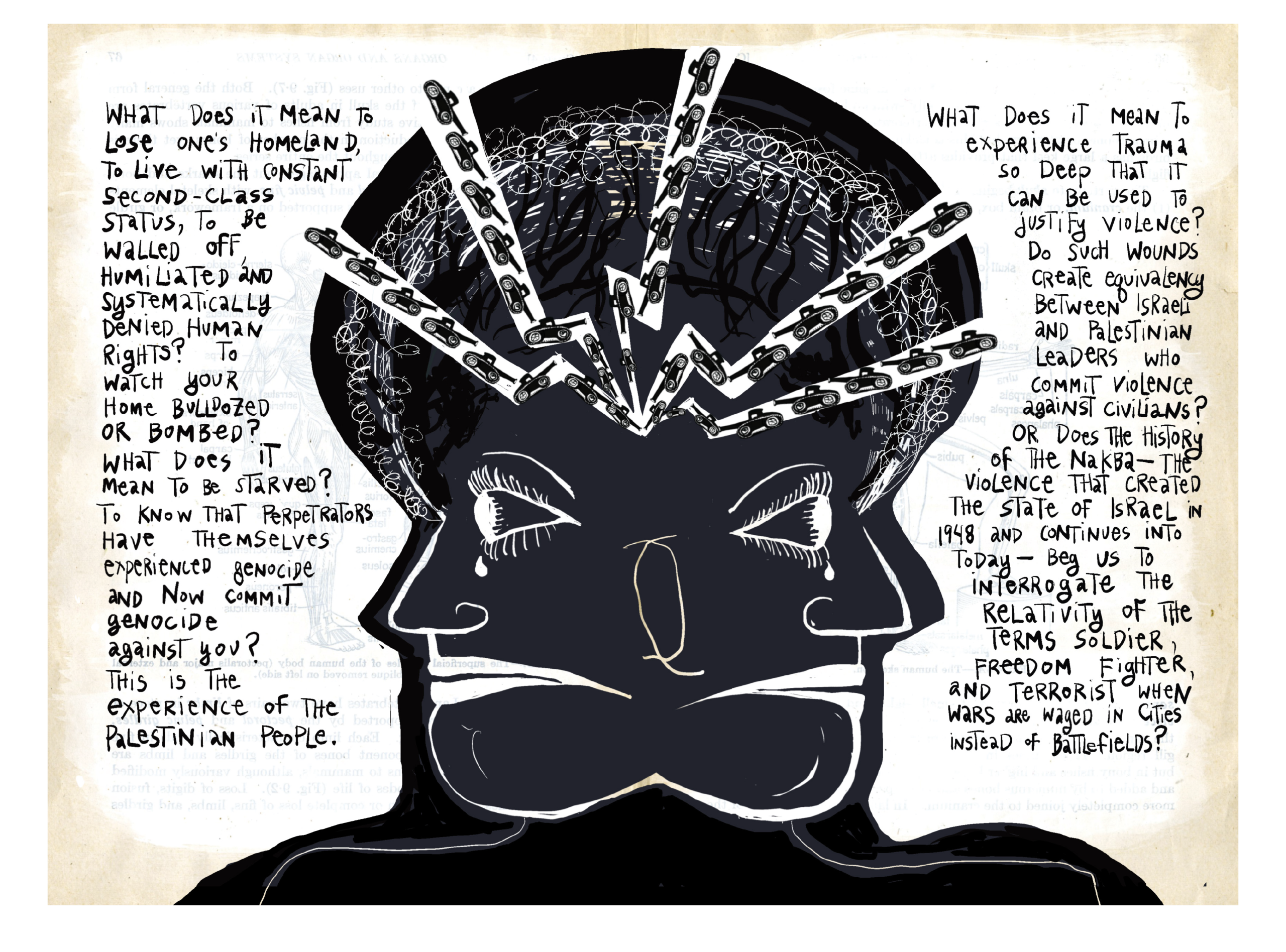
At this historical moment, it is vital to tell these histories. Peace in this world depends upon places like the United States, the United Kingdom, Russia, India, China, Israel and Turkey owning the things they have perpetrated and then repairing them. And it’s kind of like what we were all taught when we were growing up: we make mistakes and then we have to repair them and correct the hurt that we’ve caused.
For Armenians, because we live with a genocide that remains officially denied by the perpetrators, we’ve been closed out of such repair. On top of that, spurious legal arguments claim that the Genocide Convention’s mechanisms cannot be applied because the term “genocide” hadn’t been coined yet. This means that we must talk about reparations and repair all the time and really insist on it and find our natural allies. I’m so grateful for the beautiful scholarship of people like Taner Akçam and Uğur Ümit Üngör, as well as all the brilliant Armenian scholars, because they document how these things truly happened.
Peace in this world depends upon places like the United States, the United Kingdom, Russia, India, China, Israel and Turkey owning the things they have perpetrated and then repairing them.
I think of Üngör’s work on how the wealth of Turkey grew out of what was seized from Armenians who were forcibly displaced. And we see that story again and again, because genocide is always about land and resource theft. Get rid of the people because then you can take everything. We’re seeing it again with Artsakh, right?
R.N.: Reparations are the tricky part because in theory, anyone can say, “We’re sorry, we made a mistake.” But now, it’s going to cost them money and it’s going to cost them land. And they don’t want to give that up.
D.M.W.: Yes, and we have to figure out ways to make it so people do give that up. Now that Armenians are officially white people, thanks to the lawsuits that were filed so we could get around the immigration quotas, we have benefited from that status as white people in the United States. We have to then recognize how our privilege in that regard is impacting Black and brown people. The more we do that, the more we’re modeling how we can make this world better. We Armenians are incredibly poised to do good work in this world because we understand all the different sides of things.
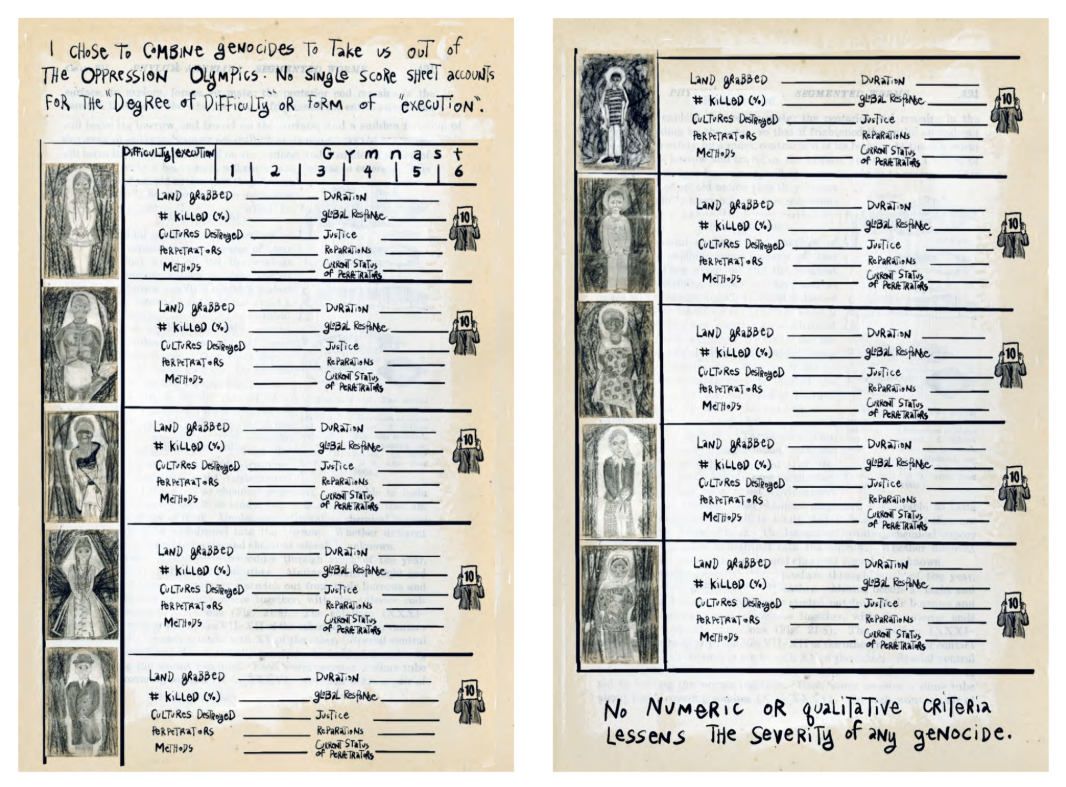
R.N.: As an Armenian, I appreciate that you’ve presented all these genocides together in one book, because every April 24, we say, “1915 Never Again.” And yet genocide continues to happen again and again, so we really do need to band together. In the book, you say that bringing them all together was an effort to “take us out of the Oppression Olympics.” Can you talk more about what you mean by that?
D.M.W.: I didn’t dream up the phrase, it is out there. But I put it down on paper in a very accessible form, complete with the Olympic judges and with a score sheet, to make the point that no single criteria lessens the severity of genocide.
We are obsessed with numbers. I was just leading a workshop on graphic storytelling for Atlantic Fellows at the London School of Economics. One of the Fellows was from Germany, and he said, “Well, the Holocaust is the worst.” And I said, “What criteria do you use?” Is it the percentage of the population? Because if it’s the percentage of the population, for us, it’s 75%, three out of every four Armenians. But for the indigenous peoples of the Americas, it’s 90 to 95%. For indigenous Australians, it’s at least 50%. And then, what’s the most valuable thing? Is it the bodies or is it the cultures and the languages and all the vital parts of identity that were lost?
Armenians are incredibly poised to do good work in this world because we understand all the different sides of things.
So, I really wanted it there in a score sheet to get people thinking about what are the criteria that we’re using and then to even think about what are the consequences of when you get called the worst and then you get some reparations, does that make it no longer the worst? What’s the status of the perpetrators in the world today? If we look at, again, something like the United States, which was founded on forcibly displacing all of its indigenous people. U.S. wealth grew from that; our position in the world — though it’s not very good right now — has been one of the great powers because of what settlers gained from colonizing this land.
I’ve noticed lately, and it’s quite wonderful, that more Armenians are thinking across genocides. Believe it or not, I’ve been talking about this since I was an undergraduate member of the Armenian Club at Columbia University. I was saying, “We should think about Cambodia. Let’s talk about apartheid.” And at that point, Armenians, we were too wounded. But there was a real turning point with the 100th anniversary commemoration in 2015. That’s when the Aurora Prize was born and Armenians were collectively ready to start doing that. I want to honor this and hope that it continues; we have a lot to say because of understanding what it’s like.
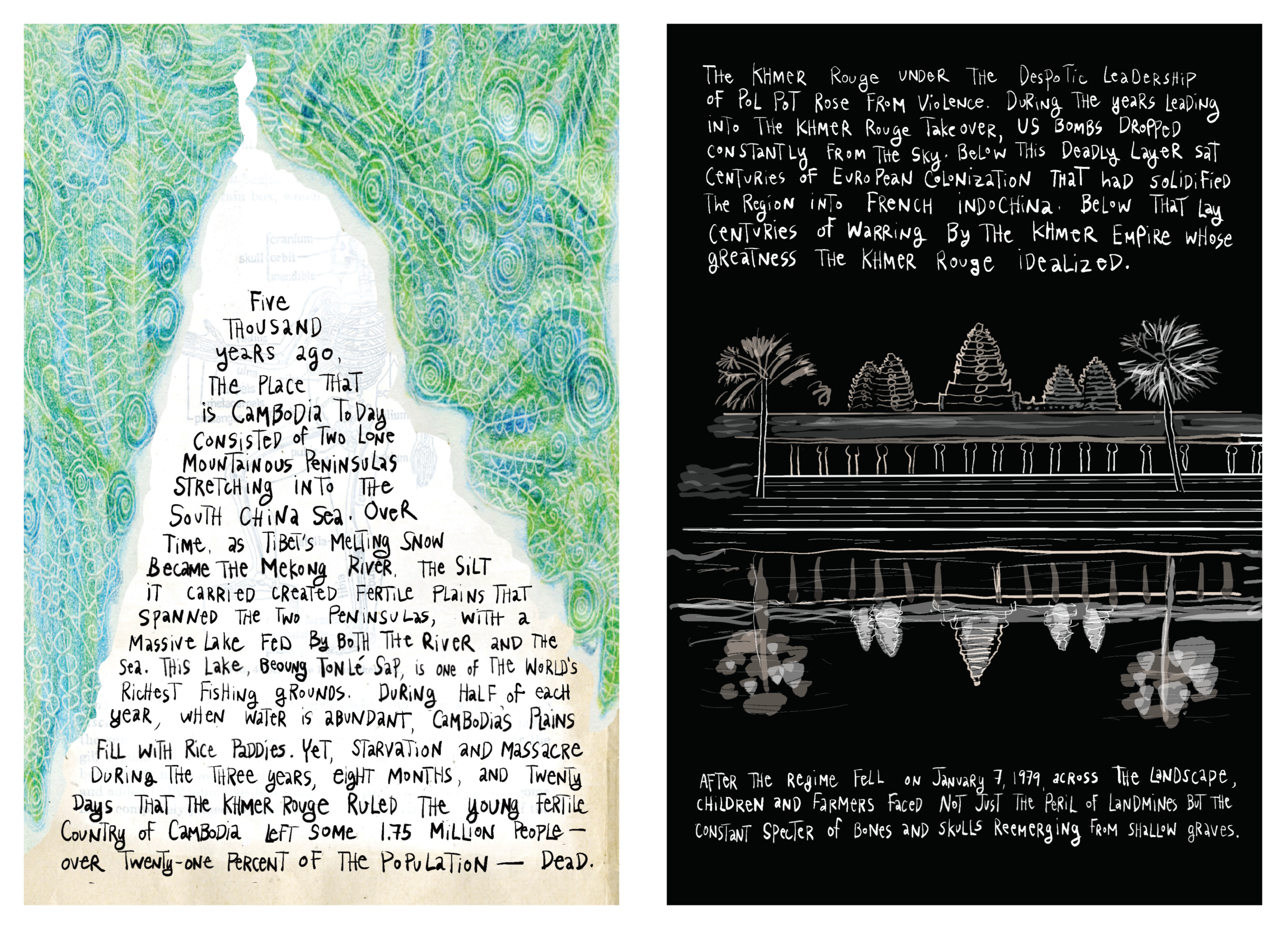
When I was in Cambodia at the Tuol Sleng Genocide Memorial Museum, where 19,000 people passed through the walls of that prison, where they were tortured and sent to the killing fields — only seven adults and four children survived — one of the children who survived was there selling the memoir that he wrote about the experience. He was the nine-year-old boy who thought to throw his younger brother and two other kids under a pile of bodies when the last killing spree was happening. When I gave him a copy of “Like Water on Stone” and told him about my grandparents and their experiences, he invited his whole family to come and meet me because I represented how, two generations later, all doors are open and you’re free. For him, I was the embodiment of hope because I represented that it is possible to recover, in much the same way that I look to many Black activists for inspiration, and to First Nations Peoples in the United States and in Australia and New Zealand. They have shown me how to stand tall and tell our story to the world.
R.N.: You feature an interactive element of cutting the pages “as a form of liberation,” alongside blackout poetry. Why is interactivity important for you to include?
D.M.W.: When we interact, we take in knowledge in a different way. I was a professor for years and know that the people who take things in through their ears excel in school. I can do the ear thing, but because I’m an artist as well, I know what it’s like to take in the world visually. I also know what it’s like to learn experientially, through embodying something.
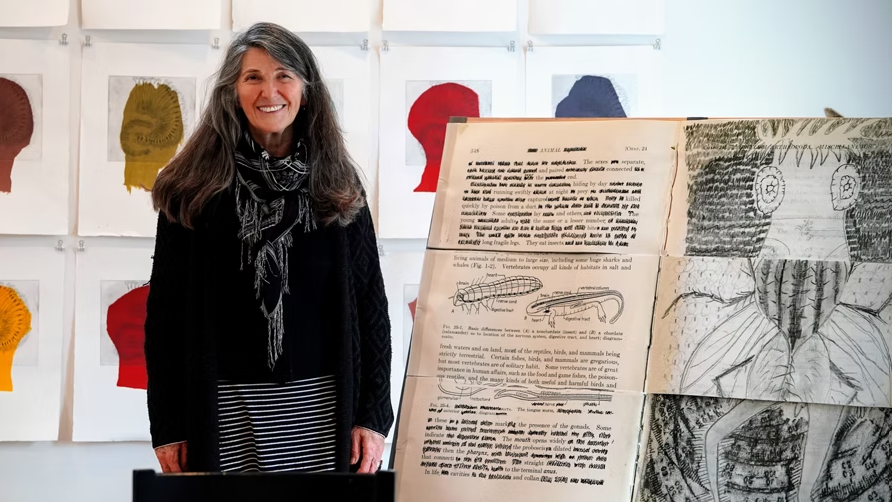
Comics, as a medium, are inherently active because they’ve got visual and verbal elements that a reader has to put together. But then to add in the cutting, it adds a layer of thinking, of discernment, regarding the social rules we have internalized. We are all taught not to desecrate books, but at the same time we are taught that war is a part of human life. The act of cutting a page with a drawing of a person on it will lead readers to think about the real violence done to our fellow humans. Cutting the pages and turning them separately places the reader inside of dehumanization. It also brings the reader back to childhood, a time when we all knew that harming one another was wrong. This interactivity amplified by blackout poems adds layers that bring readers into a topic they might hold at arm’s length. I believe more than anything, whether we’re a descendant of perpetrators or survivors, engagement is the way that we heal. It’s the way we heal collectively.
For him, I was the embodiment of hope because I represented that it is possible to recover, in much the same way that I look to many Black activists for inspiration, and to First Nations Peoples in the United States and in Australia and New Zealand. They have shown me how to stand tall and tell our story to the world.
[Creating the book] also kept me going because I could get up every day instead of feeling hopeless. During the war in 2020, I was writing blackout poems. And since the loss of Artsakh, I’ve just been drawing nonstop because I know it’s a powerful way to push back. And that’s what we can do and we are. We’re doing it.
Another little piece of sensory embodiment is that I drew into the surface of a mid-20th century scientific textbook that had belonged to my mother and so the antique pages are sepia-toned. For the original, I had each one of them standing on a long wooden table as though they were a religious book at a lectern and I let people handle them. Once I realized these are going to disintegrate, that’s when I started scanning them and making them life-size. They are two-sided pages, but I couldn’t print at that scale on two sides. I printed one side and had to figure out the physics; it wouldn’t work to just glue it.
What I ended up doing is binding it just in the very middle and the outer edges. And you see right here is the binding. I put linen tape on the outside. Linen tape comes in white or black. I put on the white and I thought, “I know, I’ll color it with ginger, turmeric and ash,” to match the color. When they were first made, the dust comes off on your fingers and it’s redolent, you get the smell of the spices; it’s another thing that brings us into the moment.
The giant books are also cut, and each section held into place with magnets. In this case, [cutting the pages] is not destructive. There is a bit of resistance when turning the pages, which creates another layer and serves as a reminder that we can resist the destructive forces.
I did intentionally want to use that as a way for people to discern what are the rules that are good for all of us and what are the rules that we’ve naturalized that are actually really destructive, like war. There’s a feeling of, “I can’t cut a book, but we’re cutting the people up right and left.” I think when things are painful, there’s an urge to keep it at arm’s length, and then this embodied experience brings one back in.
R.N.: The graphic novel “The Book of Genocides” is not your first work blending art and words. “Aliceheimer’s” is a graphic memoir and “Menopause” is a comic treatment. For you, how does the combined format help you to communicate in a way that you can’t with art or text alone?
D.M.W.: In writing, the dictum that every good writing teacher gives to their students is: show, don’t tell. When you’ve got pictures there, you’re showing, so right away, pictures help writing do the right thing. Pictures add another layer of that same notion of show don’t tell. You don’t want to literally draw every single thing; you have to figure out how to make a compelling drawing that will really show what you want to show. By having the combination, I could take the strongest parts of each and use them together.
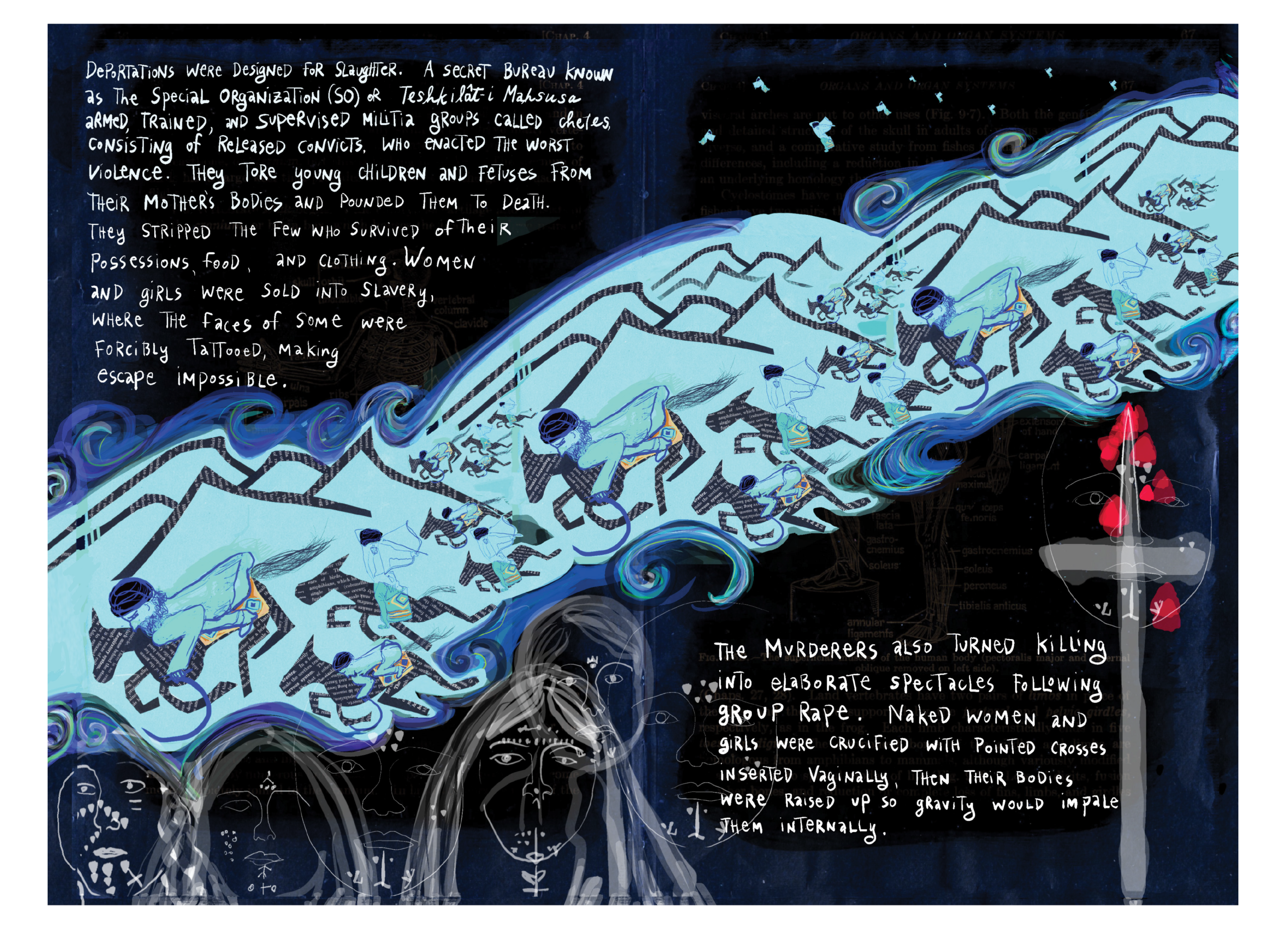
When I was at MacDowell for my fellowship, the book was already under contract. I had so much drawing to do because our hope was to get it out before the midterms. Harvard managed to pull it off and I managed to pull it off, in part through inspiration from one of the composers who spoke about her work one evening.
She had written something for cello, oboe and computer. And all of a sudden, I realized that the digital tools were my friends, that I didn’t have to think of them as cheating. I had already started handwriting the text digitally, but then I started making digital collages. One of the first ones of those was a drawing from the Armenian chapter where I was talking about the jizya taxes. I constructed a little house out of a scan of those official seals from the Ottoman Empire and all of a sudden, I had these new tools to play with, which was really, really gratifying.
To go full circle on that, I’m having fun playing with technology but I’m not using AI. Meanwhile, AI cannot decipher what the heck I’m doing, and I get such a kick out of that, because as a human I am pulling from all sorts of places. That’s the unique capacity of human beings; we make novel connections, and no matter how big the data centers get and how much of the earth they destroy, it’s always derivative. And what we do is just like, “Oh my gosh, that cloud reminds me of my father,” and we make these unique connections. I constantly felt that the drawings and the writing were talking to each other and they would make new things bubble up.
R.N.: The style of “The Book of Genocides” is very striking, incorporating handwritten script, collage, drawings and high-contrast visuals. It seems like it was meant to be an uncomfortable experience. Can you tell me more about that stylistic development and artistic choices here?
D.M.W.: The style of the book grew over time.
It was very unified at first, when it existed solely as an interactive art installation preserved in the drawn turn-the-flap sections of the book. These were all displayed on a table that was made out of a single long piece of wood that was whitewashed, and then it was supported by pipes and furnace parts, which was a conversation that anthropologists have been having forever: is it nature or is it culture? I have, throughout this project, been holding fast to my belief that human nature is not violent and that it is culture — not all cultures, but the dominant systems today that reward greed and violence and domination and extraction. Then, as the project grew, I pulled this theme forward using different elements of nature, technology and culture and always bringing in how politics and society influence the shape of scientific knowledge in our lives.
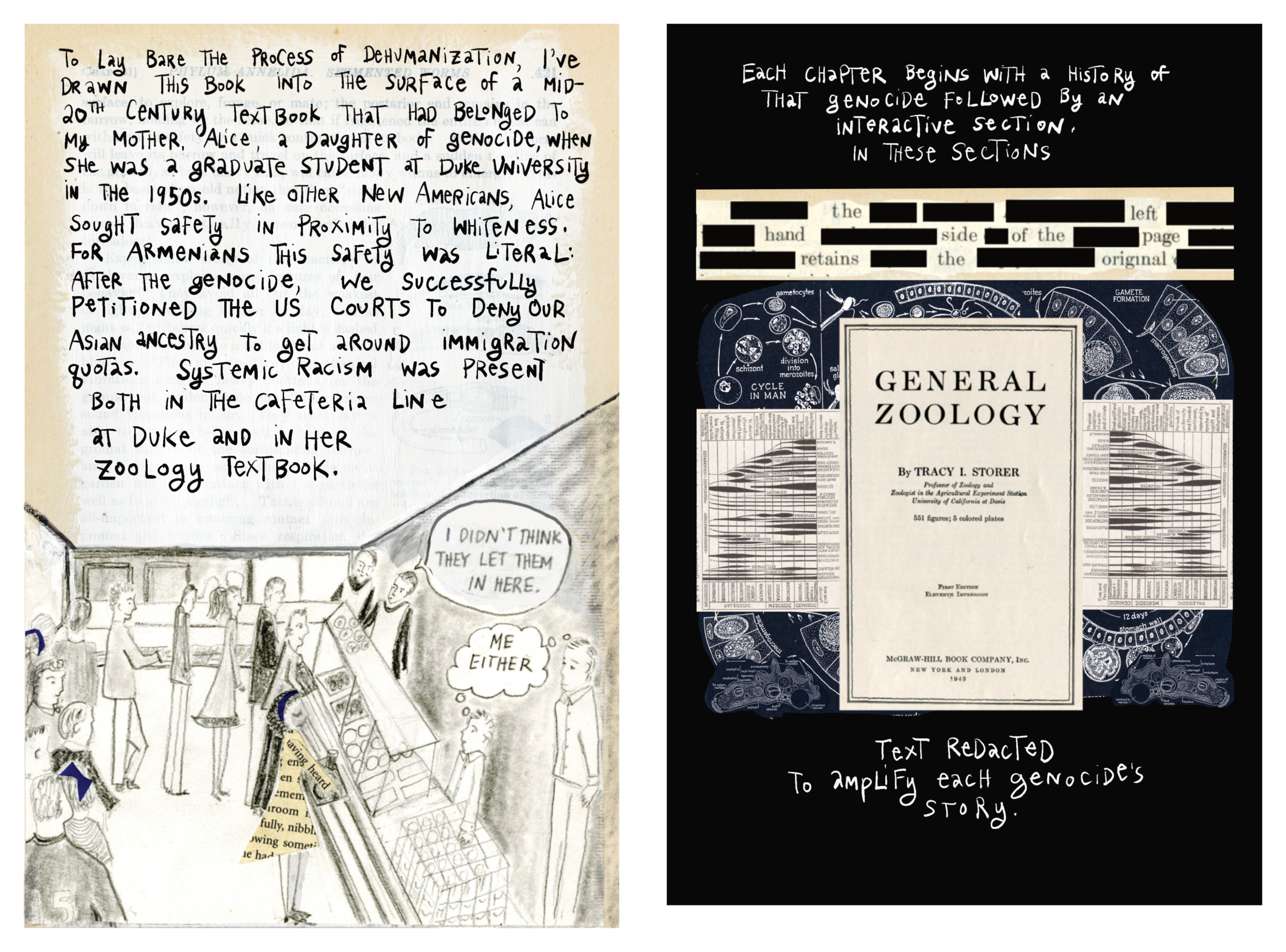
I had left myself messages in the zoology text that made the blackout poems which began during lockdown by carefully choosing what section of the zoology text I would use for each genocide. Say for Black Americans, I used the heredity chapter because of the horror of how enslavers were breeding people. With the Holocaust, I used insects because of the hatred and antisemitism embedded in calling Jewish people vermin and so forth.
Once I discovered digital technology, I went back and I started using my own analog drawings. I would scan them, cut out pieces, and use them as collage elements. So again, what’s technology, what’s natural? I was blending them.
I have, throughout this project, been holding fast to my belief that human nature is not violent and that it is culture — not all cultures, but the dominant systems today that reward greed and violence and domination and extraction.
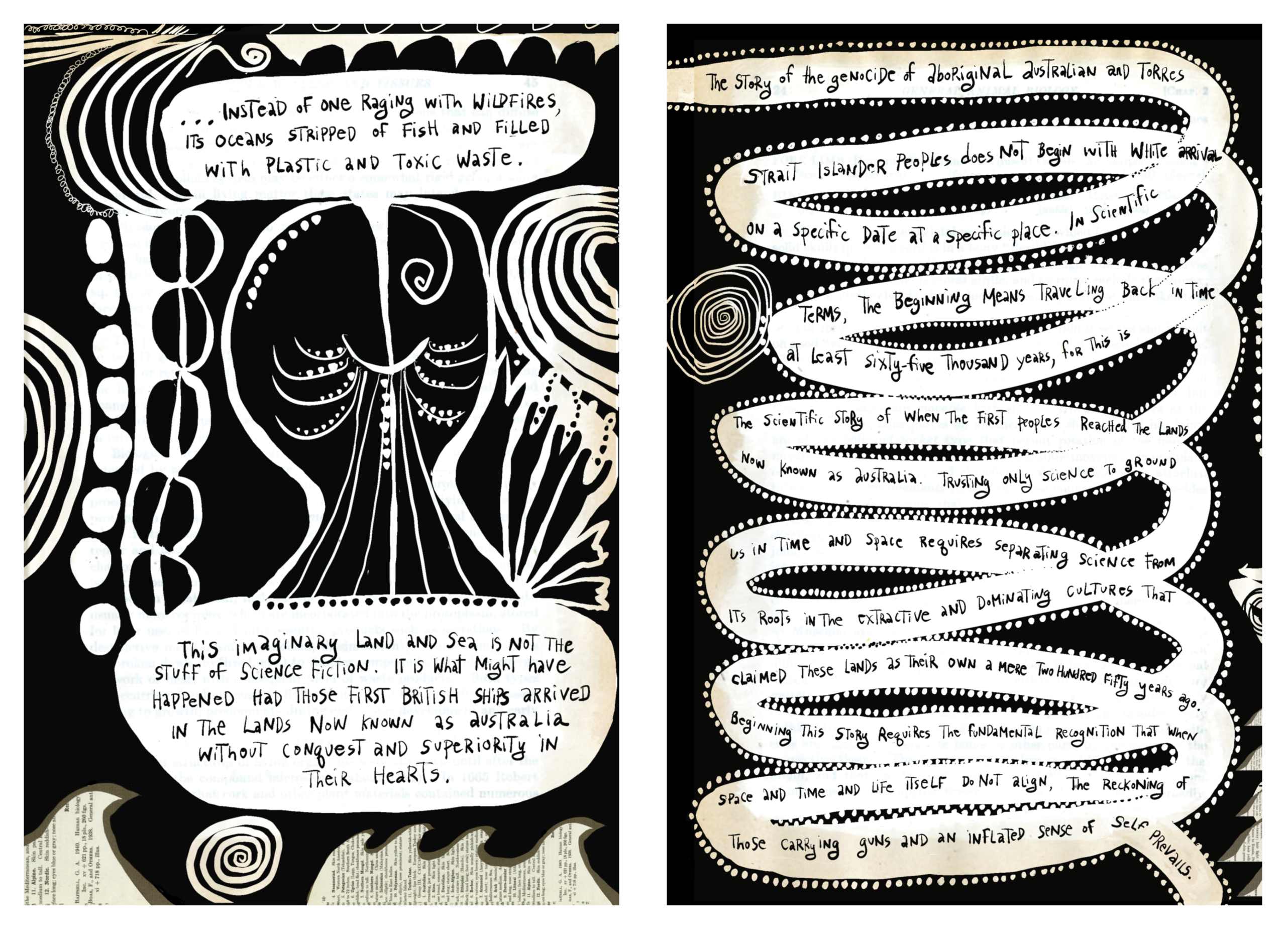
When I went to write the graphic history of each genocide, another stylistic piece appeared. My travels to every single place featured in the book let me find a visual voice that corresponded to that place. The voice corresponded to the art from that place, the culture, the pushback. In the Holocaust chapter, for example, the first pages start out yellow because the Aryan blondness is all about having golden hair. Then our pages, the Armenian pages, I use those deep reds that are so gorgeous from our carpets and come from the cochineal beetles. Dots are very much a part of Indigenous Australian art, so I tried to use those, but use them very carefully because I did not want to steal or appropriate; I wanted to honor. I was walking that line and working with members of each community to make sure that I was respectful because we don’t always see how we might not be respecting a culture.
The flip side of that is there were moments where I had to really advocate and some of the advocacy is coming post-publication. The best example of that is Rwanda. I first got connected with the Kigali Genocide Memorial people through the people I’d been working with at the United Nations. As an American with a book coming out from Harvard, all doors were opened. Then I wrote, “I’m an Armenian-American” and I noticed people stopped answering my emails. When I got to Kigali, I saw that the Armenian Genocide had been taken out of their genocide museum. I think they’re getting a lot of aid from Turkey, so the removal appears to be under pressure from the Turkish government.
I covered the Rwandan Genocide so well and I hope that this book does well enough to have them do the right thing. Because we have to stand together, we have to know who the real enemies are — those who are profiting off of genocide. After I left Rwanda, I started speaking with scholars and learned that they’ve been pushing back against this, as well. Right now, what they’re saying is that it’s temporarily not there, but it’s been quite a while, and it has been replaced with something on the Bosnian Genocide.
R.N.: It’s tough when it impacts your economy and you need the money, right? It’s tough to do the right thing when it’s going to cost you a lot, but that’s when it’s even more important to do the right thing.
D.M.W.: You said it so well, it’s tough. But that’s the fundamental change that this moment is asking from us. When you do dishonorable business, it always catches up with you. I know global politics were supposed to be about peacekeeping since World War II, but it has devolved into power, profit and control of resources. We’ve got to rethink this and have different kinds of currencies. We have to have currencies of peace and currencies of kindness and compassion, instead of it just being about wealth and greed, because we’re rewarding the wrong people and the wrong ways of being.
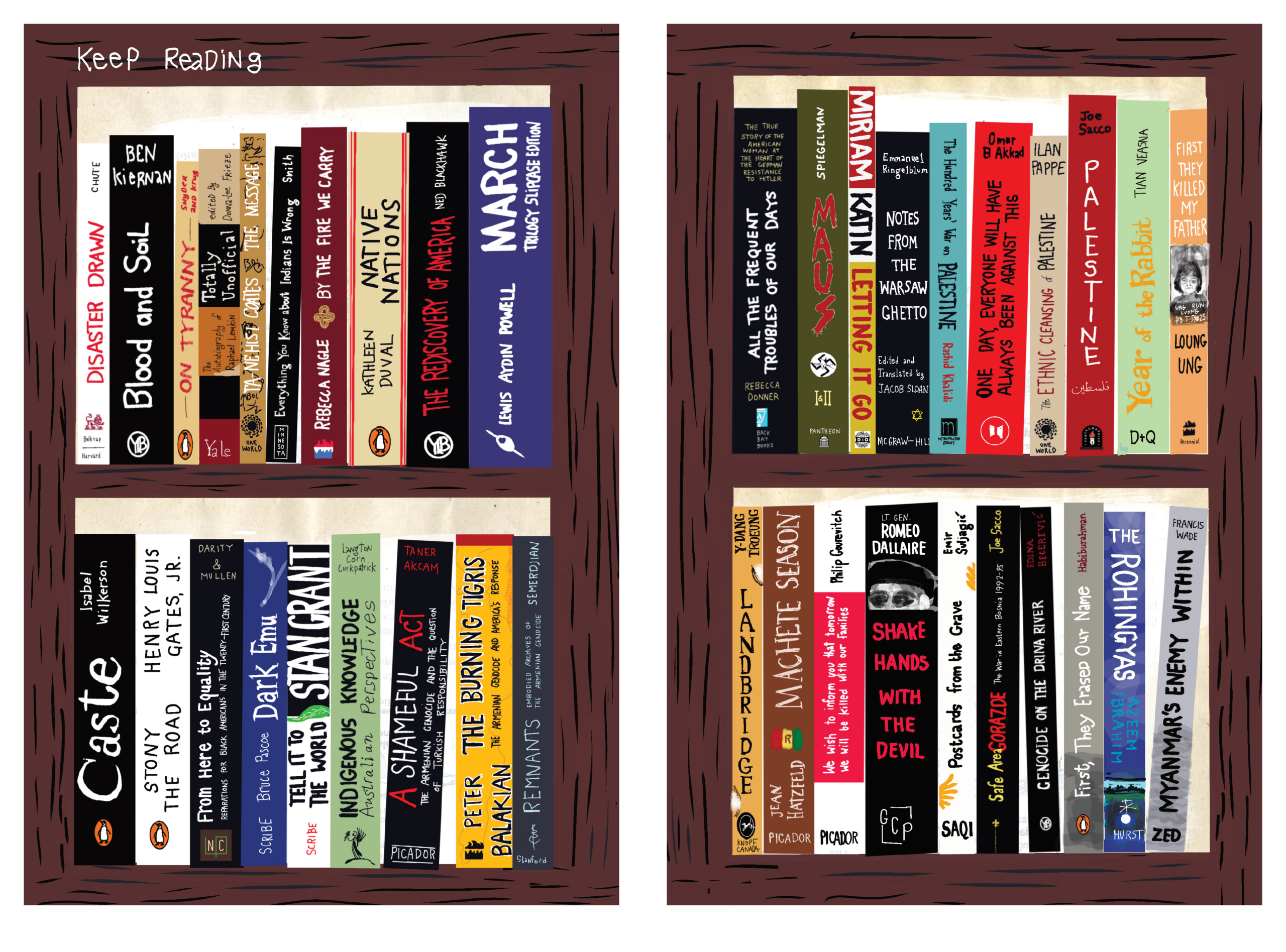
R.N.: I love that you included a “Keep Reading” page at the end that recommends other books on the topic of these genocides. Is your intention for this to be used as educational material in schools, as many of these genocides aren’t taught?
D.M.W.: Yes. I want this book in the hands of as many people as possible and Harvard does as well. It’s the obvious foundational book for a university or even graduate-level semester-long course, but it even works in high school and upper middle school because it engages with the violence carefully and respectfully. It isn’t about traumatizing people.
Especially if it’s in a semester-long or year-long course, it could be used as the historical introduction to 10 genocides. And then there’s time to even add many of the ones that are missing, like the Herero and Namaqua genocide that was perpetrated at the beginning of the 20th century, or the indigenous peoples of South Africa that I’ve dealt with in the two animations that this book has birthed (“Between The Wall and The Sides” and “Girl Earth Fire Time”).
We have to have currencies of peace and currencies of kindness and compassion, instead of it just being about wealth and greed, because we’re rewarding the wrong people and the wrong ways of being.
I had an Armenian-Ukrainian write to me about how heartbroken she was that I didn’t cover Ukraine, which, when I had imagined the book as a hybrid book that would have essays, I was going to have a chapter that was about when do we call it genocide and when do we not, which is something I could do easily in an academic essay form. But it felt like it was important to have this book be unified, so I went with the 10. But a sequel is in the works, and I will make sure that I honor many of the places that were supposed to be a part of that chapter. It’s tentatively titled “Repair” because it’s about reparations.
You can purchase Dana Mashoian Walrath’s “The Book of Genocides” at your favorite booksellers.