


FeaturedReviewsLiterary Corner

The Journey Not Chosen

On Sarah Ignatius’s “The Kaleidoscope of Destiny”
Nearly 25 years ago, on a flight from China to Beirut, I read Paulo Coelho’s “The Alchemist” for the first time. The novel follows Santiago, a young Andalusian shepherd who leaves home in search of treasure and discovers a deeper sense of purpose. Its central paradox — that we sometimes have to travel to distant lands to find the treasures hidden in our own backyard — spoke to me. Before the plane landed, I resolved to one day translate the book into Armenian. (A few years later, I did.)

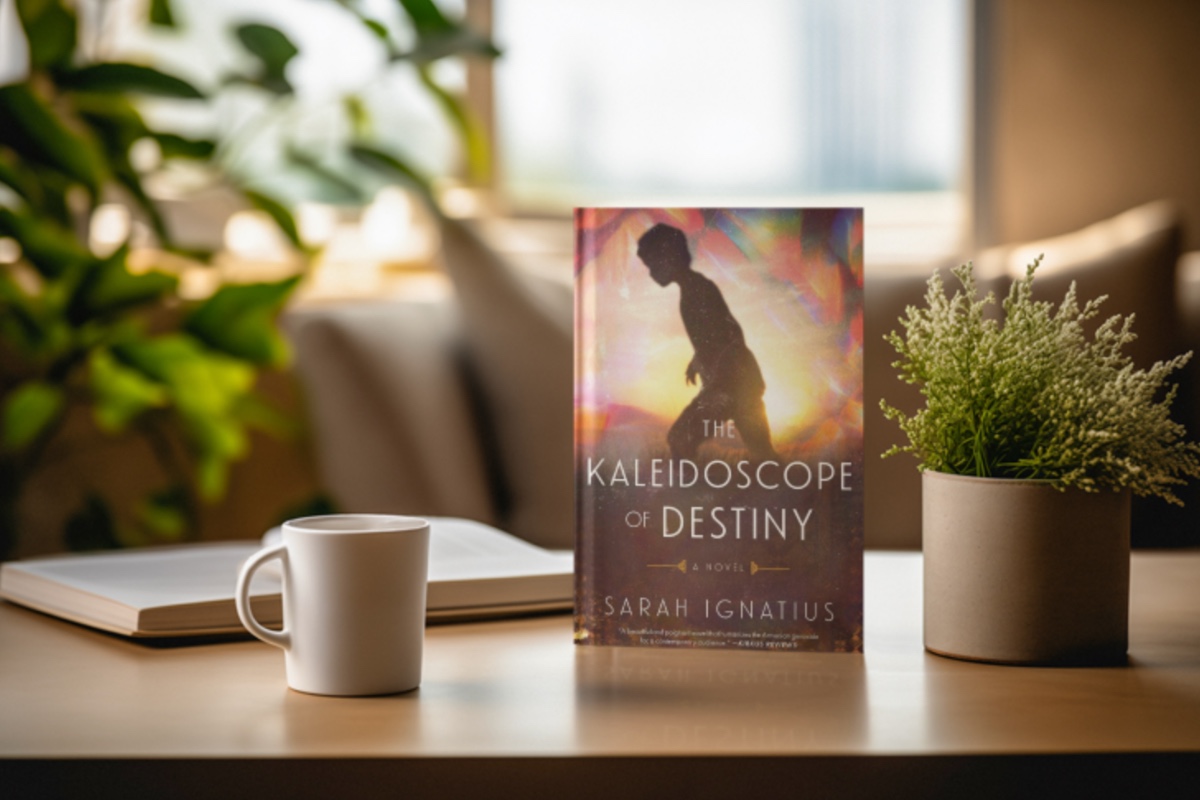
I thought of Santiago as I began reading Sarah Ignatius’s “The Kaleidoscope of Destiny.” Fourteen-year-old Arakel also dreams of distant lands. He plans to travel with his two closest friends — Vartan, who is Armenian, and Mehmet, who is Turkish — along the Silk Road to China. He studies astronomy and prepares a star chart, expecting to navigate their caravan by night. His excitement draws us into the future he imagines.

But it is 1915, and the journey Arakel undertakes is one he never chose. Deported from Kharpert (modern-day Harput, Turkey) with his family and forced toward the Syrian desert, he tells Nora, the girl he has a crush on, “I don’t think we get to choose anymore” (p. 63).

Ignatius transforms the familiar coming-of-age narrative into an account of childhood violently overtaken by genocide. Arakel recalls the jarbig children of Armenian survivor narratives. Historian Nazan Maksudyan uses the term to describe children who survived through resourcefulness and initiative, as well as friendship and solidarity. Arakel embodies these qualities as he assesses danger and finds ways to make himself useful.

Along the way, Arakel encounters Bedouins, Kurds, Arabs, Turks, Germans and a wandering dervish. Some exploit his vulnerability; others help him survive. The dervish faintly recalls the mysterious king in “The Alchemist,” offering counsel and a small symbolic object whose meaning the boy struggles to accept. Yet the dervish himself cannot reconcile what he has witnessed: “Now, my eyes have seen more than my heart can absorb. Your eyes have, too” (p. 244).

Advertisement Subscribe Today!

The first-person narration allows us to follow Arakel’s growing awareness of the violence around him. His voice is youthful, grounded in the world of school, food, family possessions and physical sensations. His body registers danger before he understands its scope: his skin itches, he sweats, his heart pounds, and he can barely swallow. Only gradually does he grasp that the violence around him is part of an attempt to destroy his people. The novel’s language is accessible, and the enormity of what Arakel witnesses emerges without rhetorical excess.

In recreating her family’s ancestral town, Ignatius renders the streets her own relatives once walked with remarkable intimacy.

The portrait of Kharpert is rich in the details of everyday life. In recreating her family’s ancestral town, Ignatius renders the streets her own relatives once walked with remarkable intimacy. We follow Arakel among its “mud-brick houses” and children “playing knucklebones in the hard-packed dirt” (p. 5), past potters at work and the shop of an Armenian carpenter who has returned from America (p. 6).

At the café, old men debate the war as their “voices waft out with the smoke from their hubble-bubble pipes” (p. 24), their arguments mingling with the routines of neighborhood life. Such details establish the texture of the world being destroyed. Even during deportation, moments of that life linger: in Arakel’s exchanges with Nora, affection and embarrassment briefly interrupt the terror.

Ignatius’s focus on Arakel’s personal experience brings the larger history vividly to life. “The Kaleidoscope of Destiny” is a magisterial work of fiction steeped in historical authenticity. No false note in the telling, to borrow from John Gardner, snaps us out of its fictional dream. Ignatius refracts one of history’s darkest chapters into a deeply moving story of friendship, courage and hope.

As I read the book, I kept wondering whether Arakel, like Santiago, would ever be free to embark on a journey of his own choosing.

Dr. Khatchig Mouradian

Khatchig Mouradian is the Armenian and Georgian Area Specialist at the Library of Congress and a lecturer in Middle Eastern, South Asian, and African Studies at Columbia University. He also serves as Co-Principal Investigator of the project on Armenian Genocide Denial at the Global Institute for Advanced Studies, New York University. Mouradian is the author of The Resistance Network: The Armenian Genocide and Humanitarianism in Ottoman Syria, 1915-1918, published in 2021. The book has received the Syrian Studies Association “Honourable Mention 2021.” In 2020, Mouradian was awarded a Humanities War & Peace Initiative Grant from Columbia University. He is the co-editor of a forthcoming book on late-Ottoman history, and the editor of the peer-reviewed journal The Armenian Review.

Leave a Reply

Your email address will not be published. Required fields are marked *


Back to top button