


Book review: Dana Mashoian Walrath’s “The Book of Genocides”
When I interviewed Dana Mashoian Walrath for The Armenian Weekly back in 2015, she was exploring trauma across two distinct forms: poetry in her Armenian Genocide novel “Like Water on Stone” and visual narrative in “Aliceheimer’s,” a graphic memoir that helped carve out the field of graphic medicine. What resonated most during our talk was her conviction that our community’s memory should never be insular, but an open bridge to other historical injustices.
A decade later, “The Book of Genocides” (Harvard University Press, 2026) brings those two paths together, applying the visual storytelling of “Aliceheimer’s” to the subject of genocide on an expansive, global scale. The book spans five centuries and 10 atrocities, connecting the slaughter of Indigenous peoples in the Americas and Australia, chattel slavery and Jim Crow violence against Black Americans, the Armenian Genocide, the Holocaust, Cambodia, Rwanda, Bosnia, Myanmar, and Gaza.
Walrath’s entry point is still Palu, her ancestral home. Back in 2015, she spoke of her family’s survival in the shorthand her mother passed down: her grandmother simply hid by day and ran by night to Aleppo. In “The Book of Genocides,” that protective veil is pulled back. We see her 10-year-old grandmother crouched inside an earthen urn while Ottoman soldiers publicly dismember her father to terrorize the village.
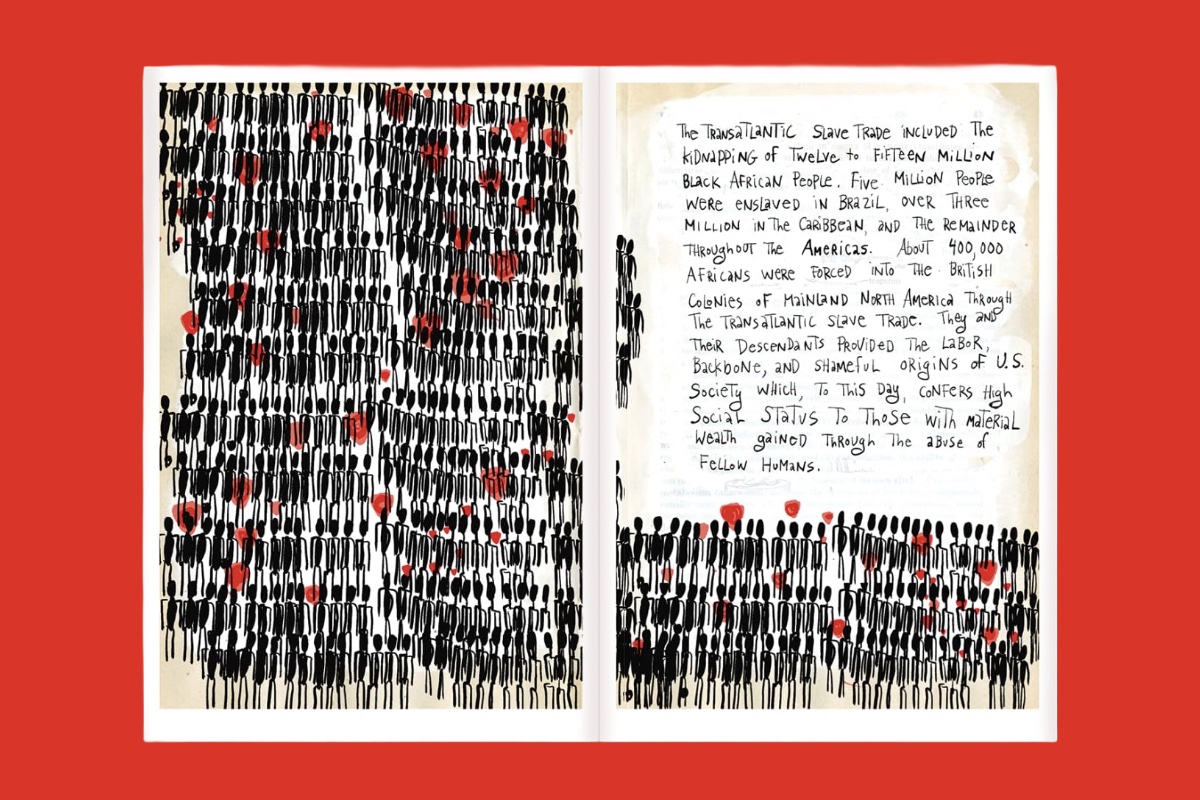
Writing on what she calls unceded Abenaki land “that have become the Northeastern United States, a country doubly built on genocide, through settler-colonization (invasion) and enslavement,” Walrath doesn’t use family trauma to argue that Armenian suffering was unique. In one drawing, styled like a gymnastics scoresheet, she mocks the “oppression olympics” — the impulse to debate which genocide was worse based on body counts or execution methods. As she writes beneath the drawing, “no numeric or qualitative criteria lessens the severity of any genocide.” Instead, she traces how these atrocities share the same mechanics: Even before mass killing begins, rights are stripped, populations are pushed out, and land is almost always stolen.
The book is not treated as distant history; Walrath wrote it in the immediate aftermath of Azerbaijan’s 2023 ethnic cleansing of Artsakh, and amid the ongoing bombardment and starvation of civilians in Gaza. In an illustrated dream sequence, she walks with Raphael Lemkin through Gaza’s rubble. She traces his coining of “genocide” back to Soghomon Tehlirian’s 1921 Berlin trial for killing Talaat Pasha, but she also highlights Lemkin’s own contradictions, including his Cold War opposition to the 1951 “We Charge Genocide” petition brought by Black civil rights leaders. Looking at ongoing violence from Sudan to Palestine, she illustrates how U.N. Security Council vetoes continue to leave international law toothless.

Visually, Walrath chose a remarkable canvas: Instead of blank paper, she drew over pages from a 1943 textbook, Tracy I. Storer’s “General Zoology,” which belonged to her mother as a graduate student at Duke in the 1950s. She layers accounts of the Trail of Tears, convict leasing, and hangings directly over diagrams of animal anatomy and racial classifications of “Mankind.” Across from the drawings, she uses blackout poetry on the zoology text, crossing out sentences until only scattered words remain, turning cold descriptions of cells and parasites into short, haunting verses about captivity and survival.
Reading “The Book of Genocides” is an intensely visceral, often gut-wrenching experience, in which the reader is not a passive spectator. Dotted lines instruct you to take scissors and cut full-page portraits into three horizontal flaps. Turning these segmented flaps transforms human subjects into birds of prey, cattle, and insects. It is an uncomfortable, disturbing exercise, yet Walrath invites us to consider cutting the page “a form of liberation.” By forcing our hands into the physical mechanics of othering, she confronts us with how easily rhetoric and classification reduce neighbors to beasts.
She channels that idea directly into the “Keep reading” section, skipping a standard typed bibliography in favor of hand-drawn book covers carefully placed on a bookshelf. It turns research into something personal, offering readers an accessible reading list. In the closing acknowledgments, Walrath letters words of gratitude across the petals of hand-drawn flowers. After more than 400 pages of violence, that visual ties the artwork to the book’s core message: Long after destructive systems collapse, human care and memory remain.
Back in 2015, Walrath told me that “we heal by telling our stories.” Reading “The Book of Genocides” while the mass violence plays out daily on our news feeds is heavy, difficult work. Yet it avoids cynicism. At the conclusion of the book, Walrath makes a clear distinction: Genocide is not an inevitable fact of human nature, but a deliberate program run by governments. By showing how genocides are built — through laws, language and human decisions — Walrath reminds us that because people built these systems, people can also recognize and dismantle them.
Title: “The Book of Genocides”
Author: Dana Mashoian Walrath
Publisher: Harvard University Press
Publication Year: 2026
Format: Paperback, 424 pages, color drawings throughout
ISBN: 9780674299054
Where to purchase: Available via Harvard University Press, NAASR Bookstore, and major online book retailers.