The Naghash Ensemble kicks off its North American tour on Nov. 4
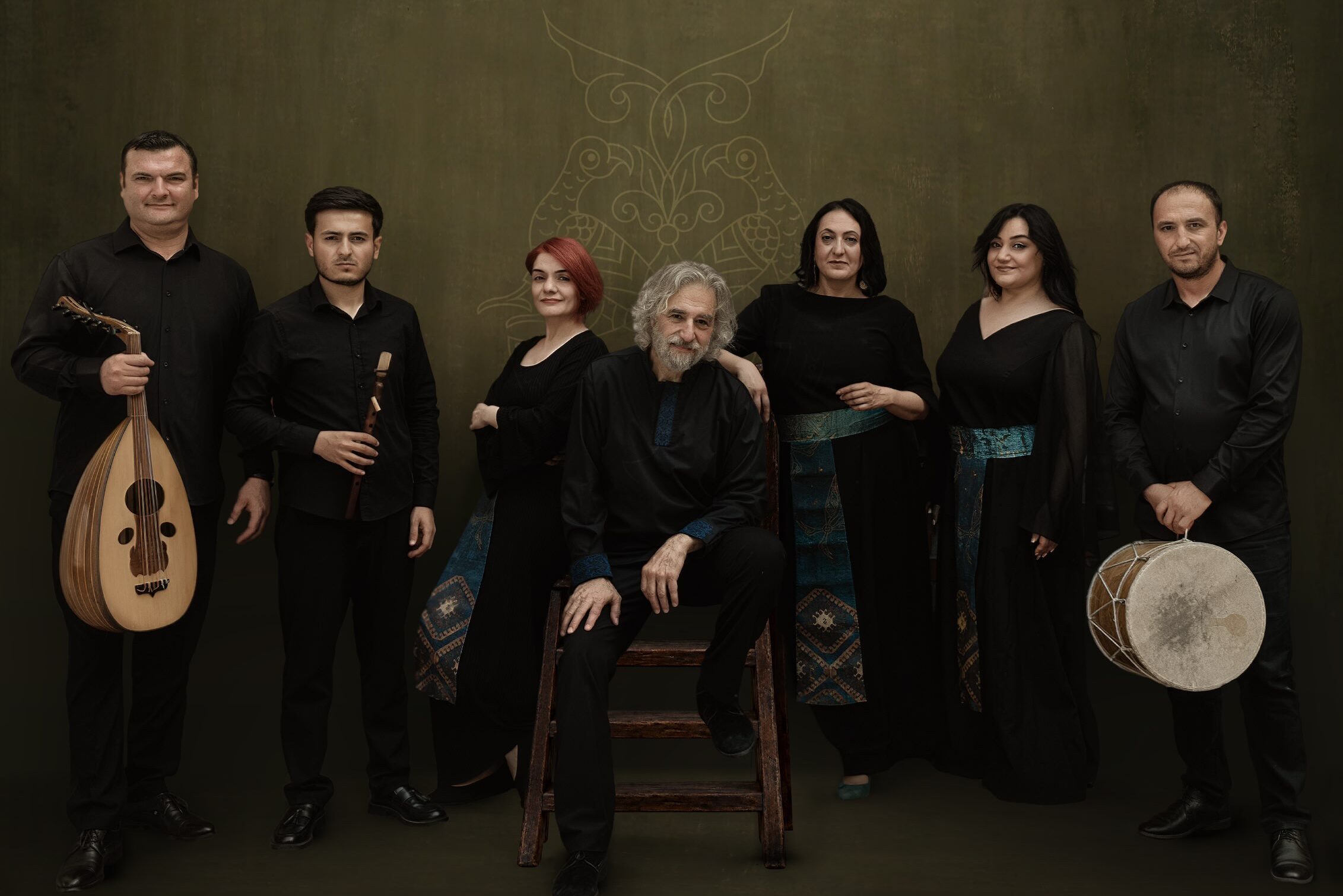
When The Naghash Ensemble kicks off its North American tour in Salisbury, Maryland, on Nov. 4, most people in the audience will have never heard the sound of a zourna before, let alone been in the same room with a duduk, oud and dhol resonating along with three Armenian vocalists and and Armenian American composer John Hodian on the piano. Most likely, the Naghash Ensemble’s concert will be their very first exposure to Armenian culture.
Performing for non-Armenian audiences and sharing new original Armenian music inspired by half-a-millennia-old poetry has been at the heart of the Naghash Ensemble’s international touring for the past 12 years, which has led them to venues such as Carnegie Hall, Lincoln Center, Paris Philharmonic and Elbphilharmonie.
“We didn’t set out to be cultural ambassadors of Armenia,” explains Philadelphia-born Armenian American composer John Hodian. “When I wrote this music, I just followed my intuition. It’s the natural outcome of someone who grew up in a tight-knit Armenian family but studied Western classical music and was surrounded by contemporary music in all its forms.”
Described as “Armenia’s most intriguing new music” by German radio WDR and “a moment of meditation and grace” by Rolling Stone magazine, Hodian’s works sit at the crossroads of Armenian folk and spiritual music, new classical music, post-minimalism and the energy of jazz and rock.
Over the years, this approach to Armenian music has inspired international presenters to create Armenian-themed cultural festivals — most recently in Finland and France — and audience members to book their first trips to Armenia, a country they barely knew existed before they attended the concert. “It’s a pretty delightful side effect of us playing a concert on the other side of the world,” Hodian says.

During their upcoming tour of North America, the Naghash Ensemble will perform in a variety of cities with no or no Armenian presence — Salisbury, Maryland; Saratoga Springs, New York; Keene, New Hampshire; and Kalamazoo, Michigan, to name a few — as well as in Armenian community hubs like Los Angeles, Toronto and Seattle.
The Naghash Ensemble’s full 2026 North American tour comprises:
Nov. 4, 2026 • Salisbury University • Salisbury, Maryland, U.S.
Nov. 5, 2026 • Universal Preservation Hall • Saratoga Springs, New York, U.S.
Nov. 6, 2026 • The Colonial Theatre • Keene, New Hampshire, U.S.
Nov. 8, 2026 • Stable Hall • San Antonio, Texas, U.S.
Nov. 10, 2026 • Goodson Chapel, Shenandoah University • Winchester, Virginia, U.S.
Nov. 13, 2026 • Camp Concert Hall, Modlin Center • Richmond, Virginia, U.S.
Nov. 15, 2026 • Stetson Chapel, Kalamazoo College • Kalamazoo, Michigan, U.S.
Nov. 17, 2026 • Town Hall Seattle • Seattle, Washington, U.S.
Nov. 18, 2026 • The Wallis Annenberg Center • Beverly Hills, California, U.S.
Nov. 20, 2026 • Koerner Hall • Toronto, Canada
Nov. 22, 2026 • The Conrad • La Jolla, California, U.S.
A homeland-diaspora synergy: The story of the Naghash Ensemble
In 2005, American Armenian composer John Hodian had just started exploring many of the ancient monasteries and sacred spaces in the country of his ancestors. He was alone at Garni temple when he was suddenly struck by what he describes as “the most beautiful sound I’ve ever heard.” It turned out to be the voice of Hasmik Baghdasaryan, a performer of medieval spiritual music, who was rehearsing at the temple.
“The sound of that voice in that temple was mesmerizing, and it remained in my mind for days after,” says Hodian. “I was determined to write something that would use this sound in a new way.”
Though he knew what the music would sound like, Hodian spent several years looking for just the right text to set to music until he finally came across a short fragment of a poem by a little-known medieval Armenian priest named Mkrtich Naghash. This text described the plight of people forced to live in exile. “The words leapt off the page and into my soul. I knew I had found my text.” The original manuscripts were lost, but Hodian was able to track down versions by later copyists. With the help of several Armenian scholars and the Mekhitarists of San Lazzaro degli Armeni, he was able to unearth all the 16 remaining poems.
In letting the texts dictate the direction the music was taking, Hodian subconsciously drew on a wide range of influences: Armenian folk and spiritual music; European classical composition, particularly medieval polyphonic vocal music; and contemporary minimalist composers. To perform his “Songs of Exile,” he gathered Armenian instrumentalists on oud, duduk and dhol, along with three female vocalists, including his original inspiration, Hasmik Baghdasaryan. The group launched its first European tour in 2014 and has been touring internationally ever since. Their upcoming tour of North America marks their third appearance on the continent.
The Naghash Ensemble consists of Hasmik Baghdasaryan, soprano; Tatevik Movsesyan, soprano; Shahane Zalyan, alto; Andranik Gasparyan, duduk; Aramayis Nikoghosyan, oud; Tigran Hovhannisyan, dhol; and John Hodian, piano and composer.
To learn more, visit naghashensemble.com