



Book review: ‘Undesirable: The Vietnam War and a Father’s Battle for Justice’
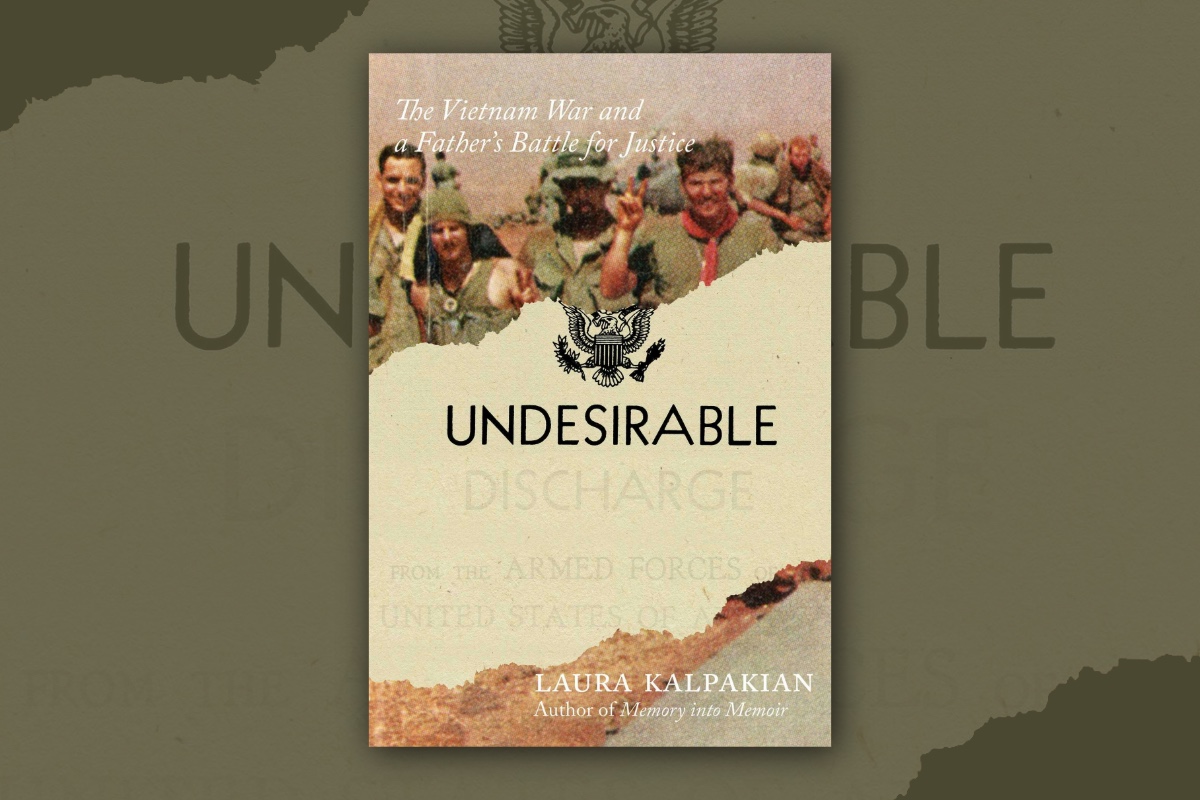
For decades, a locked basement safe held the evidence of a family’s private war: hundreds of letters, military records and documents chronicling one father’s relentless attempt to reclaim his son’s name. It is from this long-sealed archive that Laura Kalpakian’s recently published memoir, “Undesirable,” begins, opening with the aftermath of a young man’s war and the family left to reckon with it.
The central figure is Kalpakian’s brother, Douglas Scott Johnson, a talented, charismatic 19-year-old who enlisted in the U.S. Army in 1969 and was sent to Vietnam.
Within weeks, the piano-playing Eagle Scout had become addicted to drugs, repeatedly gone AWOL (absent without leave), been hospitalized for malaria and hepatitis, and found himself trapped in the machinery of military discipline.
He returned to the United States in August 1970 physically and psychologically shattered, carrying a dead Vietnamese soldier’s sandal and an “Undesirable” discharge.
The book, however, is less about Vietnam than about what happened afterward. For three years, Johnson’s father, William Jess Johnson, waged an extraordinary campaign to have his son’s discharge changed, fearing that would compromise his future prospects.


He wrote to senators, congressmen, military officials, the White House, chaplains, lawyers and anyone else he believed might possess the authority to save his son’s future. His weapon was the letter, and his conviction was that Douglas had been fundamentally good before Vietnam and could become himself again if given the chance.
Kalpakian reconstructs this long campaign from hundreds of documents preserved by her parents. The result is part memoir, part family history, part investigation into military bureaucracy and part meditation on memory itself. The author is careful to acknowledge that the archive does not answer every question.
Indeed, some of the book’s most compelling moments arise from precisely what cannot be known: where Douglas went during his AWOL periods, what he witnessed in combat, what he told his father about the acts that were “incompatible with his conscience,” and how much of his subsequent life was shaped by trauma, addiction, shame or all three.
The book’s emotional force lies in its refusal to make Douglas either hero or villain. Kalpakian does not conceal his failures. He stole, lied, relapsed, frightened people who loved him and repeatedly devastated those who tried to help him. Yet she also refuses the easier conclusion that his later behavior defines the young man he once was. The reader watches her own understanding of her brother evolve from anger and contempt toward compassion without absolution.
William Johnson’s relentless advocacy is both moving and occasionally exasperating. His letters are grandiose, repetitive and sometimes almost quixotically confident. He believes that if he can only find the right person, present the right evidence or write the right words, the machinery of the Army will acknowledge its mistake.
“Undesirable” also has an especially compelling Armenian dimension. Robert Mardian, the Armenian American lawyer who became assistant attorney general under President Nixon, was himself no stranger to the struggle to have his name cleared: after being convicted in connection with Watergate in 1975, his conviction was overturned on appeal the following year.
Perhaps that experience helped Mardian recognize what was at stake when William Johnson, a complete stranger who cold-called him in 1972, asked for help in clearing his son’s military record.
The book’s ultimate achievement is the restoration of a human being to memory. Douglas died in 2021, and his ashes apparently received no formal farewell. Kalpakian writes that, other than this book, nothing now marks that he once walked the earth. Writing becomes the memorial her brother never received.
“Undesirable” is a book about the limits of justice and the persistence of love. Institutions may reduce a person to a charge, a file number, a discharge category or an “ineffective infantryman,” while families remember the person who existed before the paperwork.
“Undesirable: The Vietnam War and a Father’s Battle for Justice” was published by the University of New Mexico Press in July 2026 and is available for purchase through Amazon, Barnes & Noble, Village Books and Bookshop.org. Readers can learn more about Laura Kalpakian and her work at laurakalpakian.com.