



Review of Jennifer Manoukian’s ‘Purist Pursuits’
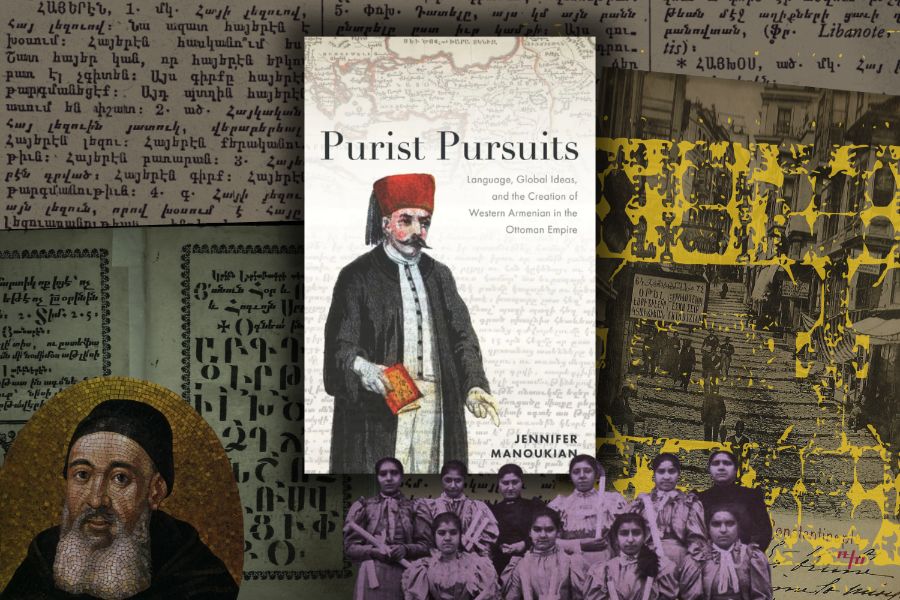
In contemporary Armenian discourse, few topics evoke as much raw emotion, deep-seated anxiety, and rigid gatekeeping as the state of the ‘mother tongue.’ For generations, speakers and learners of (Western) Armenian have been instructed to treat their language as a sacred relic—a treasure to be admired and kept pristine behind glass in a museum rather than a living, breathing tool to be used. Where did this uncompromising obsession with linguistic ‘purity’ originate? Why do so many diaspora Armenians carry a persistent guilt over using Turkish, Arabic, or French loanwords in daily conversation, constantly apologizing for speech that fails to live up to an impossibly formal standard?
In her groundbreaking monograph, Purist Pursuits: Language, Global Ideas, and the Creation of Western Armenian in the Ottoman Empire, historian and literary translator Jennifer Manoukian delivers an essential, long-overdue autopsy of these very anxieties. Across 300+ meticulously researched pages, Manoukian breaks down popular myths about Western Armenian, offering a rich social history that shows how a modern language was shaped, debated, and turned into something sacred.
At the heart of Manoukian’s study is a vital correction to popular historiography: Standard Western Armenian was not an ancient, unchanging spoken tongue that was suddenly ‘liberated’ overnight from foreign influence. Rather, it was an ideologically fueled, constantly evolving project driven by urban intellectuals, writers, and clergy responding to global ideas of their time. Tracing this evolution across four distinct historical periods, Manoukian shows how shifting transnational ideas continuously reshaped Ottoman Armenian linguistic attitudes.
Between 1730 and 1830, the Catholic Mekhitarist monks of Venice and Vienna adapted Renaissance European humanist principles to ‘purify’ Classical Armenian, inadvertently establishing an approach later transposed onto written vernaculars. From 1840 to 1860, the rise of 19th-century cultural nationalism transformed purism from an educational bridge into a sacred national duty, positioning language as the ultimate symbol of collective identity. Later, between 1860 and 1890, Euro-American comparative philology shattered long-held beliefs in Classical Armenian’s divine superiority, legitimizing Modern Armenian. Finally, from 1890 to 1915, a global turn toward folk culture birthed an ethnographic purism, leading provincial intellectuals to champion dialect vocabulary from the Ottoman provinces as authentic, even as urban print centers resisted these additions.
Crucially, Manoukian demonstrates that prior to the Armenian Genocide, most Ottoman Armenians did not actually speak a ‘pure’ Western Armenian. The standard language existed primarily in books, classrooms, and newspapers, while in daily life Armenians spoke distinct regional dialects, Turkish, Kurdish, or Arabic. The real push to make spoken Armenian match the formal written standard happened not in the Ottoman Empire, but later in the diaspora.

Crucially, Manoukian demonstrates that prior to the Armenian Genocide, most Ottoman Armenians did not actually speak a ‘pure’ Western Armenian.
In her pivotal concluding chapter, Manoukian explores how refugee leadership in Syria, Lebanon, and Egypt transformed Western Armenian into a spoken lingua franca out of both practical necessity and moral duty. In post-genocide orphanages and schools, urgent slogans prohibiting Turkish and treating old Ottoman-era textbooks as sacred turned language purity into a vital way to rebuild the nation.
Yet, as Manoukian clearly argues, this monumental achievement carried a high long-term cost. Forcing an old, formal written standard onto everyday speech created an artificial model for spoken language. By framing loanwords as contamination and acting as if the language was constantly in danger, purism generated an acute culture of language anxiety. Today’s speakers are often made to feel like ‘bad Armenians’ for using the household words passed down by their families. Manoukian offers a liberating reframing of this dynamic, suggesting that borrowings should not be viewed as signs of cultural decay, but rather as the “rings of a tree trunk,” each keeping a record of distinct phases in the history of Armenian and its speakers.
Manoukian’s work is also built upon an extraordinary empirical foundation. Supported by nearly 100 pages of notes and bibliography, the book mines previously un/dertapped Armenian-language sources from across the world. Manoukian thoughtfully highlights the critical role of the digital humanities in her research, crediting the massive digitization projects of the National Library of Armenia, the Mekhitarist Congregation, and the National Association for Armenian Studies and Research (NAASR) for making such comprehensive cross-continental scholarship possible. And though her book includes only a handful of historical images, these carefully curated selections—such as multilingual street signs in 1920s Istanbul and classroom portraits from 1930s Damascus—add visual richness and help contextualize this complex story.
Manoukian suggests that borrowings should not be viewed as signs of cultural decay, but rather as the “rings of a tree trunk,” each keeping a record of distinct phases in the history of Armenian and its speakers.
While Purist Pursuits is a landmark contribution to Armenian studies and historical sociolinguistics, it is equally urgent reading for community leaders, educators, and language activists today. Since UNESCO classified Western Armenian as ‘definitely endangered’ in 2010, revitalization initiatives have often collided with the very prescriptivism (preference for prescribing rules of language) Manoukian critiques. By revealing standard language ideologies to be recent, human constructions, Manoukian empowers modern speakers and readers to see themselves as the next architects of Western Armenian, freeing the language from glass display cases so it can be lived, spoken, and renewed in daily life.
In an earlier review of Talar Chahinian’s Stateless, I expressed hope that her English-language study would one day be translated into Western Armenian, the language whose post-Genocide literary tradition she analyzed. One can hope for the same for Purist Pursuits. An Armenian edition of Manoukian’s book would offer a practical demonstration of the language’s living vitality—exemplifying that Western Armenian is far more than a museum piece, but a dynamic medium fully capable of examining its own rich and complex history.
Title: Purist Pursuits: Language, Global Ideas, and the Creation of Western Armenian in the Ottoman Empire
Author: Jennifer Manoukian
Publisher: Stanford University Press
Publication Year: 2026
Format: Hardcover, eBook; 306 pages
ISBN: 9781503645677, 9781503646841
Where to purchase: Available via Stanford University Press, NAASR Bookstore, Abril Books, and major online book retailers.



While reading this critically important book, I congratulated the author on her brilliant study. By chance she and her husband lived nearby, so we were able to meet for dinner in person. It’s an extraordinary study by such a young scholar, with wide ranging sources, particularly Armenian language studies. There has been nothing like it in English, or probably any western language. It should definitely be translated into Armenian, hopefully in the near future. I look forward to her future works, which I am certain shall merit the same meticulous scholarship. I’m certain that her graduate training at UCLA in Armenian language played a central role in her training, having experienced similar preparation in Armenian Studies at UCLA 55 years ago!
I heard Jennifer Manougian on February 26, 2025, in a webinar organized by Dr. Herand Markarian on behalf of NY Hamazkayin Chapter. The subject was “How Western Armenian came about.” She talked about her upcoming book. I found her exhaustive study revealing and fascinating. Languages evolve. So, the book is out. I intend to purchase a copy to read.