



For much of the twentieth century, the central question confronting the Armenian diaspora was relatively clear: how could a dispersed and traumatized population survive as a collective community? In the aftermath of the Armenian Genocide, survivors found themselves scattered across the Middle East, Europe, the Americas and elsewhere, often without economic security, political protection or stable social structures. Under these conditions, community-building was not simply an expression of cultural attachment. It was a strategy of collective survival.
The institutional response was remarkable. Armenians established schools, churches, newspapers, cultural associations, charitable organizations, youth movements and political structures across numerous countries. These institutions transformed refugee populations into organized communities and made possible the transmission of language, memory and identity across several generations.
Measured against the conditions from which these communities emerged, this was an extraordinary achievement.
Yet that achievement has produced a paradox that deserves greater attention. Many Armenian communities succeeded in precisely what they had set out to accomplish. Their members became educated, economically established, socially integrated and politically secure within their countries of residence. The existential insecurity that had shaped the post-Genocide diaspora gradually diminished in many places.
But institutions created to resist disappearance now confront a different problem: what happens when survival itself is no longer enough to sustain collective identity?

The challenge facing the Armenian diaspora today may therefore be understood not simply as a crisis of decline, but as a crisis produced partly by success.
The institutional architecture of survival
The post-Genocide Armenian diaspora did not develop randomly. Its institutions responded to specific historical conditions.
Schools preserved Armenian language and transmitted historical memory. Churches provided both spiritual and communal belonging. Political parties organized collective life and articulated national objectives. Newspapers connected dispersed populations and created common political debates. Cultural and athletic organizations offered spaces where young Armenians could meet, socialize and reproduce community networks.
Together, these institutions built what might be described as a parallel social infrastructure.
The challenge facing the Armenian diaspora today may therefore be understood not simply as a crisis of decline, but as a crisis produced partly by success.
In cities such as Beirut, Aleppo, Paris, Boston and Los Angeles, Armenians could participate in the broader societies in which they lived while simultaneously inhabiting a distinctly Armenian institutional world.
This model was particularly effective where Armenian populations were geographically concentrated. A child could attend an Armenian school, participate in an Armenian youth organization, go to an Armenian church, read Armenian publications and eventually marry within the community. Identity was therefore reinforced not by a single institution but by an interconnected social environment.
The success of this model helps explain the remarkable durability of Armenian diasporic identity.
But its strength also contained an important limitation: the system was designed for a social world that no longer exists in the same form.
When integration changes the problem
The early diaspora struggled against exclusion, poverty, insecurity and displacement. Later generations increasingly confronted almost the opposite reality: integration.
This distinction matters.
Integration into host societies brought enormous benefits. Armenians entered universities, professions, business, politics and cultural life. Residential mobility increased. Social networks expanded beyond the community. Intermarriage became more common. Armenian families no longer necessarily lived within walking distance of Armenian schools, churches or clubs.
These developments are often described within diaspora discourse simply as “assimilation.” But that explanation can be too simplistic.
What Armenian institutions sometimes interpret as cultural loss may also be the consequence of social mobility and successful integration.
A professional Armenian family living far from an Armenian neighborhood may value Armenian identity deeply while finding it impractical to send children to an Armenian school. A young Armenian may feel strongly connected to Armenian history while speaking little Armenian. Others may have Armenian and non-Armenian parents and refuse the assumption that belonging requires choosing between identities.
The problem, therefore, is not necessarily that younger Armenians have rejected Armenian identity. It may be that institutional definitions of Armenian identity have not expanded sufficiently to accommodate the ways in which identity itself has changed.
If declining participation is interpreted exclusively as declining commitment, institutions may respond by demanding greater loyalty. But if the underlying problem is structural transformation, demanding loyalty will not solve it.
Institutions themselves must change.
Preservation can become a defensive strategy
For communities created after collective catastrophe, preservation is understandably powerful. Language must be preserved. Memory must be preserved. Institutions must be preserved. Historical consciousness must be preserved.
But preservation contains an inherent tension. Something preserved can remain intact while becoming increasingly disconnected from the environment around it.
This raises an uncomfortable question for the Armenian diaspora: are institutions preserving Armenian identity, or are they sometimes preserving particular historical expressions of Armenian identity?
Those are not necessarily identical.
An Armenian school established in Beirut in the 1930s responded to the needs of a refugee community living in a concentrated Armenian environment. An Armenian organization operating in Los Angeles, Paris or Toronto in the 2020s confronts a population that may be multilingual, geographically dispersed, professionally mobile, digitally connected and culturally hybrid.
It cannot automatically be assumed that the institutional model appropriate to the first population will remain equally effective for the second.
This is where institutional continuity can become confused with national continuity.
A diaspora can possess many institutions while simultaneously experiencing declining participation, weakening language transmission and growing distance between organizations and younger generations.
Institutional density should therefore not be confused with communal vitality.
From inherited identity to chosen identity
Perhaps the most important transformation concerns the nature of belonging itself.
For much of the twentieth century, Armenian identity was largely inherited through the environment. One was born into Armenian neighborhoods, schools, churches, organizations and family networks. Participation required relatively little conscious decision because Armenian life surrounded the individual.
Globalization has weakened that environment, making Armenian identity increasingly a choice rather than something simply inherited. That changes the relationship between individuals and institutions.
Younger generations are less likely to participate simply because their parents did. They expect institutions to explain why participation matters. They are also more comfortable holding multiple identities simultaneously. They may see no contradiction between being Armenian, Lebanese, French, American, Canadian or Argentine at the same time.
Traditional institutions sometimes interpret this flexibility as weakening identity. But it can also be understood as a transformation in the nature of diasporic belonging.
The critical question becomes whether Armenian institutions can function in a world where belonging is voluntary rather than socially enforced.
An institution that survives primarily because people feel obligated to support it will struggle in such an environment. An institution that provides intellectual, cultural, professional or emotional value may not.
Armenia has also changed the meaning of diaspora
Another transformation occurred with the independence of Armenia in 1991.
Until then, diaspora institutions developed in the absence of an independent Armenian state representing Armenian political sovereignty. They consequently assumed responsibilities extending far beyond ordinary cultural preservation. They defended Armenian political causes, maintained national narratives, funded education and culture, and imagined themselves as custodians of national continuity.
Independent Armenia fundamentally altered this structure. For the first time in generations, the Armenian nation possessed a sovereign political center.
Yet the relationship between state and diaspora has never been fully resolved. Is the diaspora primarily expected to support Armenia financially and politically? Does Armenia represent the entire Armenian nation or principally its citizens? Should diaspora institutions retain autonomous political agendas? What happens when the interests or perceptions of Armenians living abroad differ from those of Armenia’s citizens living within Armenia?
The critical question becomes whether Armenian institutions can function in a world where belonging is voluntary rather than socially enforced.
These questions expose another limitation of the preservation paradigm.
A diaspora cannot indefinitely define its purpose exclusively through the historical conditions that produced it. The existence of Armenia requires reconsidering what the diaspora is for.
The new diaspora complicates the old one
There is an additional transformation that is frequently underestimated: today’s Armenian diaspora is no longer exclusively the post-Genocide diaspora.
Since the late Soviet period and particularly after Armenian independence, substantial migration from Armenia has created new Armenian populations across Russia, Europe and North America.
These newcomers entered communities whose institutions had often been created decades earlier by descendants of Ottoman Armenian survivors.
The result is not one homogeneous diaspora but overlapping diasporas.
Their languages may differ. Their historical experiences differ. Their relationships with Armenia differ. Their understanding of Armenian identity can differ.
For an established Lebanese Armenian or French Armenian family, diaspora identity may have been transmitted across four generations. For a recent migrant from Yerevan, Armenia may remain a lived social reality rather than an ancestral homeland.
Institutions designed around a single historical narrative therefore confront increasingly heterogeneous populations. This makes the question of adaptation even more urgent.
Assimilation may be the symptom, not the diagnosis
Diaspora communities frequently identify assimilation as their greatest threat. There is good reason for concern. Language loss, declining school enrollment, demographic dispersal and weakening participation are measurable challenges.
But “assimilation” can become too convenient an explanation.
It places responsibility primarily on individuals: younger generations are supposedly less committed, parents no longer transmit identity sufficiently, intermarriage weakens community boundaries, or globalization distracts people from national belonging.
Such explanations may contain elements of truth. But they can prevent institutions from asking a more difficult question: Why should a 25-year-old Armenian participate in an institution created 70 or 100 years ago?
If the answer is simply “because you are Armenian,” the institution may already be facing a serious problem.
Identity alone cannot indefinitely sustain participation. Institutions must produce value appropriate to contemporary life.
This does not mean abandoning language, history or collective memory. On the contrary, it means finding ways to transmit them effectively under radically different conditions.
Why should a 25-year-old Armenian participate in an institution created 70 or 100 years ago?
From preservation to production
The next stage of Armenian diasporic life may therefore require a conceptual shift: from preserving identity to producing contemporary Armenian life.
Preservation looks backward because its principal concern is preventing loss. Production looks both backward and forward. It asks what new intellectual, cultural, educational and institutional forms Armenians can create.
Instead of asking only how many Armenian schools remain open, one might ask what kind of education could connect Armenian students across continents.
Institutions must produce value appropriate to contemporary life.
Instead of measuring identity only through language proficiency, one could ask how Western Armenian can become intellectually and culturally productive in contemporary digital environments.
Instead of viewing young professionals merely as potential members of existing organizations, diaspora institutions could build global professional, academic, technological and entrepreneurial networks.
Instead of treating cultural preservation as the reproduction of inherited traditions, communities could invest in new Armenian literature, scholarship, cinema, digital media and art.
And rather than seeing Armenia-diaspora relations principally through philanthropy, the relationship could increasingly involve circulation of knowledge, institutional partnerships, investment, research and professional collaboration.
Such a transformation would not require abandoning the institutions inherited from previous generations. It would require reconsidering their function.
Can the Diaspora become a network rather than a collection of communities?
The traditional diaspora was organized geographically. Beirut Armenians built Beirut institutions; Paris Armenians built Paris institutions; Boston Armenians built Boston institutions.
Digital communication has fundamentally altered this logic.
A researcher in Beirut can collaborate with a colleague in Yerevan, an entrepreneur in California and a student in Paris without belonging to the same physical community.
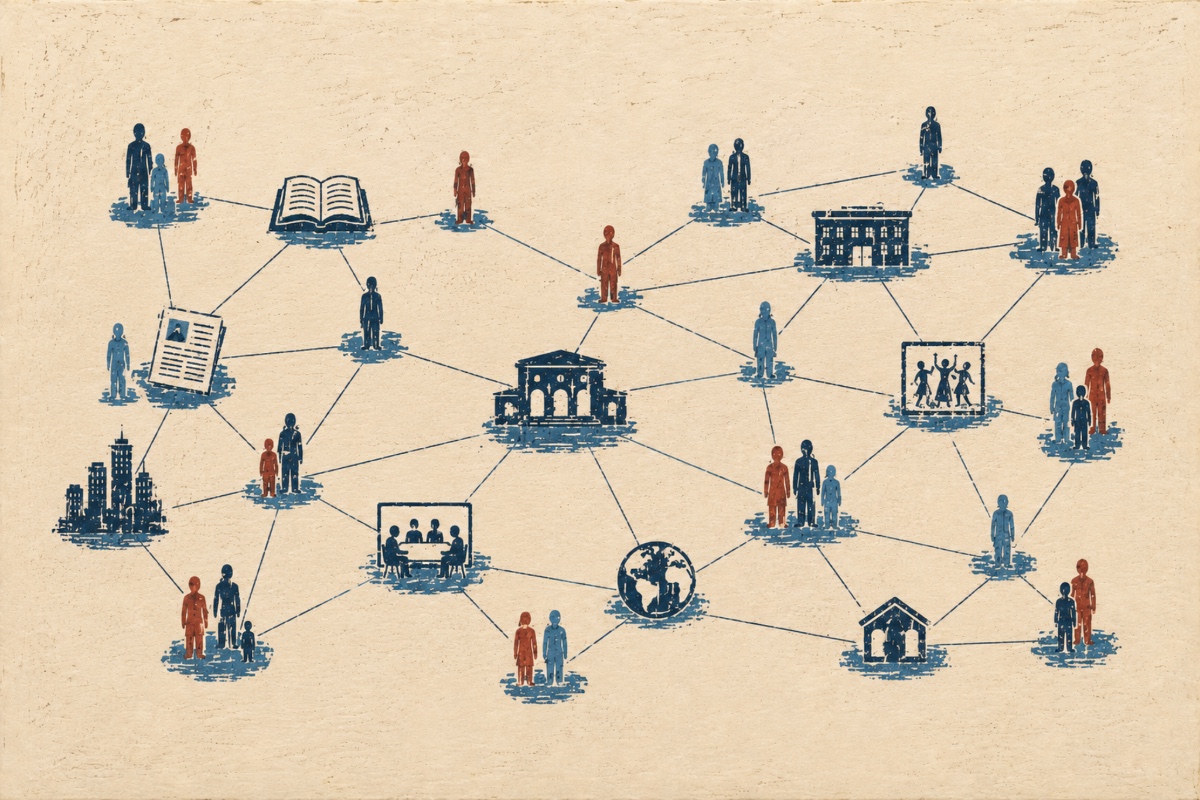
This creates the possibility of understanding the Armenian diaspora not simply as a collection of local communities but as a transnational network.
Such a network would not replace schools, churches or community organizations. But it could connect them horizontally across borders.
The principal resource of the 21st-century Armenian diaspora may no longer be demographic concentration. It may be connectivity.
This requires a different institutional imagination — one based less on controlling communities and more on connecting individuals, expertise and resources.
The paradox of diasporic success
The Armenian case illustrates a broader paradox relevant to many diasporas.
Communities often build institutions in order to help their members survive and succeed. But success transforms the very social conditions that made those institutions necessary.
Education produces mobility. Economic advancement produces geographic dispersal. Integration produces cultural interaction. Political security reduces dependence on communal structures. Individual freedom weakens inherited obligations.
The principal resource of the 21st-century Armenian diaspora may no longer be demographic concentration. It may be connectivity.
In other words, successful diaspora institutions may help create generations that no longer need those institutions in their original form.
That should not automatically be interpreted as failure. The deeper failure would be refusing to recognize the transformation.
The Armenian diaspora’s 20th-century achievement was building institutions capable of preserving a people after catastrophe. Its 21st-century challenge is different: creating forms of collective life compelling enough that people who are free not to participate will nevertheless choose to do so.
That may require abandoning the assumption that continuity means reproducing the past unchanged.
The question, then, is not simply whether the Armenian diaspora can resist assimilation.
It is whether it can transform inherited memory into contemporary relevance; institutional loyalty into meaningful participation; geographic communities into global networks; and preservation into creation.
The Armenian diaspora demonstrated during the 20th century that it could survive catastrophe.
The more difficult question of the 21st century may be whether it can survive its own success.


Vera, I found your article very thoughtful, well-articulated and surely, you have been alluding to institutional Diaspora. The Armenian Diaspora, as Diaspora defines itself Armenian, will survive success paradoxically for the very same reason Diaspora came about, the Genocide and its politicization, which came about after 1965. Before 1965, the Armenian Genocide was commemorated indoors. I happened to live long enough to experience the transformation. There is not much left for us in Diaspora, and yes, even in the Diaspora bedrock Lebanon, and Syria, if we do not uphold political Genocide, to call ourselves Armenian. In fact, I am not sure if there will be anything else left for us as Armenian Diaspora, especially in the West, if we ceases upholding political Genocide. Therein will continue to simmer the divide between Diaspora and Armenia. The citizens of Armenia, naturally live in Armenia, uphold the language, the culture, the history etc. Commemorating the Armenian Genocide is codified in Armenia, for which the citizens of Armenia contribute through their earnings. But the citizens of Armenia, along with educating the succeeding generations the Armenian language, the culture, the history and the memory of Genocide, have myriads of other issues to contend with, because of which politicizing genocide, will not its priority. In fact, politicizing the Genocide has not been priority for Armenia on and since May 28, 1918.
The formation of a diaspora took off substantially in about the 13th century, triggered by waves of attacks by predatory peoples whose homelands were formerly in Eurasia.
A puzzling and historically and academically interesting question to ask is: What is it in Armenian culture that nurtured from then a diasporan mindset?
To my knowledge, that is a study of culture yet to be written with a sociology or anthropology lens, even in book chapter form. If you know any flick them my way please.
The much older, earlier Armenian Diaspora of the Late Middle Ages, the Renaissance and the Early Modern Period in Europe and South/Southeast Asia eventually fully assimilated and disappeared as a distinct group, and were relegated to history books.
For example, the two-and-a-half-millennia old Jewish Diaspora survived to this day, because the larger and dominant societies who discriminated against them, also isolated them and generally saw them as not desirable for assimilation, and also because Jewish communities generally opposed conversion, intermarriages with non-Jews and assimilation, and resisted such attempts.
The current Armenian Diaspora risks suffering total assimilation and a loss of identity due to the inevitable and powerful process of assimilation over the generations into the larger and dominant societies of the countries in which they live. The trajectory of assimilation is such that while all other cultural heritage from one’s native language and traditions are lost, only the surname partially remains as part of one’s ethnic origin (or often not at all), like in other fully assimilated diasporas.
However, unlike the first old Armenian Diaspora, which became practically extinct, the current Armenian Diaspora, although heavily assimilated, will not completely disappear, thanks to the advent of the internet and connectivity. The will needs to be there.