



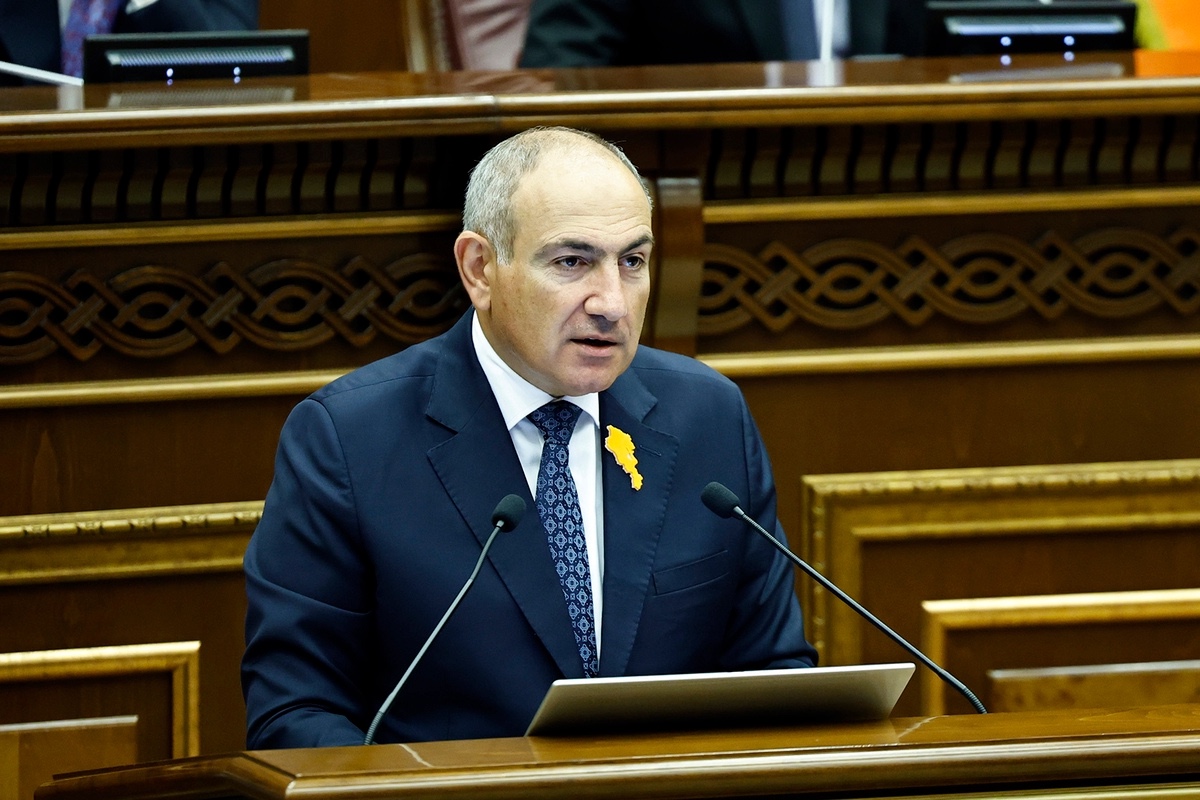
YEREVAN — On Monday, opposition lawmaker Levon Kocharyan stood in Armenia’s National Assembly and accused Prime Minister Nikol Pashinyan of crossing a line no democratic leader should cross: publicly deciding who should be imprisoned, who should lose their property and what law enforcement agencies and courts should do next.
Earlier in the session, Pashinyan had used inflammatory language against the leadership of the Armenian Apostolic Church, referring to the catholicos as “vile.” Kocharyan said Armenians likewise ask the opposition why “that vile traitor who destroyed Artsakh and brought thousands of deaths is still there.”
Pashinyan then turned directly to the wealth of the Kocharyan family, demanded to know how they had become millionaires and declared that property he believed was obtained at the expense of the Armenian state would be returned “piece by piece.” At the end of the extraordinary exchange, he made the confrontation even more personal: “Yes, I am judging you.”
The next morning, masked officers entered Levon Kocharyan’s home while his three young children and wife, singer and owner of Pregomesh, Sirusho, were inside. Former President Robert Kocharyan was detained. His eldest son, Sedrak Kocharyan, was arrested. Searches spread across properties and businesses connected to the family.
Former President Serzh Sargsyan was summoned and charged in the same broader investigation. Sedrak Kocharyan was subsequently ordered into pretrial detention, while Robert Kocharyan was hospitalized after his health deteriorated in custody.

The situation raises profound questions about whether Armenia’s criminal justice system is being used to prosecute alleged wrongdoing or to politically neutralize those capable of challenging the government.
International concern is becoming harder to dismiss as partisan rhetoric. Following Armenia’s June parliamentary election, OSCE observers noted that numerous criminal proceedings against opposition candidates and activists had discouraged supporters from participating actively in the campaign.
This week, the International Observatory for Democracy in Armenia went further, warning of politically motivated arrests and democratic backsliding and arguing that the recurring pattern of prime-ministerial declarations followed by law enforcement action raises serious doubts about judicial independence. The Armenian Center for Political Rights has separately established a formal register of people it considers victims of political persecution.
Tigranashen is now on the table
Only days before the arrests, Pashinyan made another statement that should have commanded far more international attention.
Asked about Tigranashen, the Armenian village located along the vital road south from Yerevan, Pashinyan referred to it using its Azerbaijani name, Karki, and said that according to the maps his government is using for delimitation with Azerbaijan, the territory is not part of Armenia. “This is a fact that we have to deal with,” he said, while insisting that territorial questions must be resolved peacefully through delimitation rather than force.
Roughly 4.5 kilometers of the M2 interstate highway, Tigranashen is part of the principal transportation artery connecting Yerevan with southern Armenia and the Iranian border. The strategic significance of control over the corridor is obvious. For Pashinyan, the issue belongs to the logic of reciprocal border delimitation: Soviet Armenia’s Artsvashen should be recognized as Armenian, while territories mapped as belonging to Soviet Azerbaijan should be treated accordingly. For those who continue to protect Armenia’s national security and interests, the fear is very different. They see Tigranashen as another step in a process in which Azerbaijan raises a demand, the Armenian government initially describes the issue as theoretical or manageable, and eventually Armenian society is told that accepting the new reality is necessary for peace.
That concern becomes considerably more serious when considered alongside Pashinyan’s newly unveiled vision for Armenia itself.
A government program that rewrites Armenia’s national mission
The arrests are unfolding against the backdrop of a government program that represents something far more consequential than a routine five-year policy document. Approved by the National Assembly on Aug. 25 by 63 votes to 24 — with the supporting votes coming from Nikol Pashinyan’s ruling Civil Contract faction — the 2026-2031 program formalizes an ideological transformation of the Armenian state itself.
The most revealing part of that transformation is not simply what the new program contains. It is what has disappeared.
When Pashinyan first came to power in 2018, his government program identified the security of Armenia and Artsakh as a central foreign policy objective. Even after the catastrophic 2020 war, Pashinyan’s 2021-2026 program continued to describe a “fair solution to the Nagorno-Karabakh issue” as a primary objective. Five years later, that language has effectively vanished.
The 2026-2031 program contains no comparable commitment to Artsakh, no policy seeking a political resolution of the Nagorno-Karabakh question and no stated objective of advancing international recognition of the Armenian Genocide. Instead, its ideological foundation is Pashinyan’s doctrine of “Real Armenia.” That is not a minor change in emphasis. It is a reversal of the national priorities Pashinyan himself placed in his previous government programs. Perhaps the clearest example is the proposed new constitution.
The government program formally commits Armenia to drafting and advancing a new constitutional order. For Pashinyan, the new Constitution should no longer contain a reference to Armenia’s 1990 Declaration of Independence.
Its opening language is expressly based on the Dec. 1, 1989, joint decision concerning the reunification of Soviet Armenia and Nagorno-Karabakh. The Declaration also states Armenia’s support for international recognition of the Armenian Genocide.
While presenting his political vision, he argued that the Karabakh movement, as a project, ultimately threatens Armenia’s statehood and future.
Azerbaijan has itself repeatedly raised Armenia’s constitution as an obstacle to a final peace agreement. Pashinyan insists that constitutional reform is an Armenian domestic initiative, not something being written at Baku’s instruction. One of Azerbaijan’s most persistent political demands is now being answered by an Armenian government proposal to sever the Constitution’s explicit connection to the very Declaration Baku objects to.
Removing that reference would not erase the Declaration from Armenian history, nor would it legally erase the Armenian Genocide or the history of Artsakh. But symbolically and constitutionally, it would remove one of the clearest remaining links between the Armenian state and the national objectives on which independence was founded.
The new program speaks of institutionalizing peace with Azerbaijan, continuing delimitation, encouraging Armenian-Azerbaijani civil and business contacts and developing bilateral trade with Azerbaijan. It commits the government to implementing the U.S.-backed TRIPP project, establishing diplomatic relations with Turkey, opening the Armenian-Turkish border and creating at least two modern border crossings.
The broader political critique
The arrests cannot be understood in isolation. Law enforcement actions form part of a much broader political project — one aimed at reshaping Armenia’s constitutional, territorial and political order while systematically weakening the forces most capable of resisting it.
Armenian Revolutionary Federation (ARF) Armenia Supreme Body chairman and opposition lawmaker Ishkhan Saghatelyan, argued that Prime Minister Nikol Pashinyan is seeking to dismantle the political foundations of Armenia’s Third Republic, legitimize the consequences of the loss of Nagorno-Karabakh and the displacement of its Armenian population, and construct what Pashinyan has described as a “Fourth Republic” under conditions increasingly shaped by the demands of Azerbaijan and Turkey.
According to Saghatelyan, political parties, public figures and centers of resistance that could obstruct the implementation of that agenda are increasingly being neutralized through criminal prosecutions, arrests, asset recovery proceedings and other forms of legal and financial pressure. “Today it is the Kocharyan family; tomorrow it will be another family,” Saghatelyan warned.
“Would the Kocharyan family be facing the same intensity of law enforcement scrutiny if its members had withdrawn from politics and ceased challenging Pashinyan?” Saghatelyan asked.
Saghatelyan accused Pashinyan of seeking control over the executive, law enforcement structures and the judiciary. He pointed to the prime minister’s public criticism of judges who issue decisions contrary to the government’s expectations and to suggestions that such judges may be compromised by ties to previous governments. In Saghatelyan’s interpretation, such rhetoric amounts to pressure on the courts: a message that judicial independence will be tolerated only so long as judicial decisions conform to the political preferences of the executive.
After years of negotiations and direct engagement with Azerbaijani President Ilham Aliyev, Saghatelyan argued, Pashinyan increasingly appears to be adopting the logic of a system in which political authority is concentrated around a single leader and meaningful institutional resistance is progressively eliminated.
In that reading, Armenia is moving toward the consolidation of one-person rule — not necessarily through the formal abolition of elections or democratic institutions, but through the gradual erosion of the institutions capable of limiting executive power.
Saghatelyan argues that the government benefits when public attention shifts from questions of sovereignty, constitutional identity and territorial concessions to the spectacle of arrests and prosecutions. But he insists that the strategy will not succeed.
The opposition, he said, must continue challenging the anti-national government program rather than allowing itself to be consumed by successive arrests and criminal proceedings. Ultimately, this is a struggle over whether Armenia’s future will be determined through open political competition and independent institutions — or through the progressive removal of those capable of standing in the government’s way.

The intolerance of committed liberals
As for tigraneshen, Azerbaijan has claim upon it being part of soviet Azerbaijan as an enclave and the 2020 ceasefire committed Armenia to cede control, thus the best solution is built a road around it and render it of limited use to Azerbaijan, ever heard of the choum tunnel, technically absurd but denied Spain leverage over France.
Under Pashinyan’s undisguised dictatorship, court rulings and elections are now mere formalities. The courts and elections under him are used for show, under the laughable pretense to project an image of “legitimacy”, just like in Soviet times, were everthing was already predetermined and decided at the top. After gaining control of the judiciary, the military and the bureaucracy, the National Assembly, political parties and the Armenian Constitution are next on his list of “Gleichschaltung”. It is a “prerequisite” of every aspiring dictator like him and it is not a question of if, but of when.
Should we welcome Pashinyan’s authoritarian and dictatorial tendencies?
I think we should play 3D Chess.
Let Pashinyan assault the Church and ban the Opposition.
The ARF has a history spanning 136 years during which it has been banned and gone underground several times.
So it knows what to do.
Pashinyan will ban the ARF, the ARF will go underground and the revolutionary struggle will, at long last, begin.
Hayastan will be reborn!
Unfortunately, this is the exact outcome when an uneducated electorate votes based on sound bites rather that solid evidence. My poor Hayasdan. Thank God that my parents and grandparents (who were Genocide survivors) did not see this. Vagh im Hayasdan.
The title presented to the reader is an out of context quote.
I watched the marathon session. The following exchange took place towards the end and lasted a minute or so. Ii’s almost verbatim, the PM said, I quote, “they say ‘do not judge’, but they fail to mention the other part, ‘or you will be judged’. I am to be judged as I judge”.
I found out that biblical quote is the following passage, Mathew 7:1.
Thanks for this clarification!
Pashinyan does not just judge because he is being judged. He is a deceptively manipulative fake “populist” of a sorry excuse for a leader turned dictator who has become the judge, the jury and the executioner. The Parliament is supposed to be a place where country’s internal and external issues are addressed and debated but for him these days it seems like it is more of a place to identify his next victim to eliminate. His dysfunctional and incompetent Civil Contract party has turned that place into a personal battlefield to throw dirt at anyone who disagrees with their policies. Failing to do so, they will dig into past going back decades, even a century, when many of their members were not even born yet to find something to throw at opposition that has absolutely nothing to do with issues critical to the country today. That is a new strategy they have employed to drive a wedge between the opposition parties, who are ideologically very close, in order to split them up. It is part of their new divide-and-rule policy.
The election was fraudulent and undemocratic as well because many of the leaders of the opposition parties were incarcerated, subjected to house arrests, and dragged unnecessarily through the criminal court system based on manufactured charges long ahead of the Election Day to disrupt their campaign and to impede their advance in the polls. Given such conditions that they created, and given the fact that the new “Strong Armenia” party received nearly 24% of the votes speaks volumes about these facts. The timing of their illegal activities against the members of the opposition parties and the clergy is also suspect and very critical. Going back to 2018 when they seized power their relations with such individuals was very casual and their interactions with the Church leaders were quite cordial and normal. But soon after Pashinyan’s capitulation and as soon as the enemy dogs started barking aloud about these individuals and the Church leaders accusing them of all kinds of nonsense, that is when Pashinyan started to turn up the heat on them and go after them. Pashinyan is a thin-skinned incompetent fraudster! Listen and watch him in the Parliament throw temper tantrum and lose his normal and soft-spoken demeanor and cool on a dime and then you will see his true self!