



IODA experts warn of repression, democratic backsliding in Armenia
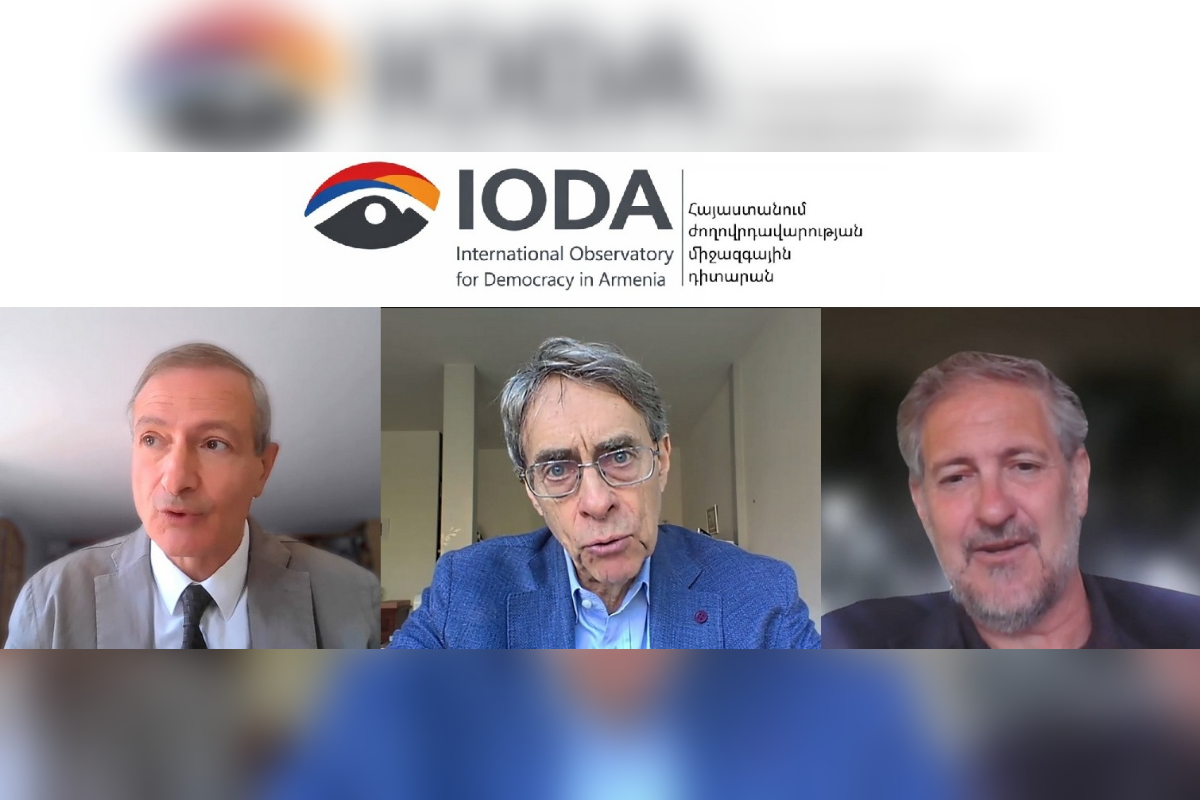
Members of the executive board of the International Observatory for Democracy in Armenia (IODA) have voiced serious concerns over what they describe as growing political repression, politically motivated arrests, pressure on opposition figures and the Armenian Apostolic Church, and broader authoritarian tendencies in Armenia.
Speaking during an online IODA press conference, Kenneth Roth, former executive director of Human Rights Watch, Philippe Kalfayan, and José Aranas argued that developments before and after Armenia’s June 7 parliamentary elections point not to isolated incidents but to a broader pattern of democratic backsliding.
The speakers were particularly critical of recent arrests and investigative actions against former senior officials and opposition figures, arguing that statements made publicly by Prime Minister Nikol Pashinyan before law enforcement action took place raise serious questions about the independence of Armenia’s justice system.
They also called on the European Union and other Western governments to respond more forcefully, especially in light of Pashinyan’s announcement that Armenia intends to begin a process aimed at eventual EU membership.
“The government itself has proven that there are political prisoners in Armenia” — Philippe Kalfayan

Asked how he assessed the situation regarding political prisoners in Armenia, IODA Executive Board member Philippe Kalfayan said the government’s own actions had demonstrated that politically motivated imprisonment was taking place.
“The government itself has proven that there are political prisoners in Armenia: people are being detained without charges. Therefore, yes, we do have political prisoners in Armenia. Are there other serious allegations involving money laundering or other corruption schemes? We do not know. But it is a fact that arrests are announced before any investigation is conducted or criminal proceedings are initiated, which indicates that what we are dealing with is not a functioning judicial and legal system, but political retribution,” Kalfayan said.
He cited the case of opposition figure Avetik Chalabyan, who was detained following the parliamentary elections.
“Avetik Chalabyan was arrested immediately after the elections and accused of bribing Russian Armenians to come to Armenia and vote. During the pre-election period, we warned that we had no evidence whatsoever of large-scale bribery. And a few days ago, he was released without charges,” Kalfayan said.
“This is a typical situation in which we can see politically motivated arrests taking place among opposition figures. And all these arrests had been announced by Armenia’s prime minister before they took place, when he said that all these people would be arrested and imprisoned.”
Kalfayan drew a parallel with subsequent law enforcement measures involving former President Robert Kocharyan, his son Sedrak Kocharyan, and Prosperous Armenia leader Gagik Tsarukyan.
“Yesterday and today, the same thing was done to President Kocharyan and his son. In effect, the same thing was done to Gagik Tsarukyan,” he said.
Robert Kocharyan and Sedrak Kocharyan were detained on Aug. 25 as part of a criminal investigation involving allegations of abuse of office, bribery and money laundering. Former President Serzh Sargsyan was also summoned to the Anti-Corruption Committee.
Kalfayan stressed that IODA was not in a position to determine whether other substantive criminal allegations might ultimately be established in any of the cases. His concern, he said, was that political declarations appeared to precede investigative and judicial action.
He also questioned the political and practical implications of Pashinyan’s announcement that Armenia would begin a process aimed at EU membership.
“What is strange is that Prime Minister Pashinyan has decided to apply for EU membership, even though he himself has stated that there has been no such invitation from the EU. Even if the process were to begin tomorrow, it would still take a very long time,” Kalfayan said.
“I would like to point out one thing: Turkey has been a candidate for EU membership since 2004 and recently stated that it sees no prospect of joining the EU in the near future. The question is whether the EU would accept Armenia as a member, given that Turkey and Georgia, which share borders with the EU, have not been admitted. This is a very interesting question.”
“Does the EU want Armenia to become simply a pro-Western dictatorship or a democracy?” — Kenneth Roth
Kenneth Roth said IODA had warned before the elections that authoritarian tendencies were already becoming visible in Armenia.
“Before the elections, our organization warned that Pashinyan and his political allies had authoritarian tendencies, which had manifested themselves during the election campaign. Pashinyan misused certain laws and the government’s discretionary powers to put pressure on opposition candidates, critical voices, independent journalists, and the Armenian Apostolic Church,” Roth said.
According to Roth, the Armenian government had been particularly effective at presenting many of its actions during the election period as measures aimed at resisting Russian interference.
“He presented much of the pressure as a means of countering Russian influence. We do not deny that the Russian government attempted to influence the elections in Armenia, but it should also be noted that European governments and American circles were doing so as well,” Roth said.
“Pashinyan successfully persuaded Western governments to overlook his efforts to manipulate the electoral process. We warned that these actions were not merely about the conduct of the elections, but reflected the nature of this government. We warned that if the Pashinyan government were allowed to act with impunity, it would be more likely to continue moving in this authoritarian direction.”
Roth argued that developments since the election had reinforced those concerns.
According to him, Pashinyan has repeatedly used law enforcement agencies and police measures specifically against his political opponents, in ways that appear to be motivated less by neutral enforcement of the law than by political retaliation.
“The executive dictates, and the justice system carries out its instructions,” Roth said.
“For example, we have learned that Robert Kocharyan and his son have been detained, while President Sargsyan has been summoned to the Anti-Corruption Committee. All of this appears to have happened following the prime minister’s instructions yesterday and as a result of his efforts.”
Roth said the timing of arrests, property seizures and other investigative measures following statements by the prime minister raised particular rule-of-law concerns.
“We cannot comment on the substance of the cases, but what we have observed in recent days is that people are detained or their assets are seized by the authorities immediately after statements by Pashinyan,” he said.
“There is no judicial or legal basis, no proceeding. In that sense, all of these actions are unlawful. There are no judicial proceedings authorizing the detention of these individuals or the confiscation of their assets.”
“In an ordinary, functioning democracy based on the rule of law, there is no possibility of seizing people’s assets or stripping them of their property without formal charges.”
Roth also urged Western governments, particularly those in the European Union, to reconsider what he described as an insufficient response to democratic deterioration in Armenia.
“We want to issue a wake-up call to Western governments, particularly the EU: since they failed to take sufficient action earlier, they should at least do so now,” Roth said.
“The question arises: Does the EU want Armenia simply to become a pro-Western dictatorship, or does it want a democracy? This issue concerns not only Armenia, but the EU’s broader foreign policy as well.”
“Armenia is a test that should demonstrate the European Union’s commitment to democratic principles. We hope Brussels will be able to respond in a principled manner.”
EU membership and the Copenhagen criteria
Roth said Pashinyan’s stated intention to move Armenia toward EU membership placed an even greater responsibility on Brussels to insist on democratic standards.
“The EU has an enormous range of tools at its disposal. It should not think that if it says something critical of Armenia, this will push Armenia into Russia’s camp,” Roth said.
“The EU must understand that its current policy of ignoring these problems will only deepen all of the concerns and difficulties.”
He contrasted the democratic requirements traditionally associated with EU accession with what he described as current trends in Armenia.
“The impression is that Pashinyan wants to advance ‘Yerevan principles’ or ‘Yerevan criteria’ in place of the Copenhagen criteria, replacing democracy with authoritarianism,” Roth said.
José Aranas, another member of the IODA executive board, made a similar point, stressing that EU integration is inseparable from democratic reform and the rule of law.
“In addition to the fact that there is no clear timetable for EU membership, I would also like to stress that authoritarianism is not a path into the European Union,” Aranas said.
“All the countries that began this process much earlier have understood that the road to the EU is one of genuine reforms, the rule of law, and respect for the law. There is no other path to the EU.”
Aranas added that peaceful regional relations and European integration could not, in his view, be sustainably pursued at the expense of democratic principles.
“Regional peace, and peace with one’s neighbors, cannot be established through authoritarian rule. Nor does the road to the EU run through constitutional reforms that could undermine the values enshrined in the constitution,” he said.
“Therefore, the more democracy and protection of human rights there is, the closer we will be to the EU. Let us hope that this is precisely the message that will be conveyed to the EU.”
IODA: These are trends, not isolated incidents
Aranas emphasized that IODA viewed the developments it had documented not as separate or accidental episodes, but as part of broader trends affecting Armenia’s democratic institutions.
“The problems that our organization has documented are not simply incidents, but trends,” he said.
“One such trend, for example, is pressure on democratic institutions. There are also trends toward diminishing constitutional values, weakening the principles of freedom of religion, and undermining the concept of spiritual security.”
The speakers also addressed the role of Armenia’s political opposition.
Asked by Aravot.am what opposition forces could do to prevent actions by the Pashinyan government that the speakers said were pushing Armenia toward authoritarianism, Roth said opposition figures themselves had increasingly become the targets of government action.
“First of all, at this point the opposition voices themselves are the victims, because they are the ones being targeted by the Pashinyan government. We therefore should not blame the victims,” he said.
“At this stage, the opposition should certainly appeal to the international community and seek support for defending and preserving democracy in Armenia. The opposition has every opportunity to raise its voice on these issues.”
“This government wants to govern without criticism, and the problem is that it does not want to be guided by democratic principles.”
Pressure on the Armenian Apostolic Church
Roth also expressed concern about the government’s confrontation with the Armenian Apostolic Church and Prime Minister Pashinyan’s increasingly hostile rhetoric toward the Church leadership and the Catholicos of All Armenians.
“The government is also trying to put pressure on the Armenian Apostolic Church, even though it has no right to interfere in the church’s internal affairs,” he said.
Asked whether the government’s actions were intended to weaken one of Armenia’s most influential institutions, Roth stressed that religious institutions have a legitimate role in public debate in a democratic society.
“The church, anywhere in the world, is an independent voice in society and must be respected,” Roth said.
“Democracy does not mean that the church should speak only about spiritual matters and remain silent on politics. The church is an important political as well as moral voice.”
He argued that attempts to prevent the church from commenting on government policies would themselves be anti-democratic.
“The government is attempting to restrict the church, including through legal pressure, and to prevent it from speaking about government policies. That is anti-democratic,” Roth said.
“This approach by the government is incompatible with the right of religious organizations to play a role in a democratic society.”
Roth also emphasized that freedom of expression extends to both the church and Armenians outside the country.
“The church also has the right to freedom of expression. The Diaspora likewise has the right to freedom of expression. Freedom of expression does not stop at national borders,” he said.
“These are universal principles enshrined in the constitution of Armenia.”
Taken together, the IODA representatives’ remarks portrayed Armenia’s current political situation as a broader test of the country’s democratic institutions, the independence of its judicial and law enforcement bodies, and the willingness of international partners — particularly the European Union — to make democratic standards a substantive condition of closer relations with Yerevan.
For Roth, the central question facing Brussels is therefore not simply whether Armenia is moving geopolitically toward Europe, but what kind of political system that rapprochement will support: “Does the EU want Armenia simply to become a pro-Western dictatorship, or does it want a democracy?”


Best thing to do is push for internationally releasing Ruben Vardanyan and pushing him to eventually become the Armenian Prime Minister in the future
The tragedy of the situation is that all of this was preventable. Pashinyan’s descent into dictatorship wasn’t a fait accompli, it was a calculated gradual process which could have been nipped in the bud if the opposition was organized, united and resolute. Now that Pashinyan is a full dictator, the only way to depose him is by force; either through a coup d’état (which, given his purge of the Armenian army, is highly unlikely, if not impossible) or a popular uprising (the most likely option). Unless if he were to die in office or were to resign voluntarily (an extremely remote scenario considering that dictators like him love and are addicted to power), he is not going to leave power through a democratic electoral process. The question is if Armenians are willing to depose him through people power?