


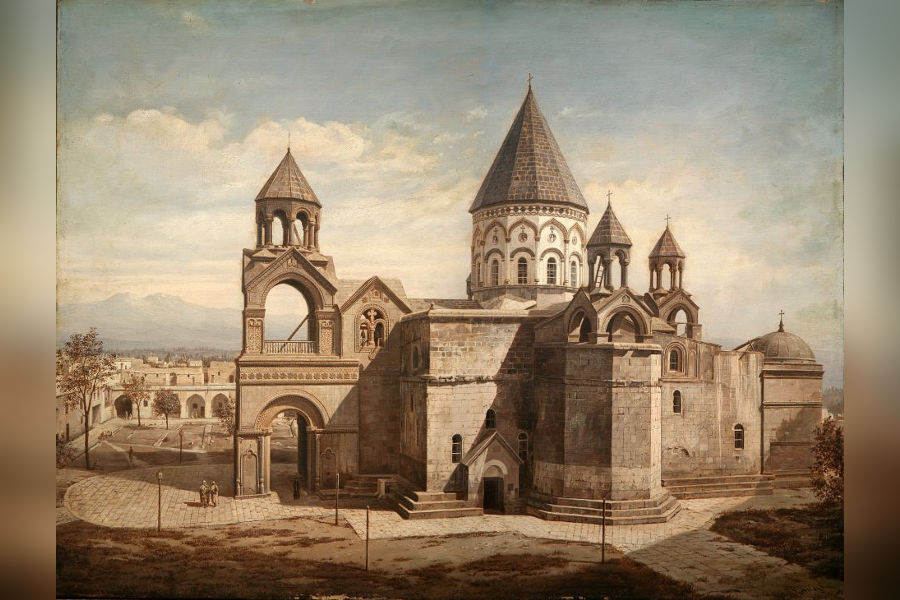
Every Christian denomination can be defined not simply by its theology and canons but more clearly by its structure and administration. The Armenian Apostolic Church is no exception. Despite our jurisdictional issues, which we choose to ignore in our current state, the Armenian Church operates as a hierarchical institution, whether one is affiliated with Holy Etchmiadzin or the Great House of Cilicia. When it comes to structure, canons and culture, we remain whole. Our church is hierarchical in nature, with democratic processes such as the election of diocesan bishops and Catholicoi by representative assemblies of lay and clergy delegates.
The hierarchy is important to understand because elected celibate clergy wield significant power in the running of the church between elections. The Catholicos is elected for life. There are provisions for the resignation of a sitting Catholicos or retirement because of health reasons, but they have rarely been used. The Holy See of Cilicia has used the coadjutor provision twice in the past 100 years. The latest was implemented when Karekin Sarkissian became coadjutor to the sitting Catholicos of Cilicia, Khoren I. After Khoren Vehapar’s death, he continued as Catholicos of Cilicia as Karekin II. He later was elected Catholicos of All Armenians at Holy Etchmiadzin, where he became known as Karekin I.
Primates and prelates are elected to four-year terms in the Americas by their respective assemblies of lay and clergy delegates. Our church grants significant authority to its elected clergy leaders. These leaders also benefit from the respect factor prevalent in the Armenian Church. Some will refer to this as patronizing. Most of the laity consider supporting the sitting bishop’s vision a vital part of their responsibility. Whether canonically or culturally, our church can be described as progressive because of its democratic foundation and very hierarchical because of the concentration of power among primates, prelates and Catholicoi.
Conflict is usually expressed in private, and tolerance of dysfunction is very high. The general perception is that the tenure of His Holiness Karekin II has been controversial in terms of management practices and credibility, yet the church has either been unwilling or unable to address these issues, which affect the functioning of our church.
In our local parishes, the full spectrum of human frailty has been part of our history. We have experienced priestly-congregant relationships that are full of love and respect, as well as the pain of controversy. This should not be surprising, given the human nature of our church. Our parish life becomes a microcosm of our entire life, complete with love, hurt, joy and forgiveness.

Of course, when our community fails to function optimally because of human relationships, including our lay-clergy experiences, it becomes very personal, and emotions may guide us. Serving as a parish priest is a very challenging vocation. Motivated by a spiritual calling, priests guide a diverse flock to salvation, a ministry loaded with challenges. I have been fortunate to know many priests who have a deep understanding of their ministry. It grounds them in their human interactions and makes them effective and loved.
I lament the loss of respect for our priests when it exists. I was raised by parents and grandparents with deep respect for the clergy. My father was a deacon of the church and served with many priests and bishops. One of the gifts he gave us was to support and love our clergy.
The greetings in our church for parish married priests, or kahanas, and celibate clergy reflect our respect and the special status of our ordained clergy. Honestly, I hear these greetings less today as our priests become more tolerant of our ignorance and more sensitive to connecting with an increasingly diverse congregation. The parish priest is recognized as the president of the parish, which empowers him to participate in all aspects of parish life.
How we interact with our priests is usually a reflection of how much we have invested in the relationship. There are times when the approach of the priest is not effective, and he needs to improve in relationship-building. As members of the laity, we must always be part of the solution. When your priest does something that upsets you, how do you respond? Do you take the time to discuss other options privately, or do you choose to be part of the critics, leaving opportunities on the table? The former reflects love and respect, while the latter adds little value.
As Christians, we are called to love and forgive. Open and transparent relationships are grounded in love and forgiveness when we disappoint each other. Think about how you can improve your relationship with your priest by subordinating your ego and helping him be more effective. That is something we can all affect.
I attend a parish that has had the same priest for its 25 years of existence. Our priest recently retired, and his absence reflects the importance of the role of a local parish priest. The immediate challenge of finding a suitable replacement is complicated by today’s supply-and-demand imbalance for priests. The reality is that St. Nersess Seminary, the only Armenian seminary in North America, simply has been unable to meet the demand in the American dioceses.
The Etchmiadzin dioceses have supplemented the supply with candidates from Armenia, which has been a blessing. The Antelias-affiliated dioceses draw their supply of priests from the renowned seminary of the Holy See. Despite improved recruitment, the number of American-born candidates here is modest. Identifying priestly candidates is a difficult process because its foundation lies in the candidate’s calling. Programs such as St. Nersess summer studies and the Datev Institute have encouraged our youth. The immersion programs are working and should be expanded.
A further challenge has been the geographic dispersion of our parish locations. We have expanded in the southern areas of America, which has increased the demand for priests. While our parish is now a participant in the waiting process, we also have felt the void of a spiritual leader.
When a parish loses its priest, there is a fairly reliable process for visiting priests and deacons’ services. In some cases, a priest may celebrate Badarak each week for the short term as a visitor. Most parishes, however, go week to week with visiting priests and deacons. That has been our recent experience.
The priests and deacons who travel to communities in need are unsung heroes in our church. Whether it is a mission parish that gathers monthly or a parish in search of a permanent pastor, they fulfill a need with sacrifice. A visiting priest or deacon is simply that, however: a visitor. They celebrate the Badarak and return to their distant homes. The communities lack the spiritual guidance that a permanent priest can provide.
Recently, when appropriate, a deacon in charge has been appointed in a few communities. This provides day-to-day continuity and helps the community stay together during the transition period. My suggestion to the Prelacy and Diocese has been to appoint, at a minimum, a priest who will serve as the spiritual adviser to the parish. This is not necessarily someone who lives in that community, but an individual who can join parish council or board of trustees meetings by video conference and serve as a resource to the lay council.
In the absence of such an individual, we may be asking too much of our lay councils, which can lead to conflicts or indecision. I have witnessed such tribulations in our recent experiences. Our priests are also a vital part of the nonliturgical aspects of parish life. Who handles that role, and if it is no one, what is the impact on the community during the interim? I find it ironic that many of the people who participate in criticism of their priest in various parishes also lament the void when they enter a transition period.
Our priests have been called to an honorable vocation, but they are also human. Do we see their shortcomings as an opportunity to improve their effectiveness, and therefore the parish, or as a weakness from which we distance ourselves? Are we part of the solution or part of the problem?
It is painfully ironic that we invest so much in our community life but at times ignore opportunities to optimize our mission. If we choose to be advocates for these ministries, it also provides an incredible example for our young people, who are always listening. Why would a young man answer the call if he has observed a lack of respect for our clergy? This also applies to women who choose to join important ministries.
I find great joy when I witness the mentoring and respect many of our youth have with their priests. A generation ago, we grew up in fear of some of our priests. Today, our priests are active role models for the next generation.
Let’s change the paradigm based on respect and forgiveness. If our orchestra is to reflect harmony, let’s respect the conductor. We will all benefit from it.