



Message in a bottle
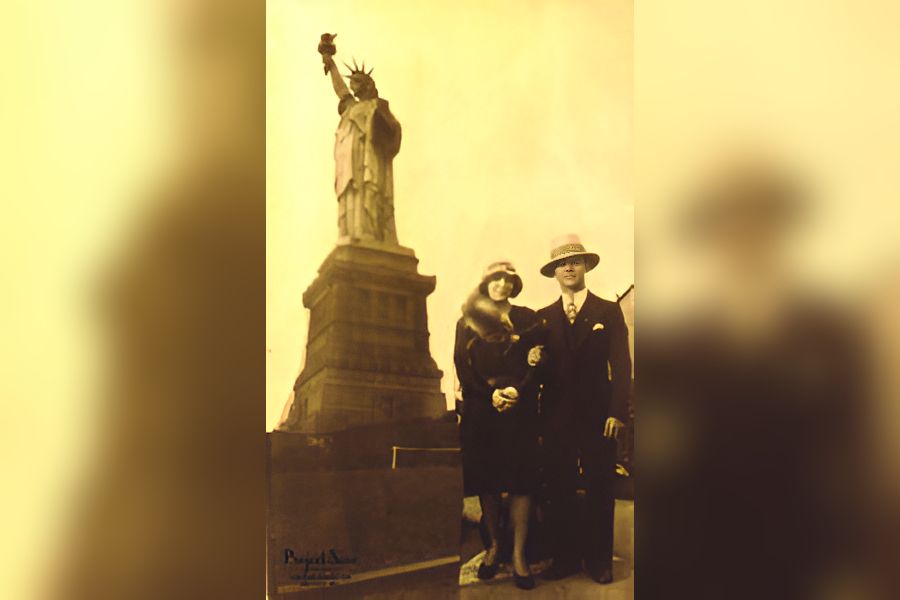
A child finds an old bottle among the rocks beneath the Statue of Liberty. Inside is a single piece of worn paper with a message that appears to have been imprinted by the sharp edge of a fountain pen.
“Mama, come quick! Look what I found,” he whispered, not wanting the other tourists to see his discovery.
“Where did you find it?” she asked.
“It was buried in the rocks. A sparkly part caught my eye, and I thought it was the kind of sea glass you like to collect,” he said.
“Can we open it?” he pleaded. “Please?”

“Call your father over. It’s jammed shut, and we can use his help to open it,” she replied.
The little boy did as his mother instructed, and they all walked over to a rocky section where fewer people ventured. His mother carefully removed the fragile letter and began reading the faded handwriting on a single page. Her hands started to shake, and her lips trembled as she began reading aloud.
“Dear Lady Liberty,
The glowing torch you held welcomed me. You called for the tired, the poor, the homeless, and the huddled masses yearning to breathe freely. You lifted your lamp for the golden welcome.*
You spoke to me and thousands of other immigrants looking for a place to call home. We were not simply seeking America. We longed to become Americans.
When our ship entered the New York harbor, exhausted passengers rushed to the railings. Some cried openly. Some fell silent. I simply stared at you, wondering if your promise could possibly include someone like me.
How can I repay such a welcome except by becoming the kind of citizen you hoped I would be?
We crossed an ocean so our children could thrive. Although our suitcases were light and our wallets were thin, we did not arrive empty-handed. We carried courage, faith, recipes, songs and the determination to become part of the country that welcomed us.
When we stepped onto these shores, we were strangers. We did not speak or read the language, and we searched for familiar faces. We accepted jobs that others refused because every paycheck means another meal, another month’s rent and another step toward a better future for our families. We learned English after long days of labor.
We worked in mills, built railroads and roads, and opened bakeries, grocery stores, factories and family businesses. We became teachers, nurses, carpenters, laborers, artists and entrepreneurs. We worshipped in churches we built with our own hands, and we proudly paid taxes. When America called, many of us answered in uniform, grateful for the chance to defend a nation that had defended our freedom.
Years passed, and our children became Americans. Our grandchildren pledged allegiance to a flag that had once been only a distant promise across the sea. Some may have forgotten our language but have never forgotten our values. They inherited our work ethic, resilience and belief that tomorrow could always be better than yesterday.
As for me, my name matters less than my story. Mine is just one among millions. I am an Armenian orphan who, by the grace of God, survived the 1915 Armenian Genocide. An estimated one and a half million Armenians never had the opportunity that America gave me, including most of my entire family. America does not erase my past; it gives me a future. My grandchildren speak English more easily than Armenian. They know little about the road that brought us here. How could they? They have never seen the frightened faces that looked upon your torch. Yet every opportunity they enjoy begins long before they are born, with one frightened immigrant who looked toward you, dear Lady Liberty, and dared to believe that tomorrow could be different.
Today, Armenian communities flourish across the country, from New York to California and everywhere in between. Yours was the first face many of them saw and the open arms many of them felt.
If you ever wonder whether immigrants strengthened America, do not focus on the ill-intended. Instead, focus on what well-intentioned citizens have created and continue to contribute. Children who became doctors, teachers who inspired generations, soldiers who defended freedom, entrepreneurs who created jobs, law-abiding citizens who strengthened neighborhoods, churches filled with prayer and grandchildren who proudly call this country home.
I hope I have made you proud and sealed these words in a bottle, because hope has a way of finding the shore it was meant to reach.
Thank you, and God bless America.”
The little boy looked up toward the Statue of Liberty. The afternoon sun cast its light across the harbor just as it had been for generations before him. They all sat still for a moment. The little boy spoke first, “Is that our story, too?”
His father replies, “In many ways… yes.”
They look to the child’s mother for guidance. She still holds the letter in her hand. She snaps a photo on her phone, carefully rolls the paper, tucks it back inside the bottle, and holds it for a long moment.
She says simply, “We have been given a gift. Sometimes, stories are meant to find the people who need them most. Let’s reflect on this message at home and leave it for the next finder it is meant to reach.”
The child and his father nodded in agreement, and the father resealed the bottle and handed it to the little boy. He smiled, stood on the rocks and proudly tossed the bottle back into the tide.



Thank you for sharing this beautiful story.
Thank you.
Beautiful!
Thank you.
A lovely, heartwarming and patriotic story perfect for a special 250th birthday of our country. Thanks for sharing Vicki!
Thank you.
What a beautiful story.
Thank you.