Budapest exhibition and conference explore the afterlives of Ani
Scholars, artists and cultural practitioners gathered in Hungary to explore the medieval Armenian capital's enduring significance
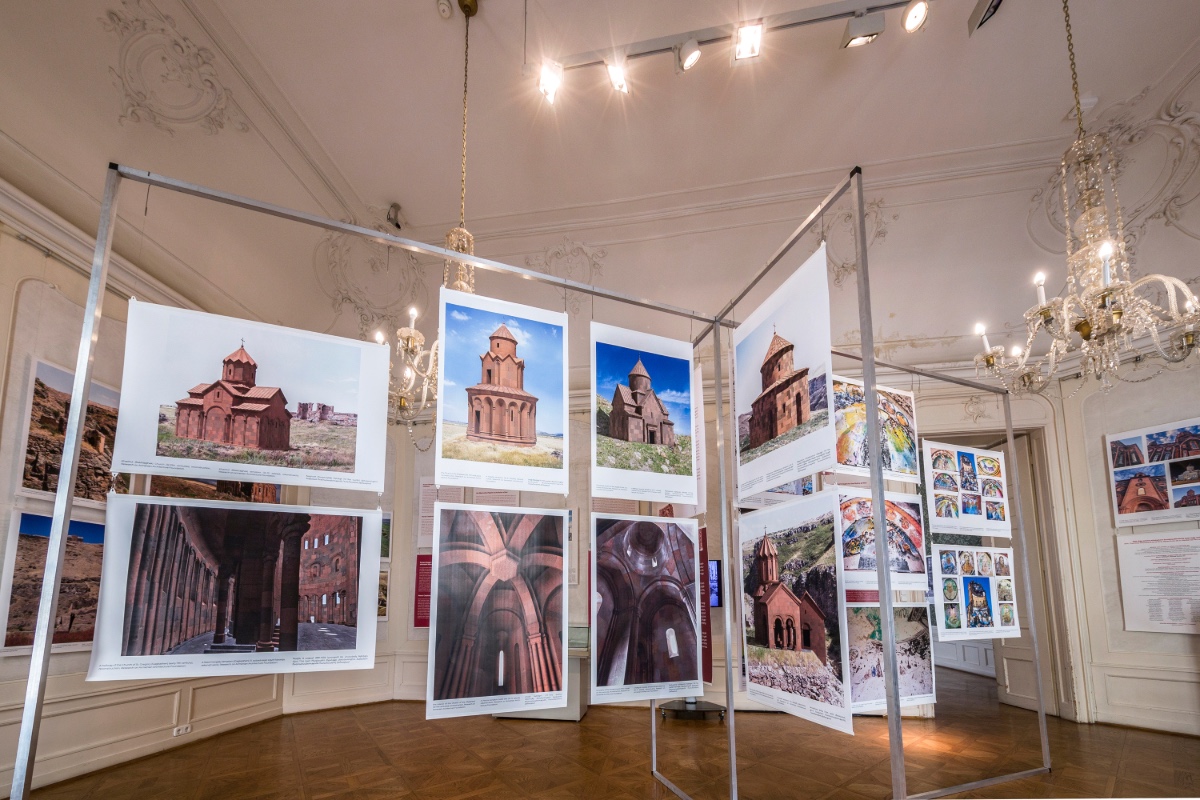
BUDAPEST – An international exhibition and conference dedicated to the medieval Armenian capital of Ani opened on March 19 at the Petőfi Museum of Literature in Budapest. The exhibition, titled “Ani: the One Thousand and One Afterlives of a Medieval Armenian Capital,” brought together scholars, artists and cultural practitioners to explore Ani’s ongoing significance for memory, art and identity. Serving as the culmination of the research project “Lost-but-found: Armenian Capital Ani at Contested Crossroads,” funded by the Gerda Henkel Foundation, it highlighted Ani’s enduring impact across national and diasporic contexts. The exhibition remained open at the Petőfi Museum of Literature until April 20.
The opening ceremony, held in the historic Károlyi Palace, featured welcome speeches by Petra Török, director general of the Petőfi Museum of Literature; Nádor Birher, dean of the Faculty of Humanities and Social Sciences at Pázmány Péter Catholic University (PPCU); Sándor Őze, head of the Institute of History at PPCU and director of the Hankiss Ágnes Institute in Budapest; Davit Poghosyan, director of the History Museum of Armenia; and Vahe Torosyan, deputy director of scientific affairs at the Mesrop Mashtots Institute of Ancient Manuscripts, the Matenadaran in Yerevan. The evening moved between scholarship and artistic response, with performances by pianist Nare Sukiasyan of the Komitas State Conservatory of Yerevan and Berlin-based choreographer, dancer and sociologist Jasmin İhraç, whose work, “Sahman-Grenze-Kuş,” underscored the event’s interdisciplinary and intermedia vision.
The evening also included the book launch of “Capturing Eternity: Jerusalem Armenian Entanglements with Photography” (L’Harmattan, Budapest & Leipzig University Press, 2026), edited by Karen Jallatyan and Diana Ghazaryan in cooperation with Bálint Kovács. The volume can be ordered from L’Harmattan, Budapest, and from Leipzig University Press.
The exhibition and conference were organized by Dr. Jallatyan of the Leibnitz Institute for the History and Culture of Eastern Europe (GWZO) in Leipzig and Dr. Konrad Siekierski of the Free University of Berlin, with the support of Dr. Bálint Kovács, head of the Department of Armenian Studies at PPCU and senior research fellow at GWZO Leipzig. Their shared vision was that Ani should be approached not only as a historical and archaeological site, but also as a dynamic field of memory that continues to generate meaning in national, diasporic, and global contexts. As the organizers note, Ani’s richly multifaceted memory offers a way to reflect on how lost cities are remembered, contested, and reimagined in the present.
On March 20, after remarks by Elke Hartmann (Free University of Berlin), the conference began with the panel “The Ruins of Ani as a Nexus of Early-Modern/Modern Social Relations,” chaired by Hakob Matevosyan (ZOiS, Berlin). Peter S. Cowe (University of California, Los Angeles) opened the session with “Ani’s Protean Gestalt in Spatiotemporal Transition,” reflecting on Ani’s changing historical presence across time and space. Davit Poghosyan highlighted the importance of Ani’s Hnadaran and Karedaran, the early-20th-century on-site museums, for Armenia’s museal practice. Lenka Panuškova (GWZO Leipzig), situated Czech engineer Jaroslav Tkadlec’s photographic documentation of Ani and the Caucasus between scenic aesthetics and documentary record; and Kristine Baghdasaryan (Free University of Berlin and PPCU) examined the critique of heritage in the Tiflis (Tbilisi) Armenian periodical “Khatabala” by showing how satire could turn Ani into a site where preservation, ownership and representation were debated rather than affirmed. Together, the papers showed how Ani has been imagined, documented and contested across different periods and media.
The second panel, “Artistic, Civil Society Relations with Ani within and beyond Turkey,” was chaired by Máté Botos (PPCU) and shifted the focus from scholarly documentation to public memory, artistic practice and local engagement. Hartmann discussed the contemporary remembrance of Ani between denialism, rediscovery and reframing, placing the city within broader struggles over recognition and historical narration. Jasmin İhraç (Berlin) presented “Choreography, Landscape, Ruins: Sensing Ani through Dance,” bringing an embodied perspective to the panel. By approaching landscape, ruin and movement as interconnected forms of memory, her presentation showed how dance can register the affective and political dimensions of a site whose histories remain both visible and difficult to articulate. Vedat Akçayöz (Kars Culture and Art Association) then presented discoveries from the Ani region, linking research at the site to cultural activism and to the ongoing documentation of Kars’s architectural and artistic heritage.
The third panel, “Pilgrimages to the Ruins of Ani,” chaired by András Bácskay (PPCU), turned to affective journeys and personal encounters. Marc Mamigonian of the National Association for Armenian Studies and Research (NAASR, Boston) explored how diasporan Armenians experience Ani not simply as an archaeological site, but as a place of return, longing and historical recognition. Konrad Siekierski’s presentation, “Ani: An Affective Place,” reflected the emotional force of the ruins, asking how silence, absence and material remains shape visitors’ attachments to the city. Brazilian-Armenian photographer and architect Norair Chahinian’s “The Power of Emptiness” offered a personal reflection rooted in family histories of displacement from Urfa, Marash, Iskenderun and Kessab, approaching Ani as a landscape where emptiness itself becomes evidence, memory and aesthetic form. The day concluded with a screening of Ani Hovannisian’s documentary “The Hidden Map” (2022), followed by a discussion chaired by Anatolii Tokmantcev (PPCU). The film extended the conversation beyond the academic paper format by following a journey through the Armenian past and present in present-day Turkey, showing how documentary storytelling can make hidden histories accessible to wider public audiences.
The second day brought in literary and philological perspectives. The panel “Literature and Ruins,” chaired by Cowe, approached Ani through textual memory, manuscript culture and literary imagination. Armenuhi Drost-Abgarjan (Martin Luther University Halle-Wittenberg) analyzed Ani as a literary site of memory in the Middle Ages, while Emilio Bonfiglio (University of Hamburg) discussed the links between Ani and the archbishop of Constantinople John Chrysostom (c. 347-407) in a medieval Armenian manuscript held at the Matenadaran (Yerevan). Kovács then turned to nostalgia and lost landscapes in Minas Bžškeanc’s 1830 travelogue “Journey to Poland,” showing how the genre can shape memory and Armenian cultural identity. Jallatyan concluded the session with a paper on diasporic ruin-images of Ani in modern Armenian literature by examining Levon Shant’s play Շղթայուածը Խաղ մեր Միջնադարէն (“The Enchained: A Play from Our Middle Ages”; 1918/1921) and Krikor Beledian’s essay Հրապարակներ (“Public Squares”; Ari Literature Foundation, Yerevan, 2021). Taken together, the papers showed how Ani has lived on not only in stone and ruins but also in textual memory and literary imagination.
The next panel, “The Ruins of Ani through Art Historical Perspectives,” was chaired by Máté Tamáska (Apor Vilmos Catholic College) and explored Ani through architectural, archival and visual analyses. Sipana Tchakerian (Institut national d’histoire de l’art) discussed Ani through the archive of Nicole and Jean-Michel Thierry, emphasizing the importance of fieldwork records and archival preservation for the study of Armenian architectural heritage. László Daragó (University of Technology and Economics) followed with a presentation on Tamás Guzsik’s Armenian legacy. Christina Maranci (Harvard University) spoke on the Cathedral of Ani and its architectural significance, and Zaruhi Hakobyan (State Academy of Fine Arts of Armenia) examined the iconography and artistic conception of the tympanum sculpture of the Church of Eznka near Ani. The session brought architectural study, archive work and visual analysis into close dialogue, showing the richness of Ani as an art historical field of exploration.
A roundtable on the “Kingdom of Ani” project, an action-adventure video game set in medieval Ani and featured in the exhibition, connected historical research with 3D modeling and immersive technologies. In this way the conference in Budapest demonstrated how Armenian cultural heritage can be studied, preserved, and shared through collaboration across different disciplines and institutions.
The conference concluded with a roundtable on the “Lost-but-found: Armenian Capital Ani at Contested Crossroads” project. The speakers were Jallatyan, Kovács, Matevosyan, and Siekierski, and the discussion was chaired by Zoltán Hidas (Institute of Sociology, PPCU).
The Department of Armenian Studies at PPCU played a particularly important role for the event, both through its organizational efforts and through its broader initiatives to promote Armenian Studies in Hungary and beyond via scholarship, teaching and public outreach.
More than a retrospective, the Budapest event presented Ani as a living site of inquiry, where architecture, literature, memory and art continue to intersect and complement each other. If the exhibition and conference marked the closing chapter of one research project, they also pointed unmistakably toward a beginning. By uniting historians, artists, digital practitioners and other experts, the event highlighted the enduring relevance of Ani and the ways lost cities can shape collective memory and identity, both within Armenian Studies and beyond.