Life in the American Armenian diaspora is built on, and dependent upon, the concept of community. Communities are often described as social units in which common interests, values and culture create a sense of belonging and cohesion. They can be geographic, such as the Armenian community in Fresno, Racine and Worcester. They also form communities through networks of organizations such as the AYF, AGBU and ARS, which create a sense of camaraderie and kinship independent of geography.
When members of the Knights or Daughters of Vartan meet across distances, a sense of brotherhood and sisterhood creates a lasting bond. The common thread formed through community participation is an essential and unique feature of the Armenian diaspora. The foundation of these communities has always been the ability to maintain a shared mission and vision that serve as a magnet, keeping people connected.
For decades, the diaspora was sustained by a single mission: perpetuating the culture and vibrancy of the global Armenian nation. Although a Soviet Armenian state existed, Armenians operated essentially as a stateless people, with limited interaction with the homeland. The primary exception was the connection to the seat of the Armenian Church at Holy Etchmiadzin.
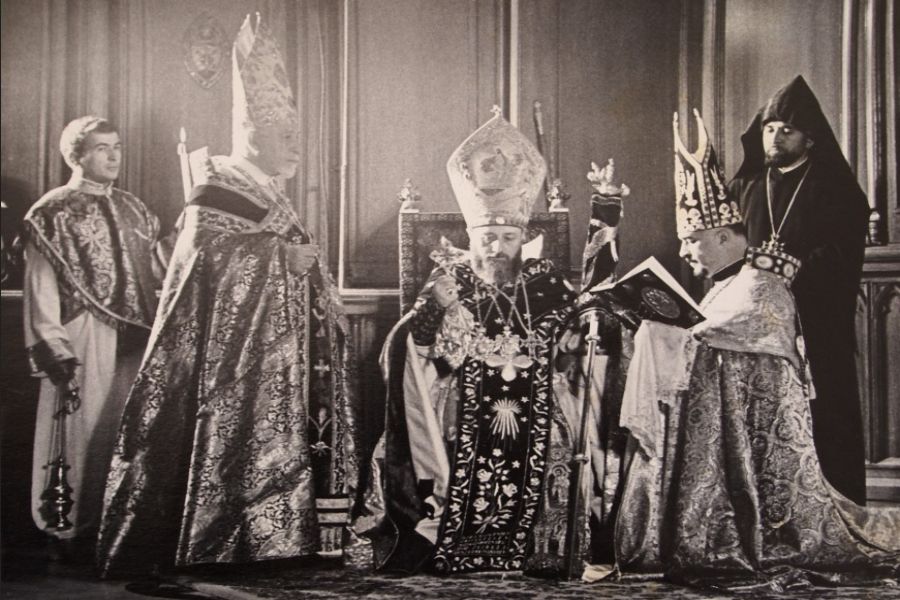
Despite severe constraints on a meaningful relationship, the birthplace of Armenian Christianity and its vast history transcended the Soviet attempts to suppress faith. When Catholicos Vazken I visited the United States in 1968, it was not only a mission to consecrate the newly built St. Vartan Cathedral, but a reaffirmation of community ties. In 1991, with the birth of the sovereign Republic of Armenia, the diaspora embraced another vital mission: supporting the people and the state.
This evolving relationship has developed into one of mutual benefit. Regardless of the current political environment, both the people of Armenia and the diaspora continue to benefit from this alignment. Diaspora support in talent and capital has been well documented through individuals, international organizations, nonprofits and nongovernmental organizations. The presence of a sovereign state has provided the diaspora with a significant opportunity to pursue their long-stated goal of sustaining Armenian identity.

Thousands of Armenians from the diaspora, particularly younger generations, have benefited from visiting, living in and contributing to the nation-building process.
They have developed a strong identity and commitment to their heritage, and in many cases have applied that resolve to both in their diaspora communities and in the homeland. This opportunity remains unique and holds even greater potential. For this reason, any estrangement between Armenia and the diaspora is tragic.
When Armenians in the diaspora establish an emotional connection to the homeland through projects and relationships, they develop a deeper understanding of pan-Armenian behavior within their communities. Gone are the days when children searched for an Armenian flag while studying the world’s nations, only to discover Armenians did not have an independent state.
One of the challenges of building and sustaining a sense of community in the diaspora is the choice between embracing diversity and maintaining a more homogenous environment. The former encourages broader participation but carries the burden of integration and harmony. In the diaspora, individuals are influenced by the host cultures in which they reside. As these cultures intersect through migration, the challenges of achieving consensus increase.
The American Armenian diaspora has undergone several periods of communal reintegration, driven by waves of migration from the Middle East, Iran, Armenia and elsewhere. While a shared sense of identity persists, language dialects, local cultural norms and differing values place stress on maintaining a unified community. In many cases, communities have expanded into distinct subgroups.
Communities may establish schools offering lessons in Eastern Armenian and others in Western Armenian. Cultural groups tied to different diaspora regions often promote distinct nuances in cuisine, tradition and social norms. The pattern is similar to the survivor generation forming associations based on shared origins from Tadem, Kharpert, Sepastia or Van. Communal structures evolve to reflect demographic and historical realities. Contributing to the increasing complexity and diversity of the diaspora.
To illustrate this point, it is useful for members of the diaspora to consider their relationship with Armenia from the perspective of those in the homeland. With honorable intentions, diaspora actors engage Armenia through their values and organizational capabilities. They may represent organizations such as the ARS, Tufenkian Foundation or ABGU. There is often a tendency to interpret the amazing complexity of the diaspora through a singular organizational lens. From Armenia’s perspective, however, the diaspora can appear as a fragmented landscape of groups with differing priorities, opinions, values and political views. Coherence emerges primarily through direct engagement with diaspora organizations or networks.
Understanding the diaspora without direct relationships is challenging. At the same time, contributing effectively can be difficult without expectations of influence.
Separating the emotional bonds shared by Armenians from the political reality of a sovereign state, in which authority resides with its citizens, is complex. The most effective nonprofit organizations have built models in which decision-making rests with beneficiaries, fostering partnerships that benefit the people.
The Paros Foundation, for example, has implemented hundreds of projects in Armenia and has consistently demonstrated the humility to ensure that the investments reflect the decisions made by local communities based on their needs. This approach has built trust and led to improvements in the quality of life in rural and border villages.
Others have followed a similar approach with notable success. While attention often focuses on headline-driven developments, this model has fostered a level of trust that should serve as the foundation of the diaspora-homeland relationship. These under-the-radar investments may offer a sustainable model that benefits communities both in the diaspora and in Armenia.
If the goal of Armenian communities is to sustain identity through trust and integration, what are the key enablers of that vision? Communities in the United States are best sustained when they attract an optimal level of participation. If their purpose is to nurture identity, then maximizing participation is essential. Communities rarely decline because of financial constraints; they rise and fall based on participation.
The vision and leadership of communities are often the most visible indicators of long-term viability. A clear vision provides a shared purpose that brings people together, while strong leadership fosters integration and harmony. Each community develops a reputation, often shaped by an established subculture. Descriptions such as “warm and inviting” or “highly diverse” are commonly used. Regardless of composition, transparency and inclusion remain essential principles.
Transparency, in this context, refers to the responsibility of community leaders to keep members informed with accurate information. A lack of transparency arises when communication is limited or deliberately constrained, resulting in rumors, frustration and conflict. At their core, communities are collections of individuals united by a common purpose. However, power dynamics and preventable conflicts can hinder transparency, allowing misinformation to spread. In such cases, two responses typically emerge.
When individuals feel strongly enough to oppose such actions, it can lead to conflict and division.
More often, however, community members disengage or “vote with their feet.” Participation in community life is voluntary, and engagement is ultimately a personal choice. The bonds formed are essential to sustaining cohesion.
Another related attribute is inclusion. Simply stated, the more people involved in community life, the healthier the community. Inclusion welcomes individuals regardless of experience and financial position. It represents the essence of community life, where all can contribute and develop their identity.
Unfortunately, many have experienced situations in which participation or decision-making is limited because of cliques, conflicts or biases. While this may result in short-term influence for certain factions, it also contributes to the gradual decline of the community. Community service should reflect a broader purpose.
In churches, service is directed to the Lord and the church. In organizational life, efforts are directed toward the stated mission of the group, which is greater than any individual or faction. Adherence to the principles of transparency and inclusion contributes to sustainable communities, where new leaders are encouraged, new generations emerge and all can maintain a meaningful connection.
When the pursuit of power and control is combined with individual ego, self-inflicted conflicts emerge. How often do senior members of a community seek to retain authority rather than transition into mentorship roles? The remedy is to approach community life with humility. This encourages stronger connections, reduces the risk of power abuse and reinforces the understanding that participation is a privilege. The Armenian diaspora reflects a complex and evolving model of diversity.
The reality is that intermarriage, immigration and assimilation within host countries continue to increase complexity. The principles of transparency and inclusion are essential to maintaining viability within such an environment. The strength of a common identity, however, remains sufficient to sustain communities.
Communities must remain focused on minimizing peripheral distractions, such as biases or background differences that are irrelevant to community life but often persist. Expanding participation and welcoming diverse contributions strengthens communal resilience.