


Iranian protesters in Yerevan blocked from march as police make arrests
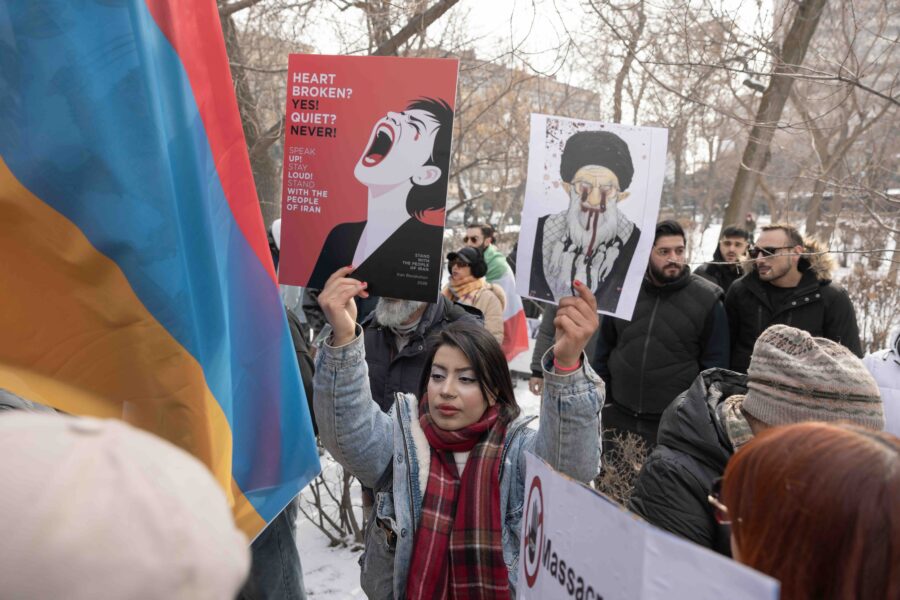
For more than a week, protests outside the Iranian Embassy in Yerevan have continued, entering a second week as Iranians and Iranian Armenians living in Armenia repeatedly returned to the embassy gates, protesting the killing of demonstrators in Iran and calling for an end to decades of religious rule. Many demand a secular system of governance, openly rejecting the authority of Supreme Leader Ayatollah Ali Khamenei. Some demonstrators have voiced support for Reza Pahlavi, whom they see as an alternative, symbolic or political, to the current regime.
For those living abroad, the most frightening development has been the communications blackout. Phones went silent without warning. Internet connections vanished. Daily calls to parents, siblings, children and friends abruptly stopped. For many protesters in Yerevan, the absence of information became its own form of torment. Not knowing whether loved ones were alive, detained, injured or in hiding became a daily reality.
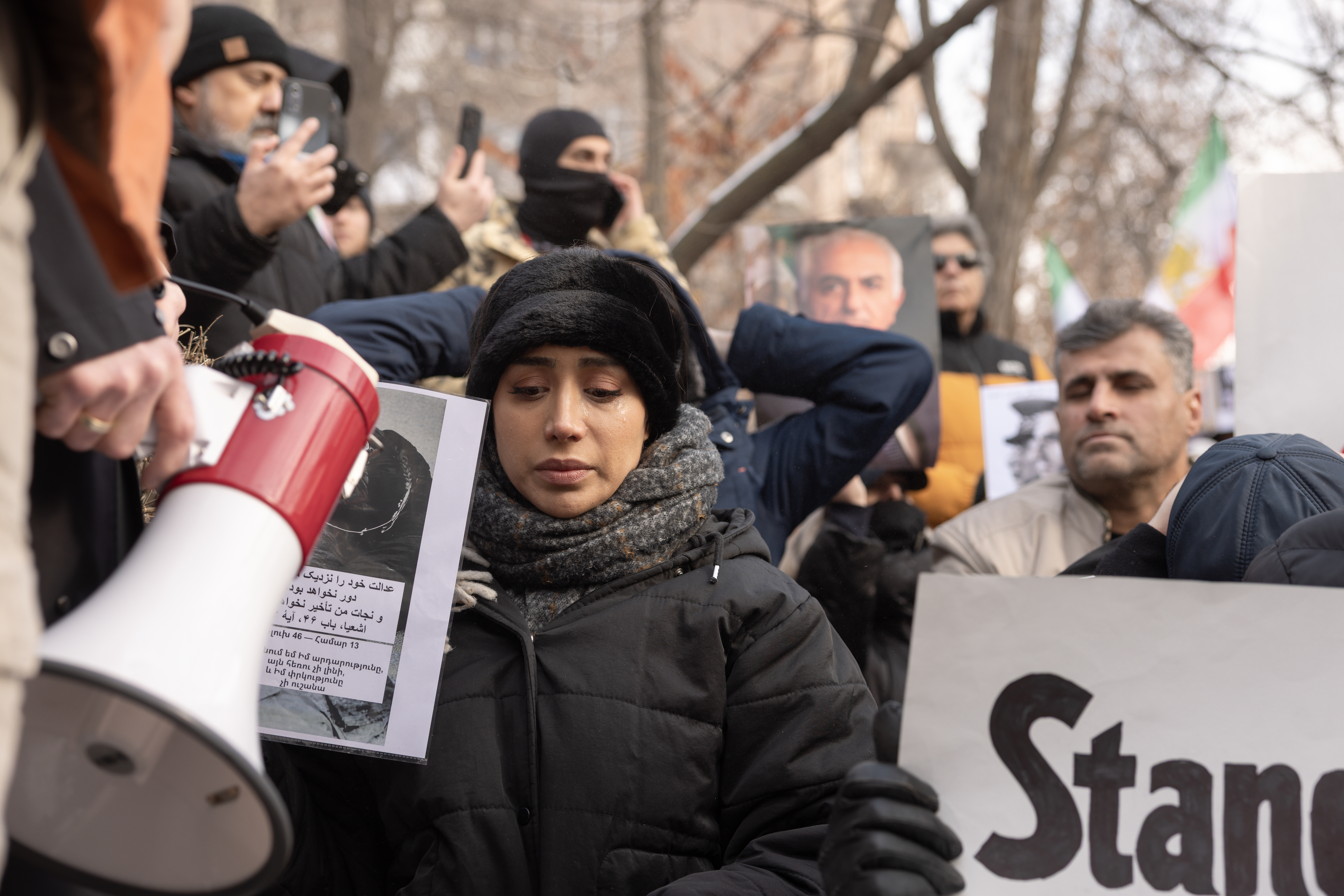 Inside Iran, curfews were imposed and movement restricted. Security forces, alongside militias and proxy groups, were deployed to prevent protests from restarting. Streets once filled with chants were cleared by force. However, the chants continue from balconies in cities across the country.
Tensions in Yerevan escalated on Jan. 17, when Armenian police prevented protesters from carrying out a pre-planned march from the embassy to the Blue Mosque. Demonstrators said the march had previously been approved by the municipality on Jan. 15, but was partially canceled following what officials described as “threats.” According to protesters, police warned that force and special measures would be used, if the march proceeded.

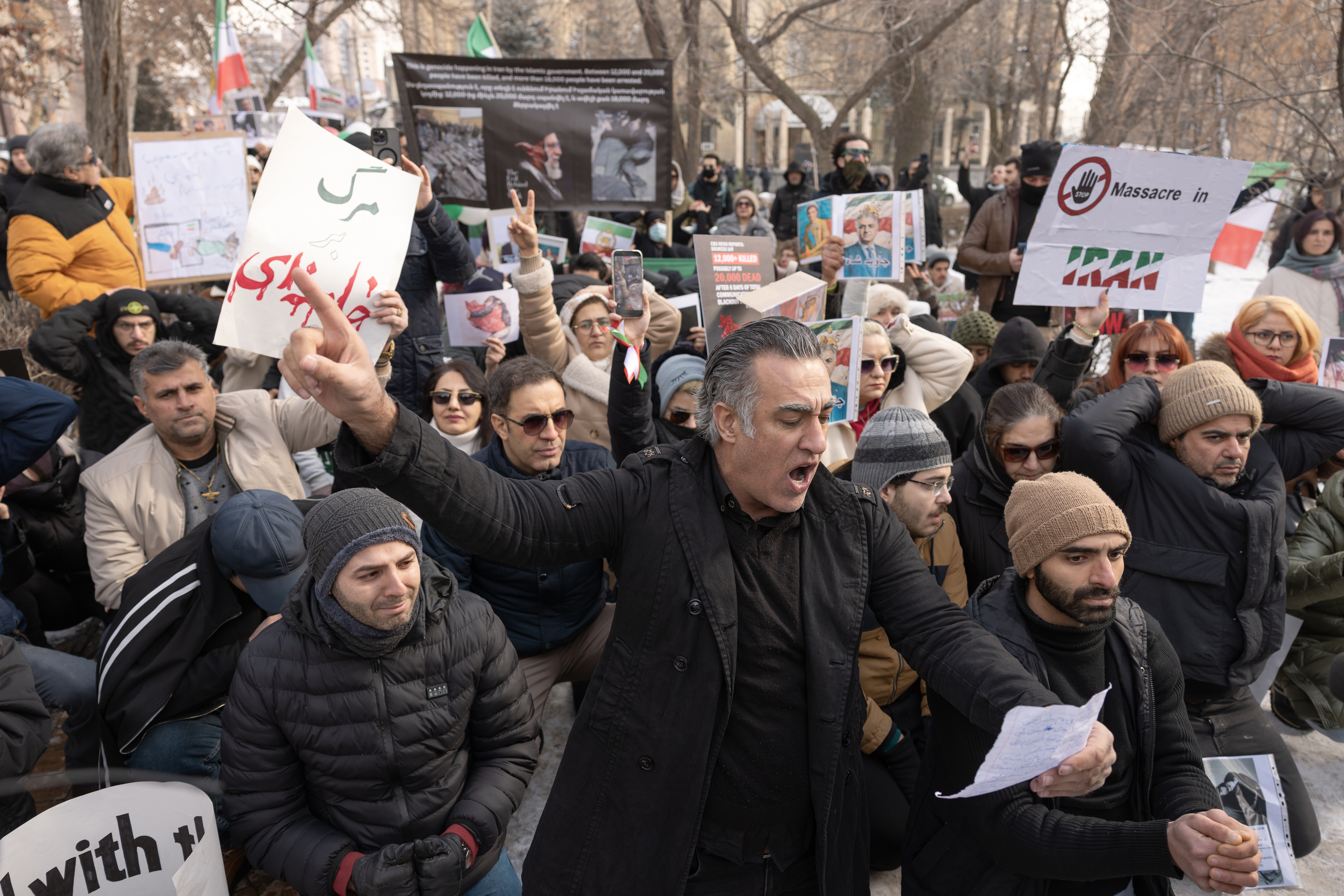 With the route blocked, demonstrators instead began a sit-in outside the embassy. The area quickly filled with police officers, and protesters accused authorities of reversing their decision under pressure from Tehran. Iran’s ambassador to Armenia, Khalil Shirgholami, publicly warned that Tehran was developing the perception that Armenia was becoming a center for hostile forces against Iran. Shortly afterward, Armenian police moved in, detaining several participants.
By the end of the day, seven protesters had been arrested. Armenia’s Interior Ministry Police said security at the embassy was being “properly ensured.” Several eyewitnesses, however, described confrontational and degrading behavior by police. According to protesters present at the scene, officers mocked demonstrators, laughed at photographs of those killed in Iran and made crude remarks about images documenting state violence. Verbal arguments followed. Witnesses said no physical force was used against police, yet arrests were still carried out.
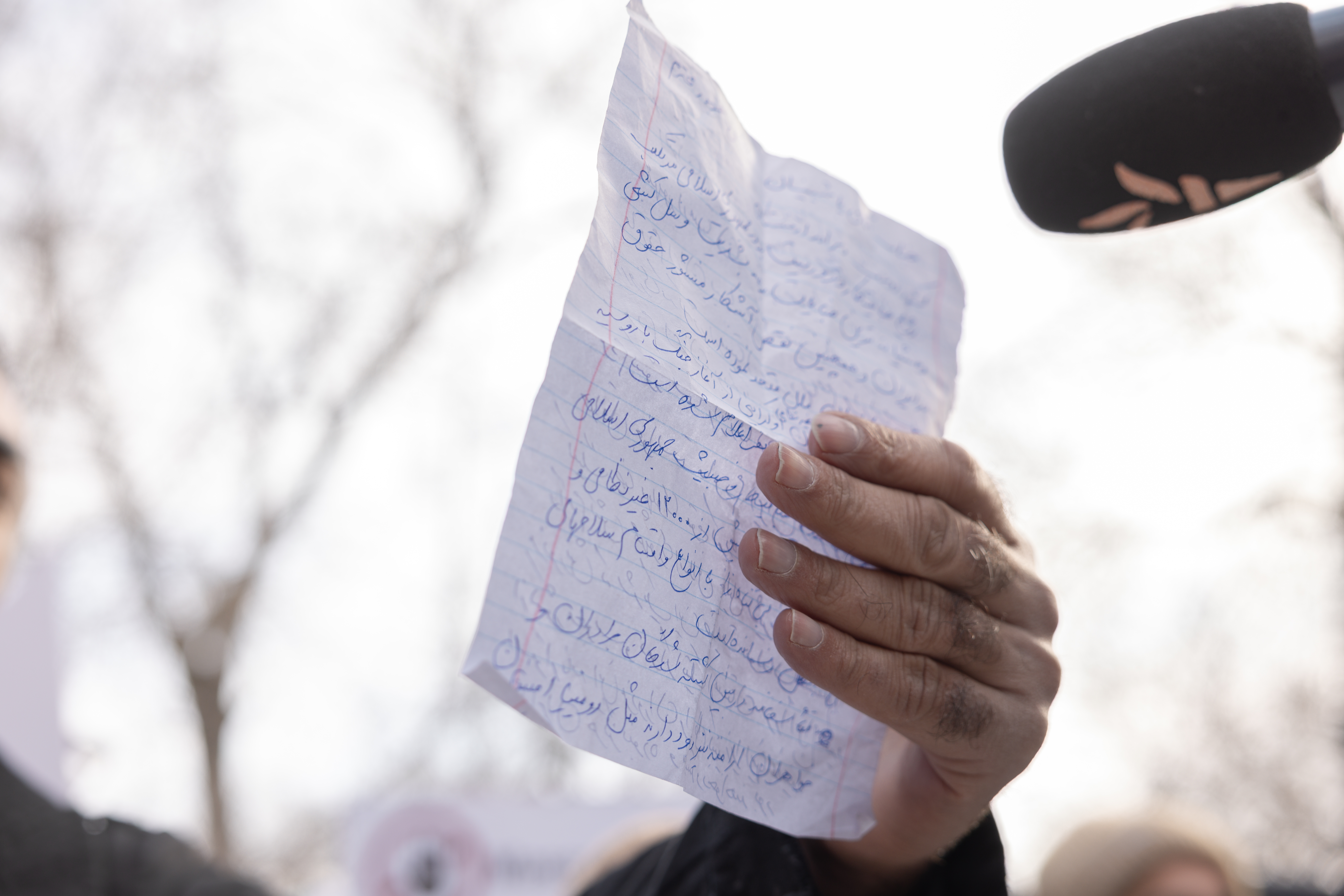 As protests continue abroad, the scale of violence inside Iran remains difficult to confirm. Two sources told Iran International that at least 12,000 people — and possibly more than 20,000 — have been killed, based on official and medical data. Doctors inside Iran have reported wounded protesters being removed from hospitals by security forces or killed outright by militias.
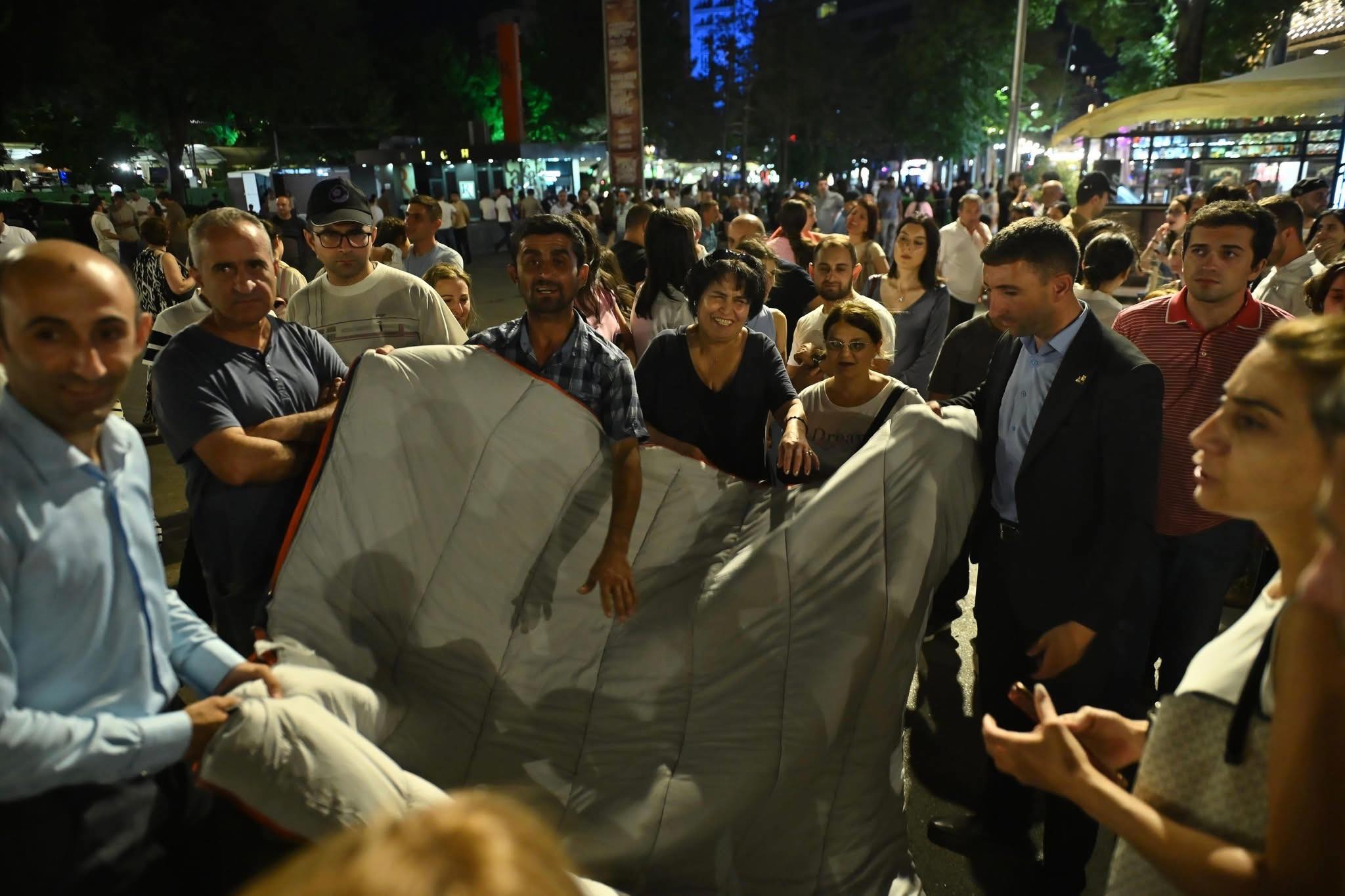
Back in Yerevan, the protests persist — smaller now and quieter, marked by handwritten signs. For those standing outside the embassy, the gatherings are no longer about drawing crowds or headlines. They are about presence and refusing to let silence erase what is happening inside their country.
All photos are by Weekly contributor Anthony Pizzoferrato.

If you are Armenian, you need to learn to take a knee to your new supreme leaders, Donald Trump, Jared Kushner, and Benjamin Netanyahu.
Armenians made a deal with the west to be like the west, now embrace what being part of the west means.
First things first, we need to put a statue of a big fat black woman in the center of Yerevan. Yerevan also needs to import 2 million more pakistanis, bengalis and Africans.
Armenian culture must be replaced with rap music and other western music.
Forget Mesrob Mashtots, embrace Snoop Dogg.
Armenians chose this with Nikol. Now embrace your western cultural depravity.
I’m not sure if you are being sarcastic or not. It sounds like you are. In any event, I am an Armenian and a sane and informed one at that and I would say with utmost certainty that there is more of a chance that pigs will grow wings long before I would even remotely consider doing what you are suggesting we do. We are not in the business of “surrendering and submitting” to anyone much less the likes of which you are suggesting and that is why we are still around despite the fact what our people have endured over the centuries. The snake oil salesman Pashinyan together with his cronies and deceived followers, who are mostly the uninformed misinformed and politically ignorant and gullible segment of the Armenian population, neither represent the Armenian nation as a whole nor do they serve the interest of the public to express the will of the Armenian people worldwide. According to reports, Trump was convicted of 34 felonies about a year before his reelection and it is highly likely he did everything to get reelected to shield himself from the consequences of those charges and the International Criminal Court (ICC) issued arrest warrants for Benjamin Netanyahu for war crimes and crimes against humanity two years ago not to mention Israel’s provision of deadly weapons to our next door enemy worth billions of dollars to commit ethnic cleansing against our nation under his watch. Where is the logic in all of what you are saying?
I don’t get the statute remark and most of those people you claim we should import are the same kind of people Trump is busy exporting. Furthermore, you can’t replace centuries old Armenian rich culture and music with fast food and manufactured noise. I mean to do that would require non-organically grown frozen food and tons of poppy seeds imported from Afghanistan. And, one truly has to be crazy to entertain the idea of incompetent and delusional Nikol as leader because the definition of crazy is to do the same thing over and over again, twice already, and expecting different results and never getting it! Embracing western cultural depravity I’m afraid will sure be an exercise in futility. It ain’t never gona happen!
You’re obviously not a serious person talking about the international criminal court. Wasn’t netanyahu wanted by them? No one cares…
Your boy nikol sold you guys out.
Now learn to be a good little vassal to the USA.
If Americans tell you to jump, only thing that will come out your mouth is “how high?”
When we wanted to bring in pakis and Africans to Yerevan, we will, and get ready for it.
If we want to put a statue (not statute) of a big fat black woman in Yerevan, we will, and you will applause.
Now get back in line little chihuahua, you belong to America
I don’t seem to be a serious person? You took the words right out of my mouth because that is exactly what I was going to say about you. And you also seem to have problem with reading comprehension. You so hilariously introduced Trump and Netanyahu to us as our new “supreme leaders” and I said why would we want to associate ourselves with or to want to have anything to do with people with multiple felony charges and human rights violation charges filed against them whether or not anybody cares about them! You sound like a high school dropout. You don’t seem to have any train of thought and speak so primitively and haphazardly about subject matters that are obviously way above your pay grade. Those are common traits among the intellectually challenged. Why would you want to bring those people to Armenia when you have already mastered how to exploit them in America? Armenia has too many statues already and I think the kind of statue you are talking about is probably much more befitting and suitable in your backyards. Speaking of “Chihuahuas” junior, how ironic that you’ve been trying very hard to insult people with that kind of remark when you yourself are the one who has been barking here all along! Now, get back in line and wait for your turn to take a knee to your master potty mouth. You are grounded!
The same is planned for Azerbaijan it might even put an end to the animosities!
Interestingly, Azerbaijan and the Arab states are very quiet about the protests in Iran. These very authoritarian and repressive states have barely issued official statements on Iran, and of course protests are strictly banned and clamped down hard there. Likely because they are all afraid of the chaos spreading to themselves, after experiencing this during the 2010-11 Arab Spring, which they violently crushed. Increasingly reclusive Azerbaijan has permanently closed all its land borders to all passenger traffic, initially because of COVID-19, later citing national security and threats of terrorist attacks as a reason. Azerbaijan doesn’t allow any refugees, and an Azeri population in Iran, which is double that of Azerbaijan, as potential refugees, is one of the reasons why it hermetically sealed all its land borders.
It’s ironic that Azerbaijan whilst under self imposed isolation over coronavirus was able to import hired guns and weapons for its war in 2020 as if as coronavirus wasn’t really an issue at all just like the woke BLM riots apparently without any concerns about catching or spreading the virus in the USA the same year…
While Azerbaijan closed its land borders and its Caspian Sea ports to passenger traffic, it never stopped cargo traffic by land and sea, even during the COVID-19 pandemic. Azerbaijan hardly seemed in pandemic mode, when it attacked Artsakh, when Azeri politicians and officials appeared without masks, and when Azeris celebrated their so-called “victory” on the streets without any masks during the height of the pandemic.
Who are you to call arab states oppressive and repressive.if you think so,then take your us bases and your people.And also your so called democracy promotion already ruined many nation.You people just want a puppet government which gives you oil.
In his report Anthony Pizzoferrato DID NOT REPORT that the Armenian journalists had already raised the Iranian protesters issue to the PM Nikol Pashinyan at least two days before Anthony Pizzoferrato’s report. The PM Nikol Pashinyan spent inordinately longtime, from 30 to 33 minutes, into the 63 minutes long Q&A session. The Iranian Ambassador has conveyed to the Armenian government his government’s concern that Armenia is becoming a center for anti-Iranian government demonstrations. For which the PM went to great length to assure Armenia’s continual brotherly – yes that is the term the PM used – relations with Iran and that, while public demonstrations are permissible in Armenia, the Armenian government will assure that such demonstrations will not disrupt the normal working of the Iranian embassy and that a few have been detained for their unruly conduct during the demonstration. From the pictures Anthony Pizzoferrato posted in his report, demonstration has taken place, and from the expressions of the demonstrators, the mood in this demonstration has been intense, and apparently some crossed the line for public demonstration and have been detained.
Hopefully, the Iranian Revolutionaries will overthrow Islam and declare Iran to be a secular state.
Anything that weakens Islam is to Armenia’s benefit.
Islamic fundamentalism is a scourge of the world and a threat to world civilization. Yesterday, the threat was Nazism, today it is Islamism, which is theocratic totalitarian fascism. The world ought to unite against this threat, instead of appeasing it and squabbling among themselves.
It is a matter of when, not if the Islamist theocratic regime in Iran falls. It is on its death throes and it just lashes out like a cornered animal by massacring thousands of its citizens. Once this despised murderous religious dictatorship falls and Iran becomes a secular state, it will be a huge slap in the face and will cause a huge demoralization for all the Muslim fundamentalists across the world who are fans of the Islamic Republic, including Erdogan and other Turkish Islamists who have expressed support and admiration for this regime.
Its fall will be of course good news for Armenia, because Armenians, as “infidels”, have suffered under Muslim fundamentalist domination and have also been targeted and massacred by them throughout centuries. It does not matter if the Armenians in Iran are not specifically targeted and persecuted by the Islamic Republic; being second-class citizens as non-Muslim “dhimmis” under the Sharia laws of Iran, is bad enough. Armenians had equal rights as Iranian citizens under the secular rule of the Pahlavi Shahs, like all other non-Muslim Iranian citizens.
@Steve M
Hear! Hear!
For 800 years, from the 11th to the 19th cebturies, there was no Armenia.
Armenia was ruled by the Turks or the Persians or both.
Both treated the Armenians as dhimmis.
Both are Muslims.
Neither can ever be trusted.
The oldest church in Moscow was built only in the second half of 15th century. Pathetic. Are you the ones to give us history lessons comrade?
Iranian Shia Islam under the clerical regime or not is of little issue to Armenia it’s Turanisim is the primary hazard. Indeed Shia serves as a slight check on Sunni and Iran is the primary Shia nation.
Imagine if Ankara was ruled by Osman Kavala, Yerevan by Ruben Vardanyan, Iran by Masih Alinejad (I have mixed feelings about Reza P becaused of lack of charisma), and the region has similar leaders. We all can hope!